Amniocentesis vs Chorionic Villus Sampling Clinical Decision Criteria
Gestational age determines which diagnostic test, not patient preference or risk.

Amniocentesis and CVS both give you a definitive diagnosis, pulled straight from fetal or placental genetic material, instead of the probability estimate a screen like NIPT hands you. A screen tells you risk, a diagnostic test tells you an answer, and current clinical guidance holds that every pregnant patient, regardless of age or risk category, should be offered the diagnostic option. The choice between CVS and amniocentesis is a sequence, and gestational timing decides most of it before diagnostic target, procedural risk, or patient preference get a vote. It's a sequence, and gestational timing decides most of it before diagnostic target, procedural risk, or patient preference get a vote.
Gestational age as the first and most constraining criterion
Timing settles more of this decision than accuracy or preference ever will, and it does so first.
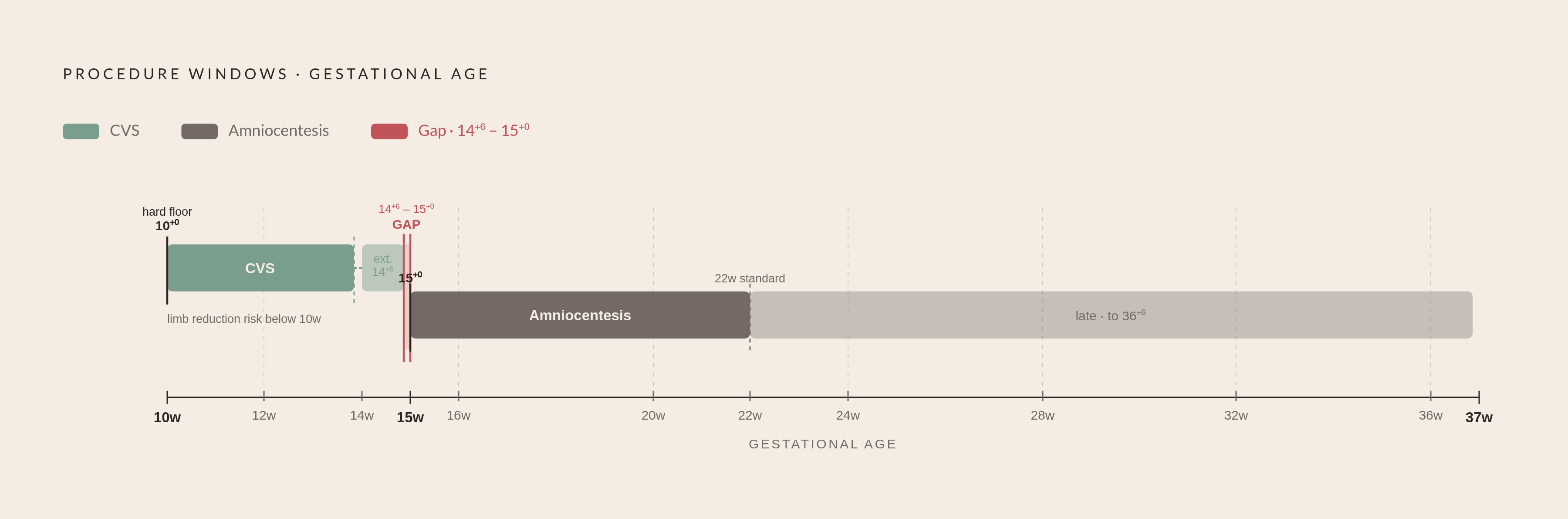
CVS has a defined window. Green-top Guideline No. 8 sets the standard range at 11+0 to 13+6 weeks, extendable to 14+0 to 14+6 weeks if circumstances require it. Below 10+0 weeks, CVS comes off the table entirely: earlier procedures have been linked to limb reduction defects, which is the reason for the hard floor. StatPearls frames the practical window a bit more loosely, at 10 to 13 weeks, but the lower boundary holds no matter which guideline is open on the desk.
Amniocentesis picks up where CVS leaves off. RCOG sets the standard offer from 15+0 weeks, with a hard lower limit at the same point, since procedures done earlier carry higher rates of fetal loss. Most genetic diagnostic amniocentesis happens between 15 and 22 weeks. Late amniocentesis, after 24 weeks, has been studied (Zemet et al., AJOG, April 2025, covering 24w0d to 36w6d), but the safety and accuracy data before 24 weeks remain the well-established baseline. Past that point, the evidence thins out fast.
Lining the two windows up reveals a gap immediately. A patient at 12 weeks has exactly one option. A patient at 16 weeks has exactly one option too, just the other one. Gestational age doesn't fail to settle the question except in the narrow band around 15 to 15+6 weeks, or in a case where dating is uncertain enough to put the window itself in doubt. Everywhere else, timing decides the matter before any other factor gets to weigh in. Treating this as an open choice between two equally viable tests is the first mistake a clinician can make, and it's an avoidable one.
How the diagnostic target shapes the better procedure
Once timing allows for both, the next question is what the test is actually meant to find, and here the two procedures pull apart.
CVS draws on placental tissue, which supports DNA-based molecular analysis for single-gene disorders in couples with known carrier status: Tay-Sachs disease, sickle cell disease. Because the sample is available at 10 to 13 weeks, CVS delivers that answer in the first trimester, when a diagnosis carries different clinical weight than it would at 20 weeks. Amniocentesis can't be rushed to match that timeline. But it does something CVS structurally cannot: amniotic fluid supports alpha-fetoprotein measurement, the basis for evaluating neural tube defects, giving it an analytic capability CVS does not share.
The indication data confirm the split. A five-year CVS series (Kuyucu et al., Medicine, n=468) found that among the indications driving referral, structural abnormalities carried the highest chromosomal detection rate in the series at 34.5%. A 2025 amniocentesis series from a tertiary center in India (n=321) told a related but distinct story: abnormal ultrasound findings drove 71% of cases, the single largest indication by a wide margin. That split isn't a coincidence. Structural anomalies often appear only at the second-trimester anatomy scan, well after the CVS window has already shut, and at that point amniocentesis is the only diagnostic tool left on the table.
CVS's diagnostic limitation: confined placental mosaicism and result certainty
CVS carries a limitation that has nothing to do with timing and everything to do with what the sample actually represents. Chorionic villus tissue shares its genetic origin with the fetus, but it's placental tissue, not fetal tissue, and that gap occasionally produces a result that doesn't match the fetus's real karyotype.
A review in AJOG MFM found mosaicism in 2% to 4% of chorionic villus samples. When mosaicism appears in a CVS result, there are two possible explanations, and CVS alone can't tell you which one is correct. Confined placental mosaicism means the chromosomal aberration sits in the placenta but not the fetus, carrying risks like preterm birth and low birth weight while leaving the fetus itself unaffected. True fetal mosaicism means the aberration is actually in the fetus, and it can carry a far more serious prognosis, including severe malformation. Sorting one from the other typically requires a follow-up amniocentesis. Research cited in PMC puts the rate of true fetal mosaicism, once mosaicism appears in a CVS result, at around 13%, so most mosaic CVS findings turn out to be confined to the placenta. Even so, there's no way to know which category a given result falls into at the moment the sample is drawn.
Sample adequacy is a related problem, and a more mundane one. In the Kuyucu et al. series, results couldn't be obtained in 3.6% of cases, with 2.5% attributable to insufficient sample or culture failure. UpToDate's May 2025 update states that CVS carries higher diagnostic uncertainty than amniocentesis, which posted culture success as high as 99.98% across 6,572 procedures at one Chinese prenatal diagnostic center between January 2017 and February 2023.
That gap doesn't make CVS a lesser test. It makes CVS a test with a known, specific failure mode a clinician has to plan around from the start, not discover after the fact. For a patient who can't tolerate ambiguity, or a case where the chromosome in question carries a high prior probability of true fetal involvement, amniocentesis is the better call on accuracy grounds alone, timing aside.
Procedure-related miscarriage risk: what the evidence shows and why the numbers vary so widely
Ask five sources for the miscarriage risk of CVS or amniocentesis and expect five different numbers, spanning nearly an order of magnitude. That spread comes from differences in study era, operator skill, ultrasound guidance technique, and how "pregnancy loss" gets defined across studies run decades apart from each other.
RCOG's Green-top Guideline No. 8 puts the added miscarriage risk from either procedure, done by a skilled operator, below 0.5%. A meta-analysis by Akolekar et al. in Ultrasound in Obstetrics & Gynecology pooled weighted procedure-related risk at 0.11% for amniocentesis and 0.22% for CVS, concluding actual risk runs well below what patients are typically told. A separate meta-analysis found a weighted procedure-related risk of 0.30% and total pregnancy loss risk of 0.91% for amniocentesis.
Route matters for CVS specifically. Route matters for CVS specifically, as evidence indicates the transcervical approach is associated with a somewhat different risk profile than the transabdominal approach. An SMFM Consult update, the most recent systematic review data available, found pregnancy loss rates of 0.7% for CVS versus 0.6% for amniocentesis within two weeks of the procedure, 1.3% versus 0.9% up to 24 weeks, and 2.0% versus 1.9% across the full pregnancy. Followed to term, the two procedures land in the same neighborhood. For twin pregnancies, RCOG advises patients that either procedure adds roughly 1% to miscarriage risk, a real jump from the singleton figure and a factor that belongs in every multiple-gestation counseling conversation.
In the hands of a skilled operator, the risk gap between CVS and amniocentesis is small enough to fall inside the statistical noise, a pattern that holds across every source cited above. Operator experience and procedure volume at the center predict the outcome far better than which of the two tests gets picked. A mistake here is choosing a test on a headline miscarriage number without asking who's holding the needle.
Maternal and pregnancy factors that tilt the decision when timing and risk are comparable
When gestational timing allows either test and risk profiles run close together, the decision moves to the patient in front of the clinician: her anatomy, her circumstances, her preferences.
Placental location is a mechanical constraint before it's anything else. It decides whether CVS gets done transabdominally or transcervically, and in some placental positions, it can make CVS technically difficult or impossible no matter how many weeks along the patient is. Twin pregnancies compound the roughly 1% additional miscarriage risk RCOG cites for either procedure, since sampling both sacs reliably depends on chorionicity and placental position, and that logistics problem can push the decision toward one test over the other. Uterine fibroids, extreme uterine retroversion, or cervical stenosis can rule out transcervical CVS.
Patient psychology belongs in this calculus, and it has for decades. The dynamic of patients weighing diagnostic timing against the emotional cost of waiting has been recognized in the literature for decades and hasn't fundamentally changed.
Termination considerations sit in the same category, and they aren't a matter of preference alone. UpToDate notes that first-trimester results from CVS arrive at a point when termination procedures are more widely available, carry lower medical risk, and come with reduced psychological burden. That's a clinical asymmetry, not just an emotional one. Privacy factors in for some patients too: first-trimester results come back before a pregnancy is visibly apparent, which matters for certain social or occupational situations.
Some scenarios settle the question. An anomaly on a mid-pregnancy anatomy scan, a need for AFP measurement, a mosaic CVS result requiring confirmation, a patient presenting after the CVS window has already closed: amniocentesis, in every one of these, is the only option left standing.
Applying these criteria sequentially: a structured clinical approach to the decision
Running the criteria in order tends to resolve the decision well before reaching the bottom of the list.
Start with gestational age. Does the patient's timing rule out one procedure automatically? Before 15+0 weeks, and particularly in the 11+0 to 13+6 window, CVS is typically the available option; from 15+0 weeks onward, amniocentesis becomes the standard choice. The narrow transitional zone around that boundary is where the rest of the criteria actually get to matter.
Move to diagnostic target next. Does the condition require a capability specific to one test? Neural tube defect evaluation points to amniocentesis, full stop, since CVS has no mechanism for AFP analysis. A first-trimester single-gene diagnosis in a couple with known carrier status points to CVS, timing permitting.
Then weigh diagnostic certainty. If the clinical scenario is one where a mosaic result, occurring in 2% to 4% of CVS samples, would likely prompt an amniocentesis follow-up anyway, going straight to amniocentesis is often the more efficient path from the outset, and it spares the patient a second procedure.
Factor in procedural risk in context after that: operator experience, center volume, singleton versus multiple pregnancy, and any anatomical constraints on CVS access. Then account for the patient herself, her need for early information, her tolerance for the anxiety of waiting, her feelings about first-trimester versus second-trimester timing relative to whatever decisions she may face afterward.
None of this happens in a vacuum. ACOG and RCOG both frame the decision as a shared conversation that takes place inside genetic counseling, with the person on the exam table at its center. Neither test wins on safety across the board, and neither wins on accuracy across the board. The right test is the one that matches the patient's gestational age, her clinical question, and the circumstances she's presenting with at that particular moment, nothing more and nothing less.