Placenta Encapsulation Evidence Review for Postpartum Recovery Claims
Study finds placenta encapsulation delivers minimal iron and no mood boost.
Placenta encapsulation, the practice of drying a birthing person's placenta, grinding it into powder, and packing it into swallowable capsules, is one of the most visible postpartum trends of the last decade. The pitch rests on four promises: better mood, restored iron, stronger milk supply, and balanced hormones. Three of those four claims fail to survive contact with a controlled trial, and the fourth, the one driving most of the demand, has the thinnest evidence of all. Marketing treats these four claims as a single package. They are not, and anyone trying to make an informed choice needs to see them taken apart.
Encapsulation typically follows a steam-and-dehydrate process, though raw, cooked, tinctured, and smoothie-blended versions exist in smaller numbers. The practice gets linked to Chinese medicine, but that lineage is disputed: placenta appears there as a rare medicinal ingredient, not a routine maternal one, and the encapsulation trend as practiced today is more closely associated with uptake that began in the 1970s as a wellness practice. A 2026 appraisal in the International Journal of Community Medicine and Public Health calls this a modern cultural phenomenon. Many mothers describe it as empowering regardless of what the lab data shows, and that gap between feeling and physiology runs through everything below.
The numbers on how many people actually do this are thin but instructive. A study in the journal Birth, surveying women planning community births, found that 30.8% of the sample consumed their placenta in some form. Of those, 85.3% chose the encapsulated version, and 48.4% specifically wanted it dehydrated and uncooked rather than steamed first. A narrower data point from a 2016 hormone-concentration study centered on the Portland, Oregon metro area put encapsulation at roughly half of homebirth mothers, versus about 10% of those delivering in hospitals or birth centers. That describes one city, not a country. Encapsulation specialists operate without a standardized credential governing the people who prepare these capsules. The same claims get repeated by anyone with a dehydrator, regardless of what the research actually shows.
The four claims that dominate encapsulation marketing and consumer choice
The 2018 Birth study asked placenta-consuming mothers why they did it. 73.1% cited prevention of postpartum depression as their primary motivation, dwarfing every other reason offered. The same survey rounds out the self-reported benefit list with better mood, more energy, improved lactation, and reduced postpartum bleeding.
Stripped of marketing language, that leaves four distinct claims, each resting on a different mechanism: hormonal rebalancing, iron and mineral repletion, prolactin support for milk supply, and mood stabilization tied to all three. A single verdict covering all four flattens distinctions that matter enormously to someone actually deciding whether to encapsulate. The mood claim carries by far the most weight in people's decision-making and, as the sections below show, rests on by far the weakest evidence. That mismatch is the real story of this trend.
What is inside an encapsulated placenta: hormones
Young et al., published in Placenta in 2016, ran 28 placenta samples through liquid chromatography tandem mass spectrometry, a method sensitive enough to detect hormones at very small concentrations. The samples turned up 16 of 17 tested hormones, including progesterone, estradiol, cortisol, aldosterone, and testosterone.
The quantities are small. At a typical maximum daily dose, the capsules deliver roughly 2.5 micrograms of estriol, 0.3 micrograms of estradiol, 1.1 micrograms of estrone, and about 37.3 micrograms of progesterone. The hormone quantities detected were small overall, with progesterone measured at roughly 37.3 micrograms and estradiol at roughly 0.3 micrograms at a typical maximum daily dose. That study measured presence and concentration. It said nothing about what happens once a body swallows the capsule.
Subsequent pilot work has pushed closer to that question by attempting to measure whether hormones detectable in the capsule produce any effect once swallowed, with results characterized as preliminary and not yet proof of anything. Detectable in the capsule and shown to do something once swallowed are two different claims, and this field keeps blurring them. The distinction matters most for lactation: progesterone's natural postpartum drop is associated with the onset of milk production, and capsules that reintroduce progesterone may run counter to that process.
What is inside an encapsulated placenta: minerals and trace elements
A companion analysis from the same research group, published in Nutrition Research, tested the same 28 samples for 14 trace minerals and elements. Iron came back at 0.664 mg per gram of encapsulated placenta, well above the 0.093 mg per gram found in the encapsulated beef placebo used in a related trial (Gryder et al.).
At the recommended daily dose of 3,300 mg of capsules, that iron content works out to about 24% of the RDA for a lactating woman. Selenium is 7.1% of RDA, zinc is 1.5%, copper is 1.4%. Evidence Based Birth's Rebecca Dekker has compared the iron content to roughly three ounces of chicken liver, a comparison that sounds impressive until you register that 24% of daily need makes this a supplement to a diet, not a replacement for one.
The same 28-sample study checked for arsenic, cadmium, lead, mercury, and uranium, and found all five present but at mean concentrations well under established toxicity thresholds. A larger 2022 study of 103 term placentas at a Spanish hospital complicates that reassurance considerably: lead turned up in 81.5% of samples, mercury in 100%, cadmium in 44.6%, arsenic in 14.56%. A sample of 28 from one region will not generalize to a population with a different environmental exposure history, so the two findings are not strictly in conflict, but the second study is the one that should set expectations. Placental tissue absorbs whatever the mother was exposed to during pregnancy. It is not a clean slate, and no dehydrator changes that. The nutritional case for encapsulation is real but modest, conditional on dose and on exactly whose placenta it is, which sets up the harder question: does any of this measurably change a mother's iron status?
The iron and energy claim tested in a controlled trial
Gryder et al. answered that question in a 2017 randomized, double-blind, placebo-controlled pilot published in the Journal of Midwifery & Women's Health, enrolling 23 healthy postpartum women. Researchers tracked hemoglobin, transferrin, and ferritin at four points: week 36 of pregnancy, within 96 hours of birth, days five through seven postpartum, and week three postpartum.
No statistically significant difference appeared between the placenta group and the placebo group on any marker, as measured by hemoglobin at P =.603, ferritin at P =.852, and transferrin at P =.936. That result is striking given the mineral data above, since the placenta capsules carried roughly seven times more iron per gram than the placebo. More iron went in on paper, and no measurable shift in maternal iron status came out the other side. That gap points to a bioavailability problem: iron sitting in a capsule is not the same as iron a body actually absorbs and puts to use.
Twenty-three participants makes for a small pilot, underpowered to catch a modest effect, so the result reads as suggestive rather than definitive. It remains, even so, the best controlled evidence available on the iron claim, and the controlled evidence on the iron claim remains limited to small pilots. Anyone leaning on encapsulation to fix postpartum fatigue or anemia is leaning on a trial that found nothing there to lean on.
The milk supply claim and the prolactin trial findings
Young et al. ran the equivalent trial for lactation, published in the Journal of Midwifery & Women's Health in 2019: a randomized, double-blind, placebo-controlled pilot with 27 postpartum women split into a 12-person placenta group and a 15-person placebo group. Researchers tracked plasma prolactin, the hormone most directly tied to milk production, along with neonatal weight gain over the first three weeks postpartum.
Neither measure showed a statistically significant difference between groups. Prolactin didn't move, and the babies' weight gain trajectories didn't diverge either. If encapsulation doesn't raise prolactin, the mechanistic case for a supply boost has nothing left to stand on.
Progesterone falls naturally after the placenta is delivered, and that fall is part of what signals the body to start producing milk, a counter-concern Aeroflow Breastpumps raised. Capsules that reintroduce progesterone could interfere with that signal, a plausible mechanism rather than a documented harm, but one that cuts against the marketing claim rather than supporting it. Anyone whose main goal is milk supply is better served by hydration, nutrition, and a lactation consultant, each of which carries a stronger evidence base than encapsulation does for this specific outcome.
The mood and postpartum depression claim: the highest-stakes question and the thinnest evidence
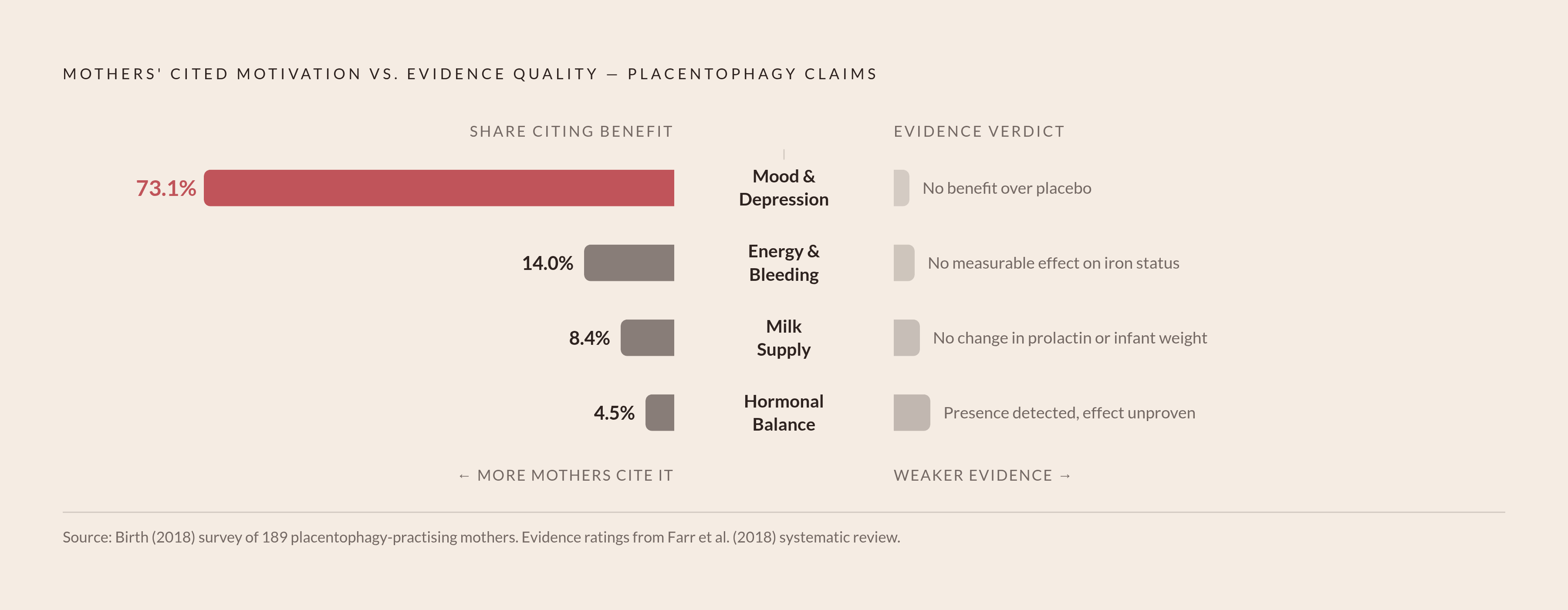
This is the claim driving the whole trend, and it holds up the worst under testing. Postpartum hormone withdrawal is a real physiological event, the capsules do contain detectable progesterone and estradiol, and some research links iron-deficiency anemia to postpartum depression in certain individuals, so the underlying logic isn't unreasonable on its face.
The controlled data doesn't back it up, though. A 2017 study in Women and Birth found no significant difference in postpartum depression scores between women taking placenta capsules and those on placebo. A 2020 review in Archives of Women's Mental Health concluded that more rigorous research is needed before anyone can validate psychological or physical benefits. A review published in the American Journal of Obstetrics & Gynecology went further, finding no scientific evidence of clinical benefit, given documented risks paired with no documented benefit.
The placebo effect deserves honest treatment here, not dismissal. Taking a concrete, proactive action during a vulnerable stretch of recovery carries real psychological value, even when the substance swallowed does nothing pharmacologically. That doesn't discredit the women who report feeling better, but it does mean self-report data can't stand in as evidence of a biological mechanism. The 2018 Birth study adds a real confound: women who chose to consume their placenta were more likely to have reported anxiety or depression before pregnancy than non-consumers. Any observed improvement could reflect regression toward the mean or general postpartum support rather than anything specific to the capsules.
The 2026 IJCMPH appraisal is right that perceived empowerment is a genuine experience even without clinical proof, and it deserves respect on those terms. Absence of evidence and disproof of benefit remain two different things, and the trials so far are small pilots rather than large definitive studies. But this single claim drives nearly three-quarters of the decision to encapsulate in the first place, so its unproven status carries more weight than the other three failures combined. Marketed as a mood and depression treatment, encapsulation is the weakest-supported use of the practice, not the strongest, and that inversion is the central failure of how the product gets sold.
Infection risk: the one documented harm with regulatory attention
The clearest documented harm in this evidence base is infectious. The CDC documented a 2016 case of a newborn diagnosed with late-onset Group B Streptococcus bacteremia after the mother had ingested encapsulated placenta. Breastmilk tested negative for GBS, so the pathogen likely transmitted through elevated maternal skin or gastrointestinal colonization instead. The encapsulation company involved had not screened for pathogens before processing, a detail that says as much about the industry as it does about the case itself.
The CDC's conclusion was blunt: the encapsulation process does not reliably eliminate infectious pathogens, and capsule ingestion should be avoided in cases of maternal GBS colonization or related neonatal GBS infection. The mechanism is straightforward. Contaminated capsules can raise maternal GBS colonization on the skin and in the gut, opening a route for transfer to the infant through close contact or breastfeeding.
A smaller microbiology study of 24 placentas offers a partial counterpoint. Among 13 mothers confirmed to carry GBS, 2 of 13 (15.4%) showed bacterial growth on the placenta surface before processing, but processed samples under that specific protocol showed reduced bacterial presence afterward. That result doesn't cancel out the CDC's case report, since it reflects one specific processing protocol under study conditions, while real-world encapsulation practices vary widely and remain entirely unregulated. Set that next to the earlier heavy-metal finding, lead in 81.5% and mercury in 100% of the 103 Spanish hospital placentas, and a clear picture forms: this is a tissue that carries a mother's own environmental and microbial exposure history, not a sterile supplement manufactured to a spec. Anyone considering the practice should disclose GBS status upfront and ask the specialist directly what pathogen-screening protocol, if any, they actually follow.
Reading the overall evidence landscape before making a personal decision
Laid side by side, the four claims don't collapse into one verdict, and they shouldn't. The iron claim has a controlled trial behind it, and that trial found no measurable effect on maternal iron status despite meaningfully higher iron content in the capsules than in the placebo. The milk supply claim has its own controlled trial, and it found no change in prolactin or infant weight gain, undercutting the exact mechanism proponents point to. The mood claim, the one driving the overwhelming majority of decisions to encapsulate, has the least support of the three: multiple reviews and a randomized trial found no significant benefit over placebo, and at least one major review recommended against the practice on those grounds specifically.
None of this proves the practice is dangerous for everyone who tries it. It proves that the specific mechanisms marketed to justify it have not held up under direct testing, in trials that, while small, remain the best evidence currently available. The one clearly documented harm, GBS transmission to a newborn following unscreened capsules, is not theoretical. It's a case the CDC investigated and published. Weighed against that sits a real, non-trivial psychological value some mothers report from feeling proactive about their own recovery, a value that doesn't need a pharmacological explanation to matter to the person living it.
Compositional studies confirm that hormones and minerals genuinely exist in the capsules. Presence is not the same as effect, and every controlled trial run to date has failed to find the clinical benefit the marketing promises. That gap between what's detectable and what's proven to work is the real story here, and it is most likely to get lost in a conversation driven by testimonials rather than trial data. Anyone weighing this decision deserves to see that gap clearly, alongside the one documented infection risk, before deciding what to do with their own placenta.
Sources
- Placenta Encapsulation | Aeroflow Breastpumps
- The Evidence on Placenta Encapsulation
- Human placenta processed for encapsulation contains modest concentrations of 14 trace minerals and elements - ScienceDirect
- Human placentophagy: a review - American Journal of Obstetrics & Gynecology
- Impact of tissue processing on microbiological colonization in the context of placentophagy
- onlinelibrary.wiley.com
- onlinelibrary.wiley.com
- Effects of Human Maternal Placentophagy on Maternal Postpartum Iron Status: A Randomized, Double-Blind, Placebo-Controlled Pilot Study - PubMed