How to Add Cord Blood and Placenta Banking to a Birth Plan

There are three distinct paths, and the one you choose shapes every logistical step that follows. Get this decision wrong, or defer it, and nothing else in the plan holds.
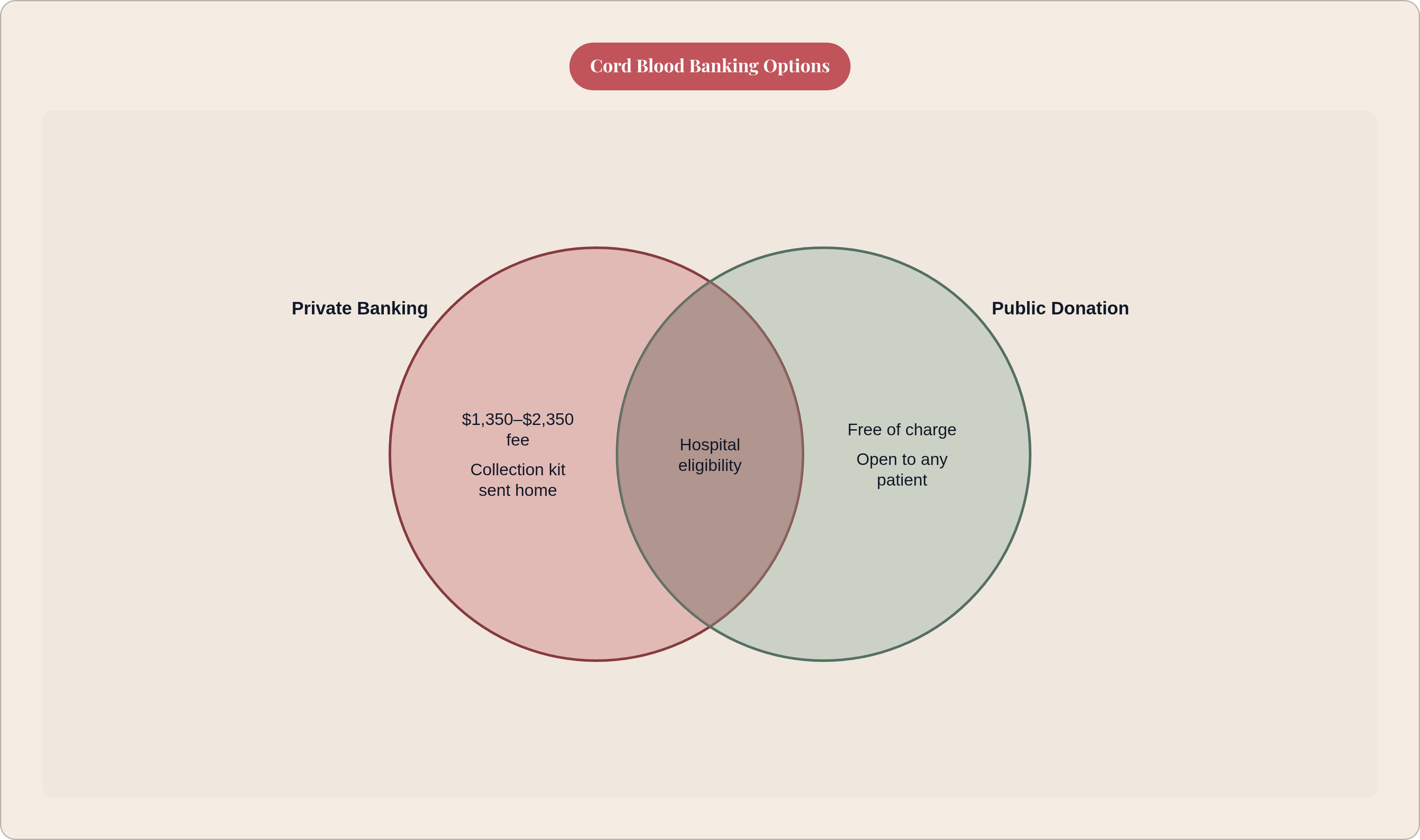
Private banking stores the cord blood exclusively for the collecting family. The unit is cryopreserved at a private laboratory, accessible for the family's own medical use. The cost is real. Upfront processing fees typically run between $1,350 and $2,350, with annual storage fees of $100 to $175. FSA and HSA funds can offset these costs, though most administrators require documentation of medical necessity before approving the expenditure.
Public donation costs nothing. The family donates the cord blood to a public registry, where it becomes available to any patient who needs a matched transplant. The constraint is logistical. Not all hospitals are authorized collection sites for public banks, and enrollment requires advance confirmation of hospital eligibility.
Directed donation occupies a specific middle ground. A family with an older child or relative who has a diagnosable condition that HSC transplantation can treat may bank specifically for that individual, often at reduced or no cost. This path requires documentation of the diagnosis and advance coordination with the bank before delivery.
On the question of private banking, the medical establishment's position deserves plain statement. The American Academy of Pediatrics and the American Medical Association have cautioned against private banking as generalized "biological insurance," citing the cost relative to the statistical likelihood that a child will ever use their own stored unit. The American College of Obstetricians and Gynecologists neither recommends nor advises against it, which is a meaningful distinction rather than a dismissal. Both the AAP and AMA actively encourage public donation where logistically possible.
Private banking earns clearer clinical justification in specific circumstances. A family with a child already diagnosed with a condition that a sibling's stem cells can treat has a concrete case. A family with a documented history of heritable diseases within the treatable range has a concrete case. The sibling-match biology is quantifiable. A full sibling carries a 25% probability of being a perfect HLA match and a 50% probability of being a partial match. Parents are always at least partial matches. These are Mendelian probabilities. For families in these circumstances, the calculus of private banking is fundamentally different from that of a family with no known medical indication.
The birth plan entry differs depending on which path is chosen. That choice must come first, because everything downstream depends on it.
How Early to Start and Why the Timeline Is Tighter Than Most Parents Expect
The start of the third trimester is the practical target for having both a bank enrolled and a care team notified. Work backward from there, and the margin shrinks faster than most parents anticipate.
ACOG recommends that families choosing private banking notify their chosen bank and secure a collection kit at least six weeks before the due date. HRSA guidance for public donation recommends initiating contact with a cord blood bank between weeks 28 and 34 of pregnancy. Three months before the due date is a reasonable point to have the initial conversation with a healthcare provider about which path makes sense.
The window closes abruptly for procedural reasons, not medical ones. Enrollment requires completing a detailed medical and family history, undergoing required blood testing to screen for infectious diseases, and providing formal consent, all before labor begins. Consent given during active labor is, at most banks, insufficient to authorize collection. A parent who calls a private bank the day before their due date will almost certainly be told they're too late. I have heard this from parents after the fact more times than I care to count, and it never gets less frustrating to hear.
Hospital confirmation carries its own separate timeline constraint. Not every hospital is an authorized collection site for public donation. Some hospitals that can perform private collections have specific protocols, or charge separate facility fees, that must be verified weeks in advance rather than discovered in a labor and delivery suite.
Enrolling with a Bank: The Paperwork and Screening That Happen Before Delivery Day
Enrollment is more substantive than most parents expect when they first make contact with a bank. It isn't a transaction; it's a screening process, and it takes time.
The medical and family history questionnaire is thorough by design. The bank is evaluating whether the collected unit will be viable and safe for potential future use, either by the family or, in the case of public donation, by a matched recipient. Certain infectious disease markers, disclosed or discovered during screening, can disqualify a collection. This mirrors the same logic that governs blood donation eligibility.
A maternal blood draw is required, screening for transmissible diseases that could compromise the safety or usability of the unit. The results are associated with the collection record and must be completed before delivery.
Consent must be finalized before labor begins. This is non-negotiable at reputable institutions, and it mirrors the consent architecture used in clinical research. A person in active labor is not considered to be in a position to provide fully informed, uncoerced consent.
Once enrollment is complete, the private bank ships a collection kit to the home. That kit contains the collection bag, the anticoagulant solution that preserves the blood, a data form for the delivery team to complete, and prepaid courier materials. It goes into the hospital bag alongside other birth essentials. Treat it as a packed item well before the due date, not an afterthought retrieved in a panic at 38 weeks.
For public donation, no kit is required. The critical step is confirming during the enrollment call that the intended delivery hospital is an authorized collection site. This confirmation cannot wait until check-in.
Among private banks, CBR (Cord Blood Registry) is one of the more established options in the United States, with a documented history of operational activity and released units. Vitalant and the National Marrow Donor Program's Be The Match registry are pathways for public donation. Parents evaluating private banks should ask directly about accreditation status with AABB (formerly the American Association of Blood Banks), the bank's track record of successful unit releases, and its laboratory processing methodology. Accreditation is not universal, and the question is worth asking bluntly.
How to Write the Banking Decision into the Birth Plan Itself
The birth plan is the mechanism by which the care team learns that banking is planned. Verbal mentions in prenatal appointments aren't reliable enough on their own. Providers see many patients; labor and delivery nurses rotate across multiple births in a single shift. The written plan is the authoritative document.
Some birth plan templates include explicit checkboxes for cord blood options: banking the cord blood, donating it, delivering the placenta spontaneously, seeing the placenta before disposal, and taking the placenta home. These checkboxes exist because each item requires deliberate action from the care team, not default action.
Placenta banking requires its own explicit notation. It is a separate item from cord blood and won't happen automatically even if cord blood banking is listed. The placenta is typically discarded as medical waste unless the birth plan states otherwise with specificity. State it with specificity.
Include the name of the chosen bank, any kit reference number, and courier information directly in the birth plan. The delivery team should be able to act on this information without stopping to ask questions during active labor. Information that requires a follow-up question in the middle of a delivery is information that won't reach the right person in time.
Place the cord blood and placenta banking section near the top of the plan, or in a clearly labeled block that stands apart visually. The timing of collection means the care team needs to see this information immediately after birth, not after working through three pages of music preferences and lighting requests.
Delayed Cord Clamping and Cord Blood Banking: How to Include Both Without Conflict
Delayed cord clamping, defined as waiting at least 30 to 60 seconds before cutting the cord, is recommended by both ACOG and the AAP for most newborns. The additional time allows for continued placental transfusion, increasing the infant's blood volume and iron stores. ACOG's 2025 clinical update raised the minimum recommended delay for preterm infants, those born under 37 weeks, to at least 60 seconds.
ACOG's position on the intersection with banking is unambiguous. Cord clamping practice should not be altered solely to facilitate cord blood collection. DCC takes priority if a conflict arises. The birth plan must reflect this hierarchy, not hedge around it.
The practical resolution, in most uncomplicated term deliveries, is that a delay of roughly 30 to 60 seconds has not been shown to significantly reduce the cell count available for collection. A 2025 peer-reviewed study published in Blood Transfusion, covering collections across four Spanish centers between July 2018 and December 2021, confirmed that various clamping delays are compatible with public cord blood banking requirements, even accounting for some reduction in collection volume. In most cases, both are achievable.
Longer delays, favored by some midwives and nurse practitioners, are possible in certain situations. Some private banks can process a viable sample even with extended delay, but this requires a direct conversation with both the care team and the bank before delivery. It is not an assumption to write into a birth plan without that prior confirmation.
Birth plan language that works: state the DCC preference explicitly ("please delay cord clamping for at least 60 seconds"), state the banking intention separately, and then add: "please discuss timing coordination with care team." This construction signals that the parent understands the tension, defers to clinical judgment on resolving it, and removes the burden of interpreting a contradiction from staff managing an active birth.
The birth plan should also state explicitly that if an emergency arises, care for mother and baby takes absolute priority over collection. Parents who have committed this to paper are better prepared for the possibility that collection doesn't happen, and they haven't compromised their clinical care in pursuit of a collection that wasn't achievable regardless.
Notifying the Care Team and Confirming the Hospital Can Collect
The birth plan informs. Direct conversation confirms. Conflating these two steps is where preparations that seemed airtight fall apart at delivery.
The OB, midwife, or primary care provider should be told about the banking decision at a prenatal appointment. This creates a record in the prenatal chart and gives the provider an opportunity to flag clinical considerations specific to the pregnancy. A risk factor that would affect cord blood viability, or a hospital policy that requires additional steps, will not surface otherwise. Assuming the provider will read the birth plan and draw their own conclusions is a gamble not worth taking.
For public donation, confirming the hospital's authorization as a collection site is the single most important logistical fact to establish. This is verified during the enrollment call, but the labor and delivery nurse also needs to be told upon arrival that a donation is planned. Authorized collection hospitals have protocols, and those protocols require activation by staff who know a collection is happening.
For private banking, confirm directly with the hospital that they perform private cord blood collections and whether they charge a separate facility fee. Ask specifically who on the delivery team performs the collection. Is it the OB? A nurse? Does the bank send an independent collector? The answer varies by institution and by bank, and knowing it before the due date prevents confusion at precisely the moment when no one has time for it.
If the hospital allows it, share the birth plan with the labor and delivery unit before the due date, through the patient portal or prenatal intake process. A phone call to confirm receipt is not paranoid; it is prudent.
What Happens on Delivery Day, from Collection to Courier Pickup
The collection kit goes in the hospital bag and is handed to the care team at check-in. Say it out loud to the labor and delivery nurse, even if the birth plan is already on file. That verbal confirmation is the last link in a chain built over weeks of preparation, and it costs nothing to make it.
After the baby is born and the cord is cut, blood is drawn from the cord using a needle attached to the collection bag. The process takes approximately 10 minutes. The infant is not involved. For placenta banking, the placenta must be explicitly requested and set aside at this same juncture. Without clear instruction, it will be discarded.
The collection kit is temperature-controlled to maintain sample viability during transport. A medical courier, arranged in advance by the bank as part of enrollment, picks up the kit and transports it to the processing laboratory, where an automated process separates the stem cells from the cord blood. Parents receive confirmation of successful processing, typically within days.
Collections fail. Preterm delivery, a delivery emergency, insufficient volume, a procedural gap somewhere in the chain: any of these can end the process before it completes. When that happens, it reflects the limits of what any birth plan can control, not a failure of preparation. The preparation exists to maximize the probability of success under normal circumstances. It cannot manufacture normal circumstances when they aren't there, and no honest account of this process should pretend otherwise.