Delayed Cord Clamping Timing Options at One Hour and Beyond
Evidence shows 2 minutes of delayed cord clamping cuts preterm mortality risk by nearly 70 percent.

Delayed cord clamping used to be a yes-or-no question: clamp right away, or wait a bit. That framing is outdated. The evidence now points to a spectrum of timed intervals, from a 60-second clinical floor up through 3 minutes, 5 minutes, and beyond, each tied to a different physiological payoff and a different evidence base. What follows maps that spectrum and explains what the data actually say at each stop along it.
The Lancet's 2023 network meta-analysis formalized this into a taxonomy: immediate clamping, short deferral (15 to under 45 seconds), medium deferral (45 to under 120 seconds), long deferral (120 seconds or more), and intact cord milking as its own separate category. Two more categories sit at the far edge of that spectrum. Physiologically based cord clamping ties the decision not to a stopwatch but to the infant's own stability, with resuscitation support given while the cord stays intact. Lotus birth, or umbilical cord nonseverance, goes further still: the cord is never cut, and the placenta stays attached until it separates on its own at the belly button, usually within three to ten days. That practice sits well outside clinical guidance and isn't something obstetric bodies weigh in on with any real evidence base. Before comparing what happens at 60 seconds versus 3 minutes versus 5, it helps to understand the plumbing involved, because none of these numbers make sense without it.
Why interrupting the cord early has consequences
The umbilical cord doesn't shut off the moment a baby is born. Blood keeps moving from placenta to infant through the intact cord for as long as it's left alone, a process researchers call placental transfusion. Three things happen during that window. First, the infant picks up iron-rich red blood cells and stem cells that seed early immune function and support tissue repair. Second, the continued circulation itself helps steady the newborn's cardiovascular system as it switches from placental to lung-based oxygen exchange. Third, the added blood volume brings mechanical benefits: better microcirculation, steadier metabolism, and knock-on support for organ function.
Clamp the cord immediately and that pipeline shuts down before it's finished its job. Venous return to the heart drops right away, which briefly reduces cardiac output and blood flow to the brain, and this happens before the lungs have even taken over gas exchange. Clamping before the lungs aerate is the riskier sequence: the infant loses the placental blood supply and hasn't yet established its own circulatory rhythm through breathing. Wait until ventilation kicks in, and the transition runs smoother. Immediate clamping denies the newborn its full share of iron and stem cells, and that shortfall produces a cost that is visible later in ways this piece will get to.
When the blood-transfer curve levels off
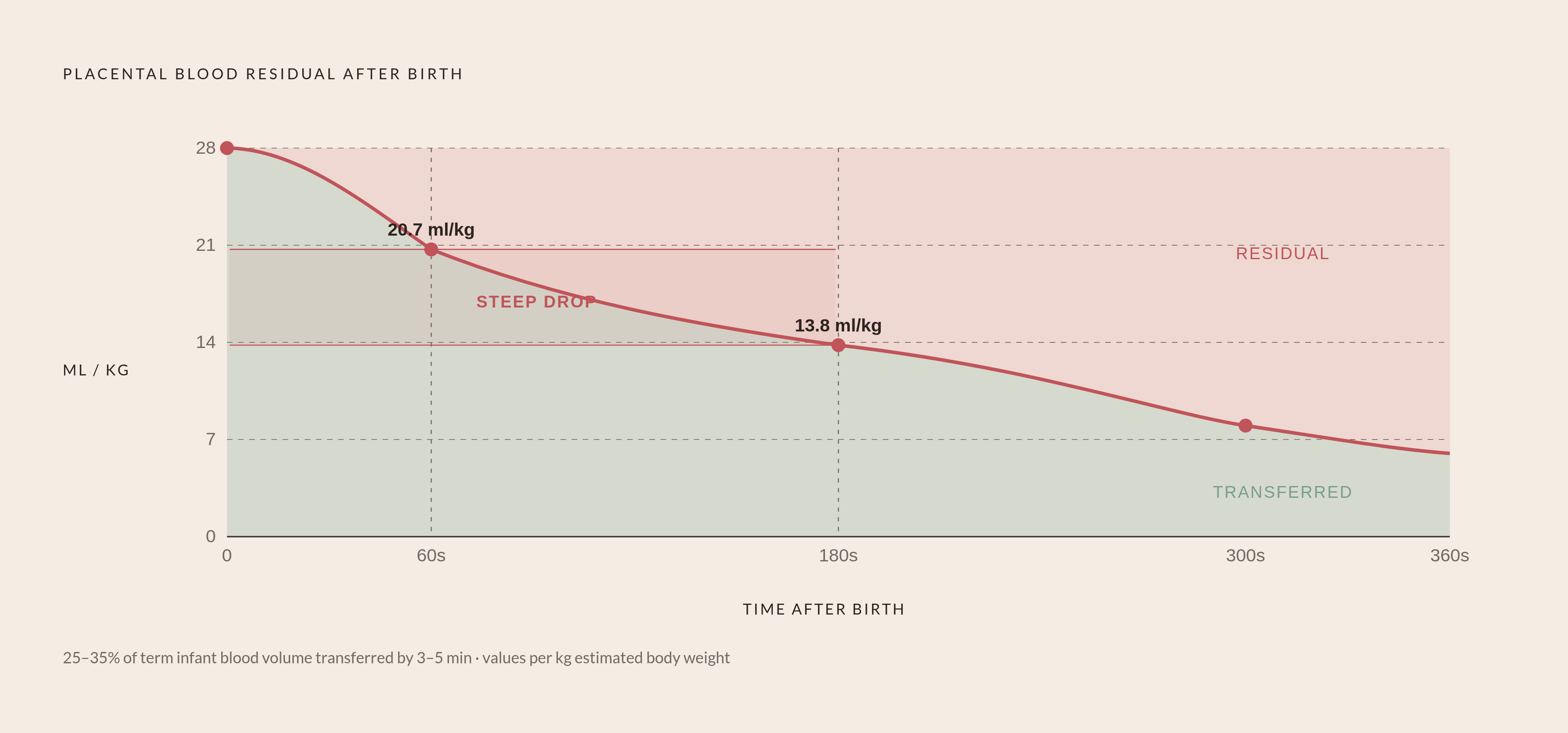
Delaying clamping somewhere between 30 and 180 seconds adds roughly 80 to 100 cc of blood volume and around 40 to 50 mg/kg of iron to the infant's supply. Delaying clamping somewhere between 30 and 180 seconds adds roughly 80 to 100 cc of blood volume and around 40 to 50 mg/kg of iron to the infant's supply. By the 3-to-5-minute mark, a term baby has typically received a placental transfusion equal to 25 to 35 percent of its total blood volume, which is not a trivial top-up.
Older hemodynamic studies, still cited widely, show the shape of that curve directly. At 60 seconds post-birth, the placenta still holds about 20.7 ± 1.5 ml/kg of blood, roughly 74 ml, that hasn't yet moved to the infant. By 180 seconds, that residual drops to 13.8 ± 1.0 ml/kg, around 49 ml. Less blood sitting in the placenta means more has crossed over to the baby, so the longer the deferral, the bigger the transfer, at least up to a point.
That point matters. Most of the transfer happens in the first few minutes, and the curve flattens out after that. Practically, this means every additional minute of deferral in that early window carries a real, if shrinking, marginal benefit. It's also the reason guidelines vary so much between a 60-second minimum and recommendations pushing past 3 minutes: different bodies are drawing the line at different points along the same curve, not disagreeing about the curve itself.
What the 2023 Lancet meta-analyses established about deferral duration and mortality in preterm infants
The strongest evidence to date on why timing matters for survival, not just blood counts, comes from two companion Lancet publications in November 2023. One was a systematic review and individual participant data meta-analysis covering 48 randomized trials, the other a network meta-analysis covering 47, together spanning 12,461 babies born before 37 weeks.
The headline finding: preterm infants whose cords were clamped anywhere between 30 seconds and at least 180 seconds after birth had a 32 percent lower risk of dying before hospital discharge compared with infants clamped within 15 seconds (odds ratio 0.68). But the benefit wasn't spread evenly across that range. Short deferral (15 to 45 seconds) and medium deferral (45 to 120 seconds) didn't produce a statistically solid reduction in mortality on their own. Long deferral, 120 seconds or more, is where the effect concentrated, cutting the odds of death before discharge with an odds ratio of 0.31 (95% credibility interval 0.11 to 0.80). The network meta-analysis backed this up with a clear dose-response pattern: longer waits, past the 2-minute mark specifically, produced bigger reductions in mortality.
That's a meaningful gap to sit with. The mortality signal lives in the 120-second-plus group; the 30-to-60-second range that most current guidelines treat as sufficient does not show it. The floor set by policy and the optimum suggested by the data are not the same number.
Why current guidelines land at 60 seconds even though the mortality data favor longer waits
ACOG's September 2025 update, revising its 2020 Committee Opinion No. 814, recommends deferring cord clamping for at least 60 seconds in preterm neonates born before 37 weeks who don't need immediate resuscitation. Given the Lancet data above, that number reads as conservative, and ACOG says so explicitly: the trials generating the strongest long-deferral mortality signal were largely run in specialized settings, and generalizing a 120-second-plus standard to the full range of delivery environments carries more uncertainty. That reasoning traces back to a post hoc analysis from the International Liaison Committee on Resuscitation's Advanced Life Support Task Force.
Other bodies land in similar territory, with some variation. ACOG's still-operative 2020 guidance for term births calls for at least 30 to 60 seconds in vigorous term and preterm infants. The American College of Nurse-Midwives recommends 2 to 5 minutes for term infants, a wider range than ACOG's. A leading global health body's 2014 guidance, still referenced in current literature, simply says not earlier than 1 minute. FIGO takes the broadest stance, saying 30 seconds to 3 minutes appears justified for term babies while acknowledging there isn't enough evidence yet to pin down one optimal number.
None of this is one-size-fits-all. ACOG's 2025 guidance flags several situations calling for individualized judgment: infants needing immediate resuscitation, multiple gestations, congenital anomalies, and placenta previa. Delayed clamping is not a default that applies regardless of context. For neonates between 28 0/7 and 36 6/7 weeks where deferred clamping isn't feasible, ACOG lists umbilical cord milking as a reasonable substitute for hematologic benefit.
The takeaway: guideline minimums reflect what's practical to implement across the full range of delivery settings. Where longer deferral can be done safely, the evidence supports going further than the floor.
Hematologic and hemodynamic outcomes when deferral extends to 3 minutes in recent trials
A 2026 randomized trial, registered with a national clinical trials registry in October 2024, put this to a direct test. Researchers enrolled 304 late preterm neonates (30 to 36⁶⁄₇ weeks) and split them evenly, 152 to clamping at 1 minute and 152 to clamping at 3 minutes.
At 48 hours, the 3-minute group had a mean hematocrit of 43.18 versus 41.02 in the 1-minute group, a statistically significant gap (p < 0.001). The outcomes measured at the 6-week mark were venous hematocrit and ferritin. The trial's design directly addresses the standard worry that waiting longer means too much blood and downstream jaundice risk.
A separate 2024 cohort from AIIMS Bhopal, covering 408 neonates at 28 weeks or older and grouped by clamping time, found the same pattern: hemoglobin and hematocrit rose with longer deferral. The 2026 trial's authors point out that a low-cost intervention like this carries particular weight in settings with high baseline rates of anemia, where a 3-minute wait costs nothing and delivers a real hematologic gain.
The effect of extending DCC beyond 5 minutes on brain development in term infants
A US randomized trial of healthy term newborns pushed the deferral window further still, comparing clamping past 5 minutes against immediate clamping under 20 seconds. Actual times achieved landed at 172 ± 188 seconds in the delayed group versus 28 ± 76 seconds in the immediate group, wide variance that's typical of real-world delivery conditions rather than lab precision. At 48 hours, hematocrit ran at 57.6 percent in the delayed group versus 53.1 percent in the immediate group. By 4 months, the delayed group showed significantly higher ferritin, 96.4 versus 65.3 ng/dL (p = 0.03).
That ferritin gap connects to something more than blood counts. Researchers found a positive relationship between ferritin levels and myelin content, and infants in the delayed group showed more myelin in the internal capsule and other brain regions that mature early and handle motor, visual, and sensory processing. That difference held up at the 12-month mark, still concentrated in regions tied to those same functions.
The chain from iron to ferritin to myelin depends on a threshold rather than being triggered by any delay. It depends on a threshold. That lines up with the dose-response pattern already seen in blood volume data: what matters is whether enough iron actually crosses over, not whether some clamping was technically deferred.
Whether longer cord clamping deferral increases maternal bleeding risk
A persistent worry runs through obstetric practice: does keeping the cord intact longer interfere with uterine retraction or delay the timing of uterotonic drugs, raising the risk of postpartum anemia, hemorrhage, or the need for a transfusion. It's a fair question, and one that's had specific data brought to bear on it.
A 2026 preprint on Research Square, published August 28, 2026, looked at a calendar-time-adjusted cohort of 4,632 deliveries at 22 weeks or later from a single university obstetric department in Ankara, Turkey. DCC of 60 seconds or more was compared against immediate or 30-second clamping. Of the total, 1,889 deliveries, 40.8 percent, involved DCC, and adoption climbed sharply over the study period, from 10.2 percent in 2022 to 62.3 percent in 2024.
The primary analysis, using stabilized inverse probability of treatment weighting, found no association between DCC and postpartum anemia (risk ratio 1.01, 95% CI 0.88 to 1.16), postpartum hemorrhage (1.11, 0.77 to 1.59), a hemoglobin drop of 2 g/dL or more, or need for transfusion. That held steady across all four analytic methods the authors ran. One exploratory finding stands out: a modest signal for vaginal delivery (1.19, 1.02 to 1.38) that didn't appear for cesarean delivery (0.91, 0.81 to 1.03). The authors are careful to frame this as hypothesis-generating rather than something that should change practice, pending a prospective study built to test it directly.
This is a preprint, still under peer review, so it should be weighted accordingly. But it lines up with earlier randomized evidence and with the same global health body's 2025 consolidated guidelines on postpartum hemorrhage, which treat maternal anemia as a modifiable risk and call for more implementation research. At the guideline-concordant 60-second mark, maternal blood safety looks well supported by what's been measured so far. The vaginal-delivery signal is worth tracking, not worth abandoning deferral over.
What recent data show for infants born before 30 weeks
The most fragile population, infants born before 30 weeks, is also where the newest evidence is landing. A 2026 retrospective cohort study out of a Level 4 NICU in Bursa, Turkey looked specifically at this group, extending the deferral question into the gestational range where the stakes of getting timing wrong, in either direction, are highest. That's also where the evidence base is thinnest relative to the term and late-preterm populations covered above, and where the next wave of trial data is expected to concentrate. The direction of travel across all the research covered here points the same way: benefit tracks with duration up to a real ceiling, current guideline floors trail the mortality and hematologic data by a meaningful margin, and the frontier now is figuring out how far that ceiling can be safely pushed for the smallest, earliest infants.
Sources
- Delayed umbilical cord clamping and early maternal haematological outcomes: a calendar-time-adjusted cohort of 4,632 deliveries
- Delayed Cord Clamping and Early Neonatal Outcomes in Infants Born Before 30 Weeks of Gestation: A Retrospective Cohort Study - PubMed
- Deferred cord clamping (DCC) at 1 min versus 3 min in preterm neonates - an open label randomized, controlled trial - PubMed
- New Guidance on Delayed Cord Clamping for Preemies
- Delayed Umbilical Cord Clamping After Birth
- FIGO good practice recommendations on delayed umbilical cord clamping - PMC
- Lotus birth - Wikipedia
- thelancet.com