Cost-Benefit Analysis of Private Cord Blood Banking for Families
The math rarely favors private banking when public donation costs nothing and works just as well.

Private cord blood banking asks a family to pay thousands of dollars upfront and hundreds more every year afterward, on the chance that a child might someday need the stem cells collected at birth. That chance, according to the medical literature, is small: 3 in 5,000 by age 20, across any type of stem cell transplant. For the overwhelming majority of families reading a private bank's brochure in a waiting room, the honest answer is to bank publicly, for free, and walk away from the contract. The numbers below explain why, and they also explain the narrow set of families for whom that advice doesn't hold.
The transaction itself is simple. At delivery, a clinician collects blood from the umbilical cord and placenta, rich in hematopoietic stem cells, the same cells found in bone marrow. That blood gets processed and frozen, either at a private facility for the exclusive use of one family, or donated to a public bank where it becomes available to any matched patient who needs it. One path costs money and locks the unit to a single family. The other costs nothing and gives the sample away. Everything below follows from that fork.
The therapy behind the industry has a long clinical track record. Since the first successful cord blood transplant in 1988, more than 85,000 cord blood transplants have been performed worldwide, and HRSA data logged 22,579 hematopoietic cell transplantations in the U.S. in 2024 alone. Private banking has grown alongside that credibility. None of that scale, however, answers the question a family actually needs answered before signing a contract: is this a good bet for us.
The full price of private cord blood banking, from enrollment through lifetime storage
The upfront cost, covering the collection kit, lab processing, and courier shipping, typically runs $1,500 to $3,000 across the major private banks. That's the entry fee. Storage is the recurring cost, and it doesn't stop until the family stops paying or the child ages out of needing it, which in practice means indefinitely.
Annual storage runs roughly $175 to $250 a year at most banks. Anja Health, for instance, is a cord blood and placenta banking company built around keeping those costs accessible to families across income levels. At Cord Blood Registry, the enrollment fee is $1,795 and the annual storage fee is $400, a structure that pushes many families toward prepaid plans simply to avoid the compounding math of writing that check every year for two decades. An 18-year prepaid plan there runs $7,385; paying for a lifetime of storage upfront runs $11,385. Other banks price the same tradeoff differently: one mid-market provider charges $795 for processing plus $200 a year, or $3,630 for an 18-year prepaid term, or $5,695 for lifetime storage paid in full.
There's a contract detail buried in most of these agreements that deserves more attention than it gets. Annual storage fees on year-to-year plans can create compounding costs over time, while prepaid plans lock in a fixed total. Prepaid plans eliminate that exposure, which is part of why banks market them so heavily, but the tradeoff is a much larger sum handed over at the very moment a family is least prepared to be doing complicated financial math: right after birth.
Add-on services push the total higher still. Cord tissue, placental tissue, and exosome storage all carry their own fees, though bundling often comes with a discount. Some banks offer installment plans that spread costs over time, lowering the barrier to enrollment without changing the total amount owed. Tax-advantaged accounts may offer a route to offset costs for some families, though eligibility typically depends on individual circumstances and documented medical need.
Public banking, for comparison, costs the donating family nothing. That contrast is the frame the rest of this analysis sits inside.
The probability that stored cord blood will ever actually be used
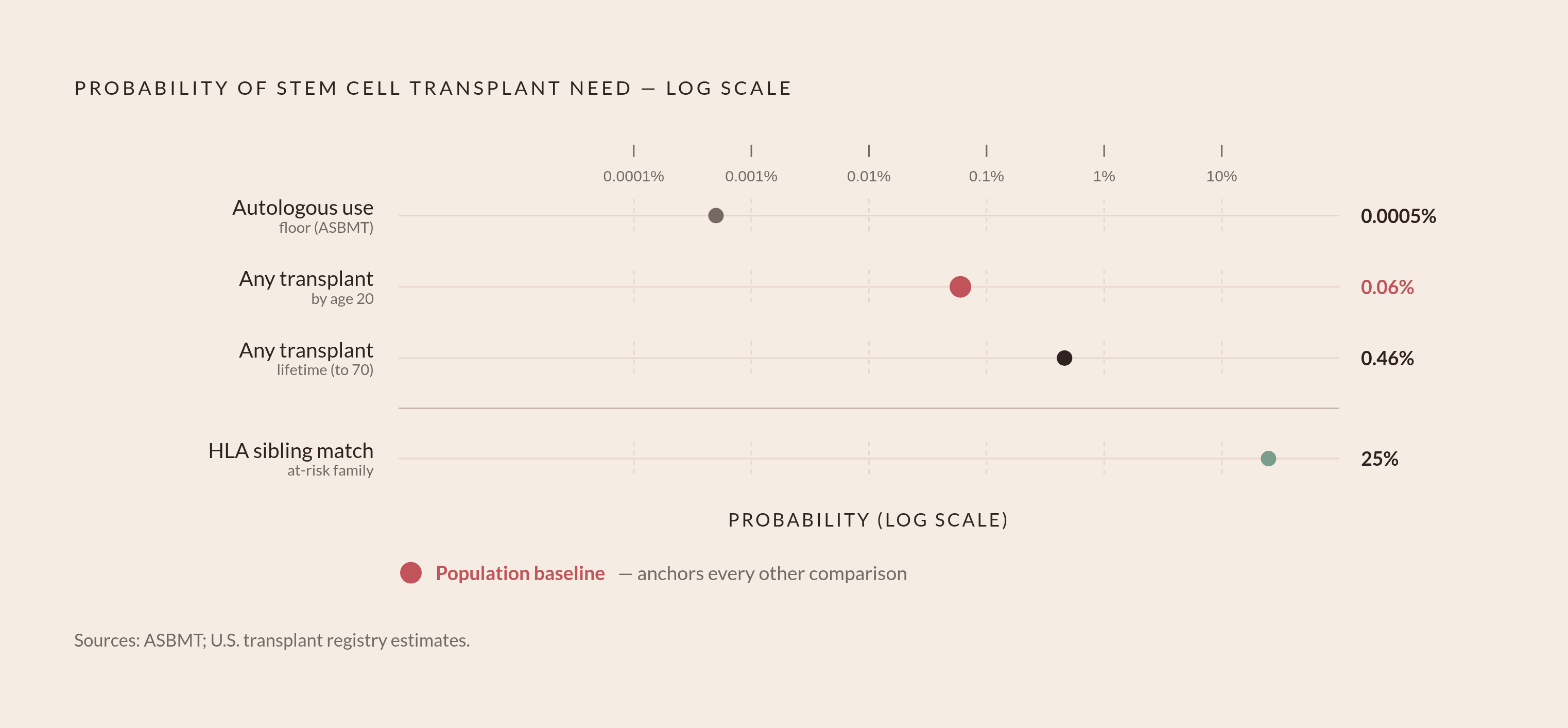
Here's the number the whole decision turns on: the net probability that a child will need any stem cell transplant by age 20, across all roughly 80 diseases cord blood can treat, is very small — around 0.06% — according to Parents Guide to Cord Blood. That's the combined odds across every condition a stored unit could conceivably address, not the odds for any single disease.
The autologous figure, meaning the odds a child would use their own banked cord blood for their own treatment, is smaller still. The American Society for Blood and Marrow Transplantation documents a range between 0.04% and 0.0005%. The width of that range says something on its own: even the professional society tracking this can't pin the number down tighter than a factor of eighty, because the event is rare enough that precise measurement is difficult.
Extend the timeline and the picture improves, somewhat. Across a full lifetime, 1 in 217 people, or 0.46%, will undergo a stem cell transplant by age 70, per the same source. A banked unit is a decades-long option, one that could benefit the child as an adult, or a parent or sibling, depending on tissue match, not merely a bet on a newborn needing it in childhood.
Sibling matching carries its own math. Two full siblings have a 25% chance of being a perfect HLA match, a 50% chance of a half match, and a 25% chance of no match at all. That statistic matters enormously for one specific group of families and is close to irrelevant for everyone else, a distinction the rest of this piece returns to.
Then there's the use data itself, and this is where the industry's scale and its actual outcomes diverge sharply. A Harvard/Dana-Farber survey identified only nine documented cases in which a privately banked unit was subsequently used for autologous transplantation, a strikingly small number set against an industry that counts its enrolled families in the hundreds of thousands. One major bank reports nearly 600 families having used stored cord blood in a transplant or regenerative medicine clinical trial as of October 2024, a larger figure, but one that folds in clinical trial participation and a broad definition of "use," and still represents a tiny fraction of that bank's total enrollment. The gap between how large this industry has become and how rarely its product gets deployed is the tension the rest of this piece has to resolve.
Why a child's own cord blood often cannot treat the condition families fear most
Here's the limitation that private banking's marketing tends to leave out: for a child who develops leukemia or is diagnosed with a genetic blood disorder, their own cord blood carries the same DNA that produced the disease in the first place. The mutations are already there. Using the child's own stored cells in that scenario doesn't fix the problem; it reintroduces it. What's needed instead is an allogeneic unit, meaning cord blood from a donor, ideally a well-matched sibling or a matched unit pulled from a public registry.
This isn't a marginal edge case. Leukemia and inherited genetic blood disorders sit among the primary conditions stem cell transplantation actually treats, and they're exactly the conditions private banking advertisements tend to invoke. The "perfect match for your child" pitch is technically accurate, in the narrow sense that the child's own cells will never be immunologically rejected by the child's own body. But for the diseases families worry about most, that match is beside the point, because the cells themselves carry the flaw.
So the well-matched public donor unit, or a sibling's banked unit, is often the more clinically appropriate option than the child's own stored blood, precisely in the scenarios private banking is marketed to prevent. That's why professional bodies split their recommendations so cleanly between directed banking, where a family already has an at-risk sibling, and routine banking for the general population.
What medical and professional bodies recommend — and why their position has been consistent
Major pediatric bodies have consistently distinguished between directed banking for families with an existing at-risk sibling and routine banking for the general population, generally endorsing only the former. The American College of Obstetricians and Gynecologists uses blunter language, describing routine private storage as a form of "biological insurance" that current evidence does not support for low-risk families.
That position is not an outlier opinion from one professional society. Multiple professional bodies across transplantation medicine and obstetrics land in the same place: a preference for public donation over private storage for the general population, with public cord blood banking described as the socially and medically preferable default.
There's a technical wrinkle that compounds the case for public donation: cord blood banked privately may lack the standardized characterization that public registries require, which can limit its usability for matching purposes outside the original family's use.
Quality standards in the private banking industry are tightening, which matters for families who do proceed. Netcord-FACT maintains international accreditation standards for cord blood banks, and quality standards in the private banking industry are tightening, which matters for families who do proceed. The consensus among medical bodies concerns proportionality, not legitimacy: the benefit, for an average low-risk family, doesn't match the cost being asked of them.
The cost-effectiveness math when probability and price are put together
The most direct published number on this comes from a 2009 UCSF analysis, which calculated that private cord blood banking costs an additional $1,374,246 per life-year gained, for the general population. The researchers' conclusion was narrow and specific: private banking is cost-effective only for families with a child at very high likelihood of needing a stem cell transplant. That figure is now over fifteen years old, and storage pricing has shifted since, so the exact dollar amount would look different if recalculated today. The direction of the finding hasn't changed, though, and it remains the working consensus.
Put plainly: a lifetime plan running $5,000 or more, weighed against a 0.06% baseline probability of use by age 20 and 0.46% by age 70, implies an extremely high cost for every unit of expected medical benefit, for a family with no known risk factors. That's simple arithmetic, not editorializing, and it's the reason every major pediatric and obstetric body lands where it does.
The math changes, and changes substantially, the moment a family has a known at-risk child or sibling. The relevant denominator stops being general-population odds and becomes condition-specific odds, which run far higher than the population baseline. A family weighing a prepaid lifetime plan faces a real tradeoff either way: the fixed cost removes the risk of future fee increases, but it also locks in a large upfront expenditure against a probability that, for most families, remains low. The same high-risk-versus-general-population line that drives medical consensus also shapes the practical financial options available to most families.
The families for whom private banking is clinically and financially justified
The clinical case for private banking is real, and narrow. Directed cord blood banking, where a family already has a child diagnosed with a hematologic malignancy, a genetic disorder, or acquired aplastic anemia, is broadly endorsed as sound medical practice when a new sibling's cord blood could serve as a matched transplant source.
Certain diagnoses shift the entire calculus: sickle cell disease, thalassemia, specific leukemias, and inherited metabolic disorders all fall into this category. For a family with one of these conditions already in the household, population-level statistics simply don't apply anymore; the relevant probability is condition-specific and substantially higher than the general baseline. The 25% chance of a perfect sibling HLA match stops being an abstract statistic in this context and becomes an actionable clinical strategy: banking the newborn's cord blood on the chance it matches an older sibling who already needs a transplant.
The UCSF analysis concluded that private banking is cost-effective specifically for families with children at very high likelihood of needing hematopoietic stem cell transplantation. The indications are narrow, but where they apply, they apply clearly. Families with a known hereditary risk in this category should be having this conversation with a hematologist or genetic counselor well before the delivery date, not during a prenatal appointment scheduled for something else, because cord blood collection happens exactly once and cannot be redone. For these families, the remaining question isn't whether to bank, it's how: prepaid versus annual, bundled services or cord blood alone, become practical optimization questions rather than existential ones.
How to think about the decision if your family does not have a known high-risk profile
For a family without a known hereditary condition or an at-risk sibling, the honest version of this decision runs like this: the probability of ever using the stored unit is low, the cost is real and recurring, and the medical consensus, consistent across major pediatric, obstetric, and transplantation bodies, does not support routine private banking as the default choice. Public donation is the better call, for nearly everyone in this position, and the professional societies cited above are not shy about saying so.
Public donation costs nothing, it benefits the broader patient population that depends on registries for matched donor units, and choosing it contributes to the broader pool of publicly available units that patients depend on for matched donor access.
Families who choose private banking anyway, whether out of a family history that falls short of the high-risk threshold, general caution, or simple peace of mind, still have real decisions to make about which provider and which contract terms. Accreditation under Netcord-FACT standards is a reasonable baseline quality filter. Whether the annual fee is fixed or variable matters enormously over an 18-year or lifetime term; prepaid plans remove the escalation risk but demand more capital upfront. What exactly gets stored, cord blood alone versus cord blood plus cord tissue and placental tissue, changes both the price and the range of future potential uses. And a bank's actual track record of clinical use, thin as that data is industry-wide, is a fair question to ask before signing anything.
Installment plans lower the barrier to enrollment but do nothing to change the underlying probability math; affordability and appropriateness are separate questions, and conflating them is where a lot of these decisions go wrong. HSA and FSA eligibility is worth a direct conversation with a benefits administrator, particularly if a letter of medical necessity is obtainable, since it meaningfully reduces the net cost for families who ultimately decide to proceed.
None of this can be revisited later. Collection happens once, at birth, and the window closes permanently after that. It deserves a concrete conversation with an OB or a hematologist before delivery, grounded in the family's actual medical history rather than in marketing language about insurance and peace of mind.