Cord Blood Viability After Long-Term Cryogenic Storage
Decades of frozen storage barely harm cord blood cells; the real damage happens during thawing.

Cord blood banking rests on one question: does freezing cells for decades leave them usable, or does storage quietly erode what makes them work. The answer, drawn from five decades of follow-up data, several independent labs, and one 29-year institutional dataset, is that storage duration matters far less than most people assume. The real damage happens in the seconds and minutes cells spend crossing between liquid and frozen states, while the years spent sitting still afterward leave comparatively little mark. That distinction, more than any single number, should guide how banks freeze cord blood and how doctors pick units for transplant.
What viability means in practice and why standard metrics matter
Three numbers show up in nearly every study on this subject, and people mix them up more often than they should. TNC viability, short for total nucleated cell viability, is the percentage of cells that come back alive after a unit thaws. CD34+ cell count measures something narrower and more useful: the share of hematopoietic stem and progenitor cells, the ones that actually rebuild a patient's blood and immune system after transplant. Engraftment is the test that matters in the end: whether those cells take hold in a recipient's body and start making blood on schedule.
A high viability score by itself says little about whether a transplant will work. A unit can post a fine TNC viability reading and still fail clinically if its CD34+ fraction thinned out during storage or handling. Judging a unit on viability alone risks hiding the number that actually predicts success.
Accreditation standards require formal stability monitoring and controlled-rate freezing protocols as expected benchmarks; viability thresholds tie back to the criteria labs get audited against. Whether a unit holds up over 20 or 30 years depends less on the calendar and more on whether the nitrogen tank it sat in held a constant temperature the whole time, and whether the technician thawing it years later followed protocol to the letter.
Why the freeze-thaw process, not the storage duration, is where cells are most at risk
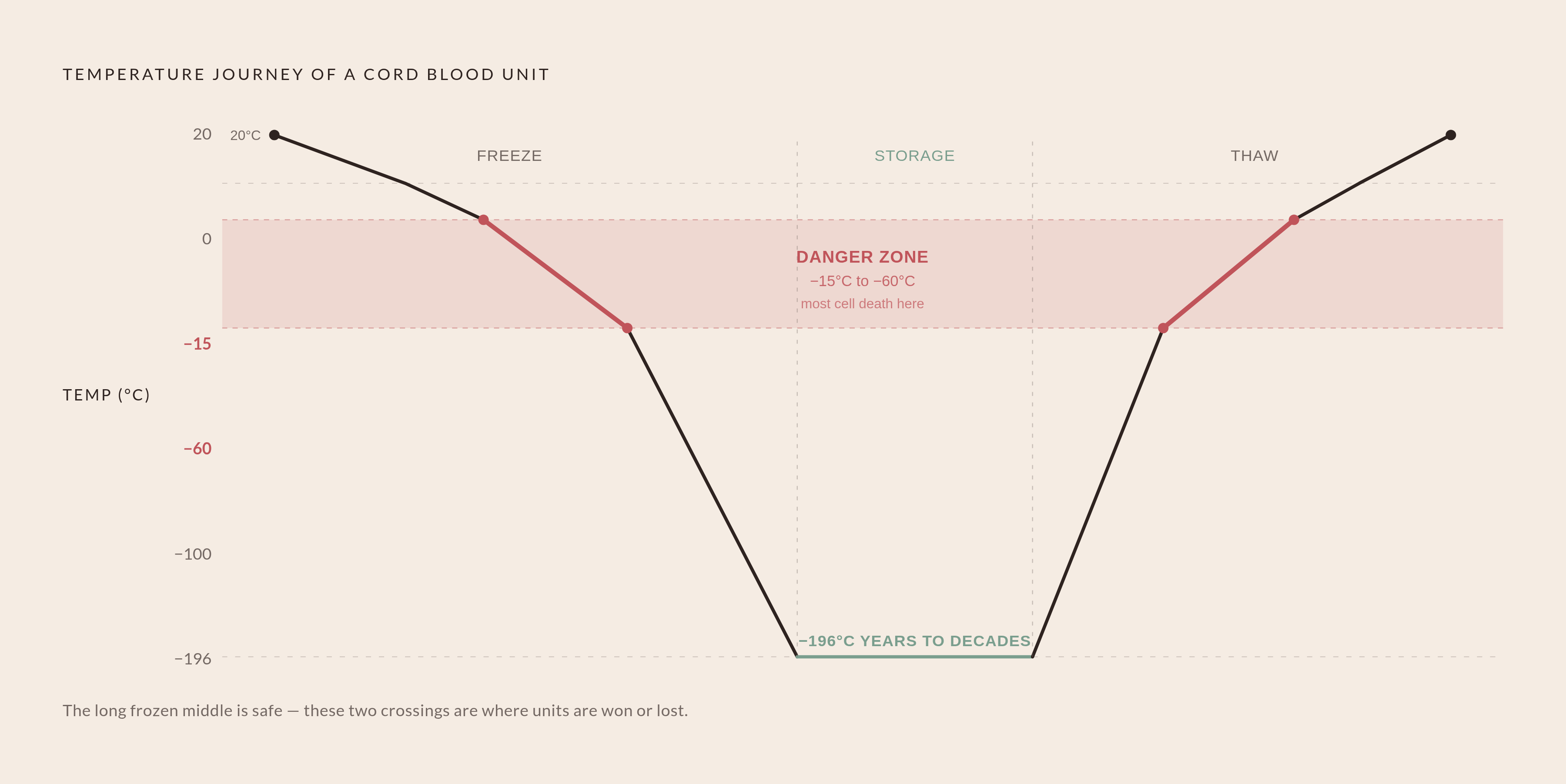
Long-term storage sits around −196°C, the temperature of liquid nitrogen, and the vapor phase at −180°C or colder is cold enough to put stem cells into something close to metabolic standstill. Cells run into little trouble there. The real danger zone sits between −15°C and −60°C, a band cells have to cross twice: once going down during freezing, once coming back up during thaw. That's where ice crystals form inside and around cells, and where osmotic shock does its damage. Most cell death tied to cryopreservation traces back to time spent crossing that narrow range, while the years spent sitting frozen on either side of it contribute comparatively little.
Labs manage that crossing three ways, and none of them comes free. Slow-cooling protects CD34+ cells well, recovering around 23.32 cells/µL, but post-thaw viability lands lower. Vitrification flips the ratio: viability climbs substantially, but CD34+ recovery drops to about 2.47 cells/µL. Controlled-rate freezing splits the difference, using computer-managed temperature curves to hold viability at an acceptable level while keeping more of the CD34+ fraction intact. If a bank has to commit to one method, controlled-rate freezing is the defensible choice, since the other two trade away too much in one direction to justify as a default.
The cryoprotectant matters as much as the cooling curve does. DMSO at 7.5% to 10% concentration is the standard, and straying outside that range causes measurable harm. Timing is just as unforgiving: DMSO exposure has to stay under an hour before freezing and under 30 minutes after thaw, because at 37°C the compound turns cytotoxic and triggers the same osmotic shock the freeze process is trying to prevent. Even the hours before freezing count. Cell health begins declining before freezing, so the clock starts well before the unit reaches a nitrogen tank.
Put together, a unit frozen 25 years ago under a tight protocol can outperform a unit frozen five years ago under a sloppy one. The transition into and out of the frozen state carries the risk; the years spent frozen in between carry comparatively little.
What Broxmeyer's longitudinal series showed across five decades of follow-up
Hal Broxmeyer's lab has tracked cord blood recovery since the late 1980s, starting with cells stored a few months and stretching the timeline out to 5, 10, 15, and eventually 27 years. Other labs filled in the gaps and kept landing on the same answer. Seo and colleagues found no meaningful differences in TNC count, CD34+ count, or viability at one and two years. Lee's group confirmed the pattern at five years, and Yamamoto's team pushed it to ten, finding no drop in TNC recovery, CD34+ cells, colony-forming units, or viability.
The capstone arrived in October 2023, published in Cell Reports Medicine under the title "Insights into Highly Engraftable Hematopoietic Cells from 27-Year Cryopreserved Umbilical Cord Blood." Three units, frozen more than 27 years, were thawed with standard clinical protocols and came back with 76% to 87% viability. CD34+ concentration averaged 4,250 cells per 1×10⁶ nucleated low-density cord blood cells, against 4,550 in fresh cord blood, a gap small enough to be statistically insignificant.
Transcriptomic analysis on those same units found gene programs tied to lineage determination and oxidative stress, both markers linked to engraftment potential, showing up regardless of how long the units had sat frozen. The authors' conclusion was direct: age alone is a poor basis for excluding a unit from clinical use, and genomic tools judge potency better than the calendar does. What gives this series its weight is continuity. It is the same lab, following cord blood from the first transplant ever performed through 27 years of data, a throughline no single-point study can match.
What an institutional bank's 29-year dataset adds to the single-lab picture
A separate line of evidence comes from outside Broxmeyer's lab entirely. Liedtke and colleagues published "Long-Term Stability of Cord Blood Units After 29 Years of Cryopreservation" in Stem Cells Translational Medicine in January 2024, drawing on data from the José Carreras Cord Blood Bank in Düsseldorf, which holds 21,215 active cryopreserved units licensed for transplant, a population large enough to compare across different eras of processing technology.
Unseparated units, processed between 1993 and 1998, showed mean TNC viability of 88.91% (± 5.01) after 29 years, the longest licensed expiration period on record. Manually volume-reduced units, processed from 1998 to 2005, came in at 84.22% (± 10.02) after 25 years. Automated volume-reduced units, processed since 2005, hit 88.64% (± 3.91) after 18 years. The automated cohort's standard deviation runs less than half that of the manual cohort, and that tells its own story: processing consistency has improved, and it shows up directly in outcomes.
Recipients of both volume-reduced cohorts engrafted earlier than recipients of unseparated units. Processing method shapes clinical outcome more than the age of the unit does, a claim the field hasn't fully absorbed yet. The Paul-Ehrlich Institute used this data to license expiration periods stretching close to three decades, so regulators, not just researchers, now stand behind numbers like these. Different institution, different processing history, same basic answer as Broxmeyer's work: viability holds.
Clinical transplant data on whether storage duration changes patient outcomes
Laboratory viability numbers are one thing. Whether they translate into working transplants is another, and that's where Mitchell and colleagues' study, published in Biology of Blood and Marrow Transplantation, carries weight. The researchers looked at 288 single-unit cord blood transplants performed between 1992 and 2013, with storage times ranging from about a month to just over 11 years.
Years in the freezer had no measurable effect on TNC recovery or post-thaw viability. More tellingly, storage time had no effect on neutrophil or platelet engraftment, the two benchmarks that actually decide whether a transplant works. The authors concluded that cord blood can sit stored for at least a decade without any measurable cost to clinical outcomes, settling a question that lab viability numbers alone couldn't answer.
Real-world transplants have drawn on privately banked units stored for close to two decades, extending the finding beyond controlled study conditions. Cases like this tend to come out of private family banking rather than public banks, since public banks generally favor newer units when several options sit on the shelf. That leaves units held for one donor's future use as the more likely source of very-long-term, real-world proof.
Where the evidence gets complicated: mitochondrial stress and early functional changes
Some findings complicate the picture rather than confirm it, and this is where the field's confidence actually gets tested. In March 2025, Huang and colleagues published single-cell transcriptomic work in the Journal of Clinical Investigation, comparing CD34+ hematopoietic stem and progenitor cells from fresh cord blood against units frozen for 1, 5, 10, and 19 years. Frozen CD34+ cells showed reduced stem cell function: lower engraftment rates and weaker colony-forming capacity in transplant experiments.
The shape of that decline matters as much as the fact of it, and it isn't linear. Function drops gradually over the first five years after freezing, then largely flattens, with no significant further decline after that point. The mechanism traces to the mitochondria: increased membrane potential in stem and progenitor cells, paired with metabolic dysfunction that raises oxidative phosphorylation and reactive oxygen species while lowering oxygen consumption and ATP production. A 2025 review in Blood Science adds a further wrinkle, finding that gene expression changes tied to oxidative metabolism peak in the first year after freezing. The freeze-thaw event itself looks like the source of the stress; the years of storage that follow contribute comparatively little.
That fits the storage-duration data rather than contradicting it, since the damage happens mainly at the transition into and out of the frozen state and spares much of the time spent frozen in between. There's a possible fix on the horizon, too: sulforaphane, an antioxidant compound, has been shown to cut mitochondrial membrane potential and reactive oxygen species in CD34+ cells drawn from frozen units, including units stored a full decade. "Viable" and "fully functional" are related claims, not identical ones, and collapsing that distinction risks overstating what current screening actually confirms. The open question now is how wide that gap runs and whether drugs can close it before a unit ever reaches a patient.
How the open questions about functional decline are reshaping how units are selected and assessed
Ruling out older units by default doesn't survive contact with Broxmeyer's 27-year data or the Düsseldorf bank's 29-year dataset. Age by itself is a weak stand-in for quality, and screening on age alone is a habit worth reconsidering rather than defending as caution.
Broxmeyer's omics results point toward where selection is headed: transcriptomic and molecular potency markers that could flag high-engrafting units regardless of how long they've sat frozen. Current practice hasn't caught up. TNC viability and CD34+ count remain the standard screening tools, but neither one captures the mitochondrial dysfunction Huang's team documented, and that gap between what labs measure and what actually predicts engraftment matters more than the age of any given unit.
The sulforaphane research points to a way of closing that gap: treat compromised units before transplant to restore what the freeze-thaw process degraded, as a complement to selection rather than a substitute for it. That's a pharmacological fix applied at the point of use, sitting alongside a stricter selection filter applied earlier. Regulators are still catching up, too. The Paul-Ehrlich Institute's decision to license expiration periods out to 29 years reflects real institutional confidence, but it rests on TNC viability data, not on the functional genomics work still coming out of labs like Huang's.
For private cord blood banking, the evidence built over the past few decades makes a strong case for long-term storage. What the newer findings on mitochondrial stress add is a second job: the work doesn't end at the freezer door, and thawing protocol and post-thaw handling carry as much weight as the storage conditions that came before them. The field's central question has moved on from how long cord blood can be stored, toward how to assess, and where needed restore, function in units frozen for decades. Long-term storage has already cleared its bar. What's left is making full use of what comes back out.