Non-Invasive Prenatal Testing Clinical Applications and Limitations
The test screens placental DNA, not fetal DNA, and the two don't always match.
Non-invasive prenatal testing reads fragments of cell-free DNA circulating in a pregnant woman's blood, and most of that DNA comes from the placenta, not the fetus itself. That gap between placental origin and fetal origin sounds like a technicality, and clinicians who treat it as one are the ones who end up delivering results they can't fully explain. Every strength of NIPT and every way it fails traces back to a single fact: the test measures the placenta and infers the fetus, and the two are not always the same thing.
The mechanics are simple to state. A blood draw at 10 weeks gestation or later goes to a genetic testing lab, where cell-free DNA (cfDNA) fragments get sequenced and sorted by chromosome of origin. The test goes by several names (NIPT, NIPS, cfDNA screening), but the underlying biology doesn't change no matter what the lab prints on the requisition form. What follows is an account of what that biology actually buys clinicians and patients, and where it stops paying out.
What standard NIPT screens for
Standard NIPT panels target the three autosomal trisomies compatible with live birth: trisomy 21 (Down syndrome), trisomy 18 (Edwards syndrome), and trisomy 13 (Patau syndrome). Most panels also screen sex chromosome conditions, including Turner syndrome, Klinefelter syndrome, Triple X syndrome, and XYY syndrome, and some include fetal Rh factor.
For trisomy 21, cfDNA screening is the most accurate non-invasive option in obstetrics right now, with sensitivity around 99% and a false-positive rate near 0.04%. Compare that to traditional first-trimester combined screening, which catches roughly 85% of trisomy 21 cases at a 5% false-positive rate, and the reason NIPT rapidly displaced serum screening as the preferred option in many practices becomes obvious. Trisomy 18 detection is 97 to 98%, with trisomy 13 detection also reported at high but variable rates. Sex chromosome conditions read less cleanly, with detection estimates ranging from 79% up to 95% depending on the source, and a combined false-positive rate for trisomies 21 and 18 near 0.2%.
Those numbers explain why NIPT moved from a niche add-on to a first-line conversation at most prenatal visits. They are not a reason to stop reading once the screen comes back.
Why a positive result is not a diagnosis
None of that accuracy changes what kind of test this is. NIPT screens for risk. It does not diagnose anything, and treating a positive result as a diagnosis is the most common mistake made with this technology, by clinicians and patients alike. A positive result means the pregnancy carries an elevated probability of a given condition, and that distinction has to survive contact with a frightened patient in an exam room, which is a harder job than the phrase "pre-test counseling" makes it sound.
Confirming a positive result takes a diagnostic procedure, either amniocentesis or chorionic villus sampling (CVS), both of which sample fetal material directly instead of inferring from fragments floating in maternal blood. Current professional guidelines endorse offering NIPT to every pregnancy regardless of age or baseline risk. Read closely, it positions NIPT strictly as a screening tool, not a stand-in for diagnostic testing. It's a screening endorsement, full stop.
The error clinicians make most often here is confusing sensitivity with positive predictive value, or PPV. Sensitivity measures how well the test catches real cases. PPV asks a different question: once you're holding a positive result, how likely is it to be real? PPV depends heavily on how common the condition is in the population tested. The same test can carry a strong PPV for trisomy 21 in one population and a weak one for a rare condition in a low-prevalence group.
Expanded NIPT's coverage: microdeletions and structural abnormalities
Beyond the core trisomies, expanded NIPT panels now screen for chromosomal deletions and duplications larger than 10Mb, plus microdeletion syndromes above 3Mb at specific, well-mapped genomic positions. Syndromes with demonstrated screening feasibility include DiGeorge syndrome, Prader-Willi/Angelman syndrome, cri du chat syndrome, 1p36 deletion syndrome, and Wolf-Hirschhorn syndrome.
Structural chromosomal abnormalities deserve more skepticism than the marketing around "expanded panels" tends to invite. NIPT reads copy number, not chromosome architecture, so it can't detect a structural rearrangement directly. It only catches whatever deletions or duplications the rearrangement happens to produce. The inferential leap from signal to diagnosis is a long one. Clinical utility for this category remains genuinely disputed among specialists, and patients rarely hear that part.
A 2026 case series from CHA Gangnam Medical Center in Seoul (Kim et al., published in Frontiers in Genetics) screened 10,025 pregnancies between January 2022 and December 2024. Three NIPT findings initially read as sex chromosome aneuploidies got clarified only after confirmatory invasive diagnostics. Three cases out of ten thousand sounds small until each one lands on a family that received a read that didn't hold up, which is the exact interpretive cost bundled with an expanded panel's expanded reach.
NIPT for monogenic diseases
Single-gene, or monogenic, diseases present a different order of problem. OMIM catalogs more than 7,000 of them, and de novo mutations, meaning mutations that arise fresh in the embryo rather than passing down from a parent, account for 70 to 80% of dominant disease cases. That number alone explains the gap in preconception carrier screening, which only catches inherited variants and misses everything that arises new.
Two technical approaches try to close that gap, and neither closes it cleanly. Targeted multigene panels check for known pathogenic variants efficiently, but only within the genes they were built to look at. Non-targeted fetal whole-exome or whole-genome sequencing casts a wider net and catches de novo variants a targeted panel would miss outright, at the cost of heavier computation and a pile of ambiguous findings someone has to sort through by hand.
A systematic review and meta-analysis evaluating NIPT performance for dominant single-gene disorders reached a similar conclusion. The authors flagged a weakness baked into the evidence itself: prior studies relied on small gene panels and incomplete follow-up, which makes any confident claim about performance hard to trust. The real bottleneck sits with maternally inherited variants. Sensitivity for these stays low, because pulling a fetal copy of a maternal variant out of the maternal cfDNA background it's swimming in is a signal-processing problem nobody has solved.
Confined placental mosaicism: why the placenta misleads
The placental origin of the test explains most of its failures directly. Fetal-placental mosaicism, where some cells carry a chromosomal aberration and others don't, occurs in 2 to 3% of pregnancies. A specific subtype, confined placental mosaicism (CPM), happens when the aberration sits only in placental cells while the fetus itself is chromosomally normal.
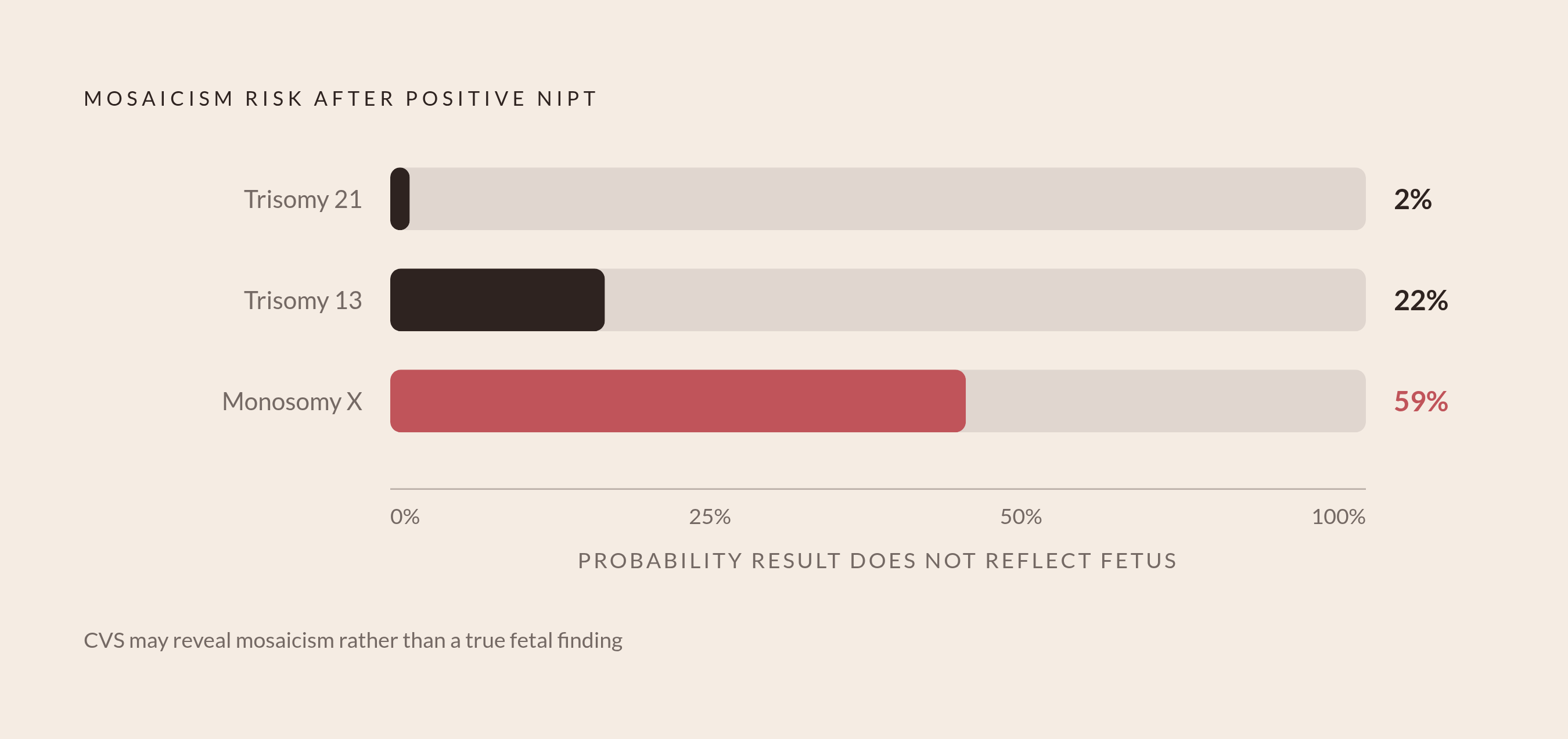
CPM is the single most common cause of false-positive NIPT results, and it drives a large share of the invasive follow-up procedures performed worldwide that end up finding nothing wrong. The risk varies sharply by condition: following a positive NIPT, the chance CVS reveals mosaicism rather than a true fetal finding runs 2% for trisomy 21, 22% for trisomy 13, and 59% for monosomy X. That last figure is why monosomy X carries a markedly poor PPV next to the core trisomies, and it's a number every clinician delivering a monosomy X positive needs to be able to explain in plain language, on the spot, not after the patient has gone home and searched it herself.
A study in AJOG Maternal-Fetal Medicine (Raymond et al.) looked at CPM prevalence specifically among false-positive cfDNA results and found pregnancies with confirmed CPM had significantly lower median birth weight percentile than matched controls, 20.1 versus 43.5 (P=0.049). CPM occurred especially often when the original NIPT flagged monosomy X or a rare autosomal trisomy. The placenta can shape fetal outcomes on its own, beyond simply relaying a signal that might occasionally be garbled. Its own abnormality can shape fetal growth even when the fetus's chromosomes are entirely normal.
Other sources of unreliable results: fetal fraction, maternal factors, and false negatives
Fetal fraction, the share of cfDNA in maternal blood that actually comes from the placenta rather than the mother, is the single most important technical variable in the whole test. Below roughly 4%, results turn unreliable enough that many labs simply refuse to report them.
That threshold carries meaning beyond lab logistics. When fetal fraction stays persistently low across a second draw, the persistence itself may carry clinical significance beyond a simple technical hiccup fixed by drawing more blood. It can be a signal in its own right. Elevated maternal BMI correlates with lower fetal fraction, and clinicians should flag this before ordering the test, not after an inconclusive result lands back on the desk.
Maternal biology adds its own noise to the sequencing signal, and it cuts in more than one direction. Maternal copy number variations can mimic a fetal finding closely enough to trigger a false positive on their own. Maternal malignancies, more rarely, shift the cfDNA profile enough to produce both false positives and false negatives, occasionally surfacing an incidental maternal cancer diagnosis through a prenatal screen nobody ordered expecting that outcome. A nine-year analysis covering 38,160 cases found increased maternal age and obesity both correlate with higher false-positive rates, with the effect sharpest for monosomy X.
Even accounting for all of that, the overall false-negative rate for the common fetal aneuploidies is around 0.65%, drawn from a mix of fetal, maternal, and placental noise. When structural rearrangements combine with dynamic mosaicism (mosaicism that shifts over the course of gestation), conventional NIPT is poorly suited to characterizing these events, since it reads copy number rather than chromosome architecture directly.
NIPT after preimplantation genetic testing: a case study in a high-stakes edge population
Patients who already went through preimplantation genetic testing (PGT) raise an unusual question. Their embryo was screened before transfer, so what does a second round of NIPT actually add, and does it risk sowing confusion into a pregnancy that already cleared one genetic hurdle?
A prospective study took this on directly. It enrolled 113 patients who underwent NIPT 2.0 after 12 weeks gestation, split across three groups: 55 who'd had PGT, 23 who conceived via IVF without PGT, and 35 spontaneous pregnancies. Of those, 56 women underwent both NIPT 2.0 and invasive prenatal testing. Concordance between the two ran 100%, and all 56 invasive results came back negative. Across the full cohort, NIPT 2.0 delivered a sensitivity of 100% and specificity of 99.3%.
For a PGT population specifically, that result answers a legitimate worry: does layering a second screen on top of embryo selection add real protective value, or does it just add noise and cost? The concordance data points toward the former, at least in this cohort. But 113 patients is a starting point for confidence, not the final word on the question, and treating it as settled science would be premature.
Counseling and confirmatory testing in the use of NIPT results
Current professional guidelines say NIPT should be offered to every pregnant patient as a screening option, regardless of risk category. It does not settle what happens after the result comes back, and it was never meant to. That gap is where counseling has to do its job, and skipping it is the single most damaging shortcut in the whole pathway.
A positive result on the standard panel (trisomy 21, 18, or 13) calls for confirmatory amniocentesis or CVS before anyone makes a management decision on the strength of it alone. That's the standard of care, not a matter open to clinical discretion, because a positive screen and a confirmed diagnosis carry two different levels of certainty.
Expanded NIPT results demand even more careful handling. Positive predictive values for microdeletions, copy number variants, and rare trisomies range from as low as 11 to 18% up to 29 to 77%, depending on the specific finding and how common the condition is in the background population. A patient hearing the word "positive" needs to understand, in plain language, that most positive results on an expanded panel won't hold up once diagnostic testing happens. Having that conversation well is the single biggest thing separating responsible use of expanded NIPT from a false sense of certainty, and it's the part of the process most likely to get rushed.
Negative results need the same careful framing, pointed the other way. They lower risk substantially. They do not erase it. A 0.65% false-negative rate for the common aneuploidies is a real number, not a rounding error, and NIPT was never built to catch every chromosomal or genetic condition a fetus could carry. Treating a negative NIPT as a clean bill of genetic health misrepresents what the test promises. Understood correctly, NIPT remains what it has been since it arrived: the most accurate non-invasive screening tool obstetrics has, provided everyone using it respects the line between screening and diagnosis and understands why that line exists.