1988 Paris Cord Blood Transplant Historical Significance
The first cord blood transplant proved a decade of laboratory theory could save a child's life.
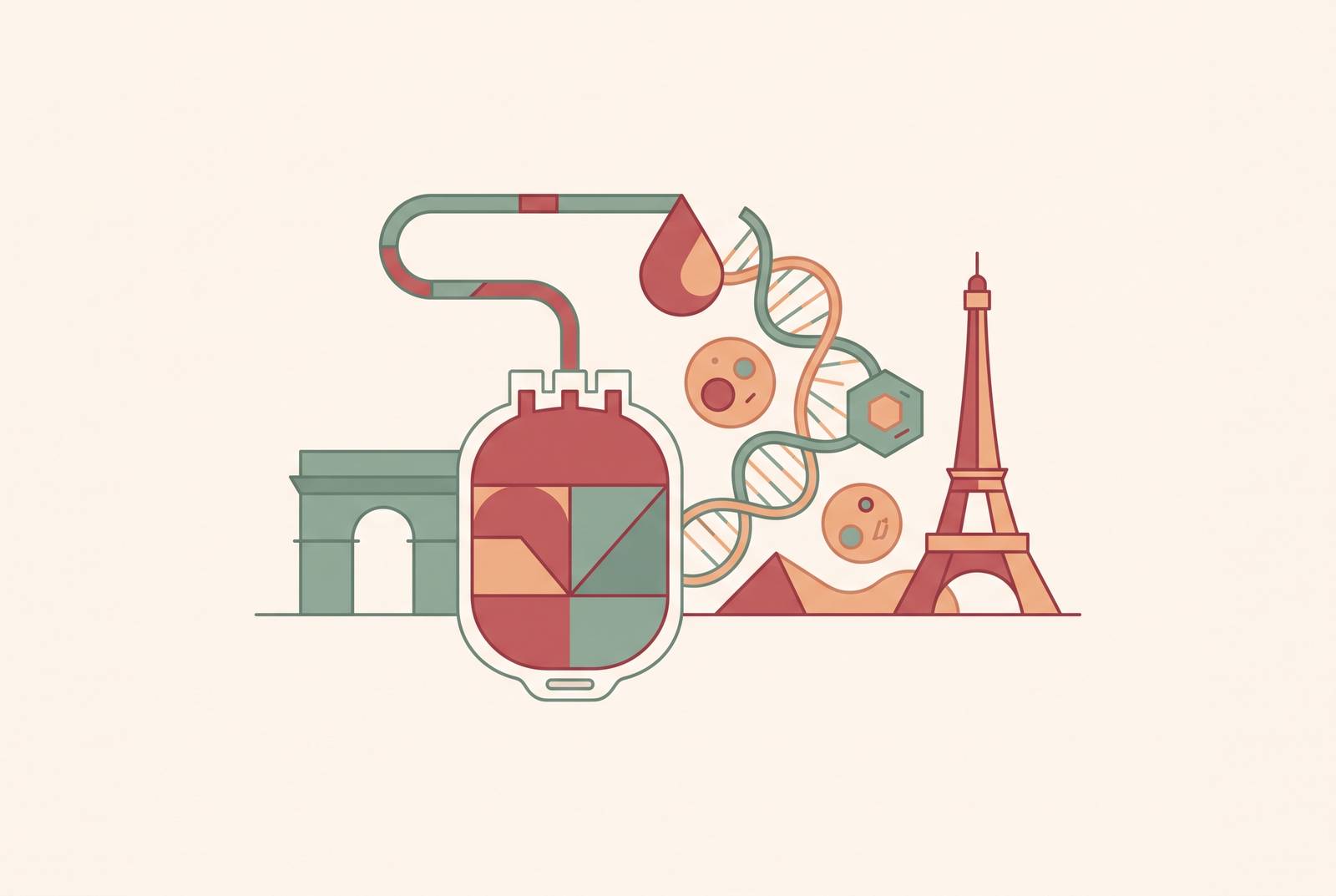
On October 6, 1988, a team of doctors in Paris did something no one had done before: they transplanted blood taken from an umbilical cord into a five-year-old boy dying of bone marrow failure. The procedure worked, and it converted a decade of contested laboratory argument into documented clinical fact. What follows traces how that single transplant happened, what it actually proved, and why the field it founded is now being asked to prove itself all over again.
A plausible moment for cord blood to move from lab to clinic
The Paris transplant was not an improvisation dreamed up in a single delivery room. It was the payoff of roughly a decade of laboratory work that most of the field regarded with skepticism. In 1982, Hal Broxmeyer and his team proposed that umbilical cord blood could serve as an alternative source of hematopoietic stem cells, a claim that drew considerable pushback from researchers who assumed bone marrow was the only serious option. By 1985, Broxmeyer had gone further than proposal: he'd confirmed that cord blood actually contained transplantable hematopoietic stem and progenitor cells, and that concentrations of some of the most proliferative progenitors were higher in cord blood than in marrow itself.
The science needed somewhere to live, so the infrastructure followed the discovery. Broxmeyer, along with Ted Boyse and Judy Bard, founded Biocyte, secured the first patent covering the freezing and banking of cord blood, and set up a proof-of-principle bank inside Broxmeyer's own laboratory at Memorial Sloan Kettering. None of this had been validated in the way medicine usually demands validation. The peer-reviewed paper that would formally demonstrate a single cord blood unit held enough stem cells for hematopoietic reconstitution, published by Broxmeyer, Douglas, and colleagues including Boyse in the Proceedings of the National Academy of Sciences, didn't appear until May 1989, analyzing over 100 samples. The clinical procedure came first; the paper proving it should have worked came after.
What made freezing cord blood viable at all was a cryopreservation method using DMSO, developed in Broxmeyer's lab, which let the cells survive long-term storage without losing function. Studies conducted years later would confirm cells could be recovered successfully after 24 years in cryopreservation. But in 1988, that durability was assumed rather than demonstrated over any comparable span.
What's missing from this list is arguably more important than what's on it. There were no animal studies underwriting the decision to try this in a human being, no preclinical model showing cord blood could reconstitute a living immune system. The in vitro assays were suggestive; the human transplant was, in a real sense, the first test at any meaningful scale.
A five-year-old boy with Fanconi anemia who became the case that forced the clinical question
The scientific groundwork needed a patient whose situation left no room for delay, and Matthew Farrow's case supplied exactly that convergence: a fatal diagnosis, no living related donor, and a sibling pregnancy that arrived at precisely the right moment. Matthew had Fanconi anemia, a genetic disease in which a mutation cripples cells' ability to repair their own DNA during division.
The standard route, a matched bone marrow donor among living relatives, simply wasn't available to him. But his mother became pregnant again, and the family tested the unborn sibling through amniocentesis. That double coincidence, healthy and matched, is what turned a hopeless case into a plausible one.
Fanconi anemia patients tolerate chemotherapy poorly, and that fragility shaped how Dr. Eliane Gluckman approached the conditioning regimen. She used low-dose cyclophosphamide paired with thoraco-abdominal irradiation, a reduced-intensity approach that departed from standard transplant conditioning protocols of the era. The design wasn't a stylistic choice. It was a constraint built directly around what Matthew's body could survive.
The donor was Matthew's newborn sister, Alison Farrow, who became, before the term even existed, the world's first savior sibling. Alison has since described that role as woven into her sense of who she is, shaped by family scrapbooks, home movies of Paris, and her parents' recollections of praying she'd turn out to be the match everyone needed. For a family with no precedent to draw on, the decision to proceed was, in her words, a complete leap of faith. When his mother became pregnant, the unborn sibling was tested via amniocentesis, and Dr. Arleen Auerbach of Rockefeller University confirmed the baby was healthy and an HLA-identical match.
Cord blood's journey from a delivery room in North Carolina to a hospital room in Paris
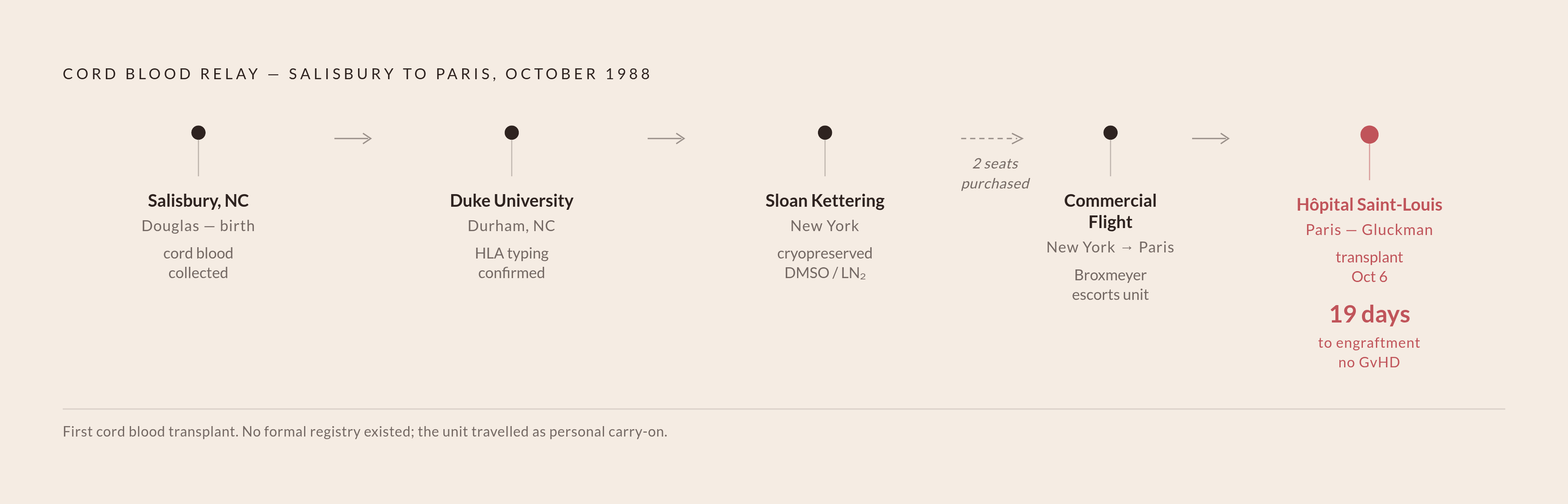
The procedure itself, performed October 6, 1988 at Hôpital Saint-Louis, required a transnational relay of institutions and individuals, and none of the people involved had a standard protocol to follow. Dr. Gordon Douglas, an obstetrician from New York Hospital, traveled to Salisbury, North Carolina, specifically to attend Alison's birth and collect her cord blood. From there the unit went to Duke University for HLA typing, then to Memorial Sloan Kettering, where it was cryopreserved in Hal Broxmeyer's own research liquid nitrogen freezer.
Getting the sample to Paris meant Broxmeyer carrying it himself, on a commercial flight, having purchased two seats: one for himself, one for the frozen cord blood. It's a detail that sounds almost comic in retrospect, but it captures how little formal infrastructure existed for something that would later become a routine, registry-coordinated shipment.
Dr. Gluckman performed the transplant in Paris without any animal-model data to fall back on. What she had was Broxmeyer's in vitro evidence and her own clinical judgment, and that had to be enough. That had to be enough, and it was. The donor cells engrafted within 19 days, and Matthew's blood and immune systems came back fully restored, with no graft-versus-host disease. GvHD is the complication that makes transplants from imperfectly matched donors so dangerous, and its complete absence here would eventually be recognized as one of cord blood's defining clinical advantages. At the time, though, it was simply what happened to one boy in one hospital room, not yet a pattern anyone could generalize from.
The 1988 result and its unresolved implications for Matthew's own fate
The transplant established that cord blood could rebuild a human blood and immune system from scratch, but it did not resolve everything about what that meant. It did not cure Fanconi anemia. That distinction matters, both for understanding Matthew's own medical story and for understanding what a cord blood transplant is actually capable of doing. Matthew achieved complete hematologic and immunologic reconstitution from his sister's cells, full stop.
The nuance that keeps this from becoming a simple success story is genetic. FA patients who've been transplanted remain at meaningfully higher risk of cancer than the general population, and many die relatively young, because a transplant replaces the blood-forming system without touching the underlying mutation, which persists in every other cell in the body. Gluckman and Broxmeyer's accomplishment stands on its own. It's a precise description of what a hematopoietic transplant does and doesn't reach.
None of that undercut how the result read to the field at the time. Engraftment without GvHD and full reconstitution in a case with no controls and no precedent registered immediately as proof of principle, whatever its limitations as a single uncontrolled case. That's really the crux of the whole story. One patient, one outcome, and it was enough to change how an entire discipline thought about where transplantable stem cells could come from. He is alive and, as of the interview published in 2015, was 32 years old, married, and a father; by the time of the MiracleCord article published in July 2023, he is described as healthy and living a normal life as a father, with his son Elijah.
The infrastructure the field built on the proof that 1988 provided
Once the proof existed, the field moved fast to build on it, because public banking, unrelated-donor transplantation, and international registries all needed exactly the kind of precedent the 1988 result had just supplied. In 1991, Rubinstein and colleagues established the first unrelated donor cord blood bank. Two years later came the moment that really proved cord blood could scale beyond families: Dr. Joanne Kurtzberg at Duke performed the first unrelated-donor cord blood transplant, on a four-year-old named Mitch Santa who had treatment-resistant T-cell acute lymphoblastic leukemia. The unit came from the New York Blood Center's National Cord Blood Program, established the year before, and it matched at only 4 of 6 HLA loci. In a bone marrow transplant, that kind of mismatch would typically trigger severe GvHD. It didn't here, and that outcome told the field something Matthew's case alone couldn't: cord blood's tolerance for imperfect matching wasn't a fluke.
Gluckman built the outcomes infrastructure to match. In 1995 she created the Eurocord registry to track cord transplant results internationally, starting in Europe and expanding to centers worldwide, eventually generating published analyses covering thousands of cases. Public banking formalized in 1992, and Bioinformant figures put hundreds of thousands of units now sitting in public banks globally. Private banking scaled even further in parallel, with more than 8.1 million units stored privately worldwide by the same count. Springer Nature figures put tens of thousands of cord blood transplants performed globally.
The scale of it stops you. Cord blood went from medical waste, routinely discarded after birth, to a globally managed graft source with its own banking systems, its own registries, its own transplant protocols. Companies that bank cord blood and placentas, recognizing cord blood's life-saving potential in empowering birth, are part of this broader infrastructure that traces its legitimacy directly to the 1988 proof of principle.
Cord blood transplantation's more contested position despite the growth numbers
Despite all of that infrastructure, annual cord blood transplant volumes have fallen from their peak, and the reason has nothing to do with 1988 being wrong. It has to do with a rival approach, haplo-identical transplantation, eating into cord blood's core advantage for the patients who have living relatives available to donate. Cord blood's pitch was always twofold: it's available without needing a living matched donor, and it carries a lower risk of GvHD than bone marrow does. Those remain real advantages. They're just no longer the only game in town.
A landmark trial, BMT CTN 1101, published in Blood in 2021, found no statistically significant difference in two-year progression-free survival between cord blood and haploidentical bone marrow, though secondary endpoint analyses including overall survival favored haploidentical bone marrow donors. Its secondary endpoints, including overall survival, tilted toward haploidentical donors. It's a quiet result. It's a quiet one, and quiet results are often the ones that move clinical practice the most, because they remove the urgency to reach for the harder-to-source option.
The numbers bear this out. WMDA figures show annual cord blood transplant counts falling sharply between 2012 and 2018, and a number of public banks have since scaled back collection quietly, managing existing inventory rather than expanding it. The real objection to cord blood here is logistical and economic. For any patient who happens to have a living relative, a haplo-identical transplant is almost always available, engrafts faster, and keeps getting safer, making the objection logistical and economic. What happened in 1988 stands. It means the field that transplant founded has kept moving, and cord blood's position within it has shifted accordingly.
Cord blood's expanding value beyond its original transplant application
Falling transplant volume leaves what 1988 proved intact. It reflects a field maturing past its founding application, redirecting the same core insight, that cord blood is packed with clinically potent biological material, toward targets nobody was thinking about in 1988. Cord blood and cord tissue both carry additional progenitor cells and growth factors that make them useful starting material for a widening set of biotherapies that have nothing to do with reconstituting a blood system, a point a February 2026 paper frames as the field's actual next frontier.
Regenerative applications are already underway in cerebral palsy and Type 1 diabetes, and double cord transplants have solved a real technical limitation, letting adult patients receive cord blood grafts they couldn't have used before because a single unit didn't carry enough cells for someone their size. None of this works without the cryopreservation infrastructure that transplantation medicine built decades ago and that studies have since validated out to 24 years of storage. Those existing banks are now positioned as ready-made suppliers for cellular therapy pipelines that didn't exist when the banks themselves were founded. The market reflects that shift: the cord blood banking sector has grown substantially, and Bioinformant and CB Insights figures project it to keep expanding through the next decade, driven less by transplant volume and more by the sheer range of new applications opening up. Companies banking cord blood and placental tissue, built around the idea of giving families a way to hold onto something valuable from birth, sit right at that frontier, collecting material whose full therapeutic range the field is still mapping out.
The line from that October morning in Paris to all of this is a straight one. Broxmeyer's original insight was never really about transplantation specifically; transplantation just happened to be the first application rigorous enough to prove the underlying claim correct. Decades on, researchers are still working out what else the cord blood taken from Alison Farrow that day was capable of showing them.
Sources
- History of the clinical use of umbilical cord blood hematopoietic cells - PubMed
- Umbilical cord blood transplantation: the first 20 years - PubMed
- Interview with Matt Farrow, Recipient of World's 1st Cord Blood Transplant
- First Cord Blood Stem Cell Transplant Donor Shares Her Story
- A History of Cord Blood Banking and Transplantation
- The History of Cord Blood Transplantation
- Catching up with Matt Farrow in 2023
- Profile of a Pioneer: Eliane Gluckman - Transplantation and Cellular Therapy, Official Publication of the American Society for Transplantation and Cellular Therapy