Cord Blood Banking Limitations for Autologous Use in Pediatric Cancer
Banked cord blood cannot treat the leukemia mutations that originated before birth.
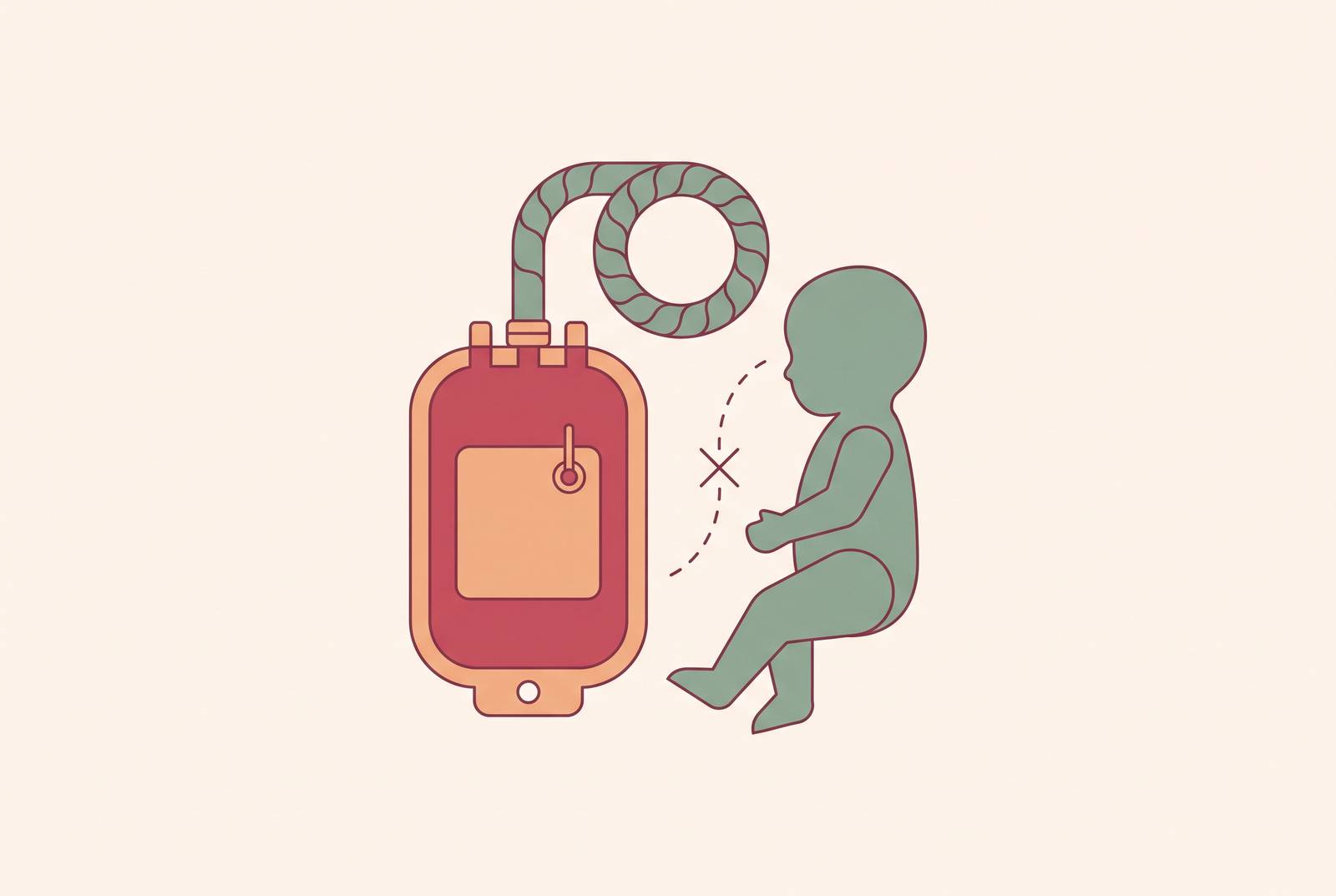
Most childhood leukemia does not begin the day a child gets sick. It begins months earlier, in the womb, in the blood-forming stem cells of a developing fetus. That timing is the whole reason autologous cord blood banking runs into trouble for cancer treatment, before getting into the clinical fine print. Professor Mel Greaves and colleagues laid out the evidence in 1998, using a study design that is hard to argue with: identical twins. When both twins in a pair developed childhood cancer, researchers found the exact same genetic mutations in both of them, even in cases where one twin got sick years before the other. That gap in timing matters. It means the mutation was not triggered by something that happened after birth, an infection, an environmental exposure, bad luck in a particular cell. It was already there, shared identically between two people, laid down before either one drew a breath.
A 2018 study went further and named the mechanism. That is a fairly dry way of describing something significant: the cell's own repair machinery makes a mistake while the fetus is still developing, and that mistake gets copied into every descendant of that cell going forward. The child is born already carrying a clone of cells with the fusion gene sitting inside them, quiet, not yet causing disease, but present.
This is not a fringe finding. It is the accepted model for how the two most common forms of childhood leukemia, acute lymphoblastic leukemia and acute myeloid leukemia, actually develop. The first hit happens in utero. A second, postnatal mutation is usually needed to push the preleukemic clone into full-blown disease, which is part of why not every child carrying one of these fusion genes at birth goes on to develop leukemia. But the initiating lesion, the one that defines the disease at the genetic level, is already present in cord blood at the moment it's collected. Bank that blood, and you've banked the mutation right along with it.
What "autologous use is contraindicated" means in clinical practice
Clinical language tends to flatten a point like this into something bureaucratic-sounding, "autologous use is contraindicated." In plain terms it means: don't give this child their own banked cord blood to treat their own leukemia, because the cord blood already has the leukemia's genetic fingerprint in it.
Ohio State Wexner Medical Center frames the same idea from a slightly different angle, one that's useful for understanding why this isn't a matter of tissue rejection or compatibility. Autologous cord blood is, immunologically speaking, a perfect match. It's the child's own tissue. But perfect compatibility is not the same as therapeutic value, and Wexner's explanation is direct: that tissue is usually not appropriate for rebuilding a leukemia patient's bone marrow, because the cells being infused can carry the same disease you're trying to cure. You'd be replacing damaged marrow with cells that already hold the seed of the same damage.
UnitedHealthcare Community Plan's coverage policy makes the point from the insurance side, which tends to be blunter than the clinical literature. It states outright that most of the conditions a patient might hope to treat with their own banked cord blood already exist in that patient's own cells, so the stored blood cannot treat the very illness it was meant to insure against. That's a policy document, not a research paper, but it reflects the same underlying biology every other source describes.
The place this disqualification bites hardest is acute leukemia, because it is the most common cancer in children and a leading cause of death for kids under fifteen. A family banking cord blood at birth is, whether they realize it or not, often banking it against the single disease category where that banked unit is least likely to help.
The low baseline probability of any autologous cord blood use, leukemia aside
Set leukemia aside for a moment and ask a simpler question: across a person's whole life, how likely is it that they'll ever need their own banked cord blood for anything? ACOG puts the lifetime probability of developing any indication for autologous transplant somewhere between 1 in 400 and 1 in 2,500. That's already a wide spread, and it's already a low number on the high end of the range.
WebMD cites an even wider estimate, 1 in 400 to 1 in 200,000. A range that wide isn't a rounding error or a matter of one source being more precise than another. It signals that nobody has pinned this down with any real confidence, and that the honest answer to "what are the odds my child ever uses this" is closer to "nobody really knows, but it's rare" than to any specific figure a bank might print on a brochure. UnitedHealthcare's policy language backs this up from the payer side, noting that the odds of a stored unit ever getting used, by the child or a family member, are remote unless someone in the family already has a diagnosed condition that cord blood could treat.
Now layer the leukemia finding on top of that. Leukemia is the largest single pediatric indication that cord blood transplant might otherwise address, and it's also the indication where the child's own unit is, by definition, unusable. Removing it from consideration means whatever slice of that already-thin probability leukemia represented disappears from the numerator. The remaining pool of scenarios where a child's own stored unit could conceivably help them gets smaller still, built almost entirely around non-malignant conditions where the child's own genetics aren't the problem.
A second biological constraint: the fixed, limited cell dose in any single cord blood unit
Even setting the genetic issue aside, cord blood runs into a second wall that has nothing to do with disease origin and everything to do with volume. A single collection yields a fixed number of stem cells, and that number cannot be topped up later. Cord blood grafts typically carry only about 5 to 10 percent of the cell counts available from a peripheral blood or bone marrow harvest https://cdn.clinicaltrials.gov/large-docs/27/NCT00864227/Prot_SAP_ICF_001.pdf. Bone marrow and peripheral blood can be harvested in larger quantities, sometimes on more than one occasion. Cord blood gets one shot, at birth, and whatever comes out of the umbilical cord and placenta at that moment is all there will ever be.
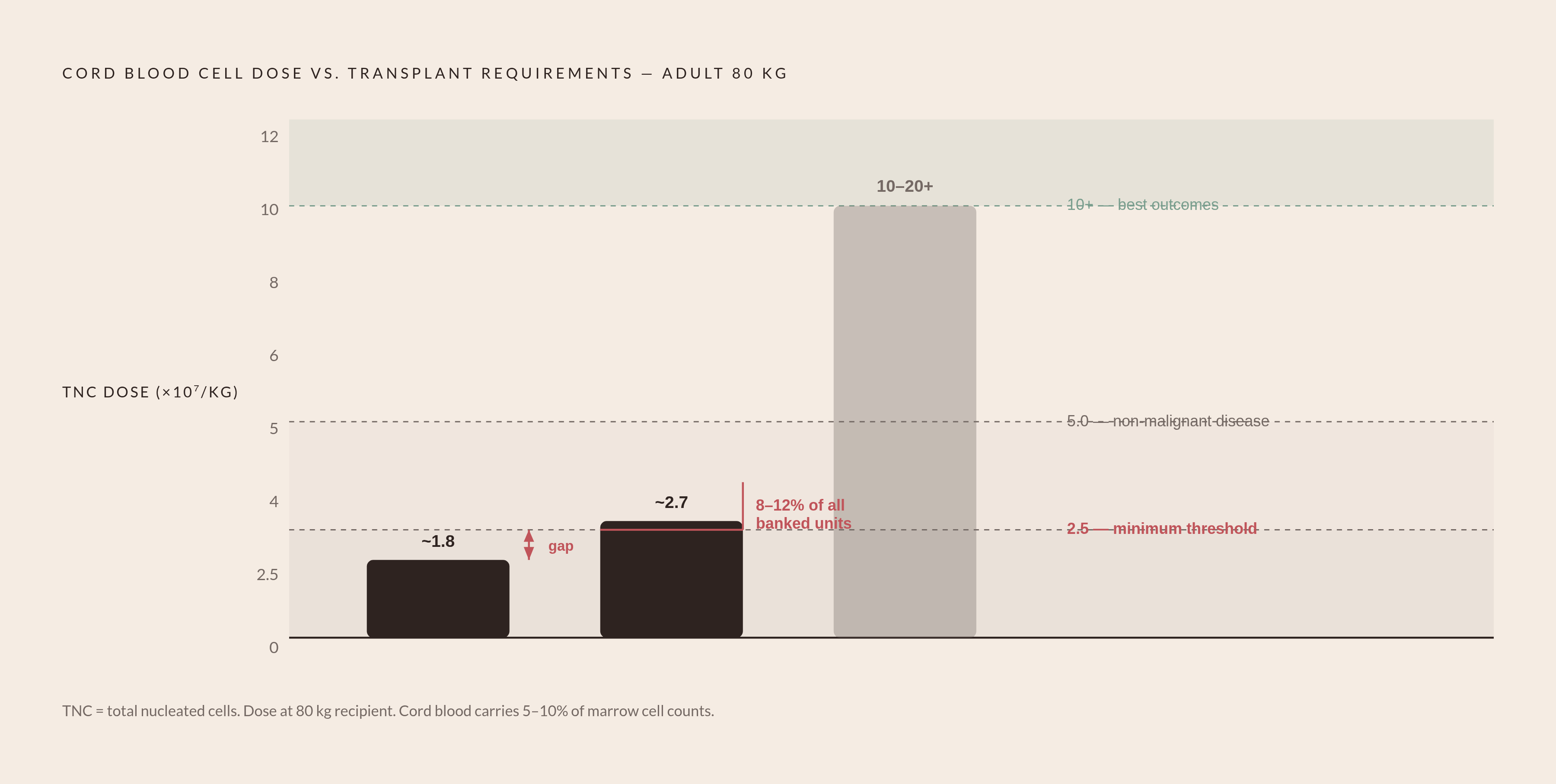
The unit itself is small to begin with. The average cord blood collection yields less than half a pint, a hard physical ceiling set by the size of a newborn's placenta and cord, not by the skill of whoever's collecting it https://www.acco.org/cord-blood-transplantation/. Transplant protocols generally require a minimum total nucleated cell dose around 2.5 × 10⁷ cells per kilogram of the recipient's body weight, with some protocols also requiring a minimum CD34+ stem cell dose of 1.5 × 10⁵ per kilogram https://cdn.clinicaltrials.gov/large-docs/27/NCT00864227/Prot_SAP_ICF_001.pdf https://cdn.clinicaltrials.gov/large-docs/70/NCT04083170/Prot_SAP_001.pdf. Do the math on an adult-sized recipient, and a lot of single cord blood units simply don't clear the bar.
Weight matters more than most people banking cord blood for "future use" tend to appreciate. Outcome data for HLA-mismatched cord blood transplants backs this up with real numbers: the best results come from grafts with a median TNC dose above 10 × 10⁷ per kilogram, while units under 2.5 × 10⁷ per kilogram, or under 1.7 × 10⁵ CD34+ cells per kilogram, are associated with worse outcomes https://www.ncbi.nlm.nih.gov/pmc/articles/PMC4675847/. For non-malignant diagnoses, current guidance from NMDP and CIBMTR pushes for even higher doses, 5 × 10⁷ per kilogram or more https://network.nmdp.org/training-education/catalog/donor-and-cord-blood-unit-selection-guidelines. A single banked unit is a fixed quantity working against a recipient's body weight that only grows over time.
Ex vivo expansion (the most promising technical fix) and its unavailability to privately banked units
Researchers have spent years working on the obvious fix: if a unit doesn't have enough cells, grow more from what's there. Ex vivo expansion techniques, cytokines, small molecules, epigenetic modulators, culture systems built to mimic the bone marrow environment, and newer gene-editing approaches, have all been developed to multiply hematopoietic stem and progenitor cells outside the body before they're transplanted.
This isn't theoretical anymore. Patients who received the expanded product recovered neutrophils, the white blood cells that fight infection, in a median of 12 days, compared to 22 days for the control group https://www.americordblood.com/articles/cord-blood-expansion-why-babys-stem-cells-can-treat-adults. That's roughly a third fewer days spent in a hospital bed for a leukemia patient, which is a meaningful outcome by any measure.
This technology isn't available to anyone holding a privately banked unit. Expansion protocols like the one behind Omisirge have been developed and validated within the allogeneic and public banking pipeline, where units are processed, tested, and prepared under specific manufacturing and regulatory conditions built for that purpose. A cord blood unit sitting in a private freezer, banked years ago against the small chance a family might someday need it, cannot simply be pulled out and run through an expansion protocol built for a different pipeline. The technical solution to the cell-dose limitation exists. It just doesn't reach into the private autologous model, at least not as things currently stand. The dose limitation described above is not something a family can expect future science to quietly fix for the unit they've already paid to store.
What cryopreservation data shows about long-term viability
Whatever else is true about autologous limits and cell dose, the cells that do get frozen tend to survive the freezer remarkably well, for a remarkably long time. Data from the José Carreras Cord Blood Bank in Düsseldorf gives some of the longest tracked numbers available anywhere. The longest expiration times determined to date are 29 years for unseparated units, 25 years for manual volume-reduced units, and 18 years for automated volume-reduced units licensed by the Paul-Ehrlich Institute https://academic.oup.com/stcltm/article/13/1/30/7344334.
A separate study in Vox Sanguinis, examining 726 cord blood units collected and tested between May 2006 and June 2023, adds a more granular picture https://pmc.ncbi.nlm.nih.gov/articles/PMC13453912/. Mean post-thaw viability came in at 60.5 percent for CD45+ cells, the broader white blood cell population, but 91.2 percent for CD34+ cells https://pmc.ncbi.nlm.nih.gov/articles/PMC13453912/. CD34+ is the marker that identifies the stem cells actually responsible for rebuilding a blood system after transplant, so the fact that this specific population held up so well post-thaw is the more clinically relevant number in that dataset.
Not every dataset agrees. A separate body of research found declining TNC recovery, declining CD34+ counts, and declining viability in units stored for 11 to 19 years in vapor-phase liquid nitrogen. The difference likely comes down to processing and storage method, liquid-phase versus vapor-phase nitrogen, manual versus automated volume reduction, and standards that vary from one bank to another. The honest summary is that viability depends heavily on how a given bank processes and stores its units." It's that viability depends heavily on how a given bank processes and stores its units, and that long-term data, while encouraging in several major studies, isn't uniform enough yet to make blanket promises about any one unit decades out.
The allogeneic evidence base in pediatric oncology
None of this amounts to an argument against cord blood transplantation as a treatment. It's an argument against the autologous model specifically, for cancer specifically. The allogeneic case, where cord blood comes from a donor rather than the patient, is a genuinely different story, and a much better-established one.
Since the first successful cord blood transplant in 1988, more than 35,000 procedures have been carried out in children and adults, treating blood cancers, inborn metabolic disorders, and genetic blood and immune conditions https://www.acog.org/clinical/clinical-guidance/committee-opinion/articles/2019/03/umbilical-cord-blood-banking. The researchers were careful to note that heterogeneity across earlier studies leaves some uncertainty in how strong that effect really is, a caveat that belongs in any honest read of the evidence.
Survival numbers in pediatric transplant more broadly are in the 60 to 70 percent range for overall survival in recent studies, and for children treated for non-malignant diseases specifically, survival is even higher, around 70 to 80 percent https://www.ovid.com/jnls/annals-of-medicine-and-surgery/fulltext/10.1097/ms9.0000000000003823 https://www.acco.org/cord-blood-transplantation/. Cord blood also carries some practical advantages over bone marrow or peripheral blood as a donor source: it tolerates a greater degree of HLA mismatch between donor and recipient, it's associated with a lower rate of acute graft-versus-host disease, and because it comes from banked units rather than living donors, it's available faster when a patient needs it urgently. Children who receive a matched sibling cord blood transplant see less than a 10 percent chance of developing graft-versus-host disease at all https://www.acco.org/cord-blood-transplantation/. None of this rehabilitates the autologous case for leukemia. It does explain why cord blood banking, as an institution, keeps expanding, just mostly on the public and donor side of the ledger rather than the private one.
Major medical bodies' guidance on the conversation between clinicians and parents
Every major professional body that has weighed in lands in roughly the same place, and the consistency itself is the finding. ACOG's position runs parallel: routine collection and storage through a private bank isn't backed by the available evidence, and private banking is worth considering only in the narrow case where a family already has an identified medical condition that cord blood transplant could address.
UnitedHealthcare's Community Plan policy language draws the same line from a coverage standpoint, describing prophylactic collection and storage for a currently healthy person, with no specified future use in mind, as unproven and not medically necessary. That's a payer's way of saying what the clinical bodies are also saying: banking cord blood on the speculative chance that a healthy child might someday need it doesn't hold up as sound medical practice, whatever its appeal as an act of parental precaution.
None of this means cord blood banking lacks value. It means the value sits almost entirely on the public and donor side, and in the narrow set of family cases where a specific, identified condition already exists. For parents weighing a private banking service against that backdrop, the conversation to have with a physician isn't whether cord blood transplantation works, the allogeneic evidence answers that clearly enough. It's whether the specific scenario being sold, a child's own unit treating that child's own future cancer, describes something biology actually allows. For the leukemias that make up the largest share of childhood cancer, it does not. ACOG, AAP, and ASBMT align in that none advocates private storage without an identified need in the family. Only 8–12% of umbilical cord blood units have sufficient cell volume for transplant to a person weighing 80 kg https://www.acog.org/clinical/clinical-guidance/committee-opinion/articles/2019/03/umbilical-cord-blood-banking. The estimated lifetime probability of an individual developing an indication for autologous umbilical cord blood transplant ranges from 1 in 400 to 1 in 2,500 https://www.acog.org/clinical/clinical-guidance/committee-opinion/articles/2019/03/umbilical-cord-blood-banking. The chance that a child will use their cord blood over their lifetime ranges from 1 in 400 to 1 in 200,000 https://www.webmd.com/baby/should-you-bank-your-babys-cord-blood. Unseparated cord blood units showed a mean total nucleated cell (TNC) viability of 88.91 ± 5.01% after 29 years of cryopreservation https://pmc.ncbi.nlm.nih.gov/articles/PMC10785215/. Manual volume-reduced cord blood units showed a mean TNC viability of 84.22 ± 10.02% after 25 years of cryopreservation https://pmc.ncbi.nlm.nih.gov/articles/PMC10785215/. Automated volume-reduced cord blood units showed a mean TNC viability of 88.64 ± 3.91% after 18 years of cryopreservation https://pmc.ncbi.nlm.nih.gov/articles/PMC10785215/. A 2025 CIBMTR analysis reviewed 1,148 patients aged ≤18 years with acute myeloid leukemia (AML) https://pmc.ncbi.nlm.nih.gov/articles/PMC13036625/. The control median hospital stay before omidubicel (NiCord) treatment was 61 days https://www.americordblood.com/articles/cord-blood-expansion-why-babys-stem-cells-can-treat-adults. Omidubicel (NiCord) shortened hospital stays to 48 days https://www.americordblood.com/articles/cord-blood-expansion-why-babys-stem-cells-can-treat-adults.