Why a Single Cord Blood Unit Often Can't Treat an Adult
Adult patients need 12 times more stem cells than a typical cord blood unit provides.
The median cord blood collection yields roughly 60 milliliters. From that volume, a typical unit contains a median of approximately 470 million total nucleated cells (TNC) and about 1.8 million CD34+ cells, the surface-marker-defined progenitor population most closely associated with engraftment potential. True HSCs, the long-term repopulating cells, are rarer still, comprising somewhere between 0.02% and 1.43% of the total cell population depending on the unit and the assay used. Each figure represents a distinct biological reality. Conflating them is one of the more persistent sources of confusion in public discussion of cord blood, and it costs clarity the field can ill afford.
Public cord blood banks apply a quality threshold to every collection. Units falling below roughly one billion TNC are generally not retained for transplant; they are redirected to research or discarded. That floor exists for sound clinical reasons, but it also reveals a structural irony: even the units that clear the minimum standard were sized, biologically, for a child. Guidance for single-unit adult grafts includes a minimum of 150,000 CD34+ cells per kilogram of recipient body weight, a threshold distinct from, and additive to, the TNC requirement. Meeting both simultaneously from a single collection for an adult recipient is the constraint the field has been working against for decades, and it shapes every clinical decision that follows.
How the NEJM's Landmark Leukemia Study Put a Number on the Shortfall
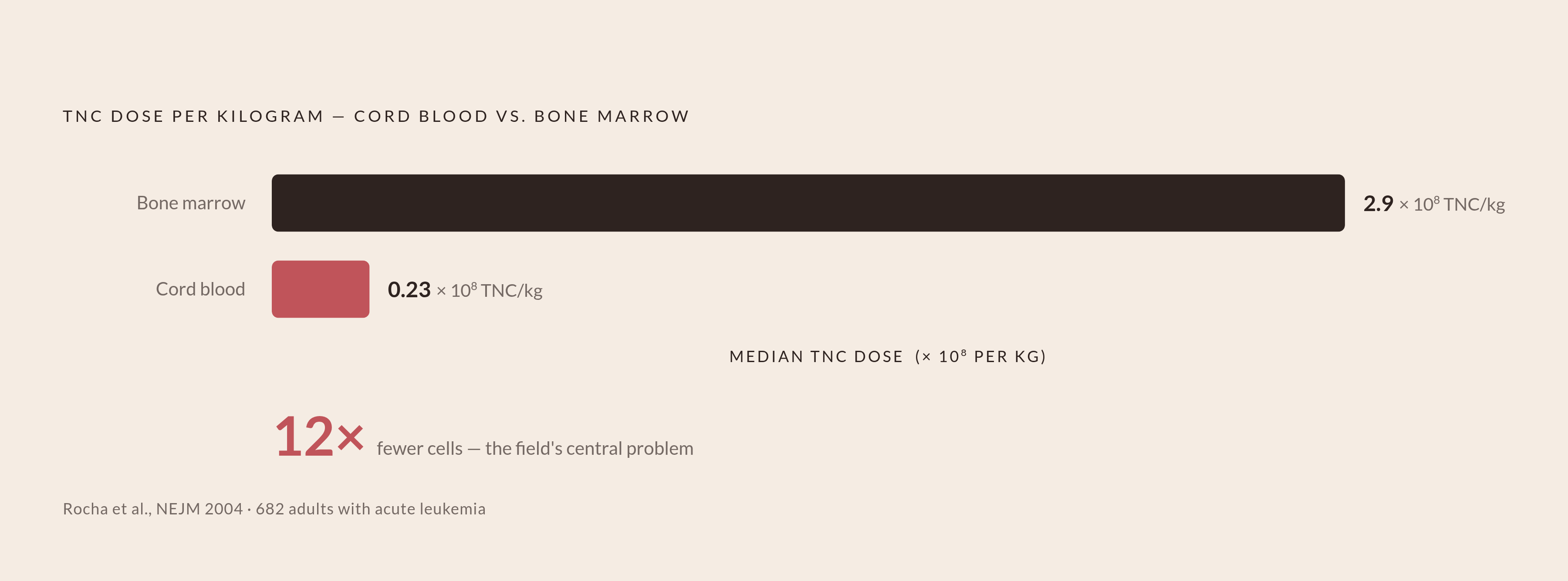
The 2004 study published in the New England Journal of Medicine examined 682 adults with acute leukemia, comparing outcomes in cord blood recipients against those who received bone marrow transplants. The numbers it produced were not subtle.
Cord blood recipients received a median TNC dose of 0.23 × 10^8 cells per kilogram. Bone marrow recipients received 2.9 × 10^8 cells per kilogram, a roughly twelvefold difference. The study identified low HSC count per unit as an explicit limiting factor in patient outcomes, naming the problem with quantitative precision at a moment when the field needed exactly that kind of clarity. Every protocol refinement, every combination strategy, every expansion platform that followed is, in a real sense, a response to this specific arithmetic. The study didn't open a debate. It closed one.
The Clinical Consequences When the Dose Falls Short
An insufficient cell dose can prevent transplantation entirely. When it proceeds despite marginal dosing, the downstream risks are well characterized: delayed engraftment, outright graft failure, elevated transplant-related mortality.
The CD34+ cell count is a particularly sharp predictor. Published data show transplant-related mortality approximating 20% in recipients who received above-threshold CD34+ doses, compared with 75% in those who didn't. The problem compounds at the point of infusion, where TNC recovery after cryopreservation and thaw ranges from only 50% to 80%, meaning the already-limited cell supply shrinks before a single cell reaches the patient. Neutrophil, red cell, and platelet recovery is slower in cord blood recipients than in bone marrow recipients as a direct consequence of lower stem cell input, and immune reconstitution lags accordingly. A 2022 retrospective study found that absolute lymphocyte count at 60 days post-transplant was significantly associated with overall mortality, with a hazard ratio of 0.24.
Slow engraftment prolongs the immunocompromised window, and that window creates the conditions for infection and organ failure. This pattern appears repeatedly across independent cohorts. It's not a statistical artifact of any single study.
Combining Two Units to Clear the Dose Threshold Adults Require
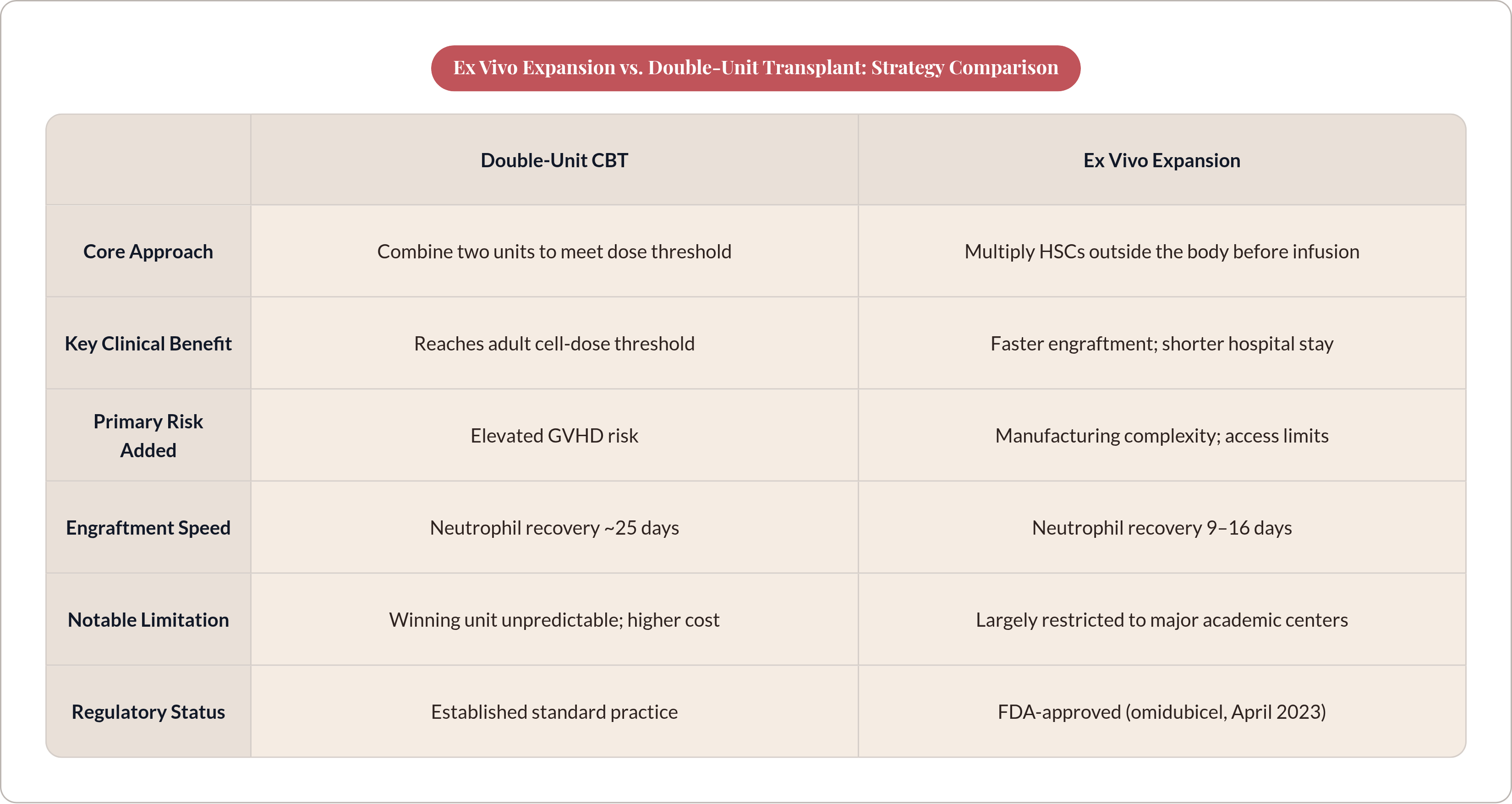
The University of Minnesota pioneered double-unit cord blood transplantation (DUCBT) as a direct response to the dose problem. If one unit can't supply enough cells, two combined can reach the necessary threshold for adult engraftment, and DUCBT has since become standard practice at many major transplant centers for adults who lack a single adequately dosed unit.
One of the more clinically striking features of DUCBT is what researchers call the "winning unit" phenomenon. In the vast majority of double-unit transplants, only one unit establishes durable hematopoiesis. The other is rejected, apparently eliminated by CD8+ T cells from the dominant unit in a form of allograft competition. The identity of the winning unit can't be reliably predicted in advance. Clinicians are, in effect, running a competition they can't stage. A 2022 Japanese retrospective study of 112 patients with a median age of 35 years found median neutrophil recovery of 25 days and platelet recovery of 34 days with DUCBT, improved relative to many single-unit outcomes but still slower than bone marrow benchmarks.
DUCBT carries increased risk of graft-versus-host disease (GVHD) relative to single-unit transplantation, and its cost is substantially higher, placing it out of reach in many health systems. Some studies have reported comparable overall survival between single- and double-unit approaches. DUCBT confers no benefit over a single unit when that unit already carries an adequate cell dose. It's a compensation strategy, not an inherently superior approach, and that distinction matters when institutions are making resource allocation decisions.
Growing More Cells in the Lab Before Transplant
Ex vivo expansion addresses the dose problem from a different angle entirely. Rather than combining units, the goal is to multiply HSC numbers outside the body while preserving their capacity to engraft. That second part is the technical crux, and it's where the field spent decades failing before it started succeeding. Cells that proliferate without retaining self-renewal capacity are not useful; they are expensive debris. The difficulty was never making cells divide. It was keeping them capable of becoming something permanent once they reached a patient.
Researchers have developed multiple biological levers to accomplish this. Cytokine cocktails combining stem cell factor (SCF), thrombopoietin (TPO), and FLT3 ligand provide proliferative signals. Small molecules including UM171, SR-1 (StemRegenin-1), and nicotinamide modulate signaling pathways that would otherwise push progenitors toward differentiation rather than self-renewal. Notch pathway activation, mesenchymal stem cell co-culture systems, and bioreactor platforms each add distinct mechanistic approaches to the same core problem.
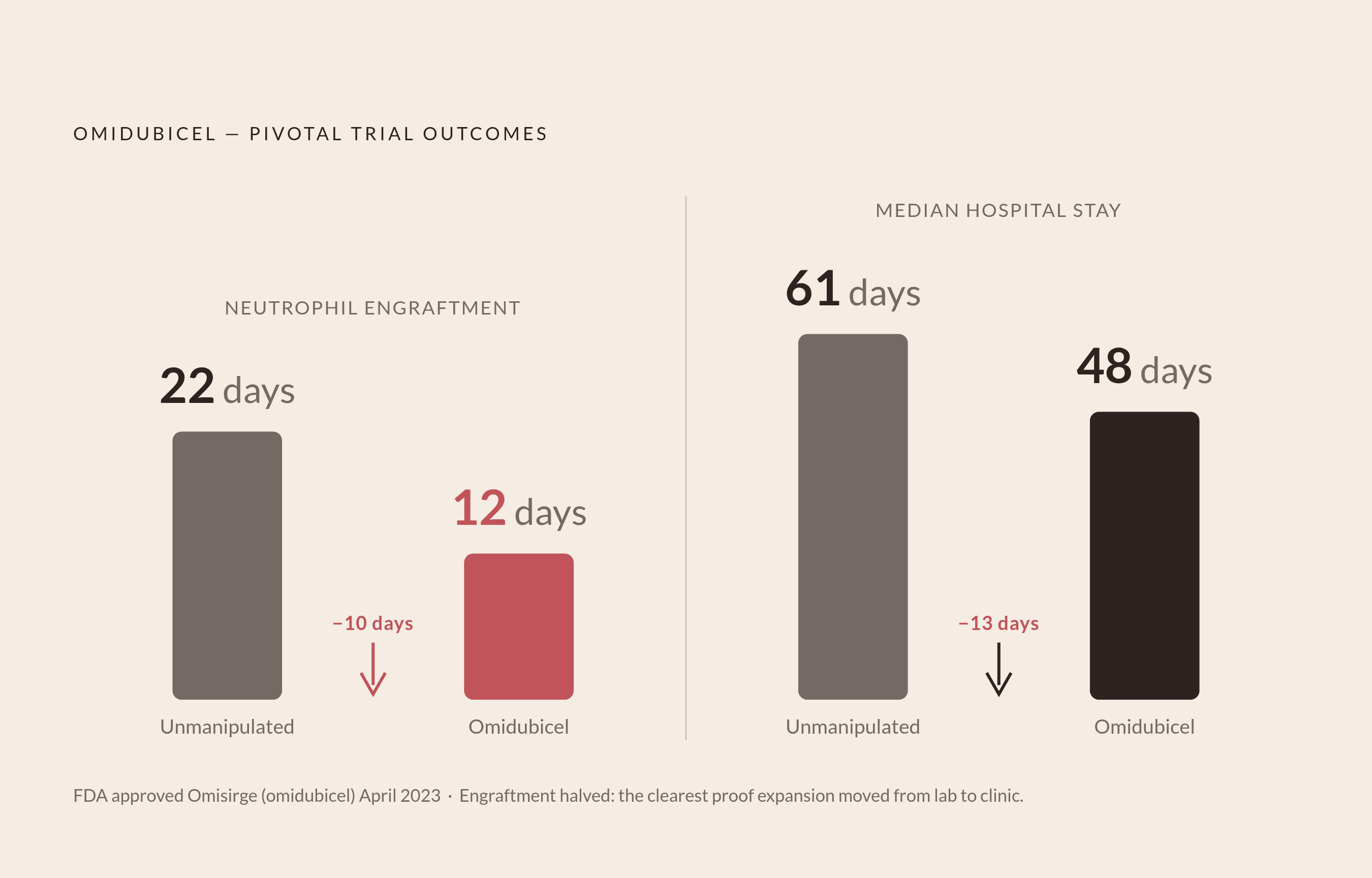
The clinical results from expanded products have been meaningful. Expanded cord blood products, including NiCord and Zemcelpro, have cut neutrophil recovery to between 9 and 16 days and improved one-year survival rates by 15 to 25 percentage points compared with unmanipulated units, according to a January 2026 review in Stem Cell Reviews and Reports. The FDA's April 2023 approval of omidubicel (Omisirge) was the most significant regulatory milestone in this space. Omidubicel is indicated for adults and pediatric patients 12 years and older with hematologic malignancies receiving cord blood after myeloablative conditioning. In its pivotal trial, omidubicel cut median time to neutrophil engraftment from 22 days to 12 days and reduced median hospital stay from 61 days to 48 days. Real-world evidence published in Blood Advances in 2023 for UM171-expanded transplants showed improved outcomes relative to other graft sources. By mid-2024, 36 clinical trials were underway using expanded cord blood for indications extending into neurological, autoimmune, and tissue-injury conditions.
What Remains Unresolved and Why Cord Blood Banking Still Matters
Neither DUCBT nor ex vivo expansion resolves the underlying constraints cleanly. DUCBT adds GVHD risk and cost. Ex vivo expansion adds manufacturing complexity and its own cost burden, with access outside major academic transplant centers still limited. HLA matching complexity remains an unresolved variable; larger studies with more granular typing are still needed before the interaction between HLA disparity and cell dose in adult outcomes can be characterized with precision. The winning-unit phenomenon in DUCBT remains mechanistically opaque, and understanding it will eventually allow clinicians to design two-unit grafts with deliberate intent, but the tools to do that reliably don't yet exist.
None of this diminishes the foundational importance of collecting and banking cord blood at birth. Every expansion protocol, every double-unit combination strategy, every clinical trial for neurological or autoimmune indications begins with a unit collected at the moment of delivery. Higher-volume collections and better collection technique determine directly how many options a patient will have years or decades later. The collection window doesn't reopen.
It's worth sitting with that last point. A unit stored in 2005 is being evaluated in 2024 trials for indications that didn't exist as clinical concepts when it was drawn. The catalog of validated uses has never been fixed. Conditions now being studied with expanded cord blood were not on anyone's clinical radar when most currently banked units were collected. What a stored unit is worth has consistently expanded over time, and there's no credible reason to expect that trajectory to reverse.