HLA Matching Thresholds for Cord Blood vs Bone Marrow Transplants
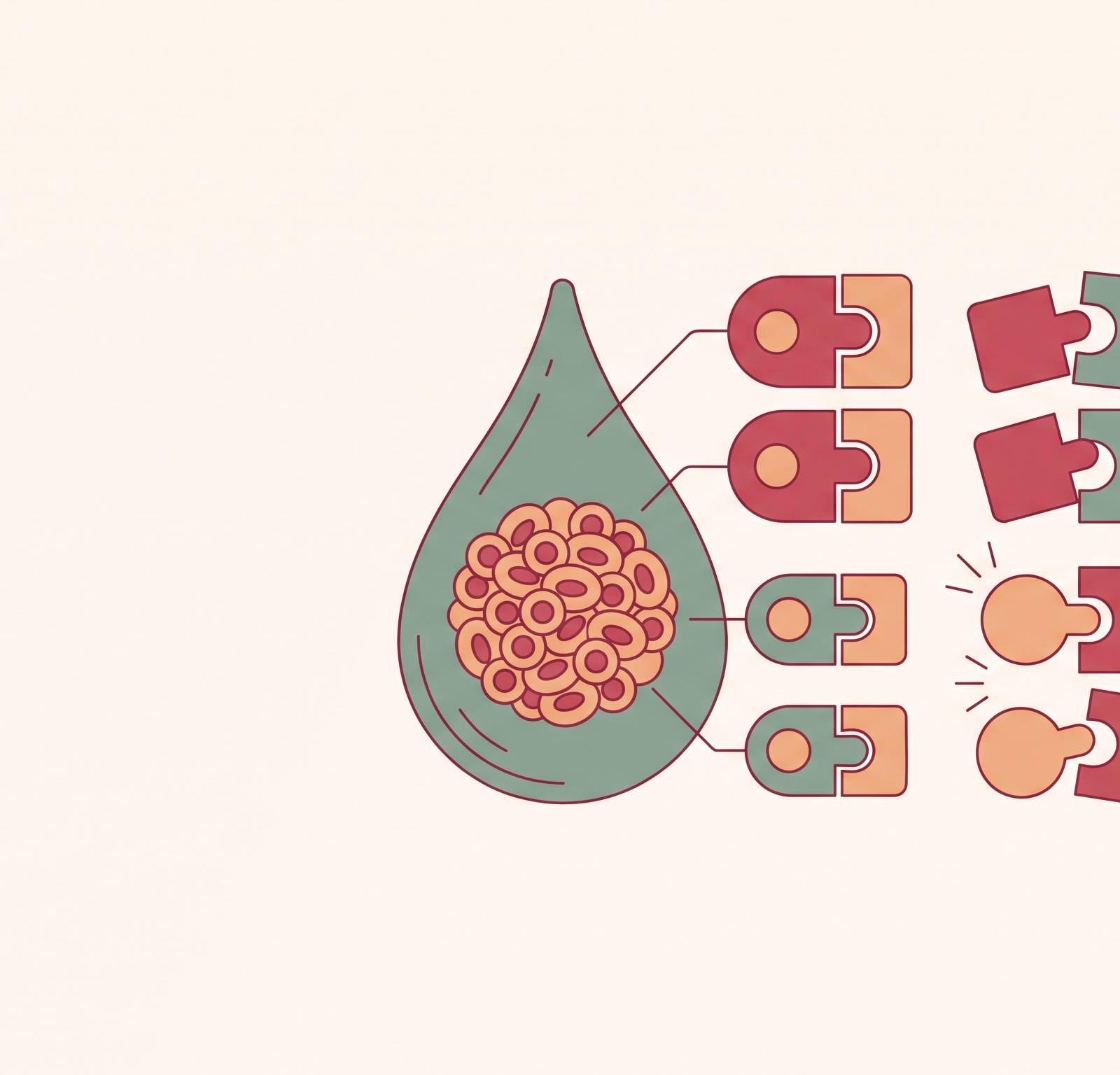
HLA proteins sit on the surface of nearly every nucleated cell in the body. The immune system reads them continuously, using them to distinguish self from non-self. In transplantation, a mismatch at any of these positions means that donor immune cells will interpret recipient tissue as foreign, triggering graft-versus-host disease (GvHD). The inverse risk also applies — recipient immune cells reject the incoming graft entirely. Better matching reduces both axes of risk, though the two don't trade off symmetrically across graft sources.
The core framework for unrelated bone marrow donors covers HLA-A, -B, -C, and -DRB1, four loci with two alleles each, yielding an eight-point matching scale. Clinical guidelines recommend a fully matched unrelated donor at this eight-locus level. In practice, a ten-locus standard adding DQB1 is increasingly preferred, because each additional locus provides additional discriminating information. HLA-C was incorporated into the standard framework relatively recently, after registry evidence demonstrated its independent effect on survival. Its addition wasn't a paradigm shift so much as a belated accounting — the cost of a C mismatch had been systematically underestimated for years.
HLA-DPB1 occupies an instructive edge position. It's not routinely included in the primary matching algorithm, yet a substantial proportion of unrelated donor transplants cross a DPB1 mismatch. The field addressed this by classifying DPB1 mismatches as permissive or non-permissive based on T-cell epitope group analysis, rather than ignoring the locus. Non-permissive mismatches are associated with higher overall mortality, and clinical guidance now recommends avoiding them when the rest of the match profile is clean. When registry science accumulates sufficient evidence that a locus carries independent prognostic weight, the matching framework absorbs it. DPB1 is the clearest demonstration of that process.
Next-generation sequencing is accelerating the whole trajectory. Ultra-high-resolution typing that resolves the full gene sequence is moving from research settings into clinical practice. Each additional mismatch carries a measurable cost, the resolution at which that cost is measured keeps improving, and the standard tightens in response. That has been the consistent direction for two decades.
Why Cord Blood Operates Under a Different Matching Logic
The central biological fact is that cord blood T-cells are immunologically naïve in a way that adult donor T-cells aren't. Neonatal T-cells have had no opportunity to encounter foreign antigens and mount memory responses. They're structurally less primed to recognize allogeneic tissue as a target and respond with the aggressive alloreactive expansion that drives severe GvHD. This is an intrinsic property of neonatal immune cells, not a clinical workaround or a convenient reframe.
Children who receive sibling cord blood transplants develop GvHD at substantially lower rates than those receiving sibling bone marrow, and the difference is attributed to immunological immaturity rather than to differences in match grade. The immunobiological starting point is simply different. Because cord blood T-cells are less likely to mount a destructive alloreactive response at a given mismatch level, the transplant community can accept a higher degree of HLA divergence without incurring equivalent clinical cost. That permissiveness is a calibration to a different immune context. It reflects what the biology actually is.
The Cord Blood Minimum Threshold and What It Actually Measures
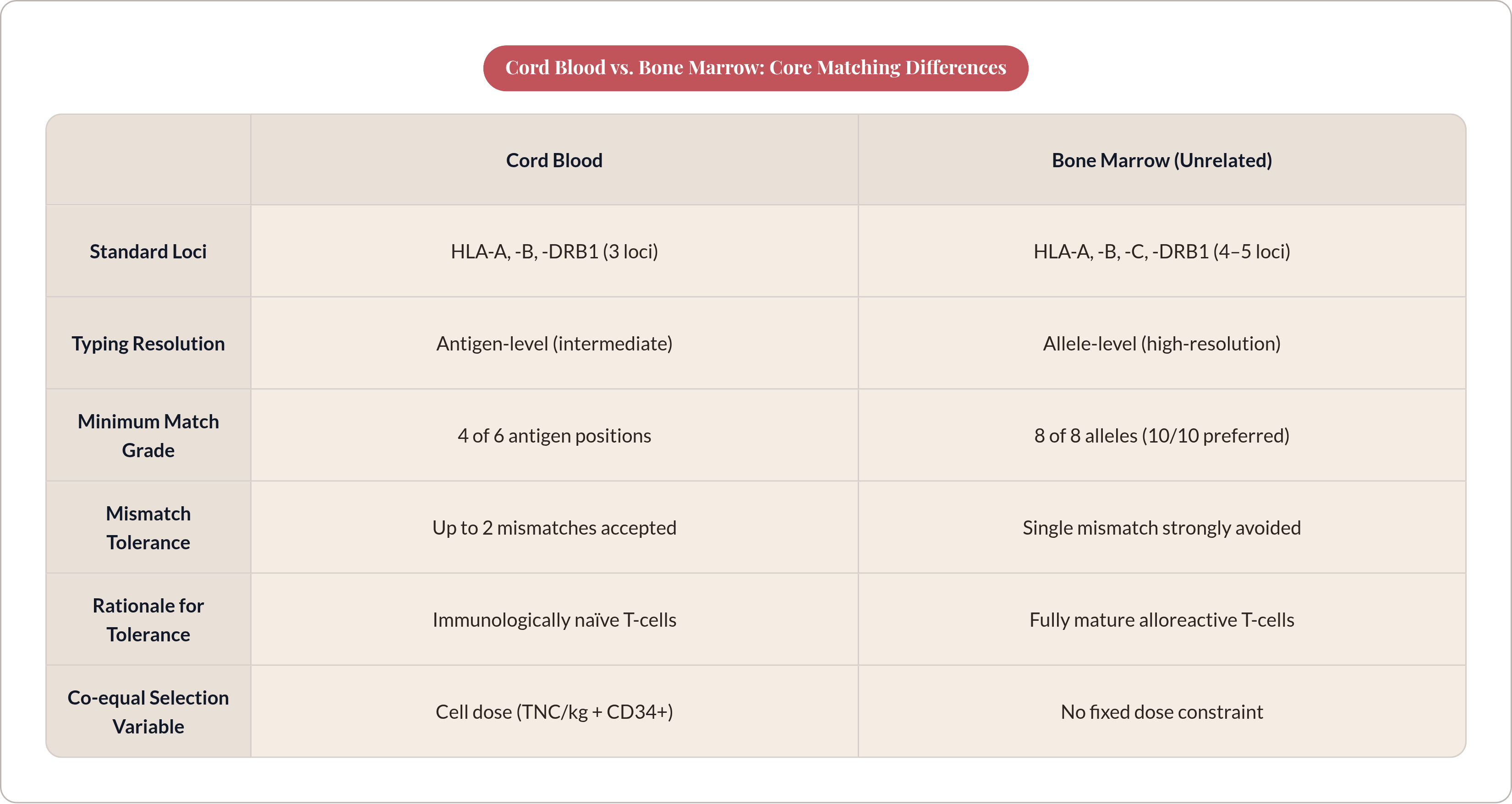
The established minimum for cord blood transplantation is a match at four of six antigen positions across HLA-A, -B, and -DRB1, meaning up to two mismatches are acceptable. The contrast with bone marrow operates at two independent levels. First, the cord blood minimum spans three loci rather than four. Second, it uses antigen-level, or intermediate-resolution, typing rather than the high-resolution allele-level typing that bone marrow standards require. Both differences matter. Fewer loci means less total genetic information is captured in the matching decision. Lower typing resolution means genuine allele-level differences, differences that still drive rejection or GvHD, remain invisible to the algorithm.
Recent guidelines have begun pushing toward eight-locus, high-resolution typing for cord blood unit selection, adding HLA-C to the framework. This mirrors exactly the trajectory bone marrow standards followed when registry data on HLA-C accumulated. The field is tightening the cord blood standard for the same reason it tightened bone marrow.
For any given patient, a cord blood unit selected under the traditional four-of-six standard harbors mismatches at loci the standard doesn't measure. This is clinically acceptable because the immunological immaturity of cord blood T-cells buffers the impact of those mismatches to a degree. Those mismatches still carry an effect; accepting the minimum is simply not the same as eliminating the risk. The floor isn't the target.
Cell Dose as a Co-Equal Variable Alongside HLA Match in Cord Blood Selection
A bone marrow donor is a living person who can be asked to mobilize and donate additional cells if needed. A cord blood unit is fixed at the moment of collection. What was banked is all there is. That constraint elevates cell dose to a co-equal selection variable alongside HLA match, and clinical guidelines treat it as such explicitly.
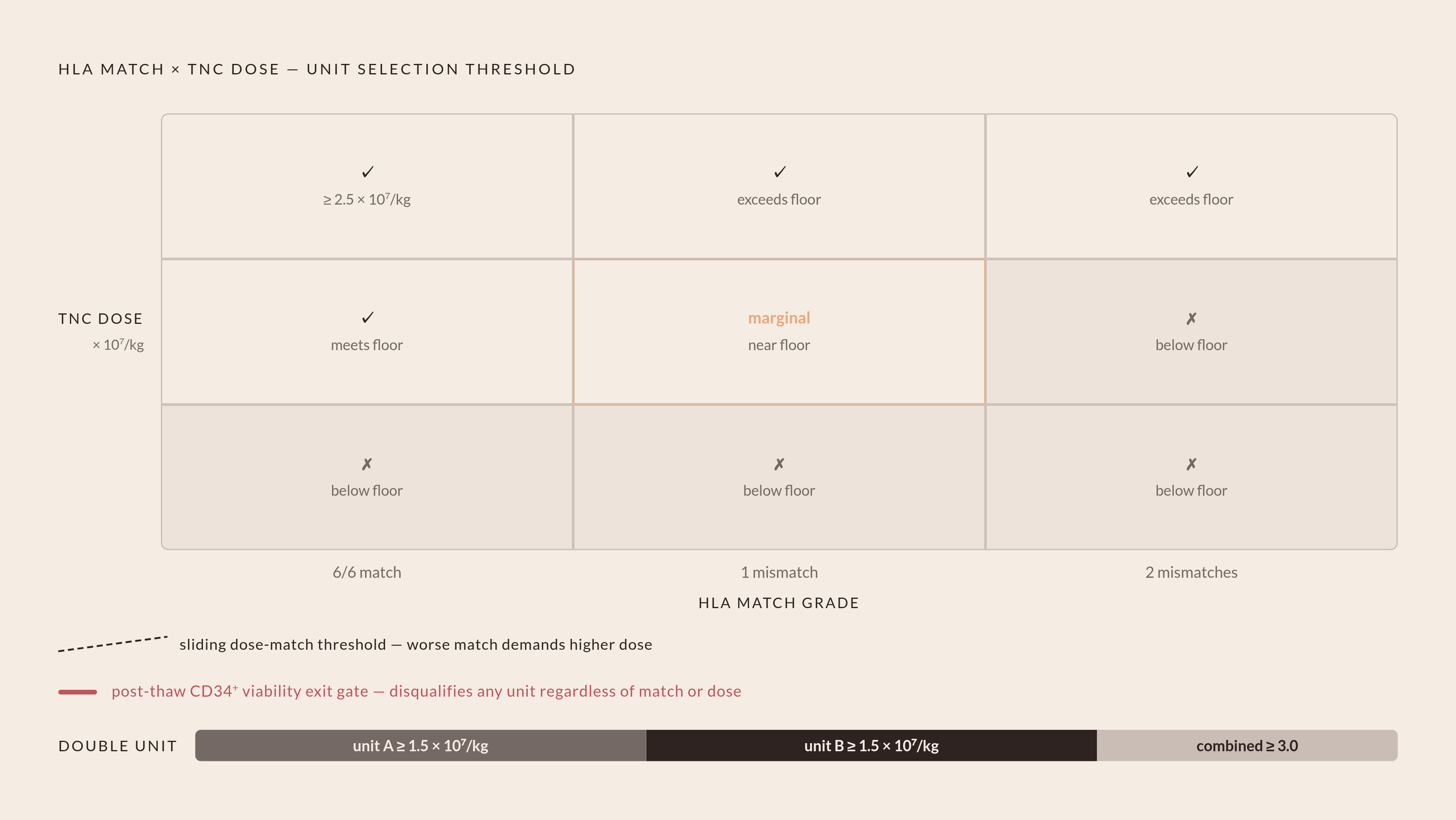
Total nucleated cell count per kilogram of recipient body weight is the primary dose metric. CD34+ cell count, which measures the engraftment-capable fraction of the unit, functions as a secondary indicator. The interaction between match grade and required cell dose is codified — a better-matched unit qualifies at a lower total nucleated cell floor, while a unit with one or two mismatches must meet a higher threshold to compensate. A unit that meets the match requirement but falls short on cell dose is inadequate. A unit with adequate cell dose but an insufficient match grade is similarly disqualifying. The two criteria are jointly necessary, not separately sufficient.
CD34+ viability at thaw introduces a third variable with no analogue in freshly harvested marrow. Units with poor post-thaw viability engraft at very low rates regardless of match grade or nominal cell dose; viability failure is effectively disqualifying. When a single unit can't meet the cell dose requirement for a given match grade, two units are combined in a double cord blood transplant, with their own combined dose floor and per-unit minimums. The logistics are considerably more complex, and the biology of unit-unit interaction within the recipient isn't fully characterized. Reducing cord blood unit selection to HLA match alone misrepresents how the field actually operates.
Which Loci Carry the Most Weight Within Cord Blood's Looser Framework
Accepting a higher degree of mismatch than bone marrow standards permit doesn't mean all mismatches are equivalent within the cord blood framework. Evidence on locus-specific effects has accumulated, and two loci have emerged with particular clinical significance.
HLA-DRB1 carries the greatest impact. A large Japanese registry study of adult cord blood recipients found that single and double DRB1 mismatches were each independently associated with higher rates of grade II through IV acute GvHD, with risk increasing in proportion to mismatch burden. Double DRB1 mismatch was also associated with higher non-relapse mortality. The same analysis found that double DRB1 mismatch correlated with lower relapse risk, a tension addressed at greater length in the final section.
HLA-B supertype mismatch has emerged as a second locus-specific concern. A 2024 study published in Bone Marrow Transplantation found that mismatch at the HLA-B supertype level was an independent poor prognostic factor for progression-free survival in single cord blood transplant recipients, significant after accounting for allelic mismatches and other established covariates. The pattern is analogous to what the bone marrow field experienced when registry data on HLA-C accumulated — a locus whose cost was underweighted by the prevailing framework eventually accumulated enough evidence to demand explicit attention.
A match at four of six is the minimum, not the aspiration. Where unit inventory allows, clinicians should prefer better-matched units and attend specifically to DRB1 and HLA-B supertype compatibility, even within a framework that formally tolerates their mismatch.
Where Engraftment Differs Between Cord Blood and Bone Marrow, and Why the Gap Has Narrowed
Bone marrow transplants achieve neutrophil recovery typically within two to three weeks post-infusion. That timeline shortens the window of profound immune vulnerability, during which patients are at highest risk of lethal infection. Cord blood engraftment is slower. That delay has been understood and accepted as the cost of the immunological and access benefits cord blood offers. The consequences are real.
Cell dose above a meaningful total nucleated cell per kilogram threshold substantially improves cord blood engraftment rates. The dose-match interaction described in selection guidelines has a direct and measurable engraftment payoff. A fully matched cord blood unit at adequate cell dose approaches bone marrow engraftment rates, though the gap doesn't fully close. Post-thaw CD34+ viability is the variable that can collapse outcomes entirely; units with poor viability engraft at very low rates regardless of all other selection parameters, and freshly harvested bone marrow carries no equivalent liability.
Double cord blood transplants were developed in part to address the cell dose constraint, and they've partially succeeded. They introduce their own complexity, particularly around unit competition within the recipient and the eventual dominance of a single unit in long-term engraftment.
Why Cord Blood's Permissive Matching Matters Most for Patients Who Can't Find a Bone Marrow Match
The probability of identifying a fully matched unrelated bone marrow donor varies dramatically by ancestry. Patients of European descent have meaningfully higher odds of finding an eight-of-eight match in existing registries than patients of African, Hispanic, or Asian descent. The disparity is structural. HLA haplotype diversity is higher in non-European populations, which means that even a large registry contains fewer people whose HLA profile will match a given patient from those groups. Registry composition has historically skewed toward European donors, compounding the underlying diversity problem.
For patients who can't identify an eight-of-eight or ten-of-ten bone marrow match, cord blood's tolerance for mismatch is what makes transplantation accessible at all. A banked unit with an acceptable match grade and adequate cell dose can be identified and released on a compressed timeline, which matters considerably for patients with aggressive disease who can't wait months for a donor search to conclude.
This access function is the strongest clinical argument for cord blood's distinct matching framework. It serves a patient population that the bone marrow standard structurally underserves, not because the bone marrow standard is wrong, but because the biology of HLA diversity and the sociology of registry composition create a gap that cord blood's permissive threshold can partially fill.
How Haploidentical Transplants with Post-Transplant Cyclophosphamide Changed Cord Blood's Competitive Position
A haploidentical donor, typically a first-degree relative, shares exactly half the patient's HLA loci by definition. The availability of such donors is near-universal — most patients have at least one parent, sibling, or child who qualifies. Until recently, the immune barrier of a half-match was prohibitive. Severe GvHD rates were high enough that haploidentical transplantation was reserved for cases where no better option existed.
Post-transplant cyclophosphamide changed the calculus. Administered in the days immediately after transplant, it selectively depletes the alloreactive T-cells most likely to cause severe GvHD while sparing the regulatory and memory T-cells that support immune reconstitution. The selectivity of the mechanism is what makes it effective.
Registry data and prospective trial data both demonstrate that haploidentical transplants with post-transplant cyclophosphamide now achieve outcomes competitive with cord blood. The BMT CTN-1101 trial found lower two-year overall survival after cord blood compared to haploidentical transplants, a landmark result that accelerated a utilization shift already underway. Updated NMDP and CIBMTR guidelines issued in 2025 now recommend that clinicians consider haploidentical and mismatched unrelated donors early in the search process, a formal recognition that the evidentiary landscape has shifted. Cord blood use has declined year-over-year in U.S. and European registry data; haploidentical use has grown steadily across the same period.
Cord blood's permissive HLA threshold carried particular value because it solved a specific problem — the absence of a matched donor. Haploidentical transplantation with post-transplant cyclophosphamide solves the same problem through a different biological mechanism and, in recent data, with improving outcomes. The two approaches aren't interchangeable at the level of biology or logistics, but they compete for the same patient population.
What Remains Unresolved: The Graft-versus-Leukemia Question in Mismatched Cord Blood
The GvL paradox has never been cleanly resolved in cord blood transplantation, and I'm not sure the field is close to resolving it. If HLA mismatch drives immune activation in the graft, then strategic mismatch suppresses relapse, because the same immune pressure that risks GvHD also kills residual leukemic cells. This isn't a hypothetical; it shows up in actual registry findings.
The Japanese registry analysis of double DRB1 mismatch found lower relapse risk alongside higher GvHD rates and higher non-relapse mortality. The opposing forces are real and simultaneous. Earlier analyses of double cord blood transplants suggested that a higher degree of allele-level mismatch reduces relapse of acute leukemia without worsening overall outcomes, a signal strong enough to generate sustained research interest.
A 2025 study from Fred Hutchinson Cancer Center, published in Transplantation and Cellular Therapy, contested this directly, finding no association between losing-unit HLA interactions and relapse reduction in a reasonably sized cohort. The conflicting evidence doesn't reconcile cleanly. Separately, experimental cellular products such as dilanubicel, a non-HLA-matched pooled cord blood-derived product under investigation as of a 2024 abstract in Blood, raise a different order of question — whether HLA matching in cord blood matters at all if the product is engineered to circumvent the need for it. That question is premature to answer, but it is being asked with increasing seriousness.
What the field is actually sitting with is whether the permissive matching threshold should be calibrated differently for patients with high relapse risk versus low relapse risk, and whether any degree of deliberate mismatch confers net benefit rather than merely acceptable risk. The matching thresholds that appear settled at the level of clinical guidelines are still being actively interrogated at the level of registry science. Follow the guidelines. Know that the evidence base beneath them is still being written.