cord blood banking payment plans compared: monthly installments vs. upfront pricing across major banks
Most cord blood banks hide their true first-year costs in separate line items.

Cord blood banking prices look simple on a company's homepage and turn confusing the moment you try to compare two banks side by side. Every bank splits the cost into the same rough pieces (a collection kit, a processing fee, and annual storage), but each names and bundles them differently, so a "starting at" number on one site might exclude fees another site folds in upfront. Distrust any headline price that doesn't already include the first year of storage. That's where the real gap between banks shows up, and it's the gap most families never actually check before signing.
Most banks charge in three layers. There's the collection kit, usually $100 to $300, the box and materials sent to the hospital. Then there's processing, the one-time lab fee for isolating and preparing the stem cells for storage. Then there's annual storage, a recurring charge that continues for as long as the family keeps the unit banked. A quoted "processing fee" on its own doesn't tell you what the first year actually costs. You need the kit, the processing, and the first year of storage together to know what a family is signing up to pay before the baby arrives, and any comparison that stops short of that sum isn't a comparison, it's a partial number dressed up as one.
Scope adds another layer. Cord blood alone is the base case. Cord blood plus cord tissue costs more, and cord blood plus cord tissue plus placental tissue costs more still, since each is a separate product with its own processing fee and its own storage line. At the high end, first-year costs run $2,000 to $3,500 before storage even renews, with annual fees afterward landing somewhere between $200 and $300.
Timing matters just as much as amount, maybe more. Some banks bill the full fee at enrollment, months before delivery. Others don't charge anything until the cord blood is received and accepted at the lab, which decides whether a family pays during the uncertainty of the second trimester or only once the baby has actually arrived. The rest of this piece works through six banks' actual numbers to settle the question that matters most: does paying more upfront save money over the life of a storage plan, and what does an installment plan really cost once the finance charges get counted instead of skimmed past.
CBR: the widest range of plan structures, from $52 a month to $11,385 paid once
CBR calls itself the largest private newborn stem cell bank in the world, and its pricing structure reflects a company built to serve buyers across a wide income range. As of 2025, per CBR's own published figures, the annual storage plan runs $1,795 in initial fees plus $400 a year afterward. An 18-year prepaid plan costs $7,385 total with no annual fees. A lifetime prepaid plan runs $11,385, also with no recurring charges.
CBR markets the lifetime option as a 69% savings against paying annually. That math only holds if storage rates never rise and the family keeps the unit banked for decades, which is a large assumption to build a purchase around, and it doesn't survive contact with CBR's own record. A source from August 2023 noted CBR had raised its storage fee three times in five years. A savings projection built on a rate the company itself hasn't held steady is a guess dressed up as arithmetic. It's a marketing number wearing a discount's clothing.
For families who can't manage a lump sum, CBR offers a monthly plan starting at $52 a month for initial fees, plus a separate $200 annual storage charge. A sliding scale stretches that initial payment across six months, one year, or four years, and the first payment isn't due until after the baby is born. CBR also runs a gift registry, letting relatives contribute toward initial fees the way they might contribute toward a crib, plus a referral program where referred families get a discount and the referring family saves on their plan.
ViaCord: lower processing entry point, guaranteed storage rates, and a no-charge-until-delivery policy
ViaCord is the second-largest cord blood bank in a major national market, with more than 500,000 units stored, and now operates as a wholly owned brand of Revvity, the renamed successor company to PerkinElmer.
Cord blood-only processing runs $750, not including the first year of storage, and annual storage from year two runs $185. Add cord tissue and processing rises to $1,365, with year-two-and-beyond storage at $370. Per Parents Guide to Cord Blood, the actual first-year total, once storage is folded in, comes to $895 for cord blood alone and $1,695 for cord blood plus tissue: numbers that undercut most of CBR's comparable tiers.
Installment plans break the cord blood-only option into six payments of $159.17 or twelve payments of $84.59. The combined cord blood and tissue plan runs six payments of $292.50 or twelve payments of $151.25. No payment is due until delivery.
Two structural details set ViaCord apart, and both matter more than any sticker price. Storage fees are guaranteed not to change for five years, a direct hedge against the kind of repeated rate hikes CBR has already gone through. And families who prepay 20 or 25 years of storage and then retrieve the unit early get reimbursed for the unused portion, which cuts the risk of locking into a long prepaid term. Both the rate guarantee and the reimbursement policy address risks that any long-term prepayment carries, and that combination is a meaningful argument for choosing ViaCord over a lower headline number elsewhere.
Americord: 0% interest installments, placental tissue banking, and a September 2026 multi-service promotion
Americord's processing fee for cord blood alone runs $599, undercutting many competitors on the headline number, and nothing is charged at enrollment. Families are billed only after the baby is born and the collection is confirmed viable, with the remaining balance due after the baby is born.
Annual storage has to be paid in a single sum; there's no financing option for that plan. The Essential Family Plan, covering cord blood only with 30-year storage, totals $3,868.85: a $280 nonrefundable deposit due immediately, then $149 a month for 24 months at 0% interest, starting after birth. The lifetime version of that same plan, covering 78 years of storage, totals $6,068.85, with the same $280 deposit followed by $241 a month for 24 months, also at 0% interest. Multi-service plans covering cord blood, cord tissue, and placental tissue start at $3,499 for cord blood and tissue combined, with placental tissue plans starting at $3,999.
The 0% interest term is the detail worth sitting with, because financed purchases almost always carry some interest cost. A 24-month plan with no APR is a structurally different offer than a plan that looks cheaper per month but tacks on a finance charge, and the contrast becomes concrete when a bank publishes its full APR and finance charges alongside the monthly figure.
Americord is running a promotion in September 2026: 20% off multi-service 30-year plans and 35% off multi-service lifetime plans, valid for orders placed between September 1 and September 30, 2026, before 11:59 p.m. Eastern Time. Annual plans, shipping fees, and kit costs sit outside the discount, and it can't be combined with other offers or applied retroactively. Families with a due date inside 48 hours can pay $189 for rush shipping, while standard shipping runs $81 and covers both the outbound kit and the return trip to the lab.
Americord backs its service with a $110,000 quality guarantee and holds FDA registration, AABB certification, and AATB compliance. All plans include what the company calls CryoMaxx processing, marketed as a method for getting more stem cells out of the collected sample. Buried in Americord's own FAQ is an admission that annual storage rates can rise over time, which is the exact opposite of ViaCord's five-year rate guarantee and worth weighing seriously against the appeal of 0% financing. On the payment side, HSA and FSA funds can sometimes cover cord blood banking when it's deemed medically necessary; per Americord's own reimbursement guidance, 2026 HSA contribution limits sit at $4,400 for individuals and $8,750 for families.
Cryo-Cell, the oldest private cord blood bank, is offering a September 2026 discount along with a best-price guarantee.
Cryo-Cell was founded in 1989 and describes itself as the world's first private cord blood bank, with more than 500,000 parents across 87 countries having stored a unit there. That history comes with an unusual amount of promotional structure layered on top of a baseline list price, and the promotional layer is the part worth reading closely before trusting any single number on the page.
Running a September 2026 promotion under the code SEPT26, standard cord blood on the annual plan lists at $1,685, discounted by $800 to $885, with 12-month financing available at $84 a month. Premium cord blood on the same annual plan lists at $2,035, discounted to $1,235, or $113 a month over 12 months. Standard cord blood plus tissue lists at $2,840, discounted to $1,635 ($146 a month), and premium cord blood plus tissue lists at $3,190, discounted to $1,985 ($175 a month). Annual storage on top of any of these runs $199 for cord blood alone or $398 for cord blood plus tissue, billed each year on the child's birthday.
The 18-year prepaid plan follows the same discount pattern. Standard cord blood lists at $5,068, discounted by $1,695 to $3,373, financeable at $281 a month over 12 months or $121 a month over 24. Premium cord blood lists at $5,418, discounted to $3,723 ($310 over 12 months or $132 over 24). Standard cord blood plus tissue lists at $9,606, discounted by $2,996 to $6,610 ($551 or $223 a month). Premium cord blood plus tissue lists at $9,956, discounted to $6,960 ($580 or $234 a month). Outside the promotional window, Cryo-Cell's baseline cost page lists standard cord blood starting at $710 plus the $199 annual fee, and that baseline is the real number to compare against. A "list price minus discount" is still a marketing construction even when the discount itself is real. A lifetime plan exists too, but pricing isn't published online; families have to call for a quote, which tells you the lifetime plan is priced to be negotiated, not shopped.
Cryo-Cell backs its pricing with a best-price guarantee, matching written offers from competitors within certain limitations, a useful lever for a family holding a lower quote from elsewhere. The premium processing tier, which costs $350 more than standard at promotional pricing, uses what the company describes as more advanced processing technology, positioned as more effective in transplant settings. That claim rests on Cryo-Cell's own description, though, not on an outside comparison, so it belongs in the same category as the 69% savings claim from CBR: plausible, unverified, and worth asking about directly. On the corporate side, Cryo-Cell reported Q1 FY2025 revenue of $7.97 million, up from $7.85 million in Q1 FY2024, offered here as a marker of financial stability rather than a pricing detail.
MiracleCord and AlphaCord: what the fine print on installment contracts actually costs in finance charges
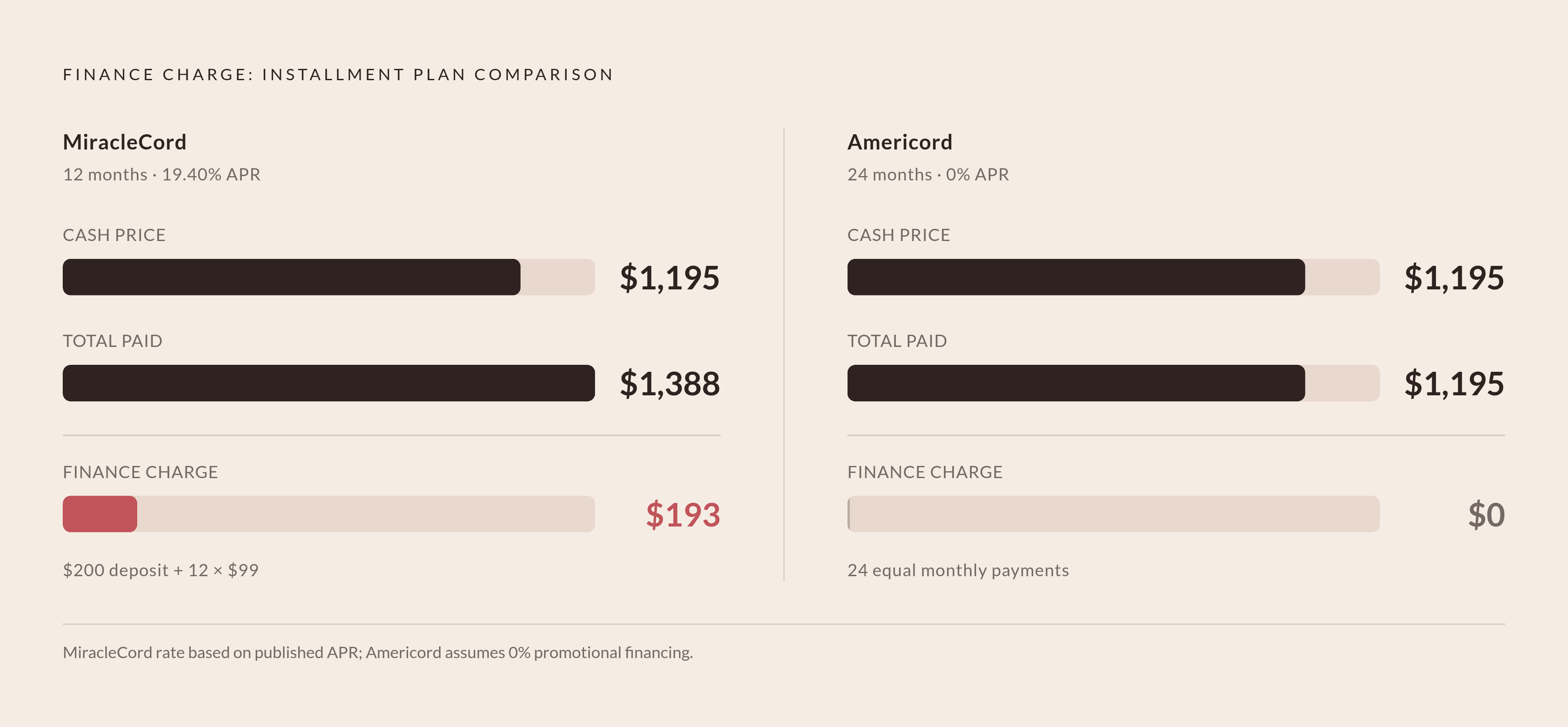
MiracleCord does something almost no other bank in this comparison does: it publishes full retail installment contract terms, including APR and finance charges, rather than just a monthly payment figure. That transparency makes it the clearest lens for reading any other bank's installment offer with a skeptical eye, and this is the section that most directly answers whether financing is worth it.
On a 12-month plan, cord blood with annual storage carries a cash price of $1,195. A $200 deposit brings the financed amount to $995, at an APR of 19.40%, paid off at $99 a month with the first payment due on the baby's date of birth. Total paid across deposit and payments comes to $1,388, meaning the finance charge alone adds $193. Add cord tissue and the cash price rises to $1,495, with the same $200 deposit, an APR of 19.54%, and payments of $129 a month; total paid reaches $1,748, a finance charge of $253. Choose cord blood with 20-year storage instead of the annual plan, and the cash price climbs to $3,095, still with a $200 deposit, but the APR drops to 9.84%, with payments of $265 a month; total paid comes to $3,380, a finance charge of $285. The deposit in every case is nonrefundable.
Set next to Americord's 0% financing over 24 months, the gap is stark: two banks can advertise a similar-looking "monthly payment" while one quietly charges $193 to $285 in interest that the other charges nothing at all. That's not a rounding difference. It's the entire argument for reading past the monthly number before signing anything. AlphaCord takes a different approach, advertising plans starting from $81 a month as an entry point for budget-conscious families, but no APR or finance-charge disclosures are publicly available for that offer, which should read as a red flag rather than an oversight. Anyone considering AlphaCord should ask for the full contract before signing, the same way they'd want it from MiracleCord, and treat a refusal to provide one as an answer in itself.
A monthly number on a marketing page tells you almost nothing about the total cost of an installment plan by itself. Only the APR and the finance charge, read together, tell you what financing actually costs, and a 0% plan is a fundamentally different financial product than one carrying interest in the high teens.
StemCyte: the dual public-private bank with a published lifetime rate and no promotional-code pricing
StemCyte was founded in 1997 and holds both AABB and FACT accreditation, along with FDA US License 2280 for its REGENECYTE product. It's delivered more than 2,300 cord blood transplants worldwide, a track record that sets it apart from banks whose stored units have never actually been used in a transplant, which is most of them.
What makes StemCyte structurally different is that it runs both a private bank and a public bank under one roof, one of the only banks in a major national market to do so. Families can pay $299 to add Public Bank Access, making their unit available for transplant matching beyond their own family, a hybrid model with no real equivalent among the other five banks covered here.
Pricing is published as a flat lifetime plan: $5,695, covering processing and storage for life with no recurring annual fee. Annual and 18-year prepaid options exist too, alongside add-ons including MaxCell premium processing, Newborn Genetic Analysis, HLA typing, and the Public Bank Access fee mentioned above. StemCyte publishes its standard price openly rather than running the rotating coupon-code promotions seen at Cryo-Cell or the sliding-scale structure CBR uses. It's a simpler model, and a less negotiable one, but a family comparing it against Cryo-Cell's discount math knows exactly what it's paying on day one, which counts for something when a decision this permanent is on the table.
On the long-term viability question, in 2024 StemCyte successfully shipped a cord blood unit that had been in storage for more than 23.5 years. That's the single most concrete answer available to the question every one of these six banks is really being asked: will a unit banked today still work decades from now. Logistically, the collection kit ships free, same or next business day, with overnight shipping available, a detail that matters for families with a due date coming up fast.