Storing Your Placenta for Your Own Family vs Donating It for Therapies
Keeping the placenta for family use takes three principal forms: encapsulation for consumption, lotus birth, and ritual or cultural burial. They aren't interchangeable, and conflating them misrepresents all three.
Encapsulation
Encapsulation is the most common form of personal placenta use in contemporary Western practice. The organ is dehydrated, ground into powder, and sealed into capsules, typically by a doula, midwife, or specialist service arranged before delivery. The motivation is almost universally medical in intent. Prevention or treatment of postnatal depression is most frequently cited, followed by mood stabilization, energy support, and lactation enhancement.
The industry is unregulated. No federal safety standards govern encapsulation services, no mandatory contaminant screening exists, and no certification body holds enforcement authority. This matters because the placenta functions partly as a biological filter, concentrating what it screens out, including bacteria and heavy metals. Those substances remain present in processed tissue.
The Centers for Disease Control and Prevention issued a documented warning following a case in which a newborn was hospitalized for late-onset group B streptococcal infection linked to the mother's placenta capsules. The CDC concluded that typical encapsulation processing is inadequate to eliminate pathogens reliably and recommends against consumption on that basis.
Practitioners counter that a large review of community births found no association between placenta consumption and adverse neonatal outcomes, and the American Placenta Practitioners Association has reported awareness of only a single harm claim worldwide. Those data points exist and deserve acknowledgment. They don't constitute clinical validation, and the distinction matters when you're the one filling the capsules.
Lotus Birth
Lotus birth involves leaving the umbilical cord uncut and keeping the placenta attached to the newborn until natural separation occurs, a process that can take a week or longer. The modern resurgence is credited to Claire Lotus Day in 1974, initially in home birth contexts and later extending to cesarean deliveries. The practice appears across communities in the United States, Australia, Turkey, and Italy, among others.
Practitioners frame it in spiritual terms: the placenta belongs to the baby, to be released when the baby is ready rather than severed by clinical intervention. That is a relational claim, not a medical one.
It is also, practically, incompatible with donation. Viable tissue requires prompt cord cutting after delivery. A parent committed to lotus birth has resolved the donation question before it is ever asked.
Ritual and Cultural Burial
Ritual and cultural burial is the oldest and most globally widespread form of placenta practice, predating modern obstetrics by millennia. A 2010 analysis of 179 cultures identified 169 distinct disposal methods across the 109 communities that observed defined placenta rituals. Navajo, Native Hawaiian, and Māori traditions involve burial to bind the child to ancestral land. The Ibo tradition treats the placenta as a deceased twin deserving full burial rites. Cambodian practice specifies burial orientation for the child's protection. Islamic Sunnah prescribes washing, wrapping, and burial. Caribbean tradition commonly involves burial beneath a fruit tree.
These practices are not medical interventions and should not be evaluated as such. They operate by relational, spiritual, communal, and transgenerational criteria that clinical evidence frameworks were never designed to weigh. A family for whom one of these traditions carries meaning isn't choosing between a proven and an unproven health claim. They are placing the birth inside something larger than the delivery room, affirming a connection between the child and a community that extends across time. Applying an efficacy lens here is not rigor. It's a category error, and one that obscures more than it clarifies.
What the Evidence Actually Shows About Placenta Consumption
Survey data consistently show self-reported benefits from encapsulation. Improved mood is most frequent, followed by increased energy and better lactation. These are real experiences. No large-scale randomized controlled trial has established that encapsulation produces these effects beyond placebo, and after decades of growing practice, that gap is worth sitting with. The demand has been there. The research hasn't followed.
The organ-as-filter problem is not theoretical. The placenta accumulates what it screens, meaning substances a healthy placenta prevents from reaching the fetus can persist at measurable concentrations in processed tissue. Encapsulation doesn't eliminate them.
The practitioners' counter-evidence isn't dismissible. The absence of documented harm at scale suggests severe adverse events are rare. But rare adverse events and demonstrated safety are not the same thing, and neither is demonstrated efficacy. Parents who proceed with encapsulation are making a decision under genuine, documented uncertainty, in an unregulated market where service quality varies considerably and the vetting responsibility falls entirely on the family.
The Donation Track: What Donated Placental Tissue Is Actually Used For
Placental tissue has been used in clinical medicine for nearly a century. Several applications are FDA-sanctioned, thoroughly documented, and reaching patients at scale.
Established Clinical Applications
Amniotic membrane grafts are among the most well-established applications, used to treat chronic wounds that fail to close within standard timeframes. Diabetic foot ulcers alone affect millions of Medicare beneficiaries annually, and the five-year mortality rate for patients with those ulcers approaches roughly a third. Placental grafts are also used in burn treatment, skin grafting, corneal ulcer repair and other sight-preserving ophthalmic procedures, orthopedic applications including nerve wrap and ligament repair, reconstructive surgery such as hernia repair and breast reconstruction, dental grafting, and injectable forms for sports medicine applications including plantar fasciitis and joint inflammation.
A single donated placenta, depending on how tissue is processed and divided, can treat multiple patients. Birth tissue donation programs in the United States collectively reach roughly one million patients annually through advanced wound dressings alone.
The Emerging Frontier
Beyond established wound care, placental tissue is at the frontier of regenerative medicine in ways that weren't plausible two decades ago. Placental mesenchymal stem cells are in active clinical trials as of 2024 and 2025, including trials targeting cancer and secondary progressive multiple sclerosis. Minovia Therapeutics is actively collecting donated placentas for mitochondrial augmentation therapy, with an observational study ongoing as of mid-2025. A 2024 review of perinatal stem cell trials registered between 2019 and 2023 found that 9% of mesenchymal stem cell trials, specifically 36 of 402, derived cells from placental, amniotic, or combined perinatal sources. The placental stem cell therapy market was valued at USD 968 million in 2024 and projected to reach USD 1,871.3 million by 2033 at a compound annual growth rate of 7.6%.
That trajectory reflects where research investment is moving. It is not a promise of near-term routine availability, but it is a meaningful signal about the organ's therapeutic ceiling, one that was not visible a generation ago.
How Donation Works
Donation operates within a defined regulatory framework. Programs require informed consent and comply with FDA Good Tissue Practice guidelines and standards set by the American Association of Tissue Banks. Placentas from scheduled cesarean sections are preferred because tissue remains in an aseptic field throughout collection. Vaginal deliveries aren't automatically disqualifying, but tissue quality considerations apply, and not all programs accept them uniformly.
Program availability is growing but uneven. Maimonides Health launched New York City's first hospital-based placenta donation program in September 2025. Trinity Health Ann Arbor grew from four donations in 2019 to more than two hundred annually by 2023 and 2024. Most hospitals still don't have a program at all.
Why Supply Is Falling Short of the Demand Donation Programs Are Seeing
The American Association of Tissue Banks has identified growing demand for birth tissue as the single largest driver of overall growth in living tissue donors. At the AATB's September 2023 annual meeting, an epidemiologist stated directly that the need for donated placentas to treat venous stasis ulcers is growing faster than supply can meet it.
Most placentas are still discarded. Awareness of donation as an option remains low among both patients and clinicians, and structural barriers compound that. Running a donation program requires hospital infrastructure, staff training, cold-chain logistics, and active coordination with tissue banks. Most birthing facilities haven't built that infrastructure, and no regulatory mechanism currently compels them to.
For a parent considering donation, availability depends entirely on where you deliver. Ask your provider before your due date, not at the delivery itself. If your hospital doesn't have a program, donation isn't a realistic option; the coordination required isn't something most families can arrange in the days surrounding birth.
There are patients who need this tissue right now and aren't receiving it because awareness and infrastructure haven't caught up with demand. The gap is not a rounding error.
The Practical Constraints That Make Some Choices Mutually Exclusive
Timing governs all of these decisions. Placental tissue must be collected promptly after delivery for donation or encapsulation to be viable. Lotus birth forecloses both by definition; the cord cannot be cut promptly if it is not cut at all. For parents committed to lotus birth, the donation and encapsulation tracks are closed before the conversation begins.
Delivery type matters for donation specifically. Scheduled cesarean sections are preferred by tissue banks for collection quality. Vaginal deliveries aren't disqualifying, but they introduce variables that affect tissue eligibility. Maternal health history is also screened, as it would be for any tissue donation.
Geography matters more than most parents realize until they ask. If your hospital doesn't have a donation program, donation requires coordination that most families in the peripartum period aren't equipped to arrange.
For encapsulation, a provider must be contracted before delivery. Vetting that provider is entirely the parent's responsibility. There is no licensing board to consult, no certification standard to verify against.
Ritual burial is, logistically, the most accessible path. It's compatible with any delivery type, requires no hospital infrastructure, and creates no procedural conflict with standard discharge protocols. It is the only path most parents pursue without advance planning, and it remains the default alternative to biological waste disposal in most hospital settings.
Circumstances frequently eliminate one or more options before a values conversation is possible. Knowing what your hospital offers, what your delivery plan involves, and which logistical constraints apply to your specific situation is not preliminary information. It is the decision.
How Values, Evidence, and Circumstances Actually Interact When Parents Decide
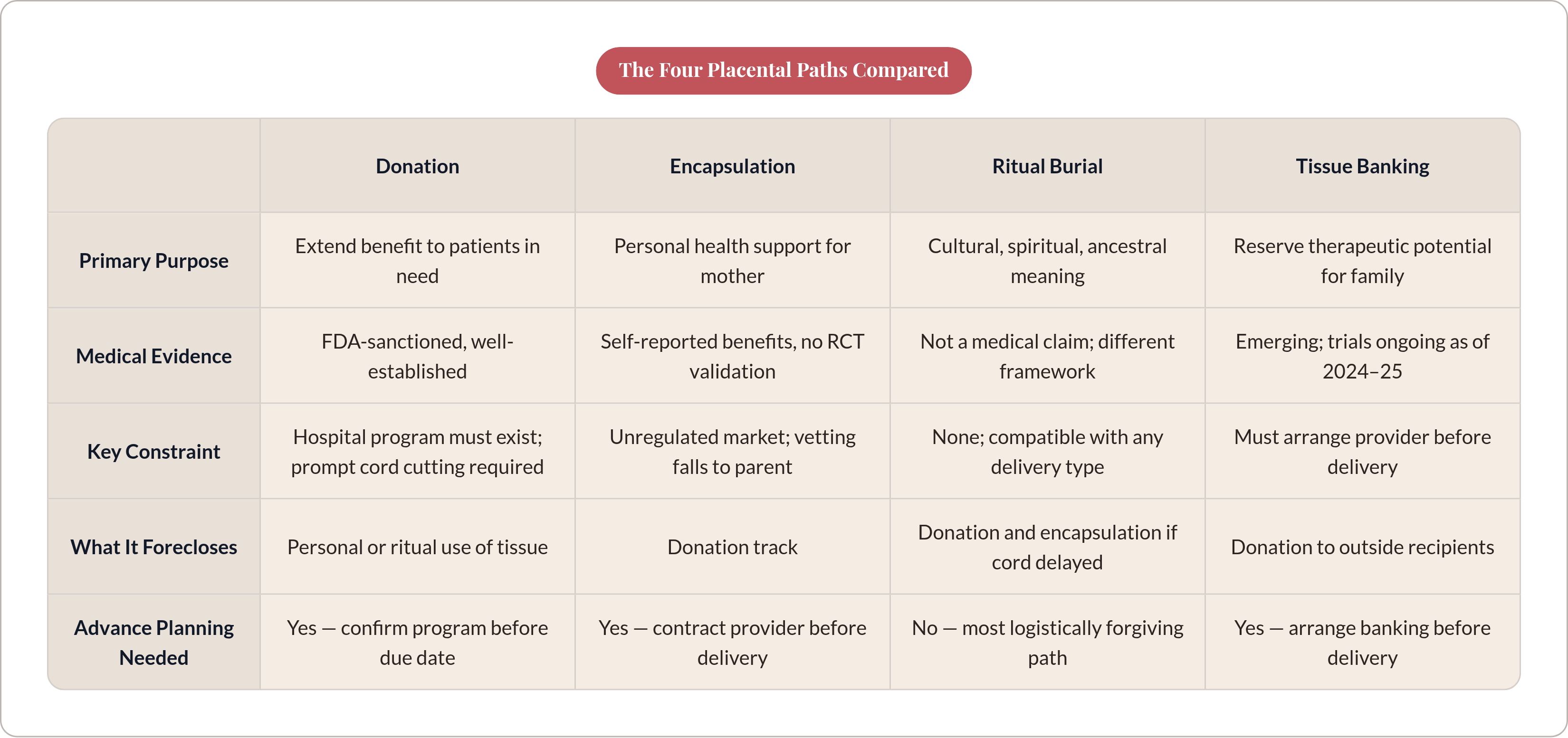
Donation and family use are not competing answers to the same question. Donation extends the placenta's biological utility outward, to patients who need it, through established medical channels. Family use keeps something of the birth within the family, whether for personal health reasons, spiritual meaning, or cultural continuity. Framing them as a head-to-head comparison distorts both.
For parents drawn to donation, the medical case is established and the unmet need is documented. The hospital program manages collection, compliance, and distribution. The trade-off is relinquishing personal or ritual use of the tissue, which matters considerably to some families and not at all to others.
For parents drawn to encapsulation: benefits are widely reported but not clinically validated, risks are documented but rare and contested, and in an unregulated market, provider selection is the primary variable within a parent's control. It is also not compatible with donation.
For parents with cultural or religious ties to burial or ritual disposal, the practice is ancient, geographically widespread, and carries meaning that medical evidence categories weren't built to measure. It is also the most logistically forgiving of all the paths.
A fourth option, less commonly discussed but substantively distinct, is banking placental tissue for potential future family therapeutic use. It sits between personal family use and donation, preserving optionality for the child rather than releasing tissue to outside recipients. It is a coherent choice for parents who want the organ's therapeutic potential held in reserve for their own family rather than directed toward the broader patient population.
None of these paths are equivalent, and none of them are trivial. Each one forecloses something. Understanding what is foreclosed, and by what, before labor begins is the only way to make a decision that is actually yours.