Collecting Cord Blood After Cesarean, Twin, and Preterm Births
Roughly one in three American babies now arrives by cesarean, one in ten arrives early, and twin births have climbed steadily since the 1980s. A lot of parents hear "C-section" or "twins" or "preterm" and assume cord blood banking is off the table. Each of these birth types comes with its own logistics, but none of them close the door, provided someone plans for the actual delivery instead of following a script written for a routine, full-term, single birth.
How cord blood collection works during a cesarean delivery
Hospitals that offer cord blood collection have been doing it during C-sections for years now, and it's a documented part of surgical delivery protocol.
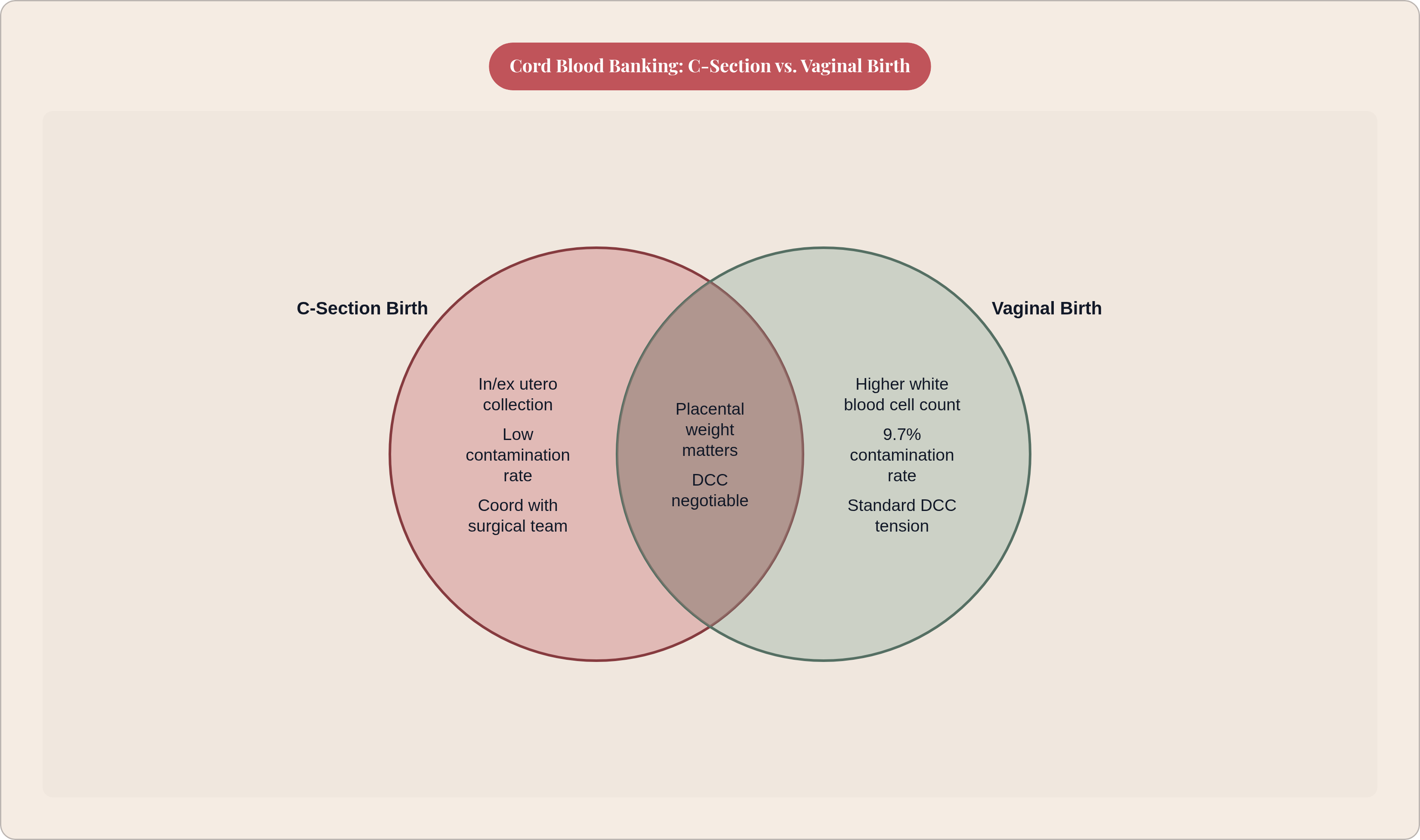
Two techniques get used: in utero collection, done before the placenta separates from the uterine wall, and ex utero collection, done after the placenta comes out. Studies comparing the two found no statistically significant difference in Total Nucleated Cell counts or CD34+ counts between them. Neither method shortchanges the sample.
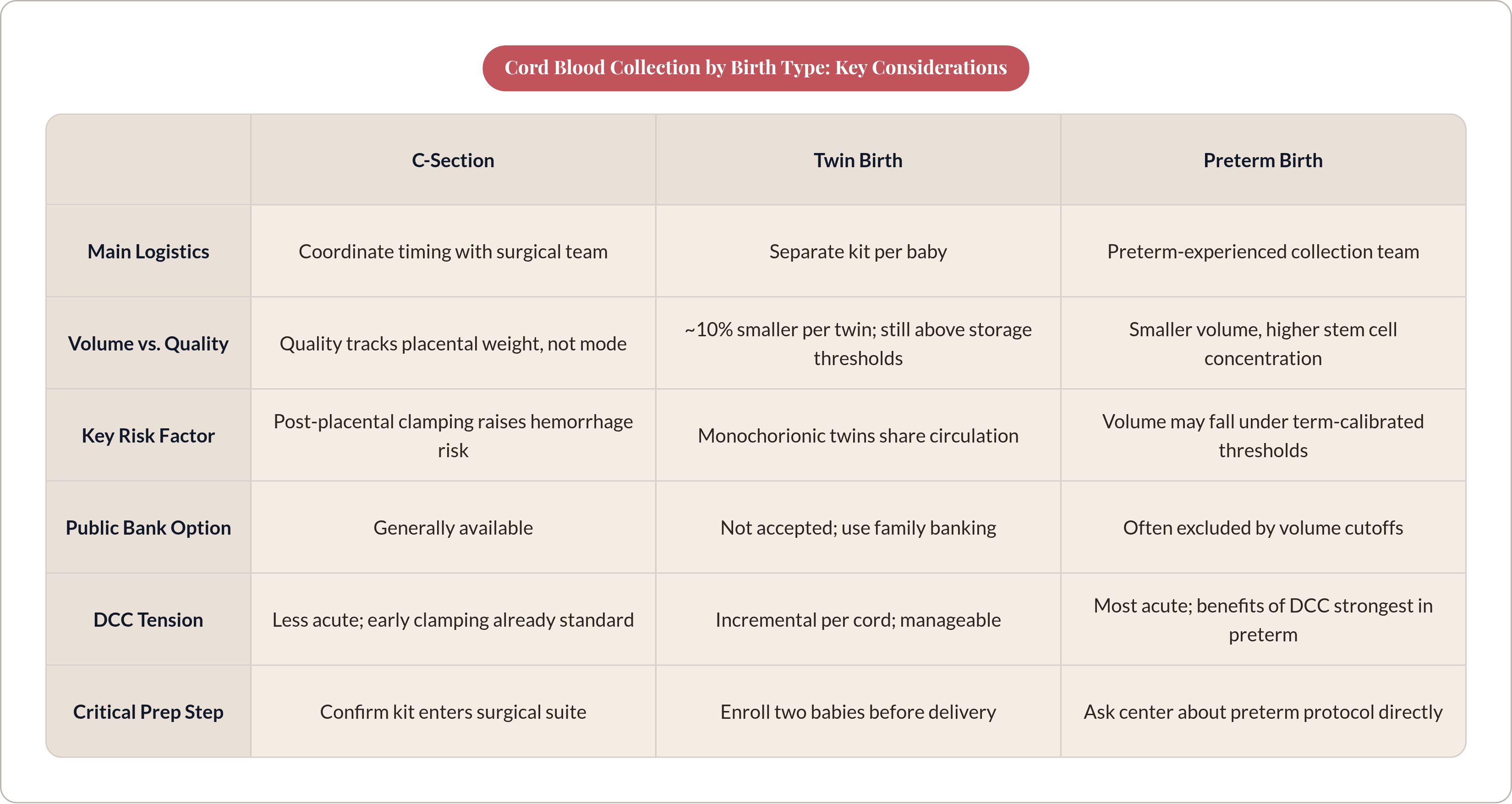
One thing worth knowing ahead of time: doctors won't clamp the cord after the placenta has separated during a cesarean, because that raises the risk of maternal hemorrhage. The surgical team and whoever's handling the collection kit have to coordinate timing as a result. A parent's job here is simple: tell the OB and the banking provider that the delivery will be a C-section, well before it happens, so the plan gets settled ahead of time rather than worked out on the fly in the OR.
Cell quality differences between C-section and vaginal births — what the research actually shows
Here's the concern parents raise most often. Spontaneous vaginal labor produces measurably higher white blood cell counts in cord blood than an elective cesarean does, and the gap is statistically significant. The physiology tracks: labor stresses the fetus, and that stress pushes hematopoietic cells into fetal circulation.
That finding is only half the picture, though. Manegold and colleagues, writing in Transfusion in 2008, found that cesareans done because of fetal distress actually raise stem cell numbers in cord blood. The distress seems to be doing the work, not the surgery itself.
A Scientific Reports study out of Mansoura University Hospital, published in December 2025 and covering 150 elective C-section units, found something more useful: placental weight and neonatal birth weight predicted cell counts far better than birth mode did. Placentas of at least 600 grams paired with babies over 3.0 kilograms consistently produced higher counts, regardless of how the baby arrived. Placental weight is the variable that actually matters, and it cuts across every birth type in this piece.
There's a quality advantage, too, that rarely comes up in these conversations. Across more than 10,000 cryopreserved samples collected between 2010 and 2020, the bacterial contamination rate sat at 1.4% for cesarean deliveries versus 9.7% for vaginal ones. That's a sevenfold gap. Put it together and quality tracks placental weight and the reason for surgery far more closely than it tracks the delivery mode itself.
Collecting for twins: one kit per baby, and why volume is less of an obstacle than parents assume
For twins, each baby needs a separate collection kit, and that's the whole logistical wrinkle. The mechanics of drawing from each cord don't change from a singleton birth; you're just doing it twice.
Volume runs a bit lower per baby. Data compiled from roughly 300 multiple births, set against about 10,000 singleton births, shows twin units come in around 10% smaller on average. That sounds worse than it is. One study comparing units from multiple births found they held far more total nucleated cells and CD34+ cells than the minimum thresholds required for storage. Separate research found units from multiple births carry enough stem cells to treat conditions like cerebral palsy diagnosed later in childhood, under current dosing guidelines. Smaller volume, here, still means enough volume.
Bank both twins, even identical ones. Fraternal twins have distinct genetic profiles and separate disease risk, so one twin's stored unit tells you nothing useful about the other. Identical twins share DNA but not environment, and epigenetic drift over time means two genetically matched people can still end up with different outcomes down the road. Banking both also gives the family more total volume to draw on. There's a sharper clinical argument too: for some blood and immune disorders, one twin's cells can treat the other, since HLA matching between twins tends to run very strong.
One thing worth knowing before you assume a public bank is an option: public cord blood banks don't take donations from twin births, because their volume cutoffs are calibrated for singleton units, and most twin collections won't clear that bar. Private, family banks do take twin collections, and many price it to account for enrolling two babies at once. For twin parents, family banking is the realistic path, with two kits and two enrollments sorted before delivery day.
Monochorionic twins and the shared-placenta complication
About 70% of identical twins are monochorionic, meaning they share one placenta instead of each having their own. Every monochorionic placenta has vascular connections, called anastomoses, running between the two fetal circulations, and blood moves between the twins in utero as a result. That's just how the anatomy works.
Most of the time, that exchange stays balanced and causes no problems. When it doesn't, you get twin-to-twin transfusion syndrome or twin anemia polycythemia sequence, both serious, both closely monitored by obstetric teams throughout the pregnancy.
For cord blood collection, shared circulation raises a genuinely different question than the one most twin parents face. Cord blood drawn from each twin may not fully represent that baby's own stem cell profile, since some of what's in each cord came from the other side of the placenta. Volume allocation runs tighter too, since two cords are drawing from one shared placenta instead of two independent ones. Pregnancies complicated by TTTS or TAPS are high-risk and often end in preterm delivery, which stacks the preterm considerations covered later on top of the twin considerations already in play.
Monochorionic twins can still collect; that hasn't changed. The conversation with the OB and the cord blood bank just needs to happen specifically around this anatomy, ideally with a look at any transfusion-syndrome history in that pregnancy, so the clinical team sets expectations instead of guessing. This is a subset of a subset: it affects monochorionic identical twins specifically, not twin pregnancies broadly, and once a scan has ruled out TTTS or TAPS, it isn't worth much more worry.
The biological paradox in preterm cord blood: smaller volume, higher stem cell concentration
Here's what surprises most people, clinicians included: preterm cord blood runs markedly higher in CD34+ hematopoietic stem and progenitor cells than term cord blood does. The earlier the birth, the more concentrated the sample.
The numbers hold up across studies. Preterm cord blood averages 0.61% CD34+ cells versus 0.3% in full-term births, a gap significant at p=0.0001. Narrow the preterm group to babies born under 32 weeks and the gap widens further: 0.95% CD34+ against 0.36% at 32 weeks or later. Each additional week of gestation corresponds to roughly a 9% drop in CD34+ concentration, likely because the placenta cuts back blood flow to the fetus as gestation moves toward term. Clonogenic capacity, meaning how well the stem cells actually form new colonies after transplant, runs higher in preterm samples too.
Here's the catch. This biologically potent blood comes in smaller total volume, and banking thresholds for volume were built on term-infant data. Plenty of preterm units get discarded right now, since total volume falls under a bar calibrated for babies who stayed in the womb longer, even though the cells inside are strong. The field is actively working to close that gap, and it isn't a permanent ceiling.
What preterm collection actually looks like in practice, and when it succeeds
The volume concern is real, but it doesn't translate into frequent failure. A study in Vox Sanguinis tracked 606 preterm collection attempts and found 570 succeeded: a 94% success rate for a birth type parents often assume is too complicated to bother trying.
Volume in that study came in at a median of 65 mL, and 42.5% of collections hit the 70 mL threshold considered adequate for processing. What drove volume most was technique, the baby's birth weight, and how experienced the person doing the collection was. Teams that collected preterm samples regularly outperformed generalist teams handling it occasionally, a clear learning-curve effect. Ask the delivery center and the bank directly whether their team has preterm experience; who performs the collection matters more here than it does in a term birth.
There's overlap worth flagging too. 62.3% of multiple births are preterm, against 8.8% of singleton births, so twin parents are disproportionately likely to be navigating preterm collection at the same time, often in the same delivery.
One more point that gets less attention than it should: a 2026 Frontiers in Pediatrics study found that preterm infants above a certain birth weight threshold who were in the umbilical cord blood collection group had significantly less blood drawn from them in the first 24 hours and first three days after birth. Collection may actually lower the risk of iatrogenic anemia in very low birth weight infants, a plausible upside to a procedure parents often worry costs the baby something.
Delayed cord clamping across all three birth types — a real tension with a workable resolution
Every major obstetric guideline body recommends delayed cord clamping, and the benefits to newborns are real and well established. Parents who want both DCC and cord blood banking often assume they have to pick one, since every extra second the cord stays attached sends more blood into the baby and leaves less behind for collection.
The tension plays out differently depending on birth type. At cesarean delivery, early clamping is already standard, and clamping after placental separation gets avoided anyway for the hemorrhage reasons covered earlier, so the DCC conflict is already less sharp than it is at vaginal birth. With twins, each cord clamps on its own, so DCC can still happen for each baby individually; the volume tradeoff is incremental, not all-or-nothing. Preterm births are where this gets genuinely difficult, because DCC's benefits (better cardiovascular stabilization, less need for transfusion) are especially well documented in premature infants. That's a real tradeoff between infant benefit and collection yield, and it belongs to the clinical team's judgment, case by case, not a blanket rule.
DCC and cord blood collection can coexist across all three situations. Duration and approach can be negotiated with the OB, and some collectible volume typically survives even a period of delayed clamping. Raise DCC intentions early, in prenatal conversations with the OB and the bank both, well before the delivery room, so there's an actual plan instead of a scramble.
How to prepare for cord blood collection when your birth is C-section, twin, or preterm
The single most useful thing you can do, across every scenario here, is tell the care team and the banking provider about the birth type early in the third trimester, not at hospital admission. Everything else follows from that.
For a planned or possible C-section, confirm ahead of time whether the OB and delivery center routinely collect during cesarean surgery, and make sure the kit actually makes it into the surgical suite. Skip the worry over in utero versus ex utero; the OB will use whatever fits their protocol, and both produce comparable cell counts.
For twin pregnancies, get a separate kit per baby, and know going in that family banking is the route available for multiples, since public donation isn't. If the twins are monochorionic, raise the shared-placenta anatomy specifically with the OB and the bank, rather than assuming standard twin guidance already covers it.
For preterm or at-risk pregnancies, ask the delivery center directly about their preterm collection experience and protocol. Go in expecting volume below the full-term median, while knowing collection still succeeds in the large majority of preterm attempts, per the numbers above. Settle DCC intentions with the team well before delivery, so nobody's deciding it in real time under pressure.
What all three cases come down to, in the end, is a banking provider with actual experience across non-standard deliveries, one that talks to families before delivery instead of defaulting to a protocol built for a routine, full-term, single birth. The birth sets the conditions, and what you do in the months before it decides whether the collection works.