What the Data Says About Cord Blood Units Stored Over 20 Years
Decades of frozen cord blood retain the stem cells needed to treat blood disorders.

Every viability claim in this literature rests on the same mechanism. Cooling a cord blood unit to approximately –196°C in liquid nitrogen doesn't slow biological activity. It stops it. Metabolic processes are suspended, not decelerated, and the thermodynamic basis for molecular degradation simply ceases to exist at those temperatures.
Getting there safely requires a controlled-rate cooling protocol, typically 1°C to 2°C per minute. That gradual descent allows intracellular water to migrate out before it can freeze into crystals that rupture the membrane. A 10% dimethyl sulfoxide (DMSO) solution stabilizes cell membranes throughout the descent. This has been standard across public and private banking for decades.
Storage vessel matters. Liquid nitrogen Dewars operating in vapor phase maintain temperatures around –160°C; liquid-phase units operate closer to –196°C. Both fall below the glass transition temperature of water, below which no diffusion-dependent processes occur. The physical chemistry is settled.
The theoretical implication follows directly: properly maintained storage conditions introduce no biological aging mechanism the physics can support. What the institutional datasets have to answer is a different, harder question — whether real-world conditions reliably hold required temperatures across years and institutional turnover. That's where theoretical elegance ends and empirical work begins.
Processing method at collection introduces a separate variable, one the strongest datasets isolate carefully. Unseparated units, manually volume-reduced units, and automated volume-reduced units represent successive generations of methodology. Differences in post-thaw outcomes across these cohorts reflect processing era and technique. Reading them as evidence of storage-duration effects produces misleading conclusions, and the distinction matters enormously when comparing results across studies.
One baseline truth runs through everything that follows: under properly maintained storage, the original quality of the cord blood sample at collection becomes the primary variable governing post-thaw recovery. A unit that entered storage with marginal cell counts won't improve with time. A unit that entered with robust cell populations has the most to preserve. The bank can protect what was collected; it cannot upgrade it.
What the Broxmeyer Lab Series Showed Across 5, 10, 15, 23.5, and 27 Years
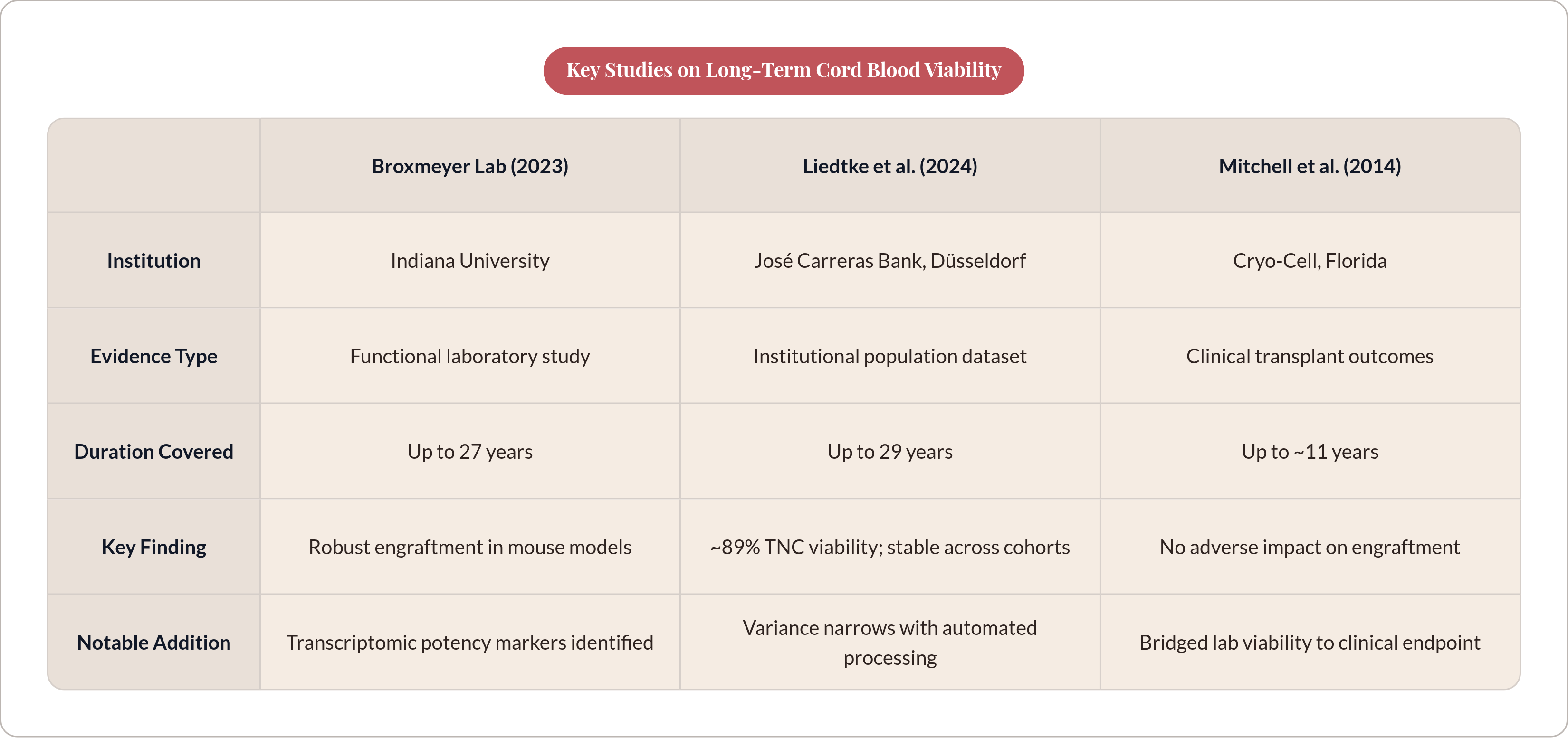
No researcher has built a more consequential empirical record on cord blood longevity than Professor Hal Broxmeyer of Indiana University. His lab produced not a single landmark paper but a genuine longitudinal series, each publication extending the timeline another interval. The November 2023 paper in Cell Reports Medicine reported on units stored for 27 years. At publication, those were the oldest cord blood units subjected to rigorous functional testing in the peer-reviewed literature.
The core finding held at every interval. Long-term cryopreserved cord blood retains similar numbers of hematopoietic stem and progenitor cells (HSPCs) compared with fresh and recently cryopreserved samples. These aren't cells that merely persisted in some attenuated state. The 27-year units demonstrated robust engraftment in mouse transplantation models, reconstituting the hematopoietic system of a recipient. Survival and function are distinct measures, and Broxmeyer tested both.
The 2023 paper added something the earlier work had not. Transcriptomic profiling of the older units identified gene signatures associated with engraftment capacity, suggesting that molecular characterization could serve as a potency marker independent of storage age. Rather than using duration as a proxy for quality, a molecular profile could eventually allow direct selection of the most potent units regardless of how long they've been held at –196°C. That approach isn't validated for clinical use yet, but its scientific foundation was established here.
The study's own language is worth quoting precisely: functional hematopoietic stem cells with short- and long-term engrafting and sustained self-renewal capacity can be cryopreserved for at least 27 years. That phrase "at least" matters. It is a lower bound on what was documented, not a ceiling on what is possible.
The series also documented meaningful unit-to-unit variability in functional HSC frequency among units at identical storage ages. This is one of the most practically consequential findings in the entire body of work. Older units need not be excluded from clinical consideration on the basis of age alone. What the unit contains is more determinative than how long it has been cold.
The Düsseldorf Bank's 29-Year Institutional Dataset — What Viability Numbers Across Three Processing Cohorts Show
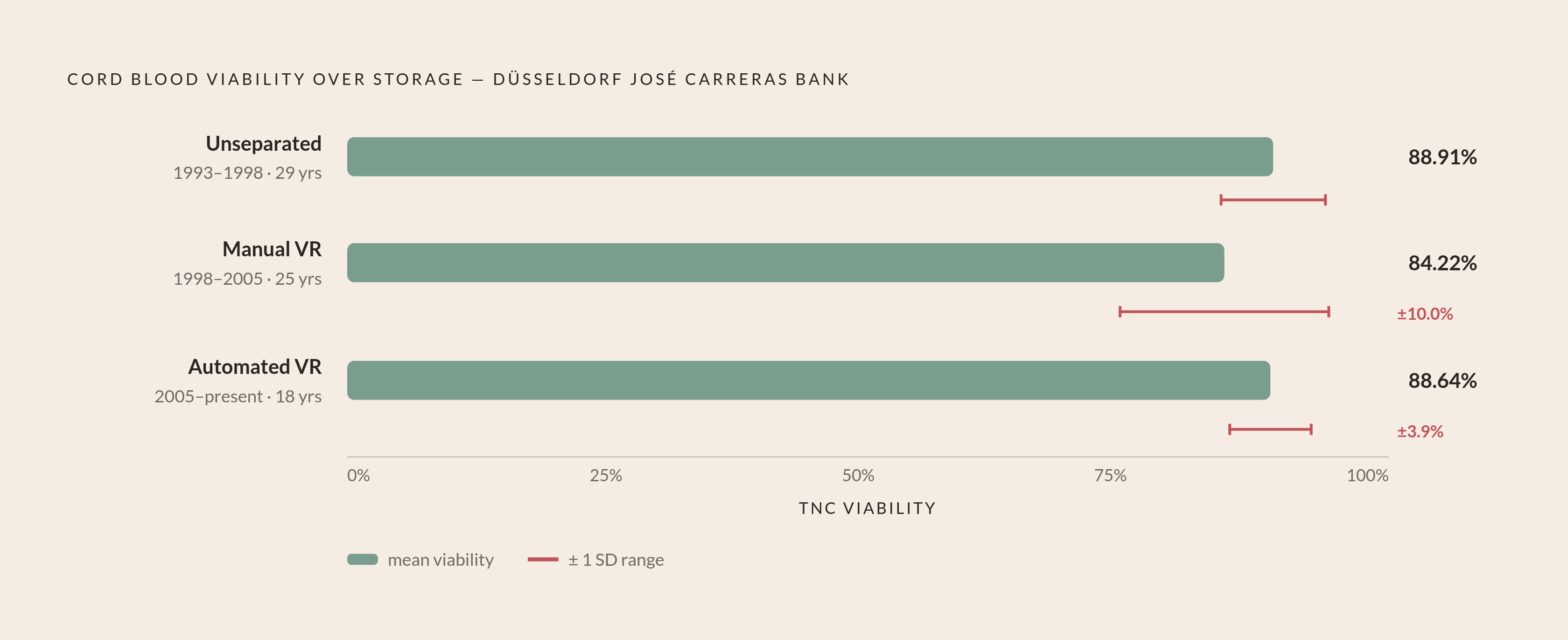
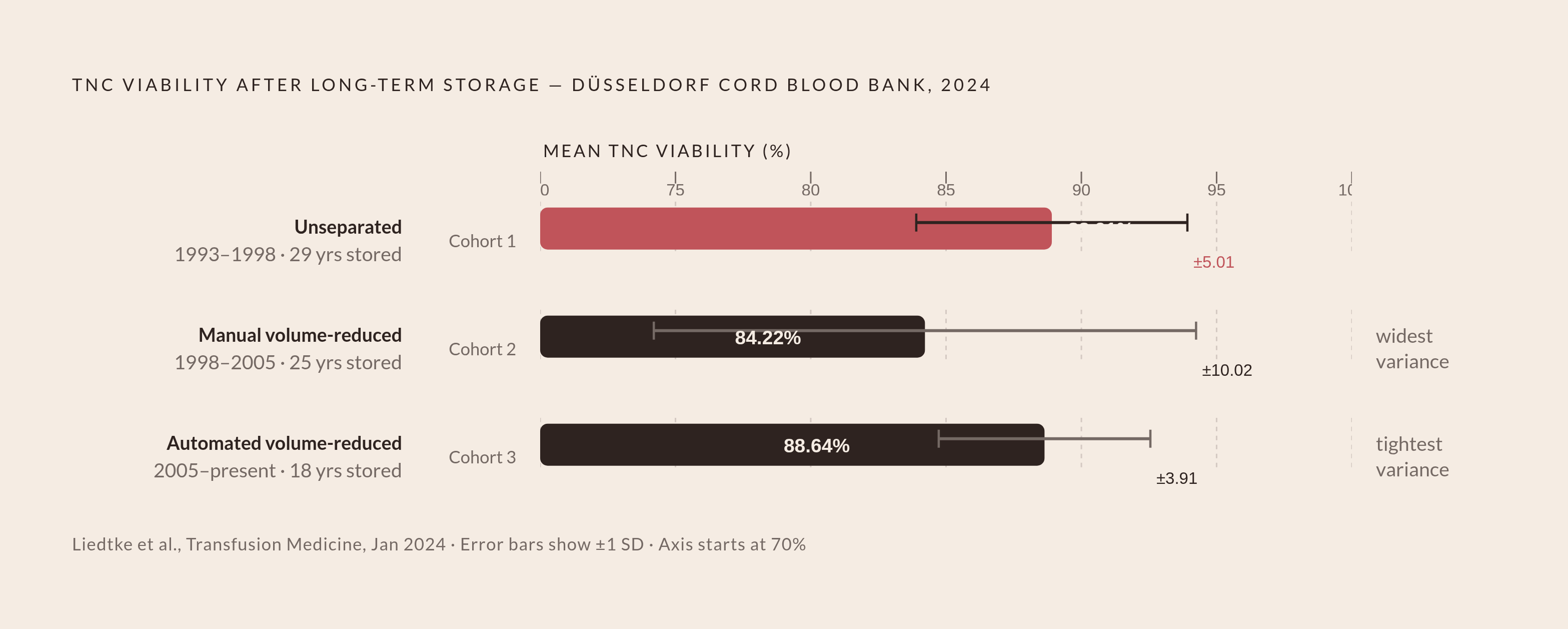
If the Broxmeyer series represents the laboratory science, the January 2024 paper from Liedtke et al. in Stem Cells Translational Medicine represents the institutional record at scale. The José Carreras Cord Blood Bank in Düsseldorf, licensed by the Paul-Ehrlich Institute, holds 21,215 active cryopreserved units. The study evaluated units across three distinct processing generations. The headline figure from the oldest cohort is not marginal: unseparated units processed between 1993 and 1998 showed a mean total nucleated cell (TNC) viability of 88.91% ± 5.01% after 29 years of cryopreservation.
The three cohorts together tell a coherent story. Manually volume-reduced units processed from 1998 to 2005 showed 84.22% ± 10.02% at 25 years. Automated volume-reduced units processed since 2005 showed 88.64% ± 3.91% at 18 years. Viability is high and consistent across cohorts spanning nearly three decades of institutional practice.
The manual cohort's standard deviation, ±10.02%, is substantially wider than the ±5.01% and ±3.91% seen in the other two. That spread reflects the less standardized nature of manual processing. Automation resolved it, and the tightening of variance across successive cohorts is itself evidence that improved methodology produces more predictable outcomes.
The study also reported that CD34+ cell count increased significantly over time across cohorts, which the authors interpret as confirmation that qualified processing methods had been applied. Post-thaw CD34+ viability, the parameter most directly correlated with engraftment outcomes, was described in the accompanying editorial by Andromachi Scaradavou as "very high and remarkably stable." Scaradavou titled that editorial "Cord Blood Stem Cells Do Not 'Age' — Under Proper Banking Conditions." The editorial title is not a marketing claim; it's the editor's reading of the data.
A word on the licensed expiration dates cited in this study. They are regulatory endpoints derived from accumulated stability data, subject to extension as additional measurements become available. They are not predictions of biological failure. The Düsseldorf data shows viability well above minimum release thresholds at those endpoints, which means the dates mark the current limit of documented evidence, nothing beyond.
How Other Institutions Have Corroborated These Findings, and What the Mitchell Clinical Data Established Earlier
Independent replication from Cryo-Cell in Florida and Medipost in South Korea, each working with distinct unit populations, processing histories, and institutional settings, has produced results consistent with the Düsseldorf findings. The approximately 89% viability figure at nearly 30 years is not a single-laboratory artifact. Separate inventories, separate institutions, converging on the same result.
The Mitchell et al. 2014 paper in Biology of Blood and Marrow Transplantation contributed something laboratory studies couldn't supply on their own: a clinical endpoint. That study examined actual engraftment outcomes in single umbilical cord blood transplants and found that long-term cryopreservation didn't adversely impact engraftment, total nucleated cell recovery, viability, or colony-forming units across a window extending to approximately 11 years. Laboratory viability is a necessary condition for graft performance, not a sufficient one. Mitchell bridged those two levels of evidence.
Clinical engraftment data reached roughly 11 years in 2014. The Broxmeyer series extended the documented range to 23.5 and then 27 years at the functional laboratory level. Liedtke et al. followed in January 2024 with population-level viability data at 29 years from a licensed public bank. Each publication moved the frontier. None identified a threshold at which stored units demonstrate meaningful functional decline.
How Quality Is Tracked Over Time — The Regulatory Framework Behind Any Viability Claim
The viability figures cited throughout this piece don't come from ad hoc measurements. They exist within a structured regulatory framework that mandates ongoing stability monitoring as a condition of licensing.
The FDA, the Foundation for the Accreditation of Cellular Therapy (FACT), and their European counterparts require in-vitro stability studies as part of the licensing process. FACT Standards specify a Stability Monitoring Program within which viability measurements are taken at defined intervals. The AABB-ISCT Joint Working Group Stability Project Team has emphasized standardization of such programs across institutions processing cryopreserved hematopoietic stem and progenitor cells.
Parameters tracked at each monitoring interval are specific: TNC count and TNC recovery; TNC viability; CD34+7AAD– viability, the measure most directly tied to engraftment outcomes; CD45+7AAD– viability; and colony-forming cell (CFC) count, which functions as a functional potency assay rather than a simple cell count. Each must meet defined release criteria at the time of thaw.
This framework also provides interpretive context for a recurring caution in the literature. The aggregate viability figures from Düsseldorf and corroborating institutions are means across units that entered storage with varying baseline quality. A unit with low initial cell counts or compromised viability at collection may not perform equivalently to a robust sample stored for the same duration under identical conditions. That is a collection-time variable. No amount of careful banking changes it, which is why the quality of the collection remains the front-end variable that everything else follows from.
Where the Evidence Genuinely Runs Out — The 30-Year Threshold and the Limits of the Current Data
The 27-year Broxmeyer data and the 29-year Düsseldorf institutional dataset mark the current outer boundary of peer-reviewed evidence. Units approaching 35 years are a small population given that the first cord blood transplant was performed in 1988, and rigorous testing of that cohort hasn't yet appeared in the literature.
The 30-year threshold is the next landmark. Whether stability continues linearly, plateaus, or exhibits some threshold effect at that point is genuinely unresolved. All three possibilities remain open. The literature has produced nothing suggesting the third option, but that is not evidence ruling it out. One is an absence of a signal; the other is a confirmed absence. They are not the same observation, and the distinction matters when families or clinicians are making decisions about units approaching that age.
Long-term clinical outcomes specifically attributable to units stored 20 years or more can't yet be cleanly separated from general unrelated cord blood transplant outcome data in large registries. Mitchell's clinical data reached approximately 11 years. Broxmeyer's functional data reached 27 years. That gap between clinical outcome evidence and laboratory functional evidence at longer durations hasn't closed, and it probably won't close quickly given the rarity of the relevant cases and the inherent latency in outcome reporting.
Unit-to-unit variability, documented explicitly in the 2023 Broxmeyer paper, also remains incompletely characterized. The transcriptomic potency markers identified there are scientifically promising but haven't been validated as clinical selection criteria. Moving from a gene signature to an actionable release criterion requires additional prospective work, and that work is ongoing.
The Düsseldorf expiration dates are lower bounds on what the evidence covers. Reading them as biological failure points misreads what the data actually says, and that misreading has real consequences for how units are evaluated.
What the Regenerative Medicine Pipeline Means for Units Banked Today Reaching Their 20-Year Mark
The utilization landscape for cord blood has shifted, and the shift is significant. WMDA data shows that cord blood's role in standard hematopoietic transplantation declined from 4,150 transplants in 2012 to 2,783 in 2018, driven largely by the expansion of haploidentical hematopoietic cell transplantation. Haplo-cord combination strategies have retained a foothold: multicenter phase 3 data demonstrated 80.5% three-year overall survival for haplo-cord versus 67.8% for haploidentical alone in acute myeloid leukemia. Cord blood wasn't displaced from combination approaches even as its standalone transplant volume fell.
The direction of growth is elsewhere. Units released for regenerative medicine clinical trials have been increasing even as transplant utilization declines. In July 2024, NMDP BioTherapies' Cord Blood Bank Alliance began making pre-identified cord blood units optimized for cord-derived natural killer (NK) cell therapies available, drawing on an inventory of more than 200,000 units. NK cell therapies derived from cord blood represent one of the more active fronts in cell therapy development. The inventory of banked units is the raw material for that work.
This is where the evidentiary record traced throughout this piece connects to something practically consequential. Units banked 20 or more years ago that retain functional HSCs and progenitor cells, which the evidence now supports to nearly 30 years, are candidates for novel therapeutic applications. They are not a legacy transplant inventory aging toward obsolescence. They are a biological resource whose potential applications are expanding as the science catches up to what banking has quietly preserved.
The transcriptomic potency markers identified in the 2023 Broxmeyer paper point toward a future in which unit selection is driven by molecular profile rather than storage age. If that approach is validated, duration of cryopreservation becomes a less meaningful filter than it has historically been. What matters is what the unit contains and what it can do, measured directly.
Banks, clinicians, and families approaching the fourth decade of stored units are asking a practical question: do these cells still work? The evidence from Broxmeyer's 27-year functional study, from Düsseldorf's 29-year institutional viability record, from Cryo-Cell, Medipost, and Mitchell's clinical engraftment data, says yes. Storage conditions must be maintained. Collection quality matters at the front end. The 30-year threshold remains ahead of the documented record. But within what the data actually covers, the answer has not changed at any interval anyone has tested.