cord blood banks with income-accessibility commitments: who offers low or no down payments and interest-free options
Most families lose access to banking at the down payment, not the sticker price.

The headline price of cord blood banking is almost never the real barrier. A family staring down a $2,000 to $3,000 enrollment fee can often make that number work if it's spread across 12 or 18 months. What actually breaks the deal is a $500 to $1,000 down payment due before delivery, paired with a hard credit check that either delays approval past the birth window or rejects the applicant outright. Those two features, not the total contract price, are the real underwriting test, and most families never find out they failed it until it's too late to matter.
That timing constraint is what separates cord blood banking from almost every other financed purchase a household makes. A mortgage or a car loan can wait a week for underwriting to clear. A birth cannot. A family with a due date three weeks out and a thin or damaged credit file needs an approval process that doesn't hinge on a three-digit score, and most consumer financing, medical or otherwise, is built around exactly that score. Banks that restructured intake around the birth deadline instead of the credit bureau made a deliberate choice, and it costs them something on every application they approve without a bureau pull to lean on. Banks that didn't make that choice will keep losing the applicants who needed the option most, and they will keep filing the loss under "credit risk" instead of what it actually is: a product built for people who never needed the product in the first place.
No or Low Down Payment: The First Filter
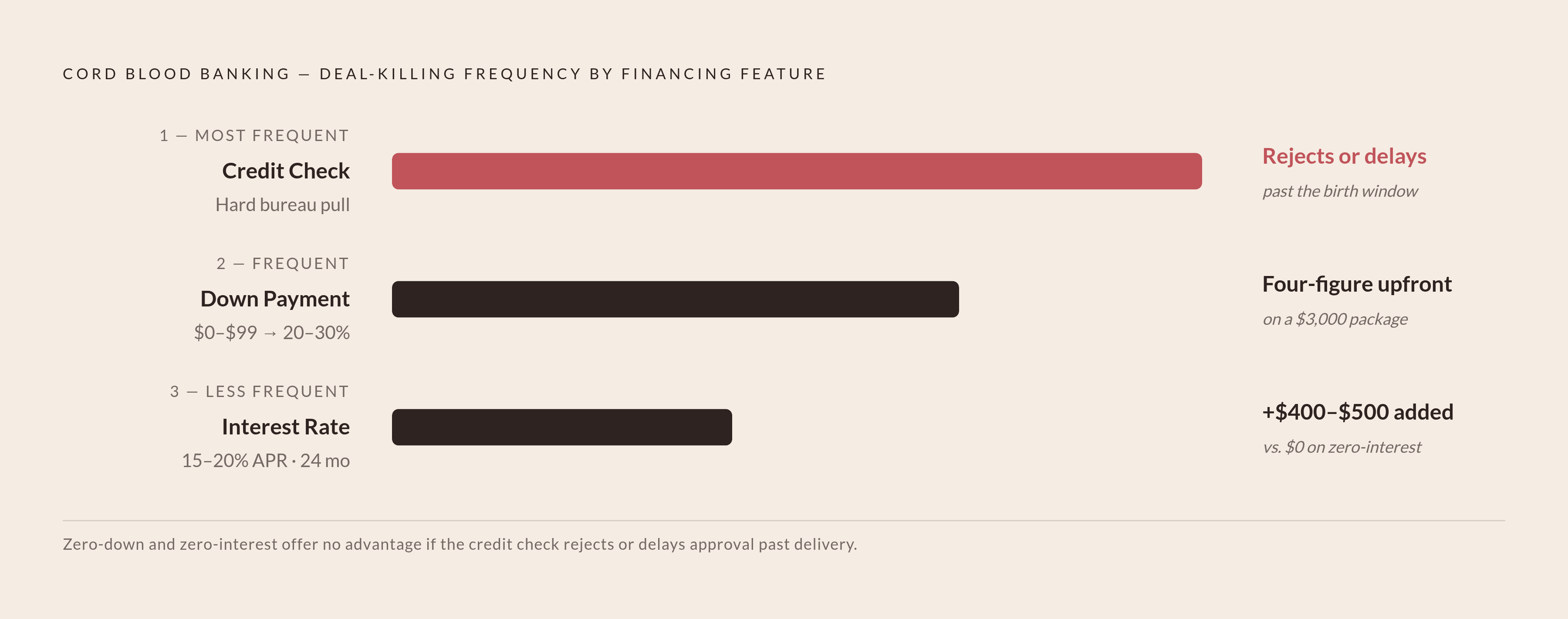
The most basic accessibility feature is a reduced or waived down payment. Some banks ask for a token deposit, sometimes as little as $0 to $99, to reserve the collection kit and lock in enrollment, financing the rest, including the first year of storage, afterward. Others still require 20 to 30 percent of total contract value upfront, which on a $3,000 package means a four-figure payment due before the baby arrives. Those aren't two versions of the same product wearing different marketing. They're two different eligibility tests, and the second one screens out exactly the households that stand to benefit most from spreading a cost over time. A bank running the 20 to 30 percent model isn't offering financing so much as offering financing to people who didn't need it.
For a family living paycheck to paycheck, that difference decides whether banking happens at all. Miss the window at delivery, and there's no follow-up appointment where the decision gets revisited the way there is with a vaccination series or a dental cleaning. The cord is clamped, the moment closes, and it does not reopen. That's what makes the upfront deposit a harsher filter here than almost anywhere else in preventive health spending: no insurance backstop, no second visit, no partial credit for showing up late.
Interest-Free Financing: What It Actually Saves
Interest-free installment plans matter more than the phrase suggests. A $2,500 balance financed over 24 months at a typical retail rate of 15 to 20 percent annual interest adds several hundred dollars in interest before the last payment clears. Zero-interest financing removes that line item entirely: the monthly payment is the balance divided by the term, nothing else layered on top.
Some banks build this in as a standard feature of every contract. Others hand the financing off to a third-party medical lender, which can quietly reintroduce interest, deferred-interest traps, or a credit check, even while the cord blood bank's own marketing page still says "flexible payment plans." That phrase is doing a lot of work it hasn't earned. Flexible describes term length, nothing more. It says nothing about the rate once a promotional period ends, which is precisely why families need to read the financing disclosure as its own document, separate from the pitch page linking to it.
No Credit Check: The Quiet Dealbreaker
Credit checks are where a lot of otherwise generous-looking payment plans quietly fall apart. A bank can advertise a $0 down payment and a 0% annual rate and still run a hard credit pull that delays approval by the exact number of days a family due in three weeks does not have, or disqualifies an applicant with a thin file outright. Zero down and zero interest mean nothing if the approval itself never clears in time.
Banks committed to income accessibility structure approval around the contract itself, not the applicant's credit score, often through in-house financing that never touches the major bureaus. That shifts collection risk onto the bank rather than the family, and that's exactly why not every provider offers it. It costs the bank something real to extend that risk. For the household it's built for, though, no-credit-check financing is usually the single feature that decides whether banking happens, ahead of the total price and ahead of the down payment size. Rank the three features by how often each one kills a deal, and the credit check wins every time.
What "Side by Side" Actually Requires
Comparing banks on affordability isn't a matter of lining up sticker prices, because the down payment, the interest rate, and the credit check move independently of one another. A bank can be excellent on one and mediocre on another: zero down payment but interest financed through a third party, or no credit check paired with a 25 percent deposit that defeats the purpose anyway. Before comparing providers, pull the same four numbers from each one: the required deposit in dollars, the annual interest rate on any balance carried, whether approval involves a credit pull (hard or soft), and the total all-in cost on the longest available term measured against paying in full.
That last figure carries more weight than it gets credit for. A plan can look affordable month to month while costing 15 to 20 percent more over the life of the contract than paying upfront does. That's a reasonable trade for a family without $3,000 sitting in savings, but it isn't a trade that should happen without the family seeing the number first, in writing, before signing.
The Bigger Picture
Cord blood banking occupies an odd position in the health economy. It's marketed as a form of biological insurance, something bought once against a risk that may never materialize, yet it's priced and financed like a discretionary purchase, a couch or a vacation package on layaway. That mismatch is exactly why payment structure deserves as much scrutiny as the lab's AABB accreditation or the storage tank's backup power supply. A family that can't clear the down payment doesn't get a smaller version of the service. It gets none of it, permanently, the moment the cord is clamped.
Judge a bank by its financing terms before its lab credentials, not after. The banks that treat income-accessible financing as core infrastructure, not a marketing bullet point, are the ones actually deciding who gets access to this technology and who doesn't. The lab science, the cryogenic storage, the accreditation binder: none of it matters to a family that never made it past the deposit.