When During Pregnancy Should You Decide on Cord Blood Banking
Decide on cord blood banking by late second trimester to weigh your actual options.

Cord blood is the blood remaining in the umbilical cord and placenta immediately after birth. It's rich in hematopoietic stem cells, the progenitor cells responsible for generating the body's entire blood and immune cell repertoire. The FDA has approved HSC-based therapies for more than 80 conditions, among them acute and chronic leukemias, lymphomas, sickle cell disease, and severe combined immunodeficiency. Tens of thousands of cord blood transplants have been performed worldwide since the first successful procedure in 1988, with thousands conducted annually at present.
One clinically meaningful advantage cord blood holds over bone marrow is matching tolerance. Cord blood transplants can proceed with a lower degree of HLA compatibility than bone marrow requires, and this matters most for patients from underrepresented ethnic backgrounds, who are statistically less likely to find a suitable donor in existing registries. For some families, cord blood is not a preference. It's the only viable path to transplant.
Cord tissue and placental tissue belong to a distinct category, and that distinction is routinely buried in marketing materials. These tissues contain mesenchymal stem cells, which differ fundamentally from HSCs in both biology and current regulatory standing. MSCs are under active investigation in clinical trials for conditions including autism, cerebral palsy, multiple sclerosis, and osteoarthritis, but they carry no FDA approval for routine clinical use. Parents evaluating storage options that include cord tissue or placental tissue are making a bet on future medicine, not accessing an established treatment. That's a legitimate bet for some families to make. It should just be understood as such.
Public Donation Versus Private Banking: The Choice That Shapes Every Timing Decision
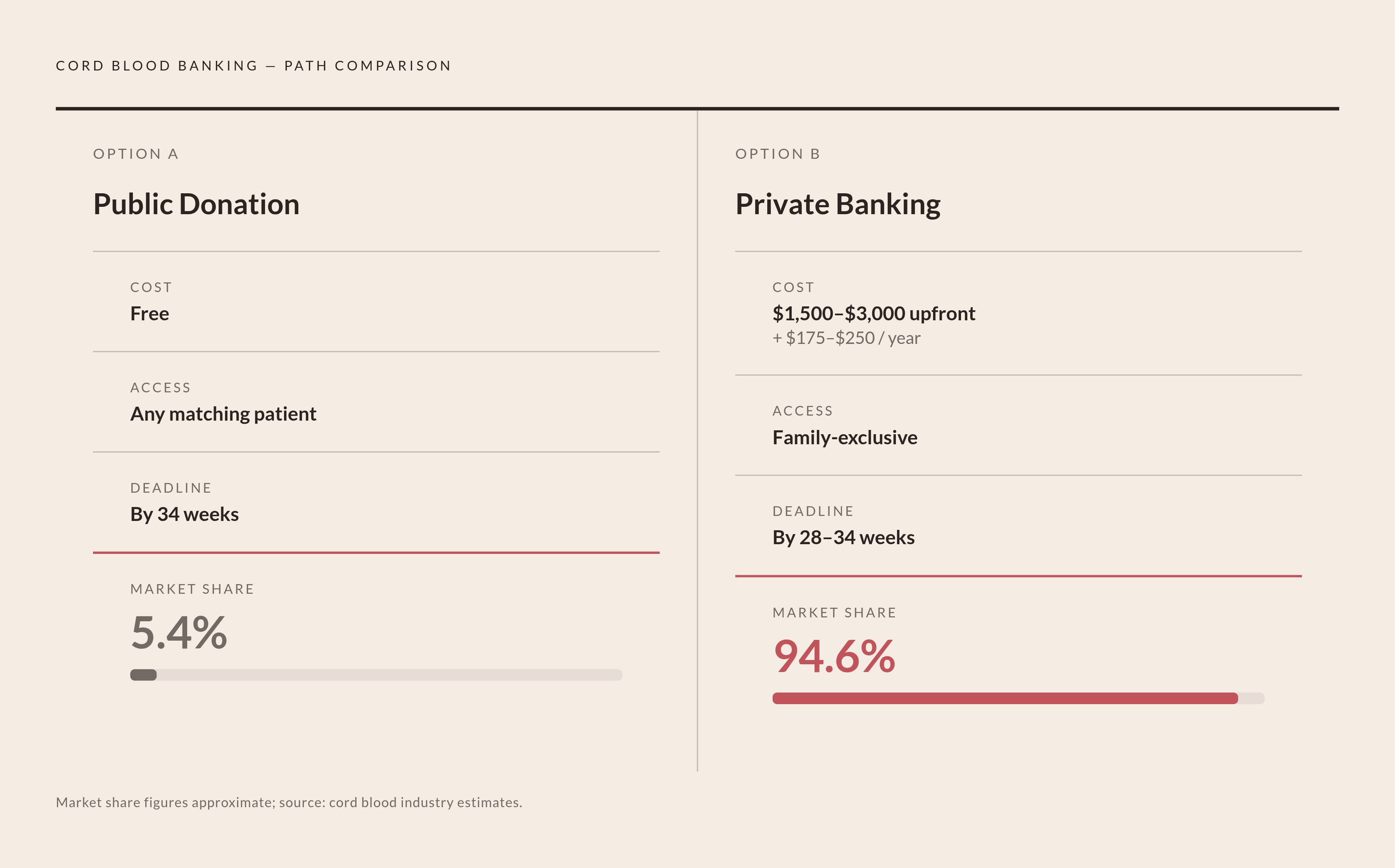
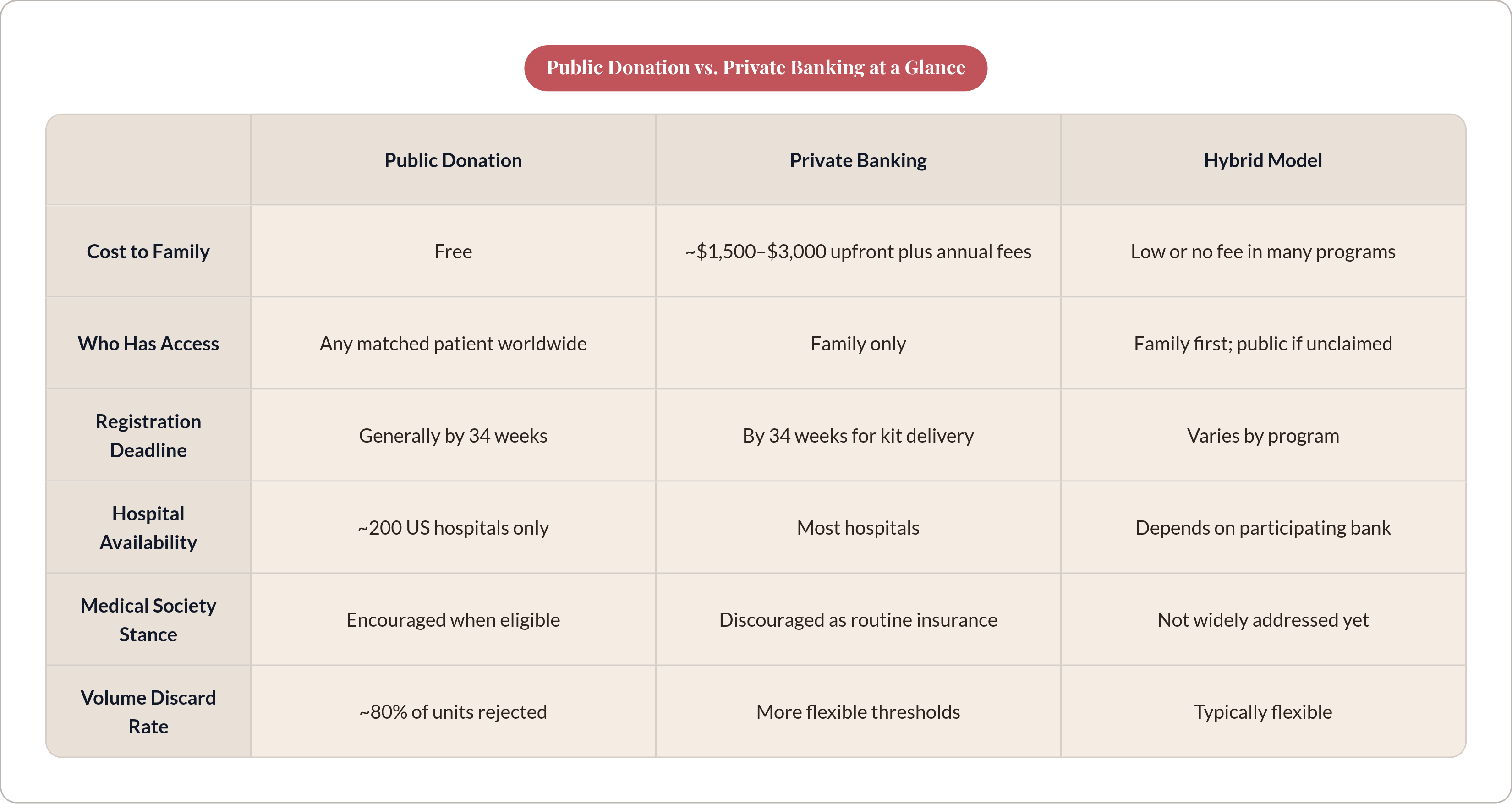
The choice between public donation and private banking is the decision everything else follows from. It determines which hospitals are viable for delivery, which registration timelines apply, and how the birth plan must be written. Making it late forecloses options that can't be recovered.
Public cord blood banking is free to the family. The donated unit enters a shared registry, available to any patient who matches, and is also directed toward research. Roughly 200 hospitals in the United States accept donations, a number concentrated in large birthing centers. Public banks impose strict volume requirements, and approximately 80 percent of donated units are discarded because collected volume falls below threshold. Registration is generally required by 34 weeks; walk-in donations are not accommodated.
Private banking inverts the model: the family retains exclusive access. Upfront costs run approximately $1,500 to $3,000, with annual storage fees of roughly $175 to $250. Private banks held approximately 94.6 percent of market share in 2024. The American College of Obstetricians and Gynecologists, the American Academy of Pediatrics, and the American Medical Association all counsel against private banking as routine biological insurance, noting that the probability a child uses their own stored unit over a lifetime is very low. The AAP does recommend private banking when a sibling has a condition treatable by cord blood transplantation. That recommendation is narrow and specific, and it's worth understanding before making the call.
A hybrid model is increasingly available. Under these programs, families store privately but commit to donating the unit for public use if it goes unclaimed after a defined period, and some charge little to no fee. For families genuinely undecided between altruistic donation and family access, this arrangement deserves a serious look.
First Trimester: The Right Time to Start Learning, Not Deciding
Enrolling in a cord blood banking program during the first trimester is premature. The decisions that matter can't responsibly be made yet. But the families who use those weeks to build a foundation of understanding are almost always better positioned later, and the ones who don't tend to feel it under pressure when the actual deadlines arrive.
Productive first-trimester research has a specific scope: understanding the difference between cord blood, cord tissue, and placental tissue banking; confirming whether the planned delivery hospital participates in public donation programs; and developing a realistic sense of private banking costs so that the financial dimension doesn't land as a surprise when a decision actually needs to be made.
The first trimester is also the right moment to raise the subject with an OB-GYN or midwife. A documented family history of blood cancers, immune disorders, or sickle cell disease in the immediate family moves the conversation from general interest to genuine clinical relevance. A physician can contextualize that distinction in ways no website can, and the earlier that conversation happens, the more it can actually shape the decision rather than simply validate one already made in isolation.
One practical detail families often overlook: FSAs, HSAs, and HRAs can cover cord blood banking costs when a physician provides a Letter of Medical Necessity, and some insurance plans cover costs when a documented medical need exists. These arrangements can't be established retroactively. Families who want to pursue this pathway need to begin before there's any urgency to do so.
Second Trimester: Comparing Providers and Making the Actual Decision
Weeks 20 through 27 are the appropriate window for comparing private banks and committing to a decision. The Health Resources and Services Administration recommends having the cord blood conversation with a provider approximately three months before the due date, which places it squarely in the late second trimester for most pregnancies.
When evaluating private banks, the quality markers are specific and verifiable: AABB accreditation, FACT accreditation, and FDA registration as a licensed biological tissue bank. These represent audit standards, processing protocols, and regulatory oversight. Any bank that can't confirm all three deserves hard questions before trust is extended.
Beyond accreditation, the operational questions matter just as much. What happens to stored samples if the company closes or is acquired? What volume thresholds must a collection meet to be accepted? What's the failed-collection policy? These questions reveal how a bank behaves when things go sideways, which is precisely when the answers matter most.
Cost structures require careful decomposition. Upfront fees in the $1,500 to $3,000 range are easy enough to compare. Annual storage fees of $175 to $250, compounded over 20 years, add $3,500 or more before processing costs are included. Many banks offer prepaid storage plans covering 18 or 20 years, or lifetime storage at a fixed rate; for families planning long-term storage, these arrangements often represent meaningful savings and protection against future fee increases.
By week 28, the decision should be made and documented. The OB-GYN should be informed, and the choice should be reflected in the birth plan. Families choosing public donation should confirm by week 28 whether their hospital accepts donations and what registration requires, because some hospitals layer their own paperwork and timelines on top of the bank's requirements.
The Delayed Cord Clamping Conflict Parents Need to Resolve Before Week 34
Delayed cord clamping is the current clinical standard. Allowing blood to continue flowing from the placenta to the newborn for at least 30 to 60 seconds after birth is associated with higher hemoglobin levels, improved iron stores, and better neurological outcomes in preterm infants. The practice is endorsed by ACOG, the AAP, and the World Health Organization.
The conflict with cord blood collection is physiological, not procedural. Delayed clamping transfers blood from the cord and placenta to the baby, and that blood is precisely what would otherwise be collected. Public banks already discard roughly 80 percent of donated units due to insufficient volume; delayed clamping reduces collection volume further. Private family banks generally maintain less rigid volume requirements, so the tension is somewhat less acute in that context, but it doesn't disappear.
This tradeoff can't be resolved during labor. It needs to be written into the birth plan before delivery, because the right balance depends on the baby's gestational age, clinical circumstances at delivery, and the family's banking goals. The only person positioned to weigh those variables honestly is the care provider, consulted weeks in advance, not a nurse handed a birth plan mid-contraction.
Weeks 28–34: The Optimal Enrollment Window and What Must Be Completed
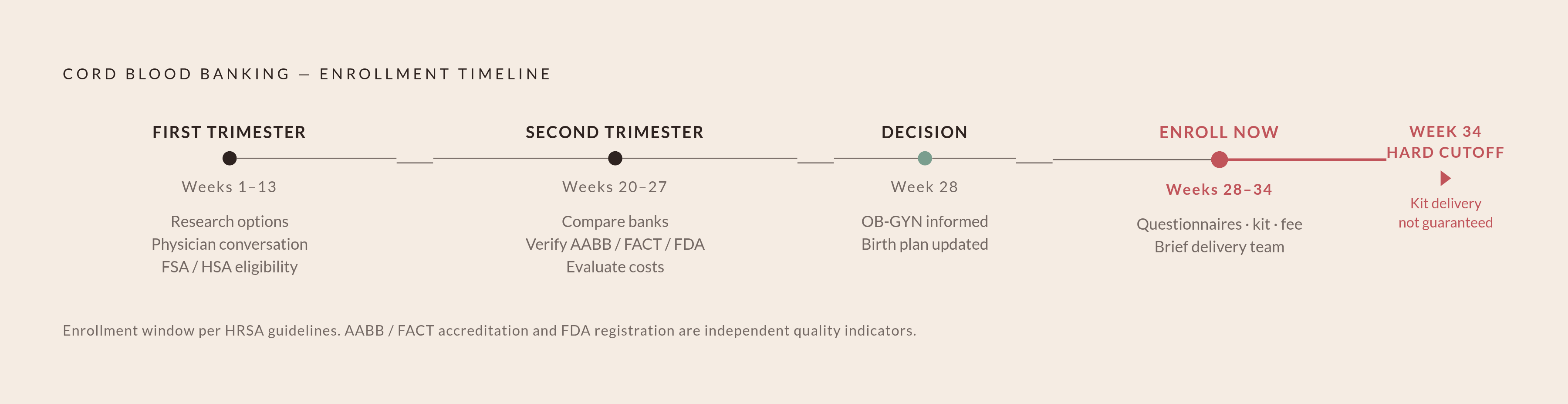
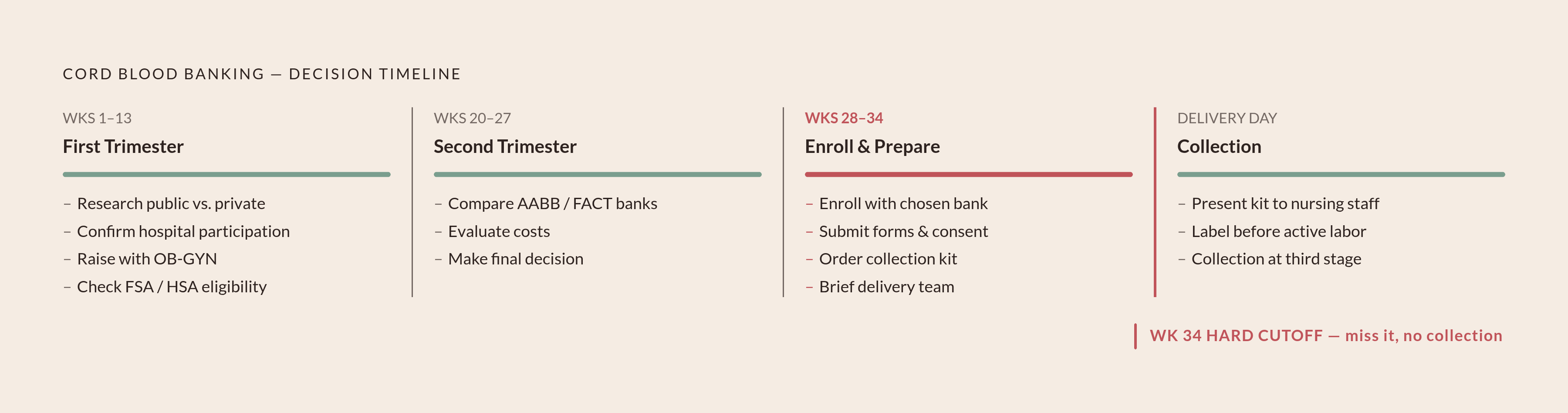
The 28-to-34-week window is the HRSA-recommended enrollment period, and virtually every consequential logistical task must be completed within it. There's no grace period built into this timeline, and early labors don't announce themselves.
Enrollment with the chosen bank must be completed. Health history questionnaires and consent forms must be signed and submitted. The collection kit must be ordered and confirmed as en route; most hospitals don't stock kits on-site, and a kit must be sent specifically for each delivery. Payment of the collection fee to a private bank is typically required before delivery. The OB-GYN and the full delivery team must be briefed. The decision must be documented in the birth plan, in writing, accessible to any clinician present at delivery.
Dr. Masterson, an OB-GYN at Summit Health, specifically identifies the early third trimester as the moment to formalize the cord blood conversation with the care team and align on whether private or public banking fits the family's medical history and delivery circumstances. That alignment, confirmed in writing, is the actual product of this phase.
Missing the 34-week cutoff has concrete consequences. A kit won't arrive before delivery if enrollment is delayed. Any delivery before 37 weeks is preterm, and there's no margin beyond week 34 for rushed logistics. Consent paperwork can't be completed during active labor. Most banks will no longer guarantee kit delivery before birth after that point, and without the kit, there's no collection.
What Happens at the Hospital: The Day-of Logistics Parents Need to Plan For
Collection occurs during the third stage of labor, the interval between the birth of the baby and the delivery of the placenta. It's performed on the delivered placenta while it remains outside the mother's body, or on the cord immediately after clamping, and the procedure is the same for vaginal and cesarean deliveries. Some research indicates that cesarean collections yield higher blood volume, though this varies by case.
When parents arrive at the hospital, informing nursing staff about the cord blood banking plan is the first order of business. The collection kit must be presented. It contains identification labels that must be completed before collection begins, and that paperwork needs to be handled calmly, well before active delivery. The parents who handle this smoothly are the ones who already answered every question on those forms weeks earlier.
Even with thorough preparation, collection can fail. Insufficient collected volume is the most common reason. Preterm delivery reduces available blood. Emergency circumstances divert clinical attention. And if the delayed cord clamping question was never resolved in advance, it surfaces as a conflict at precisely the moment when no one has the capacity to work through it.
None of this interferes with delivery, skin-to-skin bonding, or immediate newborn care. Collection happens on the already-delivered cord and placenta. The baby is with the parents.
The day-of process is manageable because all the consequential decisions were made weeks earlier. The research, the comparisons, the provider conversations, the enrollment completed before week 34: that work is where this process actually lives. When it's done, the hospital is mostly paperwork. When it's not, the window is simply gone.