Hidden Fees in Cord Blood Banking Contracts
Banks exploit the timing of cord blood decisions to lock families into uncapped fee increases.

The decision to bank a newborn's cord blood gets made under conditions almost no other financial contract is signed in: during pregnancy, under emotional weight, against a collection window that closes the moment the baby is born and never reopens. There is no second chance to gather that tissue, so there is no second chance to shop around once the child arrives, and the sales conversation happens entirely before the family has any lived experience of what a twenty-year billing relationship with the bank will actually feel like. That timing is not incidental to the fee structure; it is the condition that allows the fee structure to exist. A federal health regulator regulates cord blood banks on the biological side: establishment registration, donor screening, and good tissue practices. The agency does not regulate what banks charge, how contracts are written, or whether fee-escalation clauses have to be disclosed clearly at enrollment, and no federal agency currently fills that gap. Some banks now market "zero hidden fees" and point to AABB accreditation as proof of their own transparency, and that marketing choice is itself a tell: a company only needs to promise the absence of hidden fees in an industry where hidden fees are common enough to be a selling point.
The five fee layers that make up the actual first-year cost
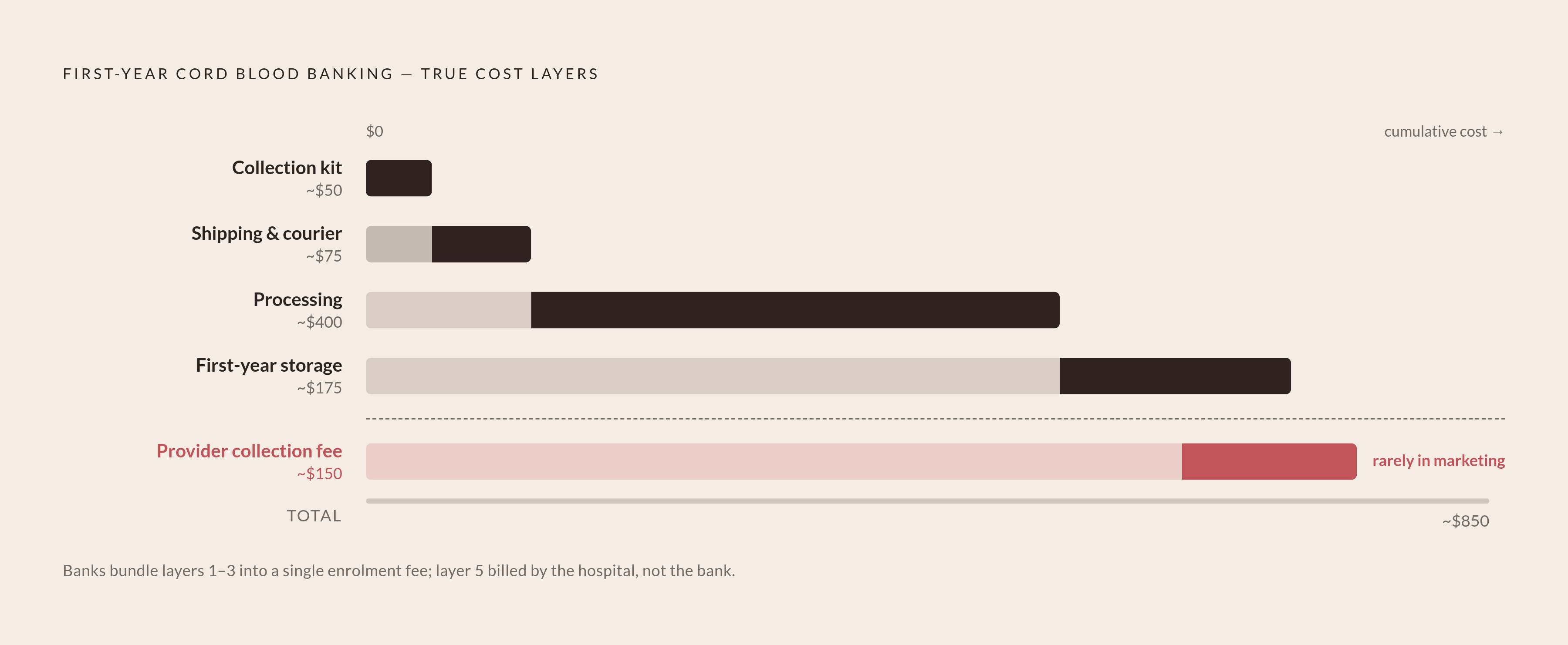
The price quoted at enrollment is rarely the number a family actually pays in year one, because that headline figure is built from five separate cost layers that different banks combine or split apart in different ways. The first layer is the collection kit, the set of materials used to gather the cord blood at birth. Some banks fold this into the enrollment fee; others bill it on its own or tack it onto the annual charge, and the range between providers is wide enough to change the comparison on its own. The second layer is shipping and courier service, the cost of moving the collected specimen from the delivery room to the lab. Some banks include return shipping in the enrollment price; others charge separately for the specialized courier and the cryogenic transport container that keeps the sample viable, and the choice of courier matters beyond cost. Families should ask directly whether a bank uses a standard commercial carrier like DHL or a dedicated medical courier, because that answer carries safety weight as well as price weight.
The third layer is processing, the lab step where clinical scientists separate hematopoietic stem cells from red blood cells and plasma. Some banks price this into the enrollment package; others quote it as its own line item, and the method used matters beyond the invoice. AlphaCord's 2026 guide points out that removing a high share of red blood cells at this stage is a key quality marker, since red blood cells left in the sample can rupture during freezing and damage the specimen. The fourth layer is the first year of storage itself, which some banks wrap into the enrollment bundle and others bill on its own starting on the child's first birthday, a pattern CBR describes for its own plans. That bundling choice does more than shift when a family pays. It makes it harder to compare what year two will cost across different providers, since the baseline a family thinks they're paying may exclude storage. The fifth layer is the fee some banks pay the healthcare provider who collects the cord blood at delivery. Some cover this cost themselves; others pass it to the family, and it rarely appears in marketing material. CBR's own pricing page lays out processing and shipping as flat rates and offers three storage tiers (annual, 18-year, and lifetime), a fairly clear structure, though it still flags that storage costs vary by plan. MiracleCord's pricing page states that annual storage fees start in the second year and that deposits can't be refunded, two terms that change the real total cost and are easy to miss if a family is only looking at the first invoice.
The fee that does the most financial damage over time: annual storage escalation
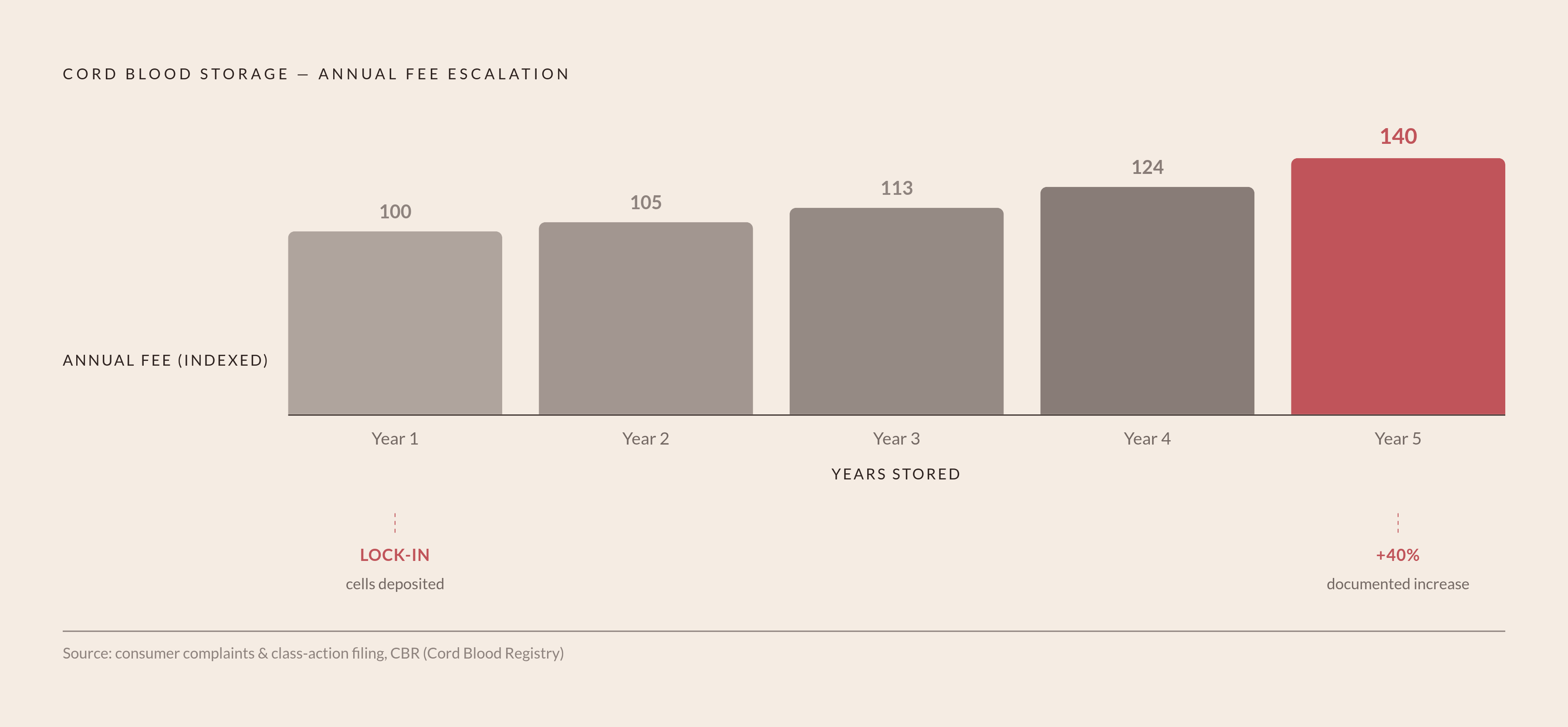
Among the five layers, the one that causes the most lasting financial harm is annual storage, because its cost grows quietly across a relationship that can run twenty years, and the contracts governing it are typically written to allow increases without any ceiling. As recently as September 2026, CBR's promotional terms stated that clients are responsible for storage fees after the first year and that those fees are explicitly "subject to change," language that has not been softened despite years of lawsuits and regulatory scrutiny aimed at exactly this clause. That phrase is accurate on its face and does real work in obscuring what a family is actually agreeing to across two decades.
Documented complaints reveal a gap between what gets said in the sales conversation and what the contract actually permits. One complaint on record describes a CBR sales representative telling a prospective customer that the company had a fifteen-year history of not raising storage fees, a claim followed by a fee increase on that customer's very first bill in 2019 and another increase the year after. A separate documented complaint describes a price increase of roughly forty percent over five years, with the customer reaching the point of weighing a switch to another plan, constrained the entire time by the fact that leaving would mean losing the stored cells already paid for. That constraint is the mechanism that makes storage escalation so damaging: once a family's cells sit in a tank, walking away means giving up a biological asset that can never be recollected, and that lock-in drives price sensitivity toward zero no matter how much the annual fee climbs. A class-action suit against CBR Systems Inc. alleged the company "slyly and substantially" raises its annual storage fees over time, pushing consumers to pay far more than they agreed to at signing, and the Texas Attorney General separately sued CBR Systems Inc. over claims it exploited new parents trying to protect their children. These are documented complaints and legal actions, not settled findings of wrongdoing, but together they describe a consistent pattern.
None of this means every fee increase is improper. Banks face real and rising costs, facility upkeep, regulatory compliance, inflation, and some movement in storage pricing reflects that reality. The defense holds up for modest, disclosed, capped adjustments. It does not explain open-ended escalation clauses with no ceiling, and it does not explain a sales representative citing fifteen years of price stability right before two consecutive increases.
The fees that appear only when you try to use or move what you paid to store
A third zone of hidden cost opens up only at the moment a family actually tries to use or relocate what they've been paying to store, and that moment arrives, if it ever does, at the worst possible time to negotiate: during a medical crisis. A retrieval fee covers preparing the stored unit for transplant, and the structure of that fee varies by provider and by the type of retrieval involved. A separate transfer or release fee can apply when a family wants to move stored cells to a different bank, whether the reason is a pricing dispute, concern about the bank's financial health, or a simple change in preference, and that charge sits apart from the cost of the cryogenic transport itself. The dewar and the medical courier needed to move a sample safely are typically billed to the family at the point of retrieval rather than built into the ongoing storage fee, a detail easy to overlook when comparing enrollment packages side by side.
Some banks now advertise that they waive retrieval charges in the case of life-saving treatment, framing it as a point of differentiation, and that marketing choice confirms retrieval fees are the norm elsewhere. MiracleCord's pricing page goes further and offers to match any competitor's price for comparable services, an offer that only makes sense if retrieval and transfer pricing vary enough across the industry to function as a real point of competition. A second risk compounds the financial one at exactly this moment. A BMJ investigation found that some private banks listed more than 75, in one case over 80, treatable disorders that medical experts described as unrealistic claims about what cord blood banking can actually address. A family reaching for stored cells at a moment of medical need may discover the therapeutic promise they paid for years earlier doesn't apply to their child's actual condition. That's a problem about the value of what was purchased, and it deepens the financial injury: years of storage payments have gone toward an asset that may not be usable for the situation the family actually faces.
Payment Plan Financing and Total Cost
Financing charges are the part of the cost structure families are least likely to factor into their comparisons, largely because they appear as a monthly number rather than a total one. CBR's pricing overview advertises payment plans that start at a modest monthly rate with no processing fees due until the baby is born, a structure that is genuinely considerate in its timing but does not make clear what the total financing cost will be once the plan runs its course. MiracleCord's pricing page states directly that families "may prepay in part or in full, lowering the total amount of finance charges," language that only makes sense because financing plans carry charges that raise the total cost above what a lump-sum payment would run.
The practical effect is that two families enrolling with the same bank at the same advertised rate can end up paying noticeably different totals over the first few years, depending only on which payment structure they chose, and that gap is absent from the marketing comparisons families use to pick a bank. Financing charges also tend to interact with promotional discounts in ways that blur the real savings: a discount applied to the enrollment fee can be partly canceled out by finance charges on whatever balance remains, so the net savings end up smaller than the headline percentage suggests. Before signing anything, families should ask what the plan costs if paid in full today, what it costs on the standard monthly plan, and what the financing charge is that accounts for the gap between those two numbers, since it belongs in the comparison the same way the storage fee does.
Contract language versus the sales conversation
The single costliest gap in this entire structure is the space between a clause that is legally sound and a sales conversation conducted as though that clause doesn't exist. The "subject to change" language attached to annual storage fees sits right there in the contract, fully disclosed in a technical sense, and it is almost never explained during enrollment in a way that conveys what it actually means across a twenty-year horizon. The documented complaint about a CBR sales representative citing fifteen years of fee stability, followed almost immediately by two consecutive increases, shows how a statement that is historically true can still function as a misleading forward-looking promise. Complaints filed with the Better Business Bureau led attorneys to look into whether customers who signed up for annual storage plans were misled about what they'd be paying, and several parents involved said they had believed their annual fee was fixed for good.
The FDA's regulatory gap is what allows this pattern to continue without triggering any legal violation. Because no federal agency requires banks to prominently disclose escalation clauses at the point of enrollment, the distance between what a sales representative says and what the contract permits is a predictable feature of an industry with no disclosure mandate governing it. A major physicians' professional association holds that private cord blood banking should generally be considered only when a family has a specific predisposition to a condition that umbilical cord stem cells are known to treat. Many families enrolling may be making decisions shaped by inflated expectations on two fronts at once, the price they'll ultimately pay and the medical benefit they're actually buying.
The specific questions that expose each fee layer before signing
Because no regulator forces banks to disclose fees in a uniform way, the only dependable tool a family has is a short, specific set of questions asked before any contract is signed, each one aimed at a different layer of the structure described above. On the first year's total cost, ask for a written, itemized breakdown of every charge due before the child's first birthday, covering the collection kit, shipping, processing, and first-year storage, and ask which of those are bundled into one price and which will be billed on their own. On collection and transport, ask whether the bank uses a standard commercial carrier or a dedicated medical courier for the return shipment, and ask whether the fee paid to the healthcare provider for collecting the sample is covered by the bank or passed along to the family. On storage, ask in direct terms whether the annual rate is fixed for the life of the contract or can be raised, ask to see the actual contract language governing any increase, and ask for the bank's history of annual fee changes over the past several years. If the answer offered is some version of a strong track record of not raising fees, ask to have that commitment put in writing, since the documented complaints above show how far a spoken assurance can drift from what the contract actually allows.
On prepaid and financed plans, ask for the full cost of paying up front compared against the projected total of a monthly plan over the same stretch of years, and ask what happens to money already paid if the bank closes, is sold, or is acquired by another company. On retrieval and transfer, ask whether pulling the sample out for use carries its own fee, whether that fee is waived for life-saving treatment, and what the process and cost look like if the family ever wants to move the sample to a different facility. On financing specifically, ask for the total cost paid in full versus the total cost on the standard monthly plan, since the gap between those two figures is the financing charge, and any advertised discount should be measured against that gap. Finally, ask whether the bank holds AABB accreditation, an independent quality standard that transparent-pricing banks already use to set themselves apart, and treat the straightforwardness of the answer itself as information: a bank with nothing to obscure tends to answer these questions quickly and in writing.
Sources
- The Hidden Costs of Cord Blood Banking: What Families Need to Know
- The Hidden Costs of Cord Blood Banking: What Families Should Know
- What Every Family Should Know About Cord Blood Banking Costs
- Decoding Cord Blood Banking Fees: A Step-by-Step Guide
- Understanding Cord Blood Banking Fees: A Parent's Guide