Cold Chain Logistics for Cord Blood Units in Transit
Temperature control during transit determines whether cord blood stem cells survive for transplant.

Cord blood banking rests on one hard requirement: the stem cells inside a unit have to reach a transplant center alive and functional, no matter how far they travel or how many hands touch the box along the way. That trip crosses two entirely different temperature worlds, a warm, time-limited window before freezing and a cryogenic window after it, and each comes with its own packaging, its own failure points, its own rulebook. Precedence Research pegged the global cord blood banking market at $17.67 billion in 2024, headed toward $28.83 billion by 2034, a 5.02% annual climb, with North America holding 38% of that market. More units moving through more corridors means the logistics either scale to match or become the weak point in an otherwise sound therapy.
What happens to cord blood cells when temperature or timing slips during the pre-freeze window
Right after collection, a cord blood unit is still living tissue. The nucleated cells inside start breaking down the moment cryoprotection gets delayed, which is why the pre-freeze window is the most fragile stretch of the whole trip, full stop. German regulatory practice draws a hard line: processing and freezing must happen within 48 hours of donation, with the unit held at 22 ± 4°C the entire time. That ceiling reflects what the cells can survive, yes, but it also reflects what regulators have decided they're willing to accept as a margin.
A study of 3,000 umbilical cord blood units processed inside that window found pre-freeze viability ranging from 61.86% to 99.5%, averaging 94.37 ± 4.67%. About 95.14% of units came in above 85% viability, but only when processing time stayed under control; researchers found a clear negative relationship between elapsed time and viability, the longer a unit sat, the worse its average cell survival got.
Viability isn't one number. A separate study of 28 cord blood donations tracked CD34+ and CD45+ cells separately and found they age at completely different rates. CD34+ viability stayed above 92.33 ± 4.11% even by day three. CD45+ dropped hard over that same stretch, from 86.36 ± 4.97% down to 66.24 ± 7.78%. CD34+ cells are a clinically critical population, so a unit can look fine on total nucleated cell count and still carry a much weaker CD34+ population than the paperwork suggests. TNC counts alone don't tell you enough. I'd argue they never did.
Here's the wrinkle that trips people up every time: German data show that keeping units within the 22 ± 4°C range produces better colony-forming unit potential than refrigerating them to 4°C before processing. Cooler storage only wins once transit runs past 24 hours, because it slows deterioration over the longer haul. The right pre-freeze temperature depends on how much time has already elapsed. Keep the unit inside a validated range, get it processed fast, and the rest follows.
Pre-freeze packaging: what collection kits must do and where they can fail
The collection kit is the first real line of defense, and it's also the piece a bank controls the least. Required transport temperature during this phase sits between 39°F and 75°F (4°C to 24°C), held with isothermal bags built for that range.
Private banking adds its own wrinkle. A mother receives the kit weeks in advance, hands it off to a doctor or midwife at delivery, and the processing lab, at companies like Anja Health, a cord blood and placenta banking service built around affordability, might sit hundreds of miles away. Forty-eight hours or more of transit is the norm here, not the exception. Every piece inside that kit, the collection bag, the labels, the shipping materials, has to arrive at the birth already validated to hold its temperature range. FACT standards require the outer container itself to be validated for the maximum transit time set for that shipment, not just labeled with a target range on paper. The UK's Human Tissue Authority goes further, requiring packaging to limit contamination risk while holding the specified temperature for the full expected transit window. In practice, that means the validation paperwork isn't optional, and any bank that treats it as boilerplate is asking for trouble.
Most failures at this stage trace back to gaps nobody's watching. A kit sits on a counter for hours before the courier shows up, no temperature log running. An isothermal bag gets left in a hot car or on a cold loading dock past its tested range. A labor and delivery nurse who's never handled one of these kits before seals it wrong, not out of carelessness, just unfamiliarity. These are the ordinary failures that emerge when non-specialist staff handle specialized material under time pressure. Validated, in this context, means the kit's been tested across the conditions it's actually likely to hit in the field, not once under clean lab conditions and never again. Staff training at the collection site and rigorous kit validation carry more weight here than almost anywhere else in the chain, precisely because the bank has so little direct control at this stage.
Cryogenic transport after freezing: dry vapor shippers and the physics of staying below −150°C
Once a unit is cryopreserved, the rules change completely. It has to stay at −150°C or colder for the rest of the trip, because warming above that threshold risks recrystallization and irreversible cellular damage.
A dry shipper, sometimes called a cryoshipper, keeps the unit in vapor rather than liquid. An absorbent material locks the liquid nitrogen in place so the shipper stays spill-free even while it's being loaded, unloaded, and jostled around a cargo hold. An outer shell handles insulation and absorbs the physical hits.
Capacity and hold time drive route planning more than people expect. MVE's Blood Bag Cryoshipper holds up to ten 250 mL blood bags; the standard model holds cryogenic temperature for 10 days, the XC model stretches to 14. Those extra four days matter enormously on an international route, where a customs delay or a missed connection can eat up time nobody budgeted for. Charge time matters too: a shipper that charges quickly can go from empty to loaded and out the door the same day. When a transplant center needs a unit fast, that turnaround counts for a lot.
There's a failure mode that doesn't show up until someone actually tests for it: tilt. If a cryoshipper gets tipped on its side during transit, the absorbent material can shift and change how vapor circulates inside, which can let the unit warm. Not every shipper on the market has published tilt validation data. Any bank sourcing containers should ask for it directly rather than assume it exists, because assuming is how gaps happen. Anti-tipping designs with locking mechanisms exist and are worth specifying for any shipment going by road or air, where rough handling is the rule rather than the exception.
For bigger or longer shipments, phase change material pallets like the Nordic Global 456 offer a different kind of protection, rated for 110-plus hours at ambient temperatures between 32°F and 77°F, and 120-plus hours in cooler conditions. Picking the right container isn't a decision made once and forgotten. Route length, expected ambient temperature, how many units are moving together, whether recharge stations exist along the way, all of it factors into which shipper makes sense for a given trip.
The regulatory and accreditation framework that governs every transit decision
Three layers of oversight sit on top of every transit decision in the U.S. Federally, the FDA regulates cord blood under federal rules governing human cellular and tissue-based products. On the accreditation side, AABB and FACT are the two principal accrediting bodies in this space. And any bank shipping units internationally has to satisfy the receiving country's own rules too, whether that's an EU tissue directive or the UK's Human Tissue Authority standards.
FACT and AABB don't say the same thing about transit. FACT requires validated, documented temperature control through storage, transport, and shipping. AABB sets its own transit standards, which differ from FACT's approach. A bank aiming for the stronger audit trail ought to recognize that FACT sets the higher bar and build its procedures to that bar, not the lower one. This isn't a close call.
Across both frameworks, "validated" carries a specific meaning. Temperature ranges have to be written down before the shipment leaves. Packaging has to be tested to prove it holds those ranges for the longest transit time expected, and any deviation has to be documented and evaluated for what it means for the unit's release. Air shipments carry a further layer of compliance obligations separate from anything the FDA or an accrediting body requires.
None of these frameworks tell a bank which container brand to buy. They specify outcomes, temperature held, viability preserved, and leave the method up to the bank. That makes a bank's transit standard operating procedure a regulatory document in its own right, one that needs version control, staff training tied to it, and documentation that holds up when an auditor asks to see it.
Monitoring and chain of custody: how temperature data travels with the unit
Keeping a unit cold is half the job. Proving it stayed cold is the other half, and regulators and transplant centers want evidence, not a verbal assurance that everything went fine.
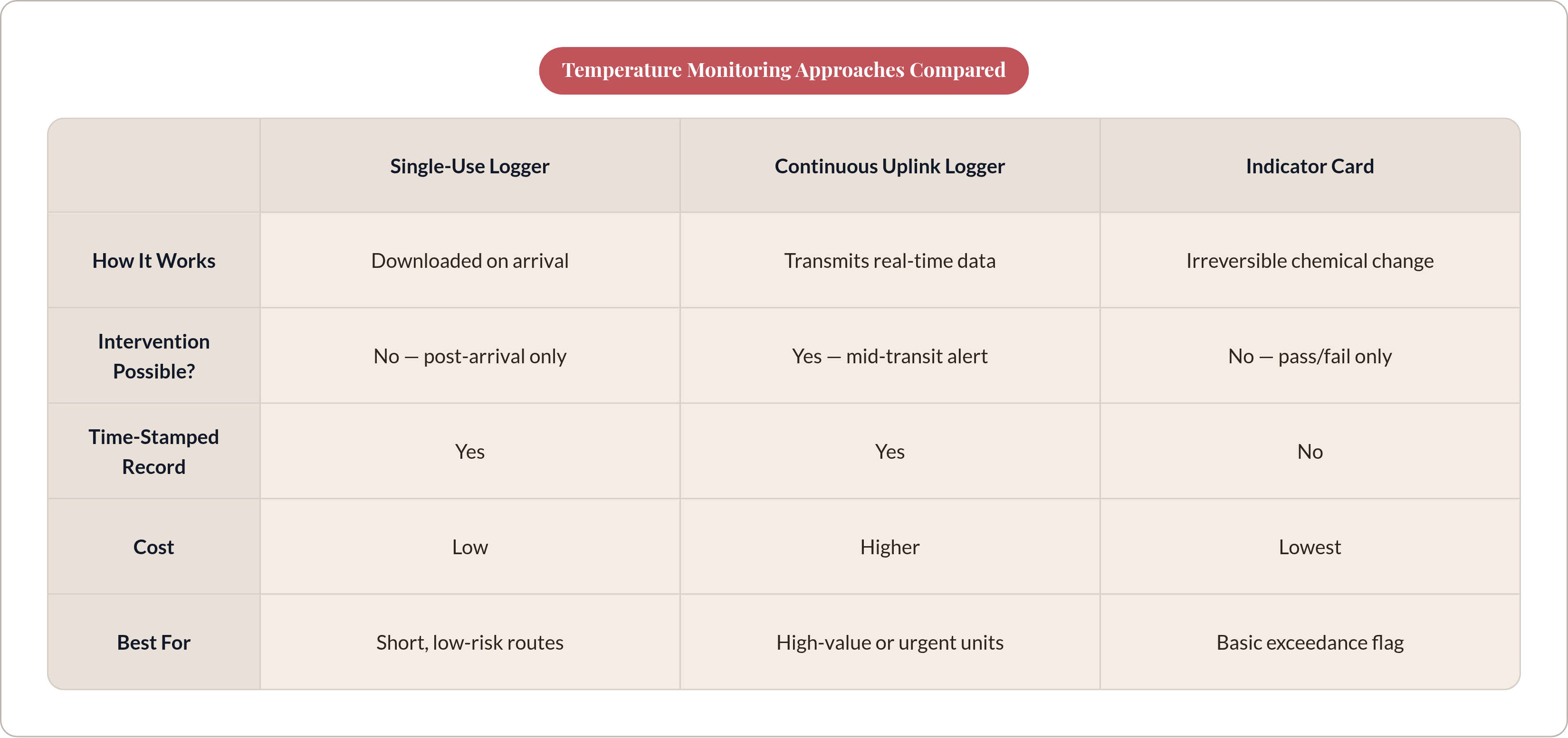
Three monitoring approaches cover most of the field, and each trades off differently. Single-use temperature loggers sit inside the shipper and get downloaded once the unit arrives, cheap, but they give no warning if something goes wrong mid-transit. Continuous data loggers with cellular or satellite uplink transmit temperature and location in real time, which gives someone the chance to intervene, redirect a shipment, alert a receiving center, before the unit ever gets there. Indicator cards use an irreversible chemical change to flag a simple pass or fail on temperature exceedance, but they leave no time-stamped record behind, which is its own kind of blind spot.
Chain of custody has to tie all of this together on paper: the unit's identifier linked to the shipper's identifier at departure, courier handoff records with timestamps, condition-on-receipt documentation once it reaches the transplant center, a temperature log archived and connected to the unit's release record. None of that works after the fact if a bank hasn't already decided, in writing, what happens when a temperature excursion actually occurs. A workable plan needs a threshold that triggers a hold or quarantine, a named person with authority to make that call, criteria for weighing excursion duration and severity against clinical urgency, and a documented rationale for whatever decision gets made.
Courier selection matters here too, more than most banks want to admit. A courier with validated cold chain handling and GPS tracking produces the audit trail a regulator will ask to see, on top of moving the box faster. And when a bank hands shipping off to a third-party logistics partner, the contract needs to say explicitly who's responsible for monitoring, because the regulatory responsibility stays with the bank no matter who's physically holding the shipper.
Where cold chains break in practice and what the data say about preventing it
Most cold chain failures in biological shipping trace back to handoffs, not hardware. The riskiest moments in a cord blood unit's trip sit at the seams between one custodian and the next, well outside the cryoshipper itself.
The collection site to courier pickup is often the longest unmonitored stretch of the entire journey, no active temperature control running while the kit waits on a counter somewhere. Airport handling introduces its own risks: a cryoshipper can end up sitting on a tarmac, stored in a cargo area with no climate control, or tipped during loading in a way that triggers the exact tilt problem MVE tested for. Customs clearance adds unpredictable dwell time in facilities never designed with cryogenic cargo in mind. Last-mile delivery, the handoff from courier to clinical staff, is its own risk point if the shipper sits in a receiving area before anyone opens it.
Long-term storage data show what's possible when nothing goes wrong. José Carreras Cord Blood Bank data from 2024 found mean total nucleated cell viability of 88.91 ± 5.01% after 29 years in storage for unseparated units. The biology holds up fine when storage conditions stay steady; cell degradation over decades simply isn't the constraint here. So when a unit loses viability in transit, it's almost never because the biology gave out on its own. It's a process failure, a gap in monitoring, a step someone skipped.
Some of those skipped steps are mundane and entirely preventable. A cryoshipper that didn't get its full charge time before loading will have a shorter and less predictable hold time than the spec sheet promises. Recharging a shipper in the field without validated equipment introduces the same risk. And private banking's longer pre-freeze window compounds all of this: a kit that sits unmonitored for 36 hours before a courier ever picks it up can still land inside the 48-hour window on paper while having quietly experienced a temperature excursion that no logger ever caught. Testing packaging and monitoring against the real ambient conditions of the actual routes being used, rather than a generic lab standard that has nothing to do with the corridor a unit will travel, closes this gap. There's no shortcut around it.
Building a transit protocol that connects every stage into a defensible whole
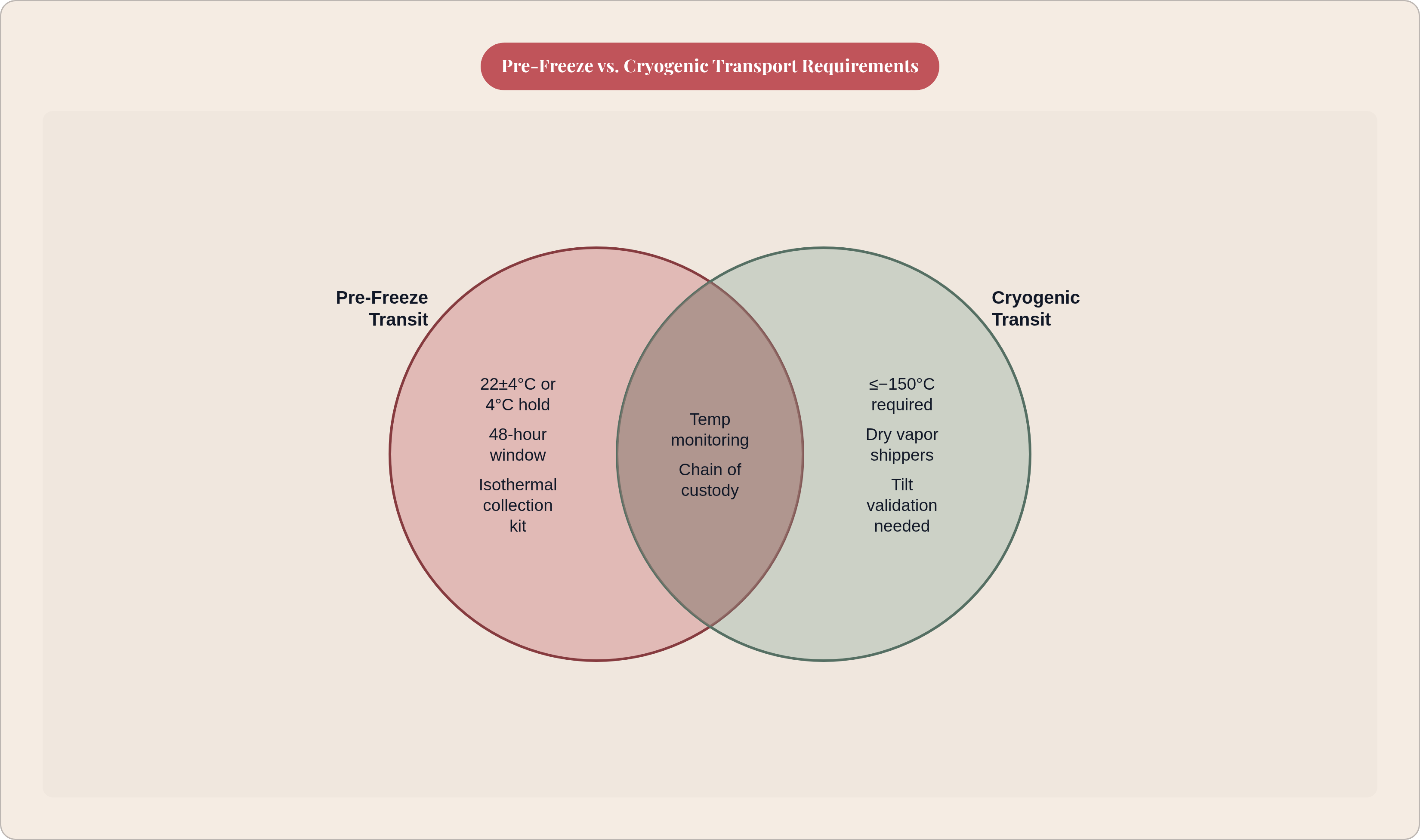
The two temperature regimes, pre-freeze and cryogenic, fail for different reasons and need different fixes. No single fix closes every gap described above, and anyone selling you one probably hasn't shipped enough units to know better.
A protocol that treats the whole trip as one continuous chain, rather than a pre-freeze problem handed off to a separate cryogenic problem, is the version that holds up under audit and under pressure. Validated kits at the collection site, tested against real-world conditions rather than a single lab scenario. Tilt-tested, properly charged cryoshippers matched to the actual route length and ambient forecast. Continuous monitoring wherever the shipment's value and urgency justify the cost, and a written excursion response plan naming who decides and on what basis, before the unit ever leaves the building.
Every one of those pieces already exists as established practice somewhere in the industry. The banks that protect unit viability best are the ones that stitched every stage into a single, documented protocol and treated the handoffs between stages as seriously as the stages themselves. That's not a complicated insight. It's just a rare one to see executed consistently, which tells you something about how hard the execution actually is.