What Diseases Are Treated With Cord Blood Stem Cell Transplants
Cord blood stem cells can treat more than 80 diseases, from sickle-cell disease to leukemia.
Cord blood stem cells collected at birth can treat more than 80 distinct diseases. The hematopoietic stem cells (HSCs) contained in cord blood are capable of producing every type of blood and immune cell the body requires, for a lifetime. When infused into a patient following a conditioning regimen, those cells engraft in the bone marrow and rebuild the blood and immune system from the foundation up.
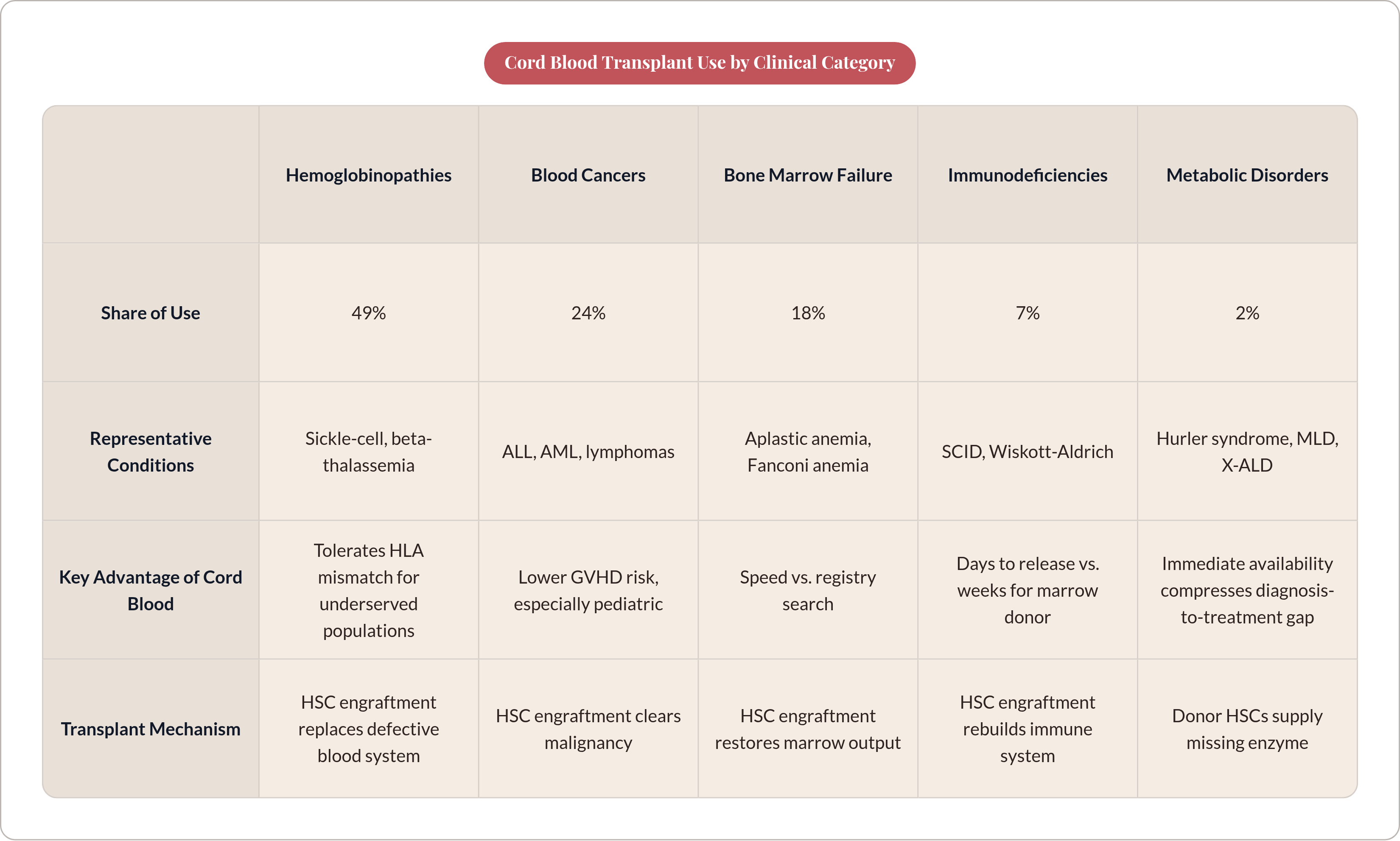
Five established clinical categories define where cord blood transplantation currently operates: hemoglobinopathies, blood cancers, bone marrow failure syndromes, inherited immunodeficiencies, and inherited metabolic disorders. The Parent's Guide to Cord Blood Foundation maintains and publishes the disease list. Nearly 5 million cord blood units are stored worldwide. The C.W. Bill Young Cell Transplantation Program registry held more than 247,900 units available for unrelated transplant as of FY2025. In 2024, CIBMTR reported more than 22,500 hematopoietic cell transplantations performed in the United States.
Cord blood is one of three HSC sources, alongside bone marrow and peripheral blood. Which source a transplant team selects depends on patient age, disease type, and donor availability. Cord blood tolerates a greater degree of HLA mismatch than bone marrow does, a property that matters enormously for patients who can't find a matched adult donor. It carries a lower risk of graft-versus-host disease (GVHD), it's immediately available because the unit is already banked, and it carries a lower risk of transmitting certain viruses, including cytomegalovirus (CMV). For immunocompromised recipients, none of that is incidental.
Beyond the five established categories, investigational use is actively expanding the list. Neurological conditions, autoimmune diseases, and post-viral syndromes are all subjects of published trial data and FDA-authorized programs.
Hemoglobinopathies: The Single Largest Category of Cord Blood Transplant Use
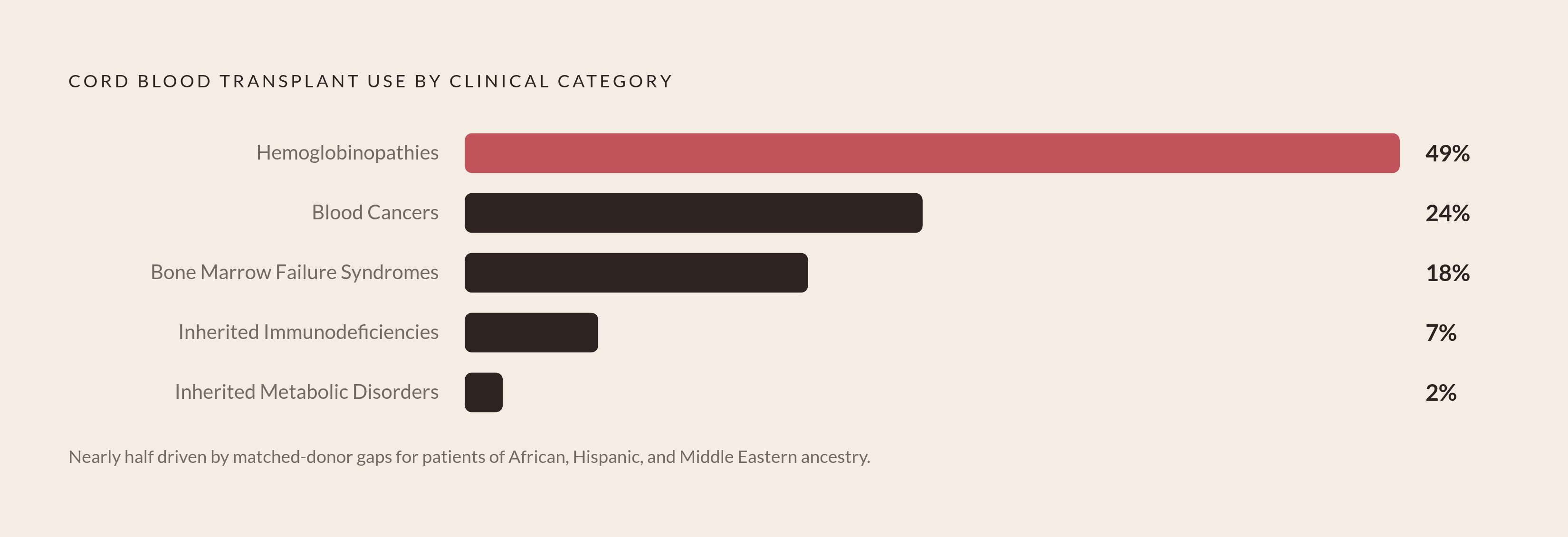
Hemoglobinopathies account for 49% of cord blood transplant use. The conditions here include sickle-cell anemia (hemoglobin SS), sickle beta-zero thalassemia, HbSC disease, beta-thalassemia major (Cooley's anemia), beta-thalassemia intermedia, E-beta-plus and E-beta-zero thalassemia, and alpha-thalassemia major, also known as hydrops fetalis. In each of these disorders, the body's own blood-producing system generates defective hemoglobin, causing chronic anemia, progressive organ damage, and, without intervention, a shortened life. Infused HSCs engraft and replace that defective system with a healthy one, addressing the underlying cause rather than managing its downstream consequences.
Sickle-cell disease disproportionately affects patients of African, Hispanic, and Middle Eastern ancestry, populations for whom finding a matched bone marrow donor is substantially harder than it is for patients of European descent. The bone marrow registry skews heavily toward individuals of European ancestry, and HLA haplotypes vary significantly across ethnic groups. This isn't an administrative inconvenience; it's a structural gap in access to treatment. Cord blood's relaxed HLA-match requirements close that gap in ways that conventional bone marrow matching cannot. A unit carrying a degree of mismatch that would disqualify a bone marrow donor can still be clinically suitable.
These diseases are often diagnosed in infancy. Families who have banked a sibling's cord blood may already hold the closest available matched unit, one positioned to move to transplant without the months-long search a bone marrow registry requires.
Blood Cancers: Leukemias, Lymphomas, and Related Malignancies
Oncology accounts for 24% of cord blood transplant use. The specific malignancies treated span a wide range: acute lymphoblastic leukemia (ALL), acute myeloid leukemia (AML), chronic myeloid leukemia (CML), chronic myelomonocytic leukemia (CMML), juvenile myelomonocytic leukemia (JMML), Hodgkin's lymphoma, non-Hodgkin's lymphoma, Burkitt's lymphoma, myelodysplastic syndrome (MDS), myelofibrosis, neuroblastoma, Wilms' tumor, pediatric primary CNS lymphomas, lymphomatoid granulomatosis, mixed lineage leukemia, and biphenotypic leukemia.
In January 2025, a three-year-old boy in Australia named Tommy Bacon was diagnosed with JMML. Two unrelated bone marrow donors withdrew before transplant could proceed. His family had banked cord blood from his baby sister, and it was a match. Four months post-transplant, Tommy achieved remission. His case is instructive not because it's exceptional, but because it illustrates exactly the contingency that cord blood banking is designed to cover: the moment when the registry fails and a banked unit is the only option still standing.
In children, JMML, neuroblastoma, and conditions with hematologic involvement drive cord blood use. In adults, AML, CML, and lymphomas dominate. Cord blood's lower GVHD risk is particularly consequential across the pediatric population, where a patient with fifty or sixty years of life ahead of them can't afford the long-term toxicity burden that other sources carry. A phase 2 trial conducted at Fred Hutchinson Cancer Center, published in the Journal of Clinical Oncology in April 2026, reported that 27 of 28 patients (96%) with leukemias and MDS survived at least one year using cord blood alongside a pooled cord blood-derived stem cell product, and none experienced severe acute or chronic GVHD.
Bone Marrow Failure Syndromes: When the Marrow Stops Producing
Bone marrow failure disorders account for 18% of cord blood transplant use. The pathology is blunt: the marrow has lost the capacity to produce adequate blood cells. Transplanted HSCs replace the marrow's workforce entirely, restoring production of red blood cells, white blood cells, and platelets.
The conditions treated include severe aplastic anemia (SAA), Fanconi anemia, dyskeratosis congenita, Blackfan-Diamond anemia, Shwachman-Diamond syndrome, congenital amegakaryocytic thrombocytopenia (CAT), congenital cytopenia, congenital dyserythropoietic anemia, pure red cell aplasia, paroxysmal nocturnal hemoglobinuria (PNH), Glanzmann's thrombasthenia, and acute myelofibrosis. Untreated, severe aplastic anemia is fatal. A 2025 NIH-published study of 115 SAA patients treated between 2004 and 2024 found a five-year overall survival of 86% and a five-year failure-free survival of 72%.
Many of these conditions are congenital, meaning diagnosis arrives in infancy or early childhood, when the window for effective intervention is already narrowing. A sibling's banked cord blood unit, already in storage and already typed, moves toward transplant in days. A bone marrow registry search takes months. In this setting, the time difference isn't logistical friction; it determines whether the transplant happens at all.
Inherited Immune Deficiencies That Cord Blood Transplants Can Correct
Immunodeficiency disorders account for 7% of cord blood transplant use. The conditions in this category include severe combined immunodeficiency (SCID) and its variants, Wiskott-Aldrich syndrome, and additional primary immune deficiency disorders in which the underlying cause traces to a defective HSC lineage.
Patients with SCID are born without a functional immune system. A routine infection can be fatal. Healthy donor HSCs reconstitute a fully functional immune system, replacing the defective one entirely. The transplant isn't adjunctive therapy; it's the treatment.
What makes cord blood specifically valuable here is speed. A matched cord blood unit in a public or family bank can be identified and released within days. A bone marrow donor search takes weeks or months. In SCID, an uncontrolled infection can close the treatment window before a matched adult donor is ever located.
Inherited Metabolic Disorders: How Transplants Slow or Stop Enzyme Deficiencies
Metabolic disorders account for 2% of cord blood transplant use. Allogeneic hematopoietic cell transplantation, including cord blood, has become standard of care for mucopolysaccharidosis type I Hurler phenotype (MPS-IH, Hurler syndrome), metachromatic leukodystrophy (MLD), and early X-linked adrenoleukodystrophy (X-ALD). Other MPS subtypes and globoid cell leukodystrophy (Krabbe disease) remain under active clinical investigation.
The mechanism here differs from what occurs in blood cancers or marrow failure. In those settings, transplant clears a malfunctioning system and replaces it. In metabolic disorders, donor-derived HSCs produce the enzyme the patient's own cells can't synthesize, slowing or halting disease progression. The underlying genetic error remains; its consequences are interrupted.
Timing governs outcome. In Hurler syndrome, transplantation before significant symptom accumulation isn't merely preferred; it's the difference between neurological preservation and irreversible damage. Cord blood's immediate availability and tolerance for HLA mismatch compress the interval between diagnosis and treatment, and that compression is clinically meaningful.
In January 2024, a five-year-old boy named Gunner Lewis-Vale in Shropshire, UK received a cord blood transplant for Hurler syndrome using a unit banked in 2008. Sixteen years elapsed between the banking of that unit and its use. The transplant restored enzyme production and prevented severe organ damage. His story isn't a curiosity; it's a data point about the longevity of banked units and the unpredictability of when they become necessary.
What Investigational Trials Are Showing for Neurological and Other Conditions
The conditions in this section aren't yet in standard clinical practice. They are supported by published trial data, FDA-authorized expanded access programs, or both.
Cerebral palsy is furthest along. A 2025 meta-analysis published in Pediatrics, covering data from more than 400 children across 11 studies, found that cord blood cell therapy combined with rehabilitation significantly improved gross motor skills compared to rehabilitation alone. Sixty-eight percent of treated children scored higher than controls, with improvements peaking at six to twelve months post-treatment. Higher cell doses correlated with better outcomes. Duke University Medical Center holds FDA permission to offer cord blood therapy for cerebral palsy under an expanded access clinical trial, with safety and efficacy data spanning more than 700 patients infused with autologous or sibling cord blood.
Autism spectrum disorder (ASD) is included under the same expanded access framework at Duke. Earlier phase trials established safety; larger efficacy trials are ongoing. For Parkinson's disease, an early-phase trial in 2023 tested stem cell therapy on a small patient group and further evaluation is underway, making efficacy claims premature. A study on allogeneic cord blood cell therapy for acute ischemic stroke was published in July 2025.
Post-COVID syndrome is also under active investigation. A January 2026 study in EClinicalMedicine, published by The Lancet, reported durable fatigue reduction in post-COVID patients. The FDA cleared an Expanded Access Program for a cord blood-derived product for Long COVID in January 2026. One study and one EAP don't constitute an established treatment.
The mechanistic distinction is worth understanding. In established categories, cord blood works through HSC engraftment, where donor cells take up residence in the bone marrow and rebuild the blood and immune system. In investigational applications, researchers are targeting cord blood's immunomodulatory properties, specifically its capacity to reduce inflammation and support tissue repair, without requiring engraftment. Whether that use proves effective, reproducible, and safe is what the trials underway are designed to determine.
Why a Family's Decision Deserves an Accurate Map
These diseases arrive without warning. They arrive in children and adults, in families with no prior history of illness, and the moment of diagnosis is rarely the moment anyone expected to need a contingency they had or hadn't prepared for years earlier. What cord blood banking offers is a specific, documented clinical record: more than 80 conditions, five established categories with real usage data, an investigational frontier with serious institutional support, and a set of mechanistic advantages that make cord blood especially suitable for patients who are hardest to match through conventional donor registries.
That record is the argument.