Infectious Disease Screening Panels for Perinatal Tissue Donors
Federal rules dictate which pathogens must be tested to clear perinatal tissue for clinical use.

Perinatal tissue, the placenta, amniotic membrane, umbilical cord, and amniotic fluid recovered at delivery, has become a real product category in regenerative medicine, and the infectious disease screening that clears it for use runs on a specific federal rule: 21 CFR Part 1271. That rule spells out which pathogens must be tested, what kind of assay counts, and how a lab result becomes a legal determination of donor eligibility. Anyone working in procurement, tissue banking, or clinical use of these products needs to understand that framework cold, because it is not background compliance detail. It is the thing that decides whether a given piece of tissue can leave the building.
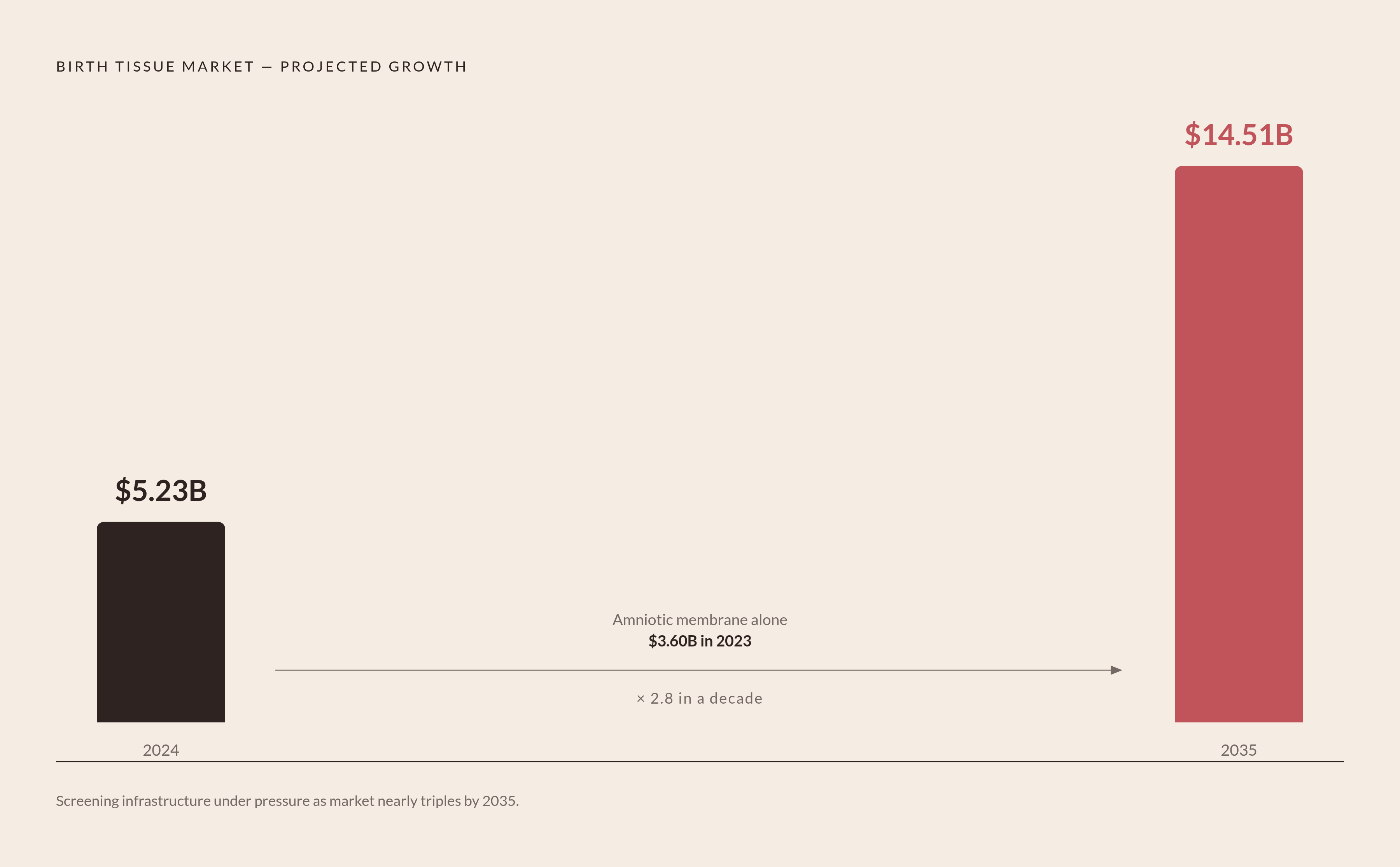
The clinical demand behind this is not small or speculative. Amnion and chorion get used as wound coverings for chronic ulcers and burns. Umbilical cord membrane shows up in tendon repair and peripheral nerve procedures. Amniotic fluid has found a place in regenerative treatments for joint pain and inflammatory conditions. The birth tissue product market was estimated at $5.231 billion in 2024 and is projected to reach $14.51 billion by 2035; the amniotic membrane segment alone came in at $3.60 billion in 2023. That kind of growth puts real pressure on the screening infrastructure underneath it, because every one of those products traces back to a single collection event at delivery, not a scheduled surgical harvest with days of lead time.
How 21 CFR Part 1271 structures the donor eligibility determination
The rule requires every HCT/P establishment (Human Cells, Tissues, and Cellular and Tissue-Based Products, the FDA's formal category for this material, regulated by the Center for Biologics Evaluation and Research) to screen all donors for what the agency calls relevant communicable disease agents or diseases, or RCDADs, and to make a formal eligibility determination before anything gets distributed. Subpart C of Part 1271 is where this lives. Section 1271.80(c) is the load-bearing clause: it requires establishments to use donor screening tests that are FDA-licensed, approved, or cleared, whenever such a test exists for the agent in question.
This list is not frozen in place. FDA adds new RCDADs through Guidance for Industry documents, and the required panel has grown over time as new pathogens get flagged. Eligibility itself is not just a lab printout, either. It's built from four things: the infectious disease test results, a review of the donor's medical and social history, a physical assessment done at the time of recovery, and, for deceased donors, an autopsy review and cause of death. A reactive result on a required test generally makes a donor ineligible, with narrow exceptions carved out in the regulation. That single fact is why the choice of assay, and the timing of when it's drawn, is not paperwork. It's the whole ballgame for that donation.
Why the birth mother, not the tissue itself, is the regulatory test subject
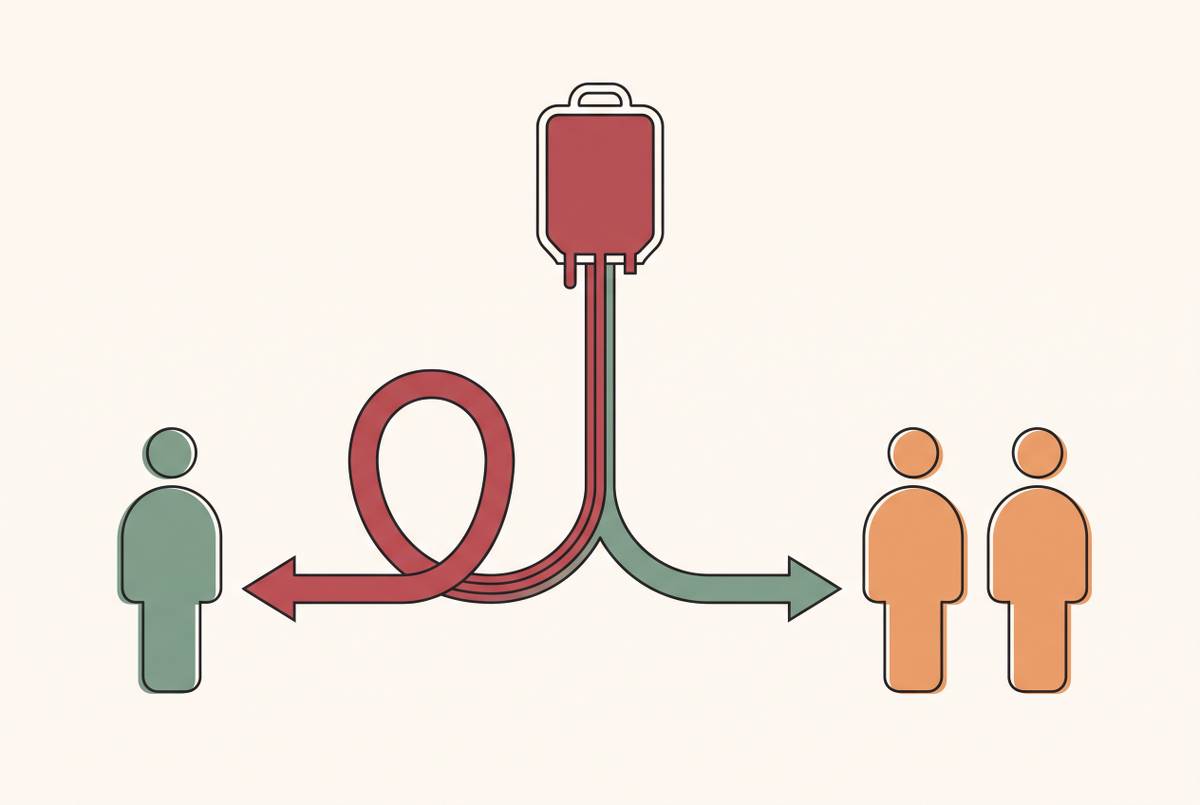
Here's the part that surprises people outside the field: for any donor one month of age or younger, Subpart C requires the establishment to test a specimen from the birth mother, not from the infant or the tissue itself. So placenta, umbilical cord, amniotic membrane, and amniotic fluid all get cleared through a maternal blood draw. The birth mother is, for regulatory purposes, the donor of record on the infectious disease side, even though the tissue in question never came from her bloodstream directly.
Timing matters just as much as the source. Subpart C requires the specimen to be collected at the time of recovery or within seven days before or after it; in the perinatal setting, that almost always means a blood draw taken at or around delivery. That single-draw model runs into an obvious limitation: it cannot catch an infection picked up in the weeks before the body starts producing detectable antibodies, the so-called window period. Some tissue banks have built a second draw into their protocol, 60 to 90 days after delivery, to recheck hepatitis B, hepatitis C, RPR, HIV-1, and HIV-2. The window period gap isn't a flaw anyone is trying to hide; it's a known constraint of serology, and it's the reason nucleic acid testing, NAT, sits alongside antibody testing for several of these pathogens rather than replacing it.
The core panel: pathogens every perinatal donor must be tested for
Four pathogen categories apply to every HCT/P donor, birth mothers included, and each has its own combination of required assays.
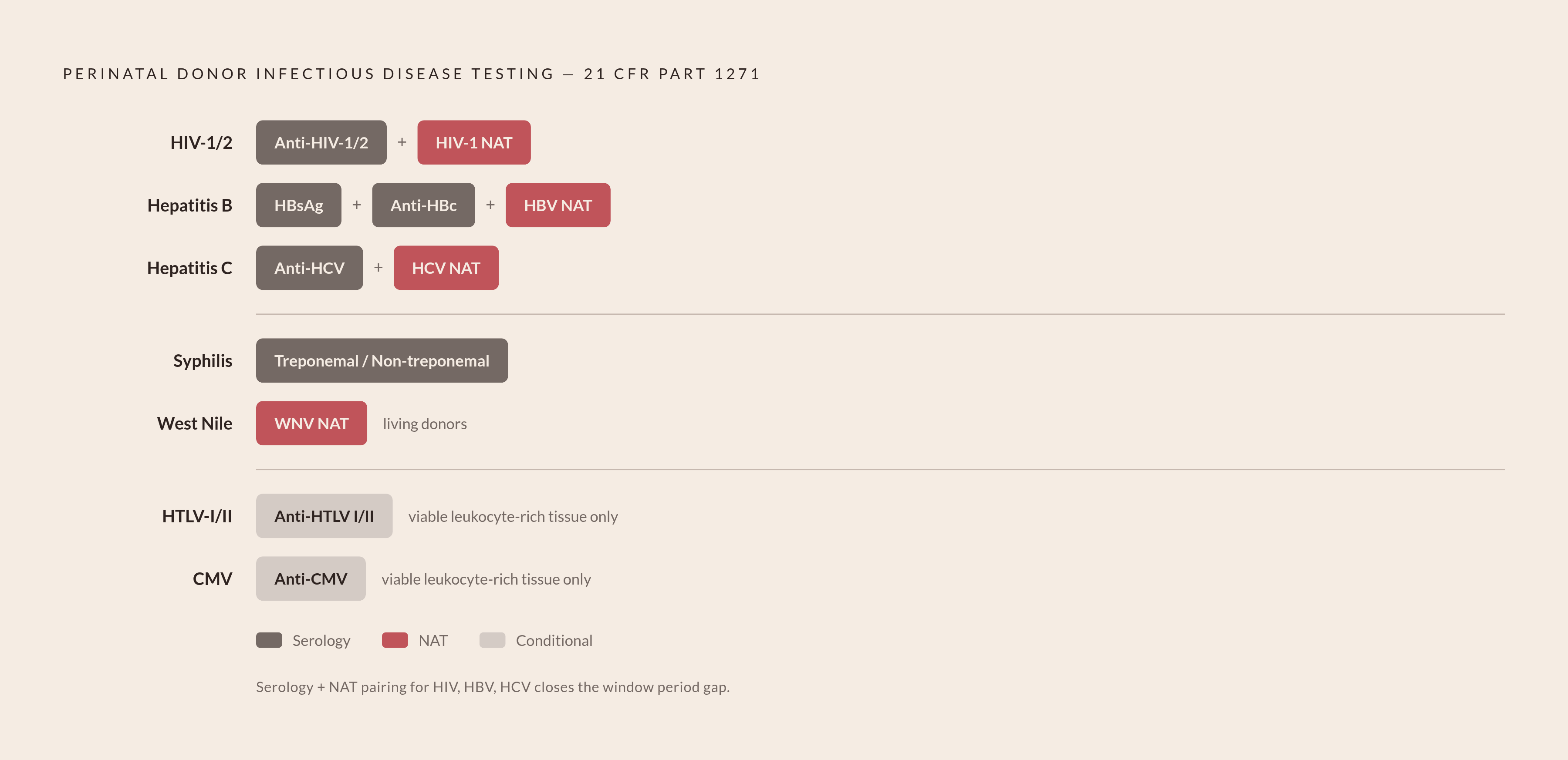
HIV-1 and HIV-2 need an FDA-licensed screening test for anti-HIV-2, or a combined anti-HIV-1/anti-HIV-2 assay, plus NAT for HIV-1. Serology by itself doesn't satisfy the requirement. Hepatitis B calls for three separate tests: HBsAg (surface antigen), total antibody to hepatitis B core antigen covering both IgG and IgM, and NAT for HBV, which can come as part of a combination NAT panel. Hepatitis C needs an anti-HCV test plus HCV NAT, again potentially bundled into a multi-virus NAT platform. Syphilis, caused by Treponema pallidum, requires an FDA-cleared donor screening test, either a treponemal or non-treponemal assay design.
The pattern across HIV, HBV, and HCV, serology paired with NAT, exists specifically to close the window period gap described above. NAT picks up active viral replication before the immune system has had time to raise detectable antibodies. And it bears repeating: every one of these assays has to be licensed, approved, or cleared by FDA specifically for donor screening use. A test that's perfectly good for diagnosing a sick patient in a clinic is not automatically valid for donor eligibility purposes; those are two different regulatory approval pathways.
Tests that apply to living donors and to viable leukocyte-rich perinatal tissues
West Nile Virus testing applies to all living donors, birth mothers included, and it has to be run on an FDA-licensed NAT assay. A 2016 FDA final guidance recommends year-round testing for establishments collecting outside the contiguous United States, while domestic establishments have historically been advised to run WNV NAT on donors recovered between June 1 and October 31. In practice, mosquito activity and travel patterns don't respect a fixed calendar window cleanly, which has informed ongoing discussion about seasonal versus year-round testing approaches.
HTLV-I/II and CMV come into play specifically when the HCT/P is viable and leukocyte-rich, which covers cryopreserved umbilical cord products and any perinatal tissue that retains live cell populations. HTLV I/II requires an FDA-licensed anti-HTLV I/II screening test, and CMV requires an FDA-cleared anti-CMV test. What's notable about CMV is that a reactive result doesn't automatically knock a donor out. Instead, the result gets passed to the physician responsible for accepting the HCT/P, who weighs it in clinical context before making a suitability call. That distinction, between regulatory ineligibility and clinical unsuitability, matters. The framework here is calibrated to actual transmission risk for that specific tissue type and use case, not built as a blanket disqualifier.
How real-world perinatal screening panels extend beyond the regulatory floor
The federal panel is a floor. Accredited tissue banks add agents on top of it routinely, based on the tissue type, the intended recipient population, and the judgment of the medical director running the program. T. cruzi (Chagas disease) antibody testing, covering both IgG and IgM, shows up on commercial amniotic membrane allograft labeling as a standard addition alongside the federally required tests, which tells you Chagas screening appears on commercial amniotic membrane allograft labeling as a standard addition even though it isn't written into Part 1271 for perinatal tissue.
A research-grade screening protocol built for umbilical cord mesenchymal stem cell donors makes the pattern even clearer. On top of every standard FDA-required test, it adds a CMV immune screen with reflex to CMV DNA testing, a T. cruzi ELISA, Zika virus testing, and VDRL with confirmatory FTA-ABS testing if the initial result comes back reactive. Zika is the most telling addition on that list: it shows how guidance-driven expansion actually works in practice. FDA flags an agent as an RCDAD, and testing for it can appear on product panels alongside the formal rule change. For anyone doing procurement, the panel printed on a given product's labeling is the most reliable signal of what was actually tested. It can run above the § 1271.85 minimum. It should never run below it.
The non-serological side of donor eligibility: history, interview, and physical assessment
Serology and NAT tell you whether an infection is present or has been present. They tell you nothing about risk behaviors, undisclosed exposures, or clinical signs that fall outside the narrow window captured by a single blood draw. That's why donor eligibility for perinatal donors also runs through a medical and social history review, a physical assessment done at the time of tissue recovery, and screening for behavioral risk factors covering drug use, sexual behavior, and travel history. AATB has published specific guidance for the birth tissue sector on how to conduct that physical assessment for signs of communicable disease.
AATB also requires use of a standardized Donor Risk Assessment Interview, the DRAI, in a version built specifically for birth mothers, meant to keep screening consistent across programs and improve donation outcomes. The person administering it works from defined expectations, not an ad hoc conversation. Oversight of the whole eligibility process in birth tissue programs may fall to a licensed, board-certified OB/GYN serving as medical director, someone who can apply clinical judgment when a lab result and a history don't line up neatly. A reactive test alone, or a disclosed risk factor alone, can each be enough to trigger ineligibility on its own. The determination pulls all of it together, which is exactly why the interview and the physical exam are written into the regulatory requirements rather than left as optional good practice.
What changed with the AATB 15th Edition Standards and the January 2025 FDA guidance package
The AATB 15th Edition Standards took effect in January 2025, the first new edition since 2016 and the output of AATB's Standards Rebuild Project. For screening purposes, the key change sits in Appendix II, the Infection Risk Review and donor eligibility criteria, which now folds in a newly required screening step for Mycobacterium tuberculosis, MTB.
That change didn't happen in isolation. On January 6, 2025, FDA's Center for Biologics Evaluation and Research published six new guidance documents at once: updated recommendations for screening HCT/P donors for HIV, HBV, and HCV transmission risk; updated recommendations covering disease agents associated with sepsis; a standalone guidance naming Mycobacterium tuberculosis as a new RCDAD for HCT/P donors, a meaningful expansion of the required panel; and an updated general donor eligibility guidance that replaces the version FDA had been running on since 2007.
The MTB addition is a clean example of the mechanism that drives panel growth generally: FDA names a new RCDAD in guidance, establishments have to build testing for it into their procedures, and accreditation bodies like AATB revise their standards to match. For anyone running a perinatal tissue program, the January 2025 package is the biggest single update to HCT/P donor screening guidance in close to two decades, and the compliance work that follows, updating standard operating procedures, retraining staff, adjusting lab contracts, flows directly from requirements that took effect in January 2025. The direction of travel here has been consistent for years: bigger panels, dual-method testing for the major bloodborne viruses, expanded testing for leukocyte-rich tissue, and new RCDADs added as the science identifies them. The January 2025 package represents a significant shift in where the requirements stand, and programs should verify their panels reflect the current guidance.