351 BLA vs 361 HCT/P: Which FDA Pathway Applies to Your Cord Blood Product
Criterion 4 disqualifies most cord blood products from the simpler regulatory pathway.

The 361 pathway exists for human cells, tissues, and cellular and tissue-based products regulated solely to prevent communicable disease transmission. These products require no premarket approval, operate under 21 CFR Part 1271, and reach the market through establishment registration and HCT/P listing. The pathway is narrow by design. Manufacturers don't choose it. A product qualifies only when all four criteria enumerated in 21 CFR 1271.10(a) are satisfied simultaneously, and failing any single one removes the product from the 361 framework entirely, subjecting it to additional FDA oversight as a biological product, drug, or device depending on its characteristics.
Criterion 1: Minimal Manipulation
Processing must not alter the original relevant biological characteristics of the tissue. For cord blood, cryopreservation of intact units is generally regarded as minimal; it preserves the cells rather than transforming them. Enzymatic digestion, ex vivo expansion, scaffold reseeding: those are another matter. The line is drawn at whether the manufacturing process changes what the tissue fundamentally is and what it fundamentally does. If yes, criterion 1 fails, and the remaining three criteria become moot.
Criterion 2: Homologous Use
The product must perform the same basic function in the recipient that it performed in the donor. FDA applies this criterion with particular strictness in the regenerative medicine context. Cord blood hematopoietic stem cells used to reconstitute a recipient's hematopoietic system represent the canonical homologous use; the cells did that work in the donor, and they're being asked to do the same work in the recipient. Deploying those same HSCs for a non-hematopoietic purpose, such as tissue regeneration or immune modulation in a system unrelated to blood production, is not homologous. Intended function matters as much as cell type.
Criterion 3: No Combination with Another Article
Manufacturing cannot combine the HCT/P with another article, with narrow exceptions requiring that any added article not raise new clinical safety concerns beyond those present in the cells themselves. Combination products present a distinct regulatory challenge. Early CBER engagement, before manufacturing decisions are finalized rather than after, is not optional.
Criterion 4: No Systemic Effect and No Metabolic Dependence
The product must not have a systemic effect, and its primary function must not depend on the metabolic activity of living cells. Three exceptions exist: autologous use, use between first- or second-degree blood relatives, and reproductive use. These exceptions are exhaustive. A product that doesn't fit one of the three cannot argue by analogy or proximity. This criterion is where most cord blood products encounter their first and most decisive regulatory obstacle, and experienced practitioners have learned to begin the analysis here rather than with criterion 1.
One further distinction deserves emphasis. FDA acceptance of an establishment registration does not constitute a determination that an HCT/P is licensed or approved. Registration is an administrative act. Licensure under Section 351 is a separate and far more demanding legal status, and conflating the two is a compliance error with real consequences.
Why Cord Blood Almost Always Fails Criterion 4 on Its Own Terms
Hematopoietic stem cells engraft and restore hematopoiesis. That's precisely what makes them therapeutically valuable, and it's precisely why they fail criterion 4. Engraftment is a systemic effect. The restoration of hematopoiesis depends entirely on the metabolic activity of living cells. The biology that defines their clinical utility is the same biology that disqualifies them from the 361 pathway. There's an uncomfortable circularity to that, and everyone working seriously in this space eventually has to sit with it.
The same logic applies to bone marrow and peripheral blood stem cells, all three of which share these fundamental characteristics. FDA doesn't contend otherwise. The agency acknowledges the systemic nature of HSC function and responds not by rewriting the criterion but by carving out three narrow exceptions rather than treating HSC products as categorically exempt.
Those exceptions determine the practical fate of most cord blood programs. Autologous use, allogeneic use between first- or second-degree blood relatives, and reproductive use represent the entire universe of criterion 4 exceptions. A product that doesn't fit one of those three designations doesn't remain in the 361 framework. The exceptions are closed. Practitioners who apply the criterion correctly begin there, because criterion 4 often resolves the question entirely before manipulation or homologous use even becomes relevant.
Where Each Type of Cord Blood Product Lands After Applying the Criteria
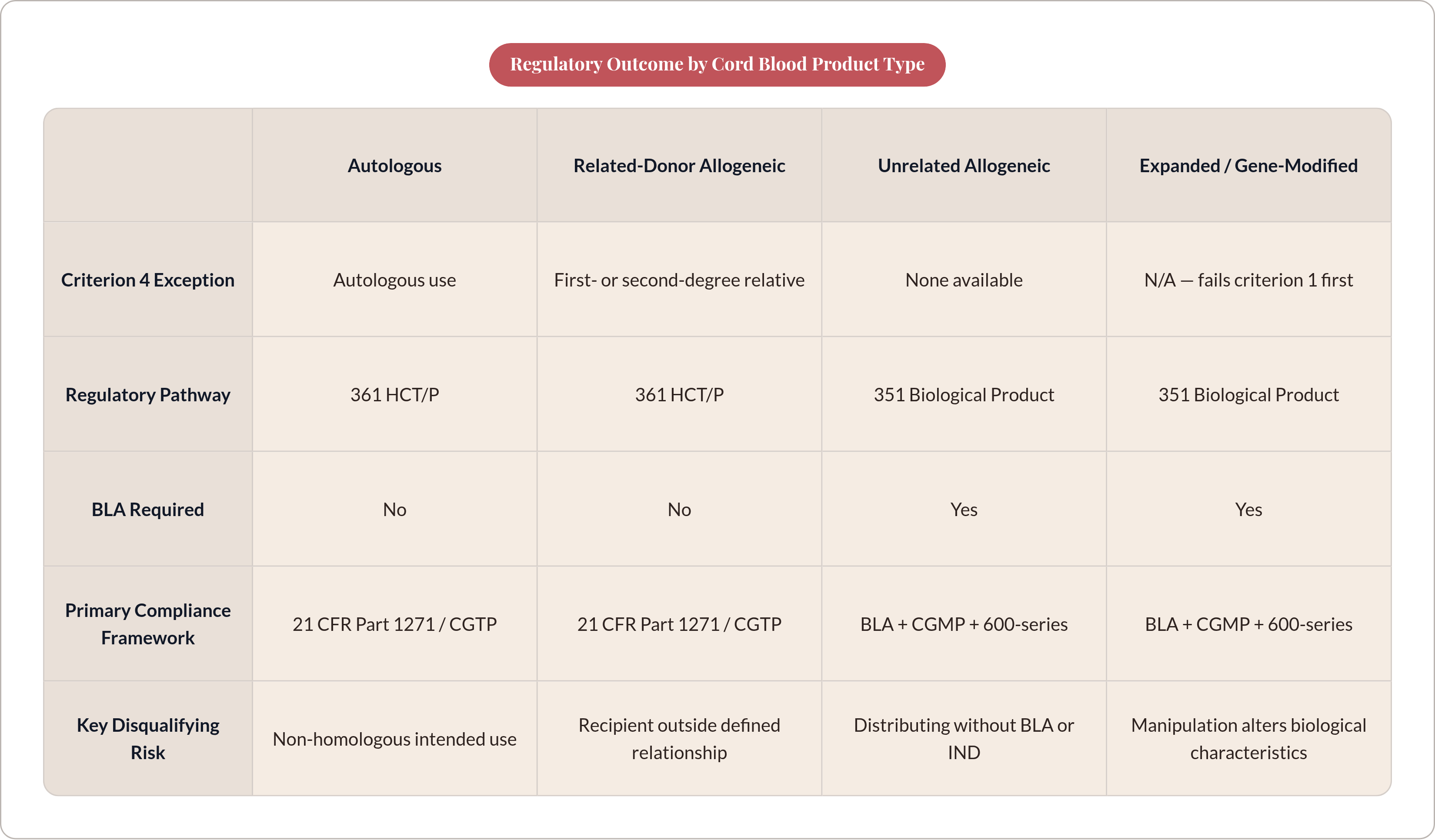
Autologous Cord Blood
Cord blood stored for the donor's own potential future use qualifies for criterion 4's autologous exception. Where processing is minimal, use is homologous, and the unit is not combined with another article, the product remains a 361 HCT/P. This is not a deregulated status. The full 21 CFR Part 1271 compliance stack still applies: establishment registration, HCT/P listing, donor eligibility determination, current good tissue practice requirements, adverse reaction reporting, and deviation reporting. The 361 designation reflects a different level of oversight calibrated to a lower risk profile, not an absence of oversight.
Related-Donor Allogeneic Cord Blood
Cord blood collected for use by a first- or second-degree blood relative qualifies for criterion 4's relative exception, provided the product is also minimally manipulated, used homologously, and not combined with another article. The definition of "first- or second-degree relative" is applied literally. It doesn't extend to cousins or more distant family members, and banks operating related-donor programs must maintain documentation sufficient to establish the relationship. The biological connection creates no broad regulatory flexibility. The exception is precisely bounded, and assuming otherwise is how programs run into trouble.
Unrelated Allogeneic Cord Blood
This is the public bank model, and it presents the clearest regulatory outcome. No exception under criterion 4 applies when a unit is transplanted into an unrelated recipient. The product is classified as a drug under the Federal Food, Drug, and Cosmetic Act and as a biological product under Section 351 of the PHS Act. A BLA is required. The mandate for public cord blood banks became effective October 20, 2011. Distributing a unit to an unrelated recipient without a BLA or an active Investigational New Drug application is a federal violation. The IND serves as a bridge to licensure, not a permanent alternative to it.
Expanded, Gene-Modified, or Engineered Cord Blood
These products fail criterion 1 before criterion 4 even becomes relevant. Genetic modification and ex vivo expansion alter the original relevant biological characteristics of the cells. CAR-T cell products illustrate the principle cleanly: genetic modification combined with the introduction of a non-native receptor function produces a product that is unambiguously a 351 biologic. The donor relationship doesn't rescue an engineered cord blood product from this outcome. A related-donor gene-modified unit is still more than minimally manipulated, and the analysis ends there.
The Private Bank vs. Public Bank Divide in Practice
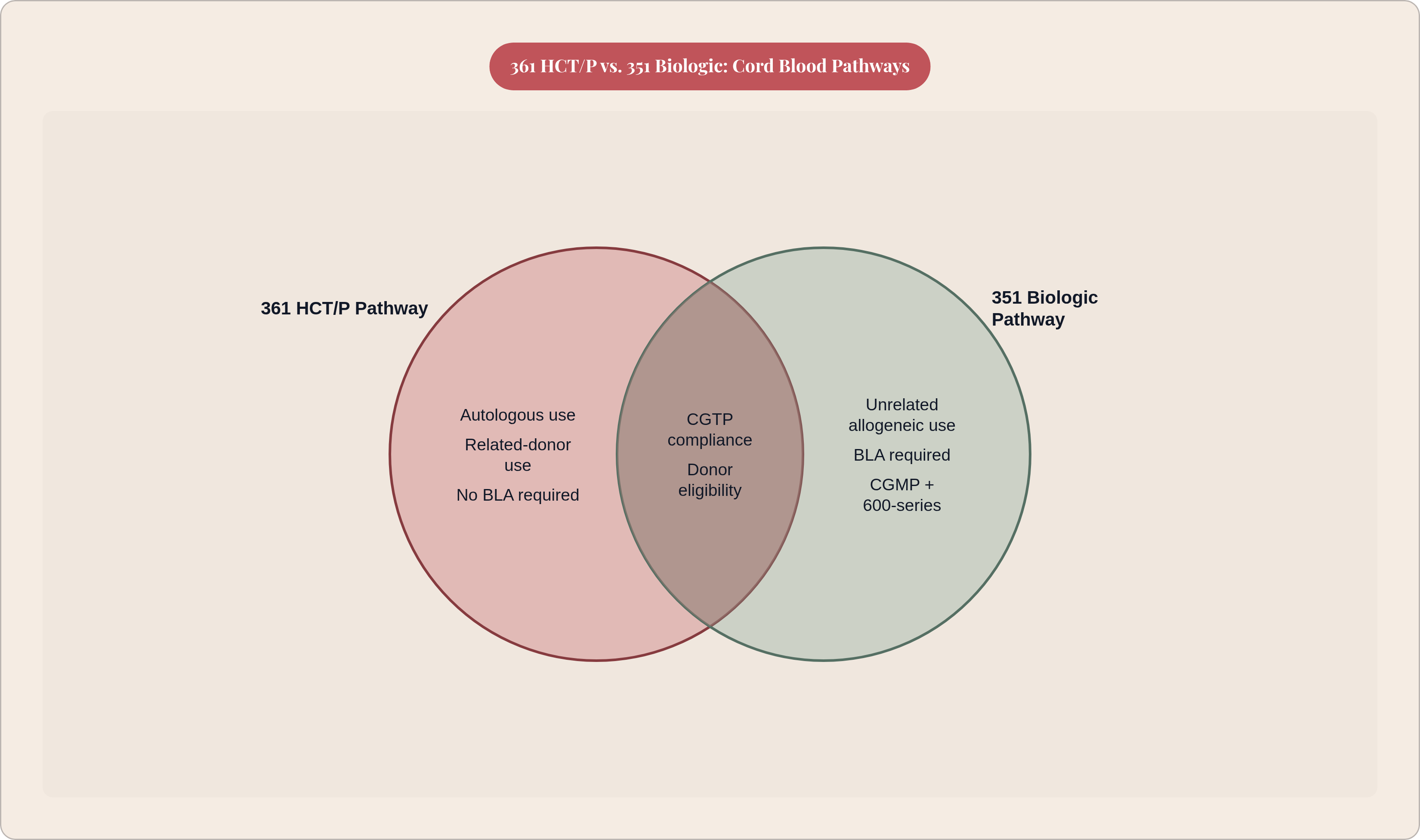
The operational dividing line is whether a collected unit can be used by someone unrelated to the donor. FDA's organizing principle is direct: human cells become a biological product, regulated as a drug, when administered to a person other than the donor or, by exception, a qualifying relative.
Private banks store cord blood for potential autologous or related-donor use. They must comply with 21 CFR Part 1271, including registration, donor eligibility determination, and CGTP, but they are not required to hold a BLA. Public banks collect donations for the general patient pool, where units may be transplanted into unrelated recipients, and each publicly distributed product must be licensed under a BLA.
A bank operating both private and public programs must manage two compliance frameworks simultaneously. The 361 obligations govern related-donor units; the 351 BLA obligations govern the publicly distributed inventory. These aren't parallel programs that share infrastructure cleanly. They are distinct regulatory regimes with distinct requirements, and the boundary between them must be actively maintained in the manufacturing and quality systems. That boundary erodes gradually and quietly, and its absence tends to surface during inspections rather than in advance of them.
What the Manufacturing Compliance Burden Actually Looks Like Under Each Pathway
The 361 compliance floor is current good tissue practice under 21 CFR Part 1271 Subpart D. That framework covers establishment registration and HCT/P listing, donor screening and testing, donor eligibility determinations, adverse reaction reporting, HCT/P deviation reporting, and labeling. It's a substantive regulatory program. It is also considerably less demanding than what the 351 pathway requires.
The 351 compliance stack adds current good manufacturing practice under 21 CFR Parts 210 and 211, and the biologics regulations in 21 CFR Parts 600 and above, to the CGTP floor. FDA inspects the facility and manufacturing controls with the same scrutiny applied to clinical data. The BLA submission must affirmatively demonstrate safety, purity, and potency. Post-approval obligations include adverse event monitoring, annual reporting, and notification to FDA of changes in product, production process, quality controls, equipment, facilities, responsible personnel, or labeling; some products carry post-marketing study requirements as well. None of these have a parallel in the 361 world.
In 2026, CBER issued final guidance on Chemistry, Manufacturing, and Controls flexibilities for cellular and gene therapy BLAs, a written acknowledgment that CGT manufacturing challenges don't fit cleanly into frameworks designed for conventional biologics. That guidance repeatedly recommends early and frequent CBER engagement, which reflects accumulated experience on both sides of the regulatory relationship. Manufacturing decisions made without that engagement early in development frequently require costly remediation before a BLA can be filed. The gap between CGTP and the CGMP plus 600-series stack is not cosmetic. It represents a substantially different investment in systems, documentation, personnel, and ongoing regulatory interaction. Programs that plan for a 361 burden and then migrate to 351 are often unprepared for what that difference actually costs.
The BLA Submission Itself: What CBER's 2014 Guidance Requires
The controlling document for unrelated allogeneic cord blood BLA submissions is FDA's March 2014 final guidance, "Biologics License Application for Minimally Manipulated, Unrelated Allogeneic Placental/Umbilical Cord Blood Intended for Hematopoietic and Immunologic Reconstitution in Patients with Disorders Affecting the Hematopoietic System." A companion guidance issued the same month addresses IND distribution of cord blood before BLA approval.
The guidance applies to cord blood used for hematopoietic and immunologic reconstitution in patients with inherited, acquired, or myeloablative treatment-related disorders of the hematopoietic system. A BLA submission under this guidance requires five sections: applicant information; product and manufacturing information; pre-clinical studies; clinical studies; and labeling. The standard review time following acceptance is ten months.
User fees change annually. A FY 2024 BLA submission fee was $483,560; applicants should verify the current FY 2026 figure directly with FDA before submission planning. The guidance addresses minimally manipulated cord blood specifically. A bank pursuing expanded or gene-modified products would need to engage CBER on a separate regulatory track, because the 2014 guidance doesn't cover products that fail criterion 1.
How the Eight Licensed Public Banks Navigated BLA Approval, and What REGENECYTE Adds to the Record
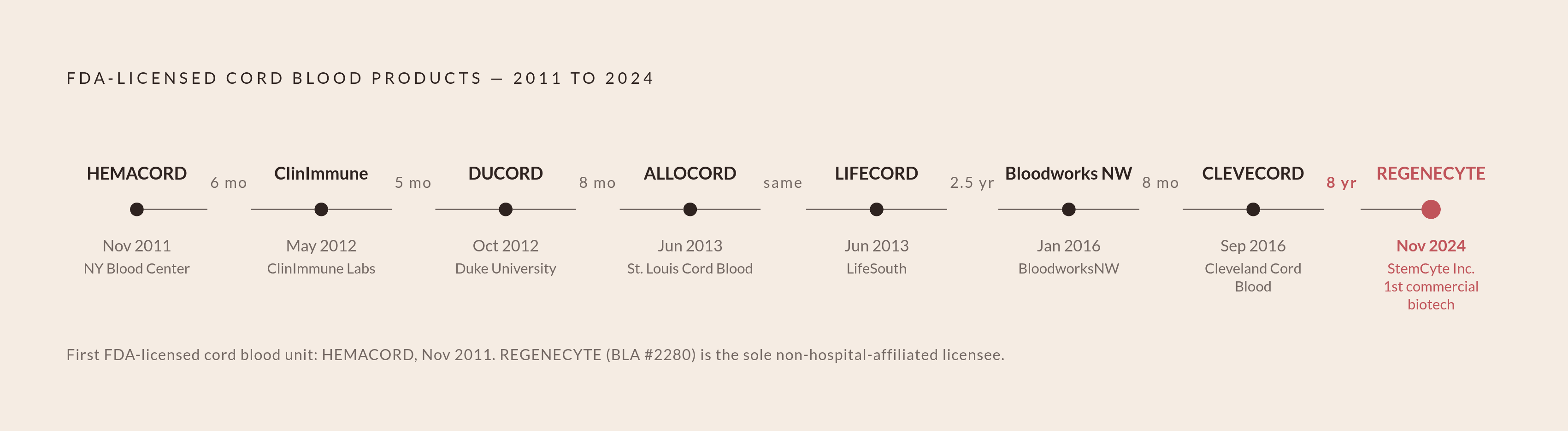
The October 2011 BLA mandate created an immediate compliance cliff for public banks already operating under the prior regulatory framework. The banks that met the requirement over the following years established the precedent and demonstrated that the pathway, demanding as it is, can be navigated by organizations willing to commit the necessary resources and time.
HEMACORD, licensed to the National Cord Blood Program at New York Blood Center, received approval in November 2011, the first licensed cord blood product in U.S. history. ClinImmune Labs at the University of Colorado followed in May 2012. DUCORD, from the Carolinas Cord Blood Bank at Duke University Medical Center, received approval in October 2012. ALLOCORD from the St. Louis Cord Blood Bank and LifeCord Cord Blood Bank at LifeSouth both received approval in June 2013. BloodworksNW was licensed in January 2016. CLEVECORD from the Cleveland Cord Blood Center received approval in September 2016.
REGENECYTE, licensed to StemCyte Inc. under FDA License No. 2280, received approval in November 2024. Its significance is institutional as much as scientific. REGENECYTE is the first commercial U.S.-based biotechnology company, distinct from a hospital-affiliated cord blood bank, to secure a biologics license for cord blood stem cell therapy; it is intended for transplantation in patients with blood and immune system disorders. Its approval demonstrates that the BLA pathway remains active and accessible to commercial entrants, not only to academic medical center programs built around existing donation infrastructure. For a field that has long been dominated by hospital-affiliated programs, that is a structural shift worth noting.
Each of these licensed products is a distinct 351 biologic. The license covers a specific product manufactured at a specific site. The approval of one cord blood product doesn't license cord blood as a category, and a bank that acquires or relocates a manufacturing operation cannot assume that existing licensure transfers. The product-specific, site-specific nature of the BLA is structural, not procedural.
Enforcement Risk for Misclassified Cord Blood Products
HCT/Ps that fail any of the four criteria in 21 CFR 1271.10(a) and don't qualify for a named exception under 21 CFR 1271.15 are legally drugs, devices, and/or biological products subject to Section 351 and the premarketing requirements of the Federal Food, Drug, and Cosmetic Act. Marketing such a product without a BLA or an active IND is a federal violation. No corrective action plan resolves that exposure retroactively once enforcement attention arrives.
CBER enforcement activity against misclassified HCT/Ps has been active and ongoing. FDA enforcement letters have cited firms for marketing products for non-homologous uses without either a BLA or an IND, citing violations of both the FDCA and the PHS Act. Coverage from the National Law Review in June 2023 and the FDA Law Blog in March 2023 documented the continued enforcement posture.
The misclassification errors most specific to cord blood recur in predictable patterns. Some private banks assume that 361 compliance covers any allogeneic unit the bank processes, regardless of whether the recipient is related to the donor. Others treat minimal manipulation of a related-donor unit as a classification that extends to expanded or gene-modified derivatives of that same unit. Still others rely on self-designation, registering as a 361 establishment without formally working through each of the four criteria against the product as actually manufactured and actually used. Registration provides no safe harbor when the underlying product doesn't qualify for the pathway. It never has.
Reimbursement exposure compounds the regulatory problem. Under CMS policies, 361 HCT/Ps and 351 biologic products are treated differently in the billing framework. A misclassified product may be billed under the wrong reimbursement code, creating a second compliance problem downstream from the first. The two exposures are independent of each other, and resolving one doesn't resolve the other.
The classification analysis is not optional, and it cannot be deferred until the product is closer to market. The biology of the product, the manufacturing process, and the intended use all determine the regulatory pathway before manufacturing begins. Getting that analysis right, and documenting it rigorously, is the first obligation of any cord blood program.