Why Some Cord Blood Units Are Rejected After Processing
Most cord blood units fail to meet the cell count thresholds transplants require.

Total nucleated cell count, referred to as TNC, is the central metric in cord blood quality assessment. Most public banks require a minimum of 1 × 10⁹ cells to accept a unit for banking at all. That threshold isn't arbitrary; it represents a floor below which the probability of adequate engraftment drops to clinically unacceptable levels.
Transplant centers apply even stricter criteria when selecting a unit for a specific patient. A CIBMTR/Eurocord/EBMT collaborative analysis found that a TNC dose of at least 3.0 × 10⁷ per kilogram of recipient body weight is associated with adequate progenitor cell delivery for a single-unit graft. Of 126,341 U.S. cord blood units analyzed in 2019 using American Society of Hematology data, only 4 percent met the combined threshold of at least 2.5 × 10⁷ TNC per kilogram and at least 1.5 × 10⁵ CD34+ cells per kilogram necessary for a single-unit graft for a 70-kilogram adult patient.
TNC and CD34+ dose don't reliably track together. A unit with a high TNC can still carry an inadequate CD34+ count, so both are evaluated independently. Acceptable collection volume typically ranges from 40 to 100 mL; volume and TNC are positively correlated, meaning low-volume collections almost always produce low cell counts. What has changed over time is the precision with which dose requirements are understood, and that precision has made the gap between what a single cord blood collection can provide and what a transplant recipient needs far more visible. The implication is structural: most cord blood units are simply too small relative to the body weight of adult patients. The thresholds aren't too strict. Adult patients haven't gotten smaller.
How Delayed Cord Clamping Reshapes What Banks Can Accept
Delayed cord clamping has become standard neonatal care, and appropriately so. It improves neonatal iron stores and produces measurable improvements in early childhood outcomes. Its effect on cord blood collection, however, is quantifiable and worth understanding precisely.
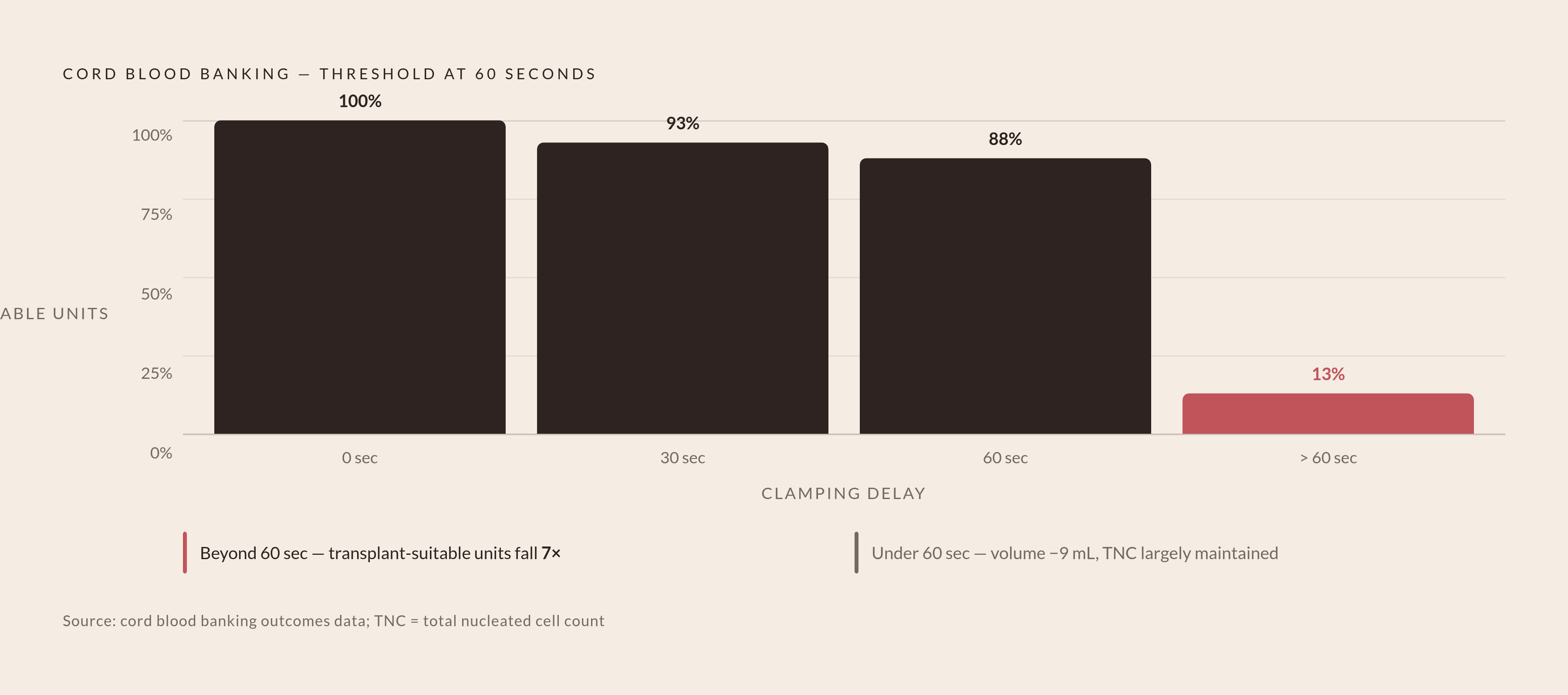
Clamping delays of less than 60 seconds reduce collection volume by an average of 9 to 10 mL. Because volume predicts cell count, even a modest reduction narrows the window of bankable units. A 2025 Spanish study published in Blood Transfusion found that at delays of 30 or 60 seconds, TNC count is largely maintained and the number of units eligible for banking remains comparable to immediate clamping.
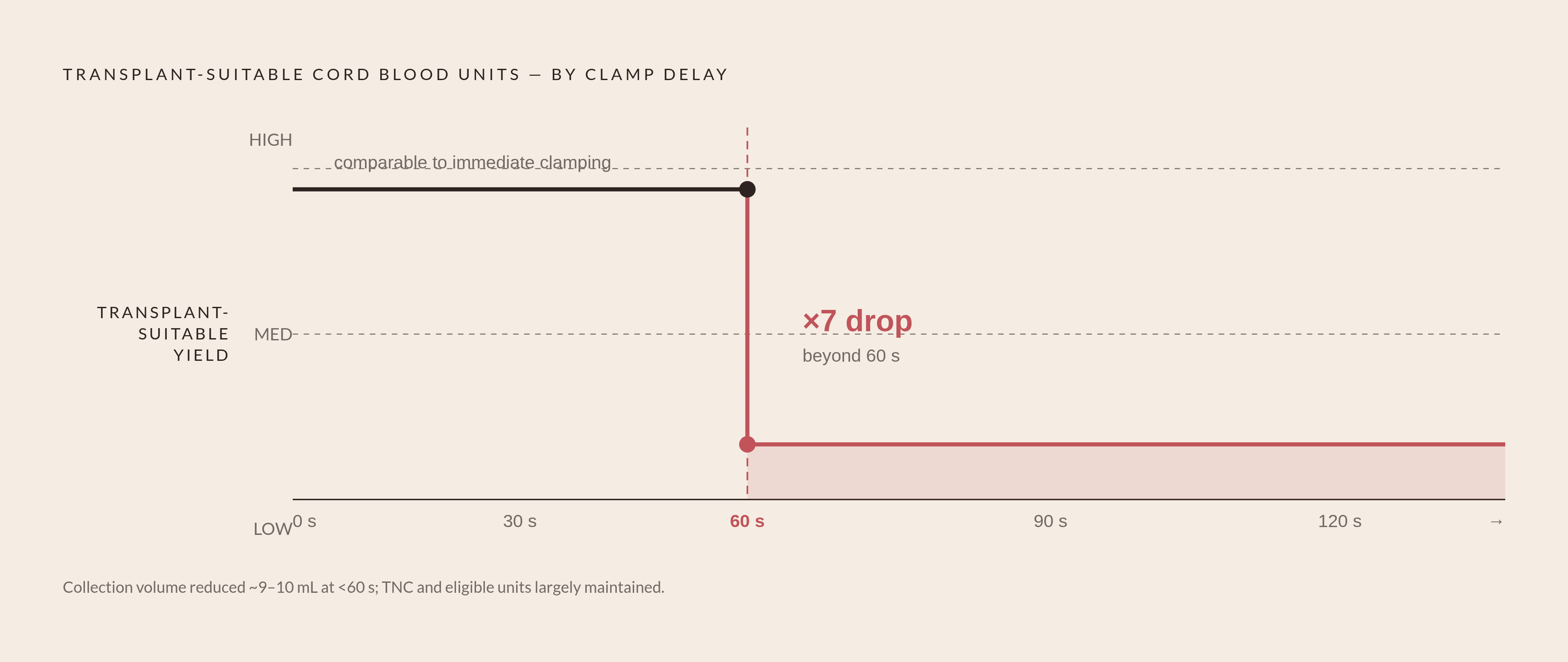
What changes sharply is the outcome at delays beyond 60 seconds. At that point, both volume and TNC drop significantly, and the fraction of collections suitable for transplant falls by a factor of seven. The 60-second mark isn't a hard regulatory rule, but it's a meaningful clinical boundary, one beyond which the probability of producing a bankable, transplant-suitable unit decreases dramatically. Some cord blood rejection is decided in the delivery room before any bank quality system is involved, the product of legitimate clinical priorities in direct competition with each other. The obstetric team is doing exactly what they should be doing, and that fact has real downstream consequences for banking yields that no process improvement can fully address.
Microbial Contamination: Where It Comes From, How Often It Disqualifies a Unit
Sterility testing is mandatory. A confirmed positive result typically disqualifies a unit from banking, though antibiotic sensitivity testing can, in cases of urgent clinical need, permit use of a contaminated unit under carefully managed conditions. That exception is narrow.
Contamination rates across multiple studies converge in a relatively consistent range. Clark et al., published in Transfusion in 2012, found a 4.0 percent rate across 13,344 units collected over 14 years at the Sydney Cord Blood Bank. A 2024 study examining 5,194 processed units found a rate of 3.6 percent. Closa et al., published in Transfusion in 2025, identified a 3.4 percent positivity rate across 4,696 sterility tests. A 2022 study covering the period from 2010 to 2020 found a higher rate of 8 percent across 10,054 cryopreserved units, a figure that also showed an inverse relationship between collection volume and contamination risk. Smaller units were more frequently contaminated, reinforcing the pattern that low volume is a liability across multiple failure modes simultaneously.
Delivery method is a reliable predictor of contamination. The 2024 ScienceDirect study found that 92 percent of contaminated units originated from vaginal deliveries, versus 8 percent from cesarean sections, a distribution that reflects the difference in sterile field conditions at the time of collection.
Common organisms include anaerobic gram-negative rods, coagulase-negative staphylococci, and viridans streptococci. Closa et al. identified Cutibacterium acnes as the most common slow-growing pathogen, a finding with direct methodological implications. When one bank expanded its sterility testing protocol to include both plasma and red cell fractions rather than testing a single fraction, detection rates rose from 1.2 to 3.5 percent. That variation reflects testing intensity, not necessarily a real difference in contamination frequency. Reported rates across institutions aren't always directly comparable; some of the variation is a function of how comprehensively a bank looks, not how clean its collections actually are.
Donor Eligibility Screening: The Rejections That Happen Before Processing Begins
A significant category of cord blood rejections never involves the laboratory at all. In a 2015 study of 249 units from 16 cord blood banks, 48 percent of all identified issues pertained to maternal medical history, making it a rejection category as large as laboratory quality control failures combined.
Mandatory infectious disease screening of maternal blood covers HIV, Hepatitis B and C, HTLV I/II, cytomegalovirus, West Nile virus, and syphilis. A positive result disqualifies the unit. Beyond infectious disease, genetic and oncological history drives additional exclusions. Units are rejected when maternal history includes cancer treatment during pregnancy, known congenital anomalies incompatible with life, active parasitic infections such as toxoplasmosis or malaria, or significant chromosomal abnormalities identified in the fetus. Hemoglobinopathy screening must be completed prior to release for administration; units that haven't been screened can't be released regardless of their performance on other parameters. Gestational age is also a factor. Premature birth below approximately 34 weeks is a common disqualifying criterion, both because preterm collections are smaller and because their documentation is often more complex.
Families who donate in good faith sometimes learn that their unit was rejected without ever knowing that maternal health history, not anything that went wrong in the laboratory, was the determinative factor. The banking system is working correctly when it screens this way. A future recipient who is severely immunocompromised can't absorb the risk of an inadequately screened graft, and the system's job is to protect that person, not to maximize acceptance rates.
Post-Processing Viability Testing and the Challenge of Measuring What Survives Cryopreservation
Even units that pass volume requirements and contamination screening must survive processing and cryopreservation with adequate cell viability intact. Most cord blood units are volume-reduced before freezing, a step that concentrates cellular debris alongside stem cells. The cryoprotectant used is dimethyl sulfoxide, known as DMSO, which prevents ice crystal formation that would rupture cells during the freeze-thaw cycle. Deviations in DMSO concentration or in controlled-rate freezing protocols can produce unacceptable post-thaw recovery, independent of the quality of the original collection.
There's a structural measurement problem embedded in viability testing that deserves plain acknowledgment. The small QC segment used to assess a unit's post-thaw viability undergoes ice nucleation at a lower temperature than the main storage bag, meaning the segment can perform worse than the bulk product it's supposed to represent. A unit can appear to fail viability testing when the main bag would, in practice, be adequate. This is a known artifact of the measurement system, not a theoretical edge case.
Process discipline matters here. A 2024 study of standardized collection protocols at a Chinese hospital found that implementing standardized procedures between January 2022 and December 2024 raised storage success rates from 84.3 to 90.6 percent. Long-term storage, by contrast, isn't a meaningful driver of rejection. Unseparated units processed between 1993 and 1998 showed a mean TNC viability of 88.91 percent, with a standard deviation of 5.01 percent, after 29 years of cryopreservation, per a 2024 report from the José Carreras Cord Blood Bank. Flow-based assays of CD34+ cell viability on a segment haven't been validated across multiple banks and centers, per NMDP/CIBMTR guidelines published in Blood in 2019. A unit's fate can depend partly on which institution is doing the measuring, and that remains an unresolved problem.
Documentation and Labeling Failures: Small in Volume, Real in Consequence
In the 2015 study of 249 units from 16 banks, labeling and documentation issues accounted for 3 percent of identified problems. That's a small share, but it's not a negligible one.
Banks must comply with AABB and FACT accreditation standards. Documentation gaps, including missing maternal consent forms, incomplete chain-of-custody records, and labeling errors on collection bags, can trigger rejection even when a unit's biological parameters are sound. A unit that is sterile, adequately dosed, and viability-verified can't be released without its paperwork. That is the correct policy. A graft administered to the wrong patient, or without informed consent on record, represents a categorically different kind of failure, one the paperwork requirement exists to prevent.
These failures are largely preventable. Delivery room personnel trained in standardized cord blood collection procedures produce fewer labeling problems alongside fewer contamination and clotting events. The quality of the unit that arrives at a bank is shaped substantially by whether the obstetric team present at birth was prepared for the collection. Banks that treat collection site personnel as peripheral to the quality system, rather than central to it, are making an error that shows up directly in their rejection rates.
HLA Matching and Donor-Specific Antibodies: Why a Banked Unit Can Still Be Passed Over
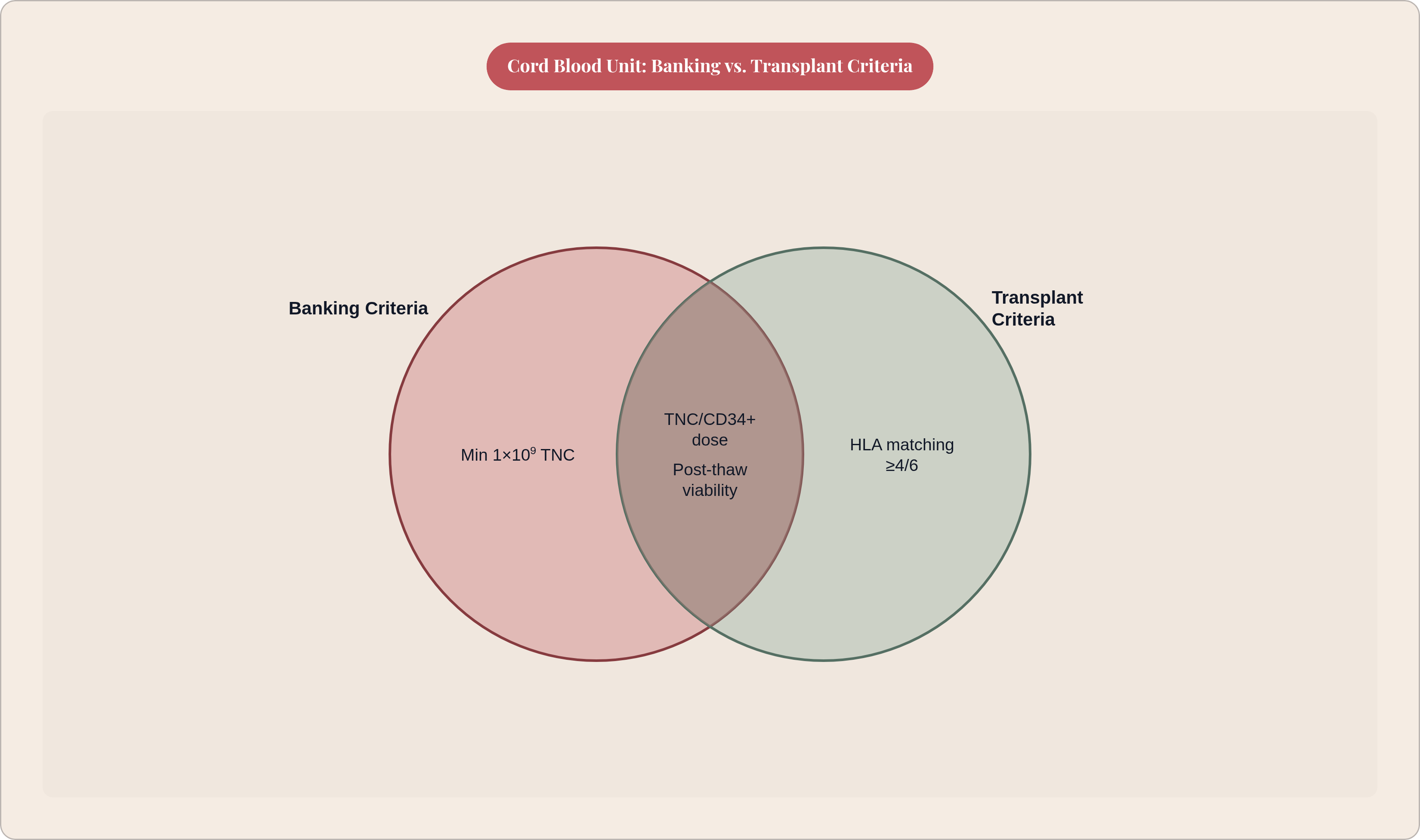
Banking a unit and using a unit are distinct events separated by everything the transplant selection process requires. A unit that clears every quality checkpoint enters a registry, but registry listing isn't selection. Transplant centers apply a second layer of criteria when matching a unit to a specific patient, and those criteria can eliminate an otherwise excellent unit.
Most centers require a donor-recipient HLA match of at least 4 of 6 alleles. Units that can't achieve that match for any waiting patient are effectively unavailable, regardless of their cell count or sterility results. Donor-specific antibodies in the recipient introduce further complexity. If a patient has preformed antibodies directed against antigens present on the cord blood unit, engraftment failure risk increases, and use of that unit must be evaluated against antibody titer, specificity, and complement fixation capacity, per NMDP/CIBMTR selection guidelines. Some units with donor-specific antibody concerns are used under carefully monitored conditions; others are bypassed entirely.
Cell dose reappears at this stage. Even a well-matched unit with no donor-specific antibody concerns can be passed over if its cell count is insufficient for the recipient's body weight. A unit can be biologically sound, sterile, well-documented, and adequately dosed by banking standards, banked for years, and still never reach a patient because no patient with the right HLA profile, compatible weight, and compatible immune history needs it while the unit remains viable. Probability applied to a rare and specific clinical need produces that outcome routinely.
What These Thresholds Collectively Mean for How Cord Blood Is Collected and Donated
The 70 to 80 percent discard figure isn't evidence of a broken system. It reflects a quality framework calibrated around patients who can't tolerate a failed engraftment. A discarded unit is a loss. A failed transplant is a catastrophe. Those two outcomes aren't comparable, and the thresholds exist precisely because the people who designed them understood that.
Not all rejections are equally inevitable. Contamination rates respond to collection technique. Documentation failures respond to training. The 60-second delayed clamping boundary is a clinical decision point that delivery teams can navigate deliberately when they understand its consequences for banking yield. A meaningful fraction of the discard rate is addressable through process improvement, and the data from standardized protocol implementation confirm that directly.
There's also a legitimate scientific debate about whether some thresholds are calibrated too conservatively. Research finding that units with identified quality issues were no more likely to fail to engraft than units without those issues raises a real question about where the lines are drawn. This is active science, and the answer matters for how the field should evolve.
One concept gaining traction in that evolution is sometimes called CBB 2.0, the idea that units which fail transplant-grade thresholds still carry value for cord blood-derived transfusional products and non-transplant applications. If that pathway matures, effective discard rates will fall without any reduction in transplant safety standards.
For families who donated and were told their unit wasn't banked: the cascade of checkpoints that rejected it was protecting a future patient whose immune system can't absorb an uncertain graft. The thresholds aren't a verdict on the donation. They're a commitment to the medicine.