Why Mixed-Heritage Donors Are Underrepresented in Cord Blood Registries
Multiracial patients face a 71% chance of finding no perfect bone marrow match.
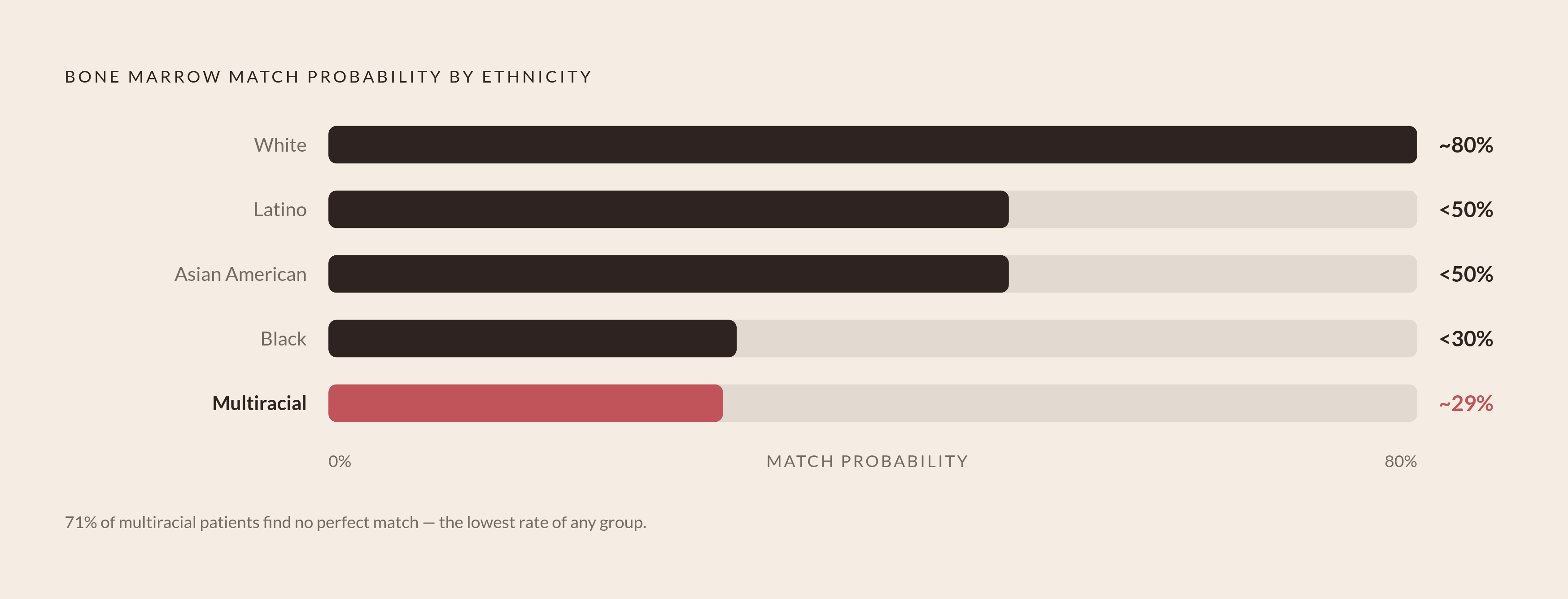
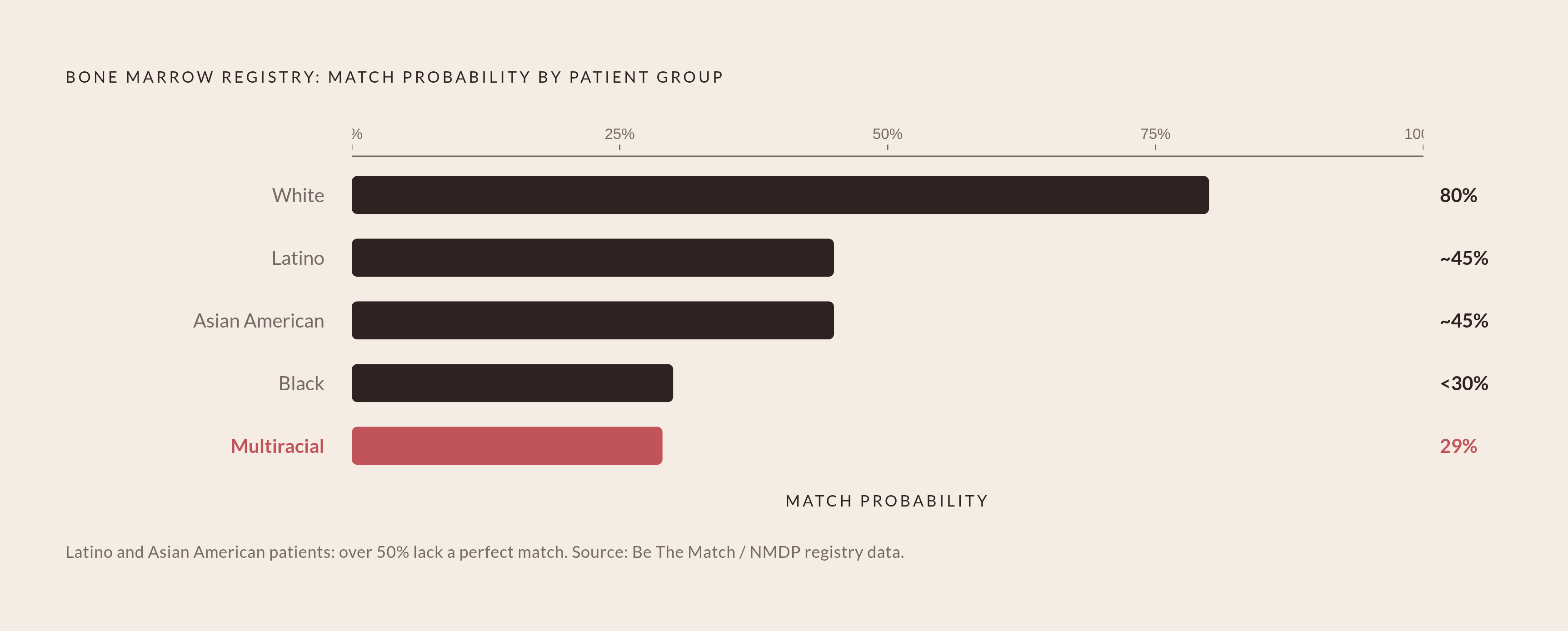
The contrast isn't subtle, and it isn't new. White patients have roughly an 80% chance of finding a perfect match across global registries. Black patients have less than 30%. Multiracial patients find no perfectly matched donor anywhere in the worldwide registry 71% of the time. More than half of Latino and Asian American patients also lack a perfect match, but mixed-heritage patients carry a compounded version of every challenge present in each ancestral line they descend from. The problem doesn't average out. It multiplies.
On the Be The Match Registry, a patient's likelihood of finding a matched donor ranges from 29% to 79% depending on ethnic background. For multiracial Americans, that range applies in full and routinely lands at its lower end. For bone marrow transplants specifically, the success rate for mixed or non-Caucasian backgrounds sits at approximately 10%. That figure is the reason cord blood matters so much to this population — for many families, it is the first realistic option.
The NMDP registry holds more than 40 million potential donors and still cannot reliably serve a large share of its most vulnerable patients. Scale alone cannot correct a composition problem. These numbers represent the floor that cord blood's more forgiving matching standards could raise, provided the inventory exists to support them.
Why cord blood matching is more forgiving, and what that means for mixed-heritage families specifically
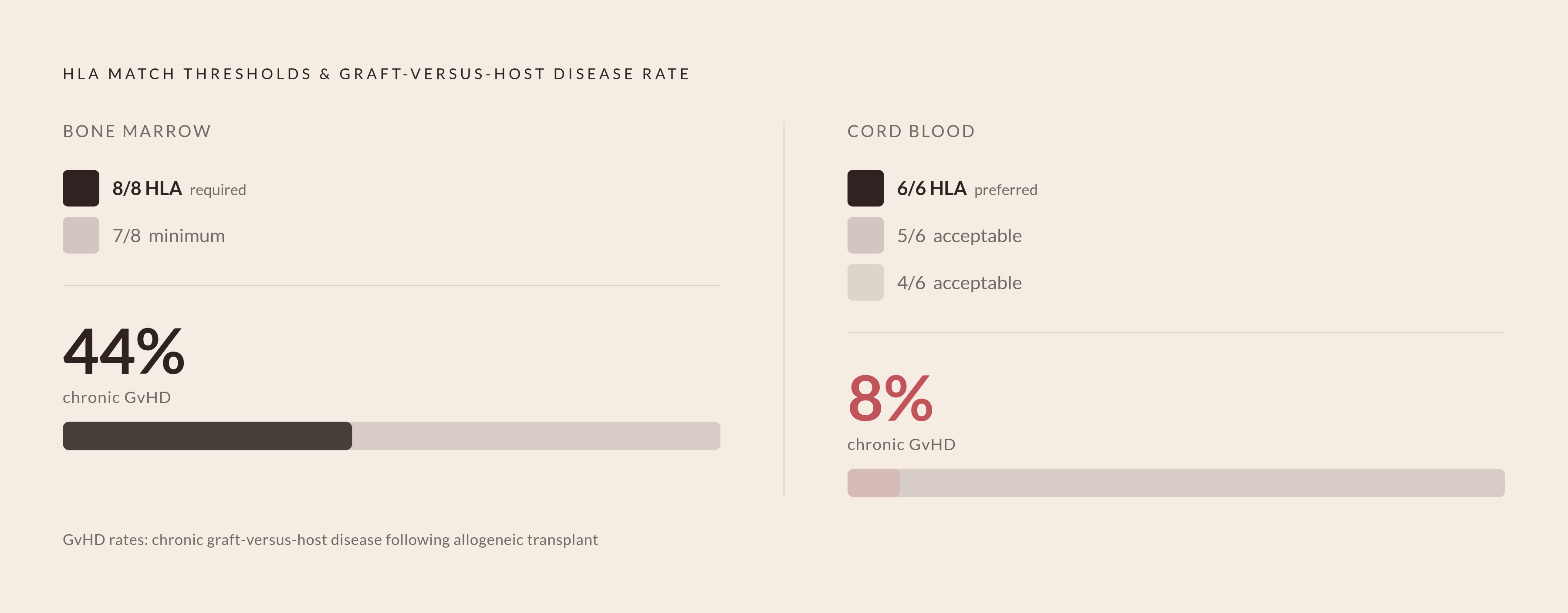
Adult bone marrow transplants require an 8/8 HLA match, or at minimum a 7/8. Cord blood is considered a match at 6/6, with 5/6 and 4/6 also clinically acceptable. That lower threshold directly widens the pool of usable units for patients whose HLA profiles are rare or novel, which is precisely the population that cannot find an 8/8 bone marrow match anywhere in the existing registry.
The NMDP has stated explicitly that cord blood is "especially promising for patients who have diverse ethnic backgrounds" because of this flexibility. The clinical advantages extend further than matching alone. Cord blood transplants carry a chronic graft-versus-host disease rate of 8%, compared to 44% with bone marrow. Banked cord blood is also available immediately, and when no bone marrow donor exists and a patient's condition is advancing, eliminating the search delay can be decisive.
The Pennsylvania Department of Health has stated directly that cord blood donations are "particularly important to provide transplants for patients who are of minority or mixed heritage." These biological and logistical advantages only translate into outcomes, though, if the inventory actually reflects the patients who need it. That is where the current system falls short.
How far current registries are from reflecting the patients who need them most
On Be The Match, only 3% of potential donors self-identify as mixed race. That figure roughly mirrors census proportions, which might suggest adequate representation until you consider what it conceals: the genetic diversity within that 3% is far greater than any single-ethnicity group of equivalent size. The population is underrepresented not just numerically, but in the combinatorial HLA complexity it carries. Proportional representation is the wrong benchmark here, and treating it as sufficient is a category error.
The broader picture is consistent. More than 12% of the U.S. population is Black; only 4% of international registry donors are Black. The proportional gap holds across non-white groups. CIBMTR data spanning 2009 to 2020 document the real-world consequence: ethnically diverse patients already disproportionately receive mismatched unrelated donor, haploidentical, and cord blood transplants — routed to alternatives not by clinical preference, but by default.
Canadian Blood Services offer a meaningful counterpoint. Their bank distributed cord blood units of non-Caucasian ethnicity at a rate of 43.3%, with 18% from multi-ethnic donors. Deliberate, targeted programming can shift a bank's inventory composition measurably. What the current U.S. picture reflects is a set of policy and infrastructure decisions, not an immutable biological constraint.
The multiracial U.S. population grew 276% between 2010 and 2020. Nearly a third of that population is under 18. The youngest, fastest-growing demographic group in the country is the one most poorly served by current registry composition, and that divergence does not resolve itself passively.
The compounding barriers that keep mixed-heritage donors from reaching public banks
Geographic access is the first barrier, and it takes shape before any individual decision is made. Cord blood donation is only possible at hospitals partnered with a public bank. Minority communities are disproportionately likely to give birth at non-partnered hospitals. Willingness, information, and community trust are all irrelevant at a facility that has no collection agreement. Individual motivation cannot solve a problem structural at its root.
Awareness is more tractable than the other barriers. Among African-American women surveyed in one study, lack of awareness was the only identified barrier to cord blood donation. Eighty-eight percent said they would donate once informed. That asymmetry between high willingness and low knowledge is something targeted outreach can actually close.
Medical mistrust and cultural context are more layered. A 2019 systematic review identified medical mistrust, cultural and religious identity, and perceived discrimination as simultaneous barriers and facilitators, which means they resist any single-variable intervention. These aren't fixed obstacles — they are context-dependent responses to accumulated institutional history. Trust is built through years of sustained, genuine community partnership, not through a campaign cycle.
Classification is a less visible problem, but consequential nonetheless. Current registry intake forms often treat race as a single fixed category. Published research in genetics has documented the limitations of applying such ontologies to multiracial individuals. Mixed-heritage donors are miscategorized or effectively made invisible at the point of intake, which means the data on their representation is likely worse than it appears.
Then there is the structural tension between private banking and public donation. Private cord blood banking carries meaningful upfront and ongoing costs; units stored privately are removed from the public pool. The families with the strongest individual reason to consider private banking — because finding a public match is statistically harder for them — are the same families whose donations the public registry most needs. The incentive structure runs directly against the public health outcome.
What programs and policies are doing to narrow the gap — and where the limits are
HRSA's higher reimbursement rates for minority-group cord blood units represent a direct policy lever aimed at shifting what banks actually collect. In 2024, HRSA awarded $16.5 million to cord blood banks for high-quality, genetically varied units, down from $18.3 million in 2023. For anyone tracking whether federal investment in this area is growing or contracting, the direction is clear enough.
Institution-level action exists and is worth naming concretely. StemCyte's renewed 2024 partnership with the California State Umbilical Cord Blood Collection Program and UC Davis Health focuses explicitly on ethnic diversity, with planned new collection sites in underserved areas. It represents what targeted, coordinated effort looks like when the institutional pieces actually align.
An international comparison is instructive without being encouraging. The NHS has made diversifying its donor base one of five strategic priorities. In 2023, 30% of the transplant waiting list were ethnic minorities who comprise approximately 14% of the population. Explicit prioritization is necessary. It has not yet proven sufficient.
Emerging science is opening new lanes, some more immediately relevant than others. Researchers have reported that dropping to a 4 to 6 out of 8 bone marrow match with pharmacological support can meaningfully expand match rates for patients who currently have no options. Those same researchers have cautioned against waiting for a perfect unrelated donor before moving to mismatched or cord blood alternatives, because delay affects survival — reframing cord blood as a parallel track rather than a fallback. CRISPR-based approaches to create hypo-immunogenic donor cells are being explored in published research, but they are not a clinical solution for families searching today.
None of the existing programs have produced registry diversity that keeps pace with demographic change. The gap is narrowing more slowly than the population is diversifying.
What mixed-heritage families can do now, given where registries and options actually stand
Public donation helps other families and grows the registry. Private banking preserves the unit for the donor's own family. For mixed-heritage families, private banking deserves serious consideration because finding a match in the public pool is statistically harder for them. The right decision depends on family health history, financial situation, and whether the delivery hospital is partnered with a public bank. Families deserve a clear-eyed account of that trade-off before they decide, and most aren't getting one.
Several practical realities apply regardless of which direction a family chooses. Confirming whether the delivery hospital is partnered with a public cord blood bank must happen before labor; if it isn't partnered, public donation is unavailable regardless of intent or willingness. Private banking removes a unit from public inventory, with real consequences for other mixed-heritage patients currently searching. The decision must be made before birth — cord blood cannot be collected after delivery.
The awareness gap documented in the research literature remains among the most closeable barriers in this space. High willingness-to-donate figures suggest that for many mixed-heritage families, the obstacle is simply information: knowing donation is possible, understanding how to pursue it, grasping what it means for someone else searching that registry right now. Structural and biological barriers resist targeted intervention. This one doesn't, which makes the persistence of the awareness gap harder to excuse.
Every diverse unit banked expands the pool for patients who have the fewest alternatives. Mixed-heritage donors aren't simply potential recipients of these transplants — they are the most irreplaceable donors for others like them, because their particular HLA combinations are the only potential matches for patients who share those combinations. The decisions made now, by families, hospitals, banks, and policymakers, will determine what the registry looks like for the generation that is currently under 18: already the most diverse in American history and the most underserved by the system as it stands.