Placenta Capsule Iron and Hormone Content Measurement Studies
Measured iron and hormones survive processing, but their presence doesn't prove the capsules work.
Placenta capsule iron and hormone measurement studies distinguish what the processed material contains from what consuming it can achieve. Iron and hormones remain after encapsulation, but their measured concentrations do not establish that the capsules improve postpartum iron status or mood.
Why the question of what survives encapsulation matters for postpartum health claims
Placenta encapsulation involves steaming, dehydrating, and grinding the postpartum placenta into capsules. It is marketed on the premise that consuming this material replenishes iron and hormones lost at delivery. Before peer-reviewed studies examined the capsules directly, those claims rested on anecdote. The biological premise is not implausible, because the placenta retains iron and accumulates steroid hormones during pregnancy. However, the presence of these substances in an organ does not establish the dose available in a product made from it.
Processing is central to evaluating the claims because heat degrades biological compounds, and both steaming and dehydration expose the material to heat. Because no regulatory body sets processing standards for placenta capsules, studies that measure what is in them are the only available guide to their contents. For practitioners interpreting postpartum health claims, the essential questions are what the studies measured, how they measured it, and what their numbers mean.
What the placenta actually contains before processing, and why that starting point is contested
What is in a raw placenta varies even before it is heated. An earlier estimate that each term placenta retained roughly 90 mg of iron was based on little data. Barad et al. 2022 used inductively coupled plasma-mass spectrometry to test a larger sample that had been more carefully described and found much lower amounts. Mean placental iron content was roughly 40 mg in teen singleton carriers and about 23 mg in women carrying multiples. Those amounts were roughly half and roughly a quarter of the earlier estimate, in that order.
Maternal iron status also mattered, but its relationship with placental iron was not uniform across the groups. In women carrying multiples, lower maternal iron status was linked to a higher concentration of iron in the placenta. In teen singleton carriers, the relationship ran the other way. Grzeszczak et al. 2023 used ICP-OES to study twin pregnancies and found variation in raw placental iron concentration, with lower concentrations associated with worse infant morphometric parameters, including birth weight. These findings place the organ’s retained iron within competing fetal transfer demands.
The baseline hormone picture is similarly variable. The placenta accumulates a range of steroid hormones across gestation, but concentrations differ with gestational age, individual physiology, and sample handling. The encapsulation trade does not standardize these conditions. Consequently, a calculation of processing loss inherits uncertainty from the raw material as well as from preparation. Comparing an assumed amount in the raw organ with a measured concentration in the capsules does not, on its own, show how much was lost during processing.
How the 2016 UNLV mineral study measured iron in encapsulated placenta and what it found
The Young, Gryder, David, Teng, Gerstenberger, and Benyshek 2016 mineral study moved the question from assumed raw content to direct capsule analysis. Published in Nutrition Research, it was the field’s first chemical analysis of encapsulated placenta. The researchers applied inductively coupled plasma mass spectrometry, or ICP-MS, to 28 placenta samples processed for encapsulation. Nonsmoking women donated the samples, and the same donor pool supplied the companion hormone study.
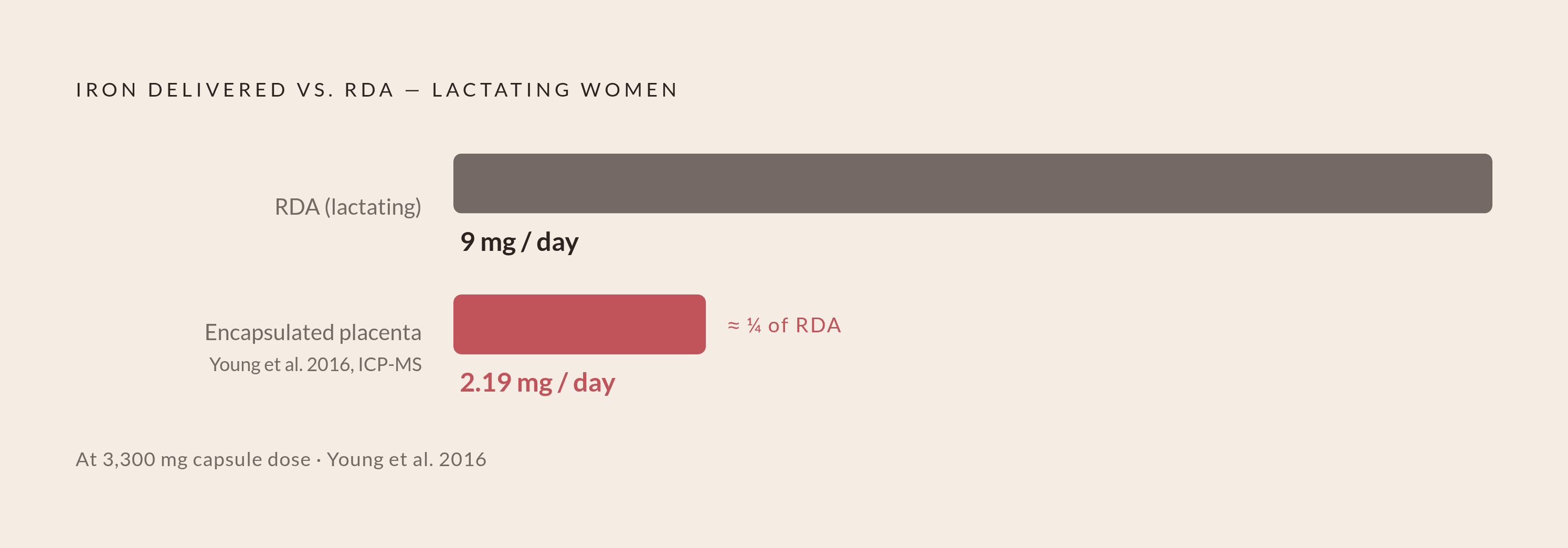
The study tested for 14 trace minerals and elements, including arsenic, cadmium, cobalt, copper, iron, lead, manganese, mercury, molybdenum, rubidium, selenium, strontium, uranium, and zinc. To work out how much someone would consume each day, the researchers used a recommended dose of 3,300 mg per day of placenta capsules. At that dose, the capsules delivered approximately 2.19 mg of iron. That was roughly a quarter of the recommended dietary allowance for lactating women. The dose reference matters because the concentration in the material and the amount consumed each day are different quantities.
The other measured elements added context to the iron result. Copper, selenium, and zinc were present at modest concentrations, while manganese, molybdenum, strontium, and rubidium appeared at still smaller levels. Mean concentrations of potentially harmful elements, namely arsenic, cadmium, lead, mercury, and uranium, were well below established toxicity thresholds. The finding of toxic-element safety at the dose tested applies to the measured elements under the study conditions.
How the 2016 UNLV hormone study measured what survived steaming and dehydration
The Young, Gryder, Zava, Kimball, and Benyshek 2016 companion study asked whether hormones also remained detectable after preparation. Published in Placenta, it examined free, unconjugated steroid hormones and melatonin. The researchers applied liquid chromatography tandem-mass spectrometry, or LC-MS/MS, to the same 28 encapsulated samples. They analyzed the material for 16 steroid hormones and melatonin, making 17 targets in total. The purpose was to detect and quantify these substances.
Fifteen of the 17 target hormones were detectable in all 28 samples. They included progesterone, estradiol, cortisol, aldosterone, and testosterone. These measurements established that steaming and dehydration do not eliminate steroid hormones entirely. But overall concentrations were relatively low, so finding hormones after processing did not show that they remained at the levels found in the raw organ.
The researchers noted that progesterone and estradiol concentrations could reach levels at which physiological effects were plausible. They treated that observation as a reason for follow-up. This distinction is central to the study’s scope, because an analytical instrument measures what is in a sample. Clinically meaningful effects on maternal physiology from the quantities delivered remained unestablished in this study. Its contribution was a defined composition finding that clinical research could then test.
What the randomized pilot trials found when they tested iron status and mood in women taking the capsules
The UNLV research group took that next step through two parallel randomized, double-blind, placebo-controlled pilot trials. Both used encapsulated beef as the control. Randomization and blinding strengthened the comparison, but the pilot scale limited what it could resolve. Both trials were acknowledged to be underpowered.
Gryder et al. 2017, published in the Journal of Midwifery & Women's Health, assessed maternal iron status through hemoglobin, transferrin, and ferritin. Measurements covered four time points, namely the 36th week of pregnancy, within four days of delivery, days 5–7 postpartum, and week 3 postpartum. The trial left improvement in postpartum iron status from the capsules’ measurable dietary iron contribution statistically unsubstantiated. The mineral study’s allowance comparison described intake.
Young et al. 2018, published in Women and Birth, reported a more mixed hormone and mood picture. Part 1 found minor but statistically significant dose-response changes in participants’ hormone profiles after ingestion of steamed, dried placenta. Part 2 found no significant overall change in the mothers' mood, bonding, or fatigue. Still, depression scores showed a dose-related difference in favor of the placenta group at the two higher doses, including 3,300 mg per day and the next lower dose. That difference disappeared at the lowest dose after nine days, suggesting that any effect might be dose-dependent and time-limited.
The depression-score result is a pilot signal. It must be read with the absence of an overall mood benefit and the trials’ limited power. A larger randomized, placebo-controlled trial on placenta encapsulation and postpartum depression has been under way at the University of Nevada, Las Vegas. No publication from that larger trial is established in the available source material.
Why the processing method introduces variability that the composition studies could not fully control
The UNLV composition findings describe capsules made under a specific, controlled protocol. The temperature, time, and methods used for encapsulation vary in practice, so those findings cannot reliably show what every commercial or independent preparation will deliver. Without processing standards, there is no official minimum temperature, time for dehydration, or quality-control requirement that practitioners must meet.
This limitation also prevents the raw-to-capsule gap from being expressed as one dependable retention ratio. The amount remaining depends on the raw material and how it is handled. The 2016 measurements show what was in the preparations tested under the study conditions. They do not show that heating the material for a different time or at a different temperature leaves the same mineral and hormone profile. Treating their values as specifications for an unstandardized product would extend the findings beyond what was measured.
A 2023 laboratory study published in the Clinical Laboratory Science Journal found that dehydration significantly decreased Group B Streptococcus in manually GBS-infected placenta samples but did not eliminate it. The CDC issued a warning after a newborn developed recurrent neonatal GBS sepsis following maternal ingestion of placenta capsules dehydrated at temperatures between 115°F and 160°F. Those temperatures were in the range commonly used for encapsulation. These findings show that heat that changes what is in the capsules may still leave pathogens behind, so tests of their contents cannot take the place of checks on how safely they are processed.
What the current body of measurement studies can and cannot tell a reader making decisions about placenta capsules
The measurement literature establishes that encapsulated placenta contains quantifiable iron and multiple steroid hormones. It also describes modest concentrations, with hormone levels reduced by up to 99.6% through encapsulation processing. That shows how much can be lost, though the loss can differ with the hormone or the way the capsules are made. For readers who choose encapsulation, the measured iron dose adds a modest amount of iron to the diet but is too low to treat postpartum anemia. The completed trials have not established an overall benefit in iron status or mood.
LC-MS/MS analysis alone does not establish the bioavailability of orally ingested hormones, meaning how much reaches systemic circulation at physiologically active concentrations. A potentially active concentration in a capsule therefore does not guarantee a physiological effect in the mother. Conversely, the underpowered pilot trials with self-selecting participants cannot conclusively exclude effects that a larger, adequately powered trial might detect.
Banking placental blood and tissue instead of, or in addition to, encapsulation preserves biological material for uses including stem-cell therapies supported by established science. The capsule measurement literature does not evaluate those options or provide a comparison between them.
Sources
- Human placenta processed for encapsulation contains modest concentrations of 14 trace minerals and elements - ScienceDirect
- Presence and concentration of 17 hormones in human placenta processed for encapsulation and consumption - ScienceDirect
- Placental Iron Content Is Lower Than Previously Estimated and Is Associated With Maternal Iron Status - PMC
- Preliminary Study of Iron Concentration in the Human Placenta in Twin Pregnancies - PMC