third-party laboratory partnerships in placenta and cord blood banking
The lab you choose matters more than the bank's marketing promises.

Third-party laboratory partnerships are the plumbing behind placenta and cord blood banking. Most families never see this layer, and yet it's the thing that decides whether a stored sample is usable decades from now. More than 400 cord blood banks operate worldwide, and many of them contract out processing and storage to a lab instead of running that infrastructure themselves. How those contracts are built, and what they demand from the labs on the other end, tells a family more about the service they're buying than any brochure will.
A banking brand can hand off as much or as little of the technical work as it wants, and that choice is the whole ballgame. Processing is usually the first thing to go: separating the cord blood or tissue, reducing volume, isolating cells. That single step decides how many viable cells actually survive to be stored, which makes it the most consequential piece of the whole operation, and it's also the piece banks most often hand to someone else. Public banks alone report spending between $1 million and $6 million a year on processing, testing, storage, and licensing fees tied to proprietary technologies, steep enough that smaller or newer entrants find it cheaper to rent lab capacity than build their own.
Testing for infectious disease and sterility isn't optional. It has to happen before a unit can be stored at all. Cryopreservation and long-term storage in temperature-controlled vaults come next, along with the quality assurance systems and audit trails regulators and accreditors expect to see on paper. A private bank might process samples in its own facility but ship them elsewhere for cold storage, or do the reverse. There's no single template here, and anyone telling a family otherwise is selling something.
Placenta banking complicates this further. Processing placental tissue means isolating the amnion and chorion layers, and not every lab accredited for cord blood is set up to do it. So outsourcing extends beyond who touches the sample. It's about whose proprietary method gets applied to it, since the processing technique itself usually belongs to the lab, not the bank marketing the service. Real accreditation, the kind that matters, attaches to the facility doing the work, not to the brand name on the contract. A family comparing two banks might be comparing the same lab twice, or two labs with very different track records, and the marketing materials won't say which. The gap between brand and facility, the single most overlooked fact in this industry, is the first thing worth checking before signing anything.
Five partnership structures currently operating in the market, from fully outsourced to internalized within a corporate family
The market has settled into a handful of recognizable arrangements, and each one changes what a family is actually signing up for. Not all five deserve equal trust. The structure a bank picks says as much about its priorities as anything in its marketing copy, and one of these five, the intercompany version, deserves more suspicion than families currently give it.
The most common form is a private bank that markets directly to families while outsourcing processing to an accredited outside lab. The bank owns the customer relationship; the lab owns the equipment, the protocols, and often the proprietary processing method. Storage facilities in this category tend to build in serious redundancy: backup generators independent of the grid, standby ultra-low-temperature and liquid nitrogen freezers, and monitoring systems designed to keep samples safe if primary systems fail. None of that requires the bank to own a single square foot of lab space. It just requires a contract that says so, and the strength of that contract matters far more than the size of the bank's ad budget.
A second structure folds the lab inside a parent biotech company, so the "third party" is really a sibling entity rather than an outside vendor, and this is the one families should trust least by default. One bank in this category has changed corporate ownership multiple times since 1998, moving from an independent family cord blood bank to a subsidiary of a larger biotech, then another, while the underlying laboratory stayed put. Families dealing with a bank like this interact with one brand, but the entity actually running the freezers is a distinct legal operation inside the same corporate family, governed by intercompany agreements rather than a contract negotiated at arm's length. That distinction matters more than it sounds like it should: an intercompany agreement can be rewritten far more easily than one negotiated between separate companies, which means the protections a family assumes it has may only last as long as the parent company wants them to.
A third model spreads the lab work across a network of separately licensed regional facilities under one consumer-facing brand. One European placenta banking service, for example, routes different services to different laboratories in different countries depending on what's being stored, cord blood to one facility, placenta tissue to another. A family banking through a service like that may never realize that two different licensed entities, not one, ended up handling two different tissue types from the same birth.
A fourth structure belongs to the public banking world, where the "partnership" isn't just a lab contract but a three-way agreement between a public bank, a state program, and an academic health system. One example: in May 2024, a public cord blood bank extended its partnership with California's state umbilical cord blood collection program, run in conjunction with UC Davis Health. That bank has supplied 83% of transplant units through the state program since 2013, focused specifically on banking units from Latino, Asian, and African American communities, groups historically underrepresented in donor registries. The renewed agreement opens new hospital collection sites in the Palm Springs area and in Sacramento. This is a hybrid public-private operator running both donation and family banking out of a single cGMP facility in California, and the partnership terms cover funding and collection logistics as much as laboratory science.
A fifth model reframes public banks entirely, turning them into upstream suppliers for a cell therapy manufacturer rather than storage vendors for individual families. In July 2024, a national cord blood registry organization and nine public cord blood banks formed an alliance making pre-identified units available specifically for manufacturing cord-derived cell therapies, including natural killer (NK) cell therapies. The alliance draws on an inventory of more than 200,000 banked units, searchable through a dedicated platform that lets manufacturers filter for units meeting specific production requirements. It has also expanded its testing menu to include KIR and CD16 analysis, markers that matter specifically for identifying units suited to allogeneic (donor-to-recipient) cell therapy manufacturing. That's a fundamentally different kind of third-party relationship. The lab now serves something other than a family. It's serving a drug manufacturer's supply chain.
What placenta banking specifically demands of third-party lab relationships
Placenta banking is a much younger business than cord blood banking, with far fewer operators, and that scarcity makes lab dependence sharper and its consequences easier to see. A narrow lab market leaves families with limited alternatives and reduces the competitive pressure that typically drives standardization.
Two branded, proprietary processing methods currently anchor much of the market, and they don't agree on much. One preserves the amnion and chorion layers, tissue rich in cytokines, growth factors, and multipotent stem cells, using storage below -130°C in vapor-phase nitrogen freezers. A separate patented method, developed by another operator, extracts the same amnion and chorion layers and preserves their multipotent cells, growth factors, and cytokines through a different proprietary procedure. Two methods, two sets of claims about cell preservation, and no shared standard tying them together. When a bank outsources placenta processing, the lab's method becomes the family's method, full stop. A family shouldn't assume "placenta banking" means the same thing at every bank offering it, because in practical terms, it doesn't.
Geography narrows the field further. The field of placenta storage operators in a given national market can be very narrow, potentially leaving families with limited options regardless of which brand they think they're dealing with. That's single-point dependency for an entire national market. If that one facility faced a disruption, equipment failure, regulatory suspension, a fire, there would be no domestic backup, full stop.
Placental blood storage is its own subspecialty, with at least one operator having offered it since 2006 and adding placental tissue banking in 2011. That's a differentiated service rather than a commodity one, requiring lab capability that goes beyond what standard cord blood or cord tissue processing calls for.
The stakes for getting this right are rising. Placental tissue already has regulatory approval for surgical use in one major market, and researchers are investigating placental cells for regenerative medicine applications, with clinical trials underway worldwide. Every one of those future applications depends on tissue processed correctly today, by whichever lab happened to be under contract at the time.
How industry consolidation has stress-tested third-party lab agreements, and what the Cryo-Save case reveals
The cord blood industry has gone through real consolidation over the past decade, especially across Europe, Latin America, and one large national market, driven by mergers and acquisitions among the largest operators. Consolidation doesn't just combine client lists. It reshuffles which lab is actually holding which family's sample, often without much fanfare, and families rarely get a clear notice when it happens.
The clearest illustration of what a lab contract is actually worth came out of a European bankruptcy in 2019. In February of that year, a major European stem cell bank and a banking group from one European country signed a memorandum of understanding around a possible acquisition. As part of that agreement, the two companies also signed a separate storage agreement: the banking group would preserve the other company's stem cell units in its own laboratories in that country's capital. In May 2019, the acquisition fell through, but the storage contract held, and the lab committed to honoring the storage agreement regardless. Shortly after, the original bank went bankrupt and shut down entirely.
Client samples stayed safe, in storage, in Warsaw, because a separate contract for laboratory services had already been signed and it survived the parent company's collapse. The banking brand died. The lab relationship didn't.
That sequence says something families rarely think to ask about. A storage contract isn't just an operational detail, it's continuity insurance. Whether a family's sample stays protected if the bank they signed with goes under depends entirely on the legal structure of that storage agreement, specifically which entity actually holds the obligation to keep the sample frozen and safe. A family evaluating a bank should ask not only who processes the sample today, but what happens to that contract if the bank itself disappears tomorrow. Most families never ask this question, and most enrollment packets are built so they never have to think of it.
Consolidation reshuffles these relationships at scale, too. Reproductive and newborn stem cell service aggregators in one large national market now manage well over a million banked units gathered through acquisition after acquisition, and each deal absorbs not just a client list but the laboratory relationships underneath it. A family who signed a contract with a small regional bank five years ago may now be, unknowingly, a client of a laboratory network that didn't exist when they made their decision.
How hybrid banking creates tripartite lab partnerships and what that means for quality thresholds
Hybrid banking tries to have it both ways: the unit is privately stored for the family, but it's also HLA typed and listed on an international registry, so a compatible patient somewhere else in the world could use it if there's a match. That third possibility turns a simple two-party arrangement into a three-way one. The private bank collects and stores. A registry partner handles search and matching. The laboratory in the middle has to satisfy both private storage standards and the tougher quality bar public banking demands, on the very same sample, at the very same time.
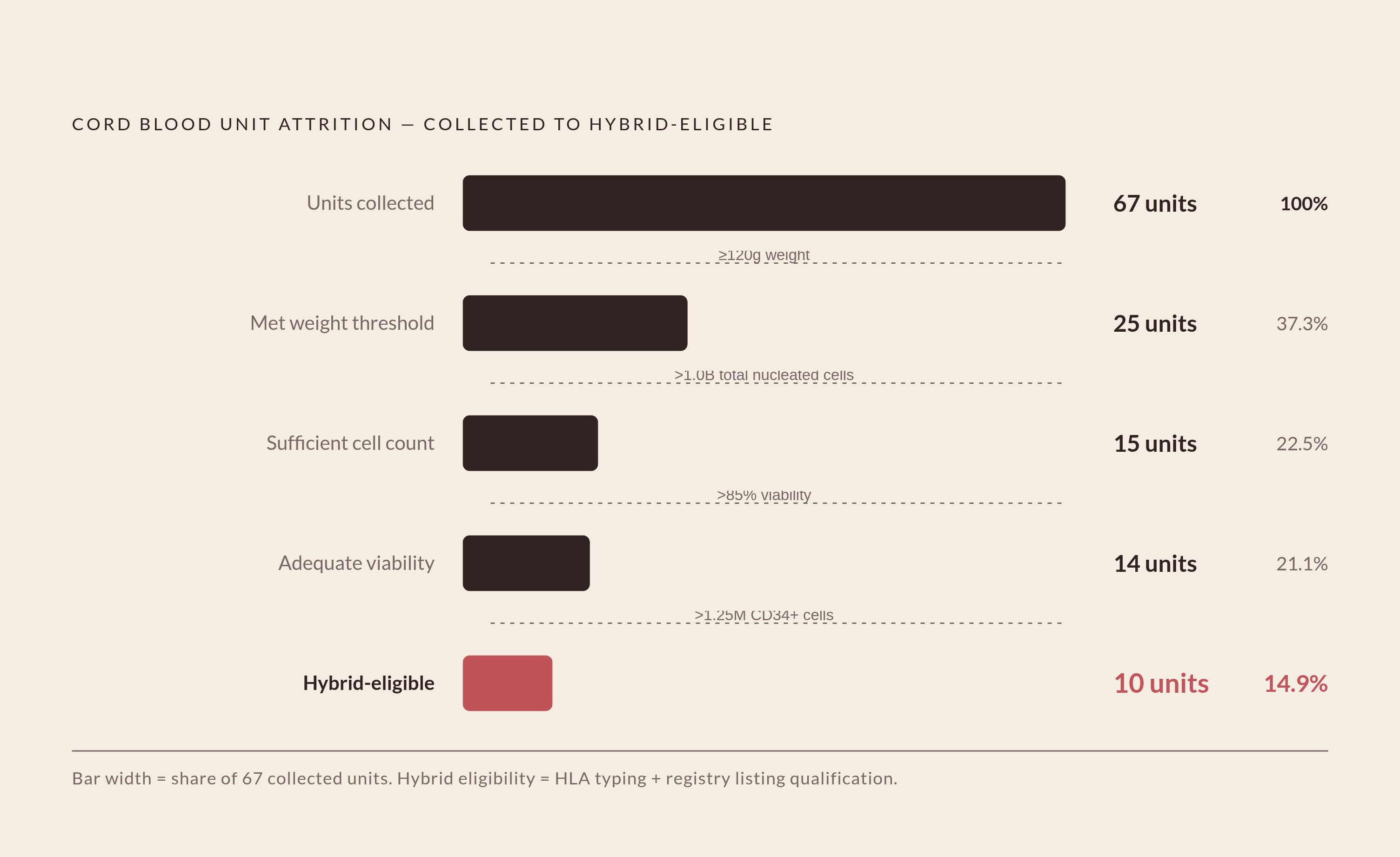
A Swiss pilot program run jointly by a university hospital, a biotech storage company, and the national blood transfusion service put hard numbers on how demanding that dual standard actually is. Between 2020 and 2023, the collaboration collected 67 umbilical cord blood units for hybrid banking. Only 37.3% of those units hit the 120-gram weight threshold required for public banking eligibility. Before processing, just 7.5% contained more than 1.5 billion total nucleated cells; after processing, 22.46% cleared the 1.0 billion cell mark. On viability, 62.7% surpassed an 85% margin using one measurement method, while 94.0% cleared 85% viability under cytofluorimetric analysis, a reminder that even "viability" isn't measured one single way across the industry. Just over half, 53.7%, had more than 1.25 million CD34+ cells, the marker most associated with blood-forming stem cell potency.
Run all those thresholds together, and only 14.9% of the 67 collected units ended up qualifying for hybrid purposes, meaning HLA typing and registry listing. One unit wasn't even suitable for processing at all. The published literature on cord blood collection more broadly puts the share of privately collected units that meet public banking requirements at somewhere around a quarter, so the Swiss figures track with a pattern seen elsewhere. This isn't an anomaly specific to that one program; it's what happens whenever you hold private collections to a public bar.
For the laboratory sitting in the middle of a hybrid arrangement, this means running two separate quality assessments on every single sample, one for private storage and one for public registry eligibility, and documenting both outcomes accurately even when a unit clears one bar and fails the other. Private storage can proceed on a unit that never had a chance at public listing. The lab just has to be honest about which is which. Researchers describe the ongoing partnership behind the Swiss pilot, published in Archives of Gynecology and Obstetrics in 2023 with implementation results following in Transfusion in April 2025, as a model other health systems could reasonably study. And the model is already moving past academic pilots: in May 2024, a health authority in Abu Dhabi and a regional health system launched a biobank that includes what's being described as the region's largest hybrid cord blood bank, announced publicly at a healthcare conference that year. Hybrid banking is no longer confined to research programs. It's becoming government-backed infrastructure, and the quality bar the Swiss data lays out is about to matter to a lot more families than it used to.
The accreditation and regulatory requirements that govern what third-party labs must demonstrate
Accreditation is where all of this gets tested from the outside. AABB accreditation, the standard most cited in the industry, attaches to the laboratory facility itself, not to whatever consumer brand is printed on the storage kit a family receives in the mail. That distinction matters more than it sounds like it should. A bank's accreditation status stays with the lab actually doing the work through rebranding, acquisition, marketing changes, and several ownership changes, because the accreditation belongs to the lab, not the brand.
That's exactly why the questions worth asking aren't about the bank's name recognition or its advertising budget. They're about the facility: is it accredited, is that accreditation current, and does the contract say what happens to the sample if the bank that sold the service stops existing. The Cryo-Save case answered that last question about as clearly as an industry case study ever will. The brand failed. The lab contract held. Families kept their samples because someone, years earlier, had written a storage agreement precise enough to survive a bankruptcy.
That's the standard a family should measure any bank against. Not the glossiness of the enrollment packet, but the durability of the paperwork behind it.