Placenta Options Beyond Encapsulation for New Parents
Explore burial, art, banking, and other ways to honor the placenta after birth.
In most American hospitals, the placenta is treated as clinical waste once the birth is over, disposed of without any prompt for the parents to consider what else might be done with it. That default is quiet and procedural, and it means most families never confront a decision that, in other times and places, carried real weight. A wellness movement built around postpartum recovery, ancestral practices that treat the organ as sacred, and a research effort now running clinical trials on placental stem cells have together pushed a growing number of parents to ask for it back. The resulting range of choices runs well past the idea that the only alternative to disposal is swallowing capsules. Earth burial, art prints, tinctures, long-term cell banking, and lotus birth each answer to a different motivation, cultural, aesthetic, medical, or spiritual, and most of them need to be decided on before labor begins, since several are mutually exclusive once the placenta leaves the delivery room.
What the placenta actually is, and why its biology makes each option possible
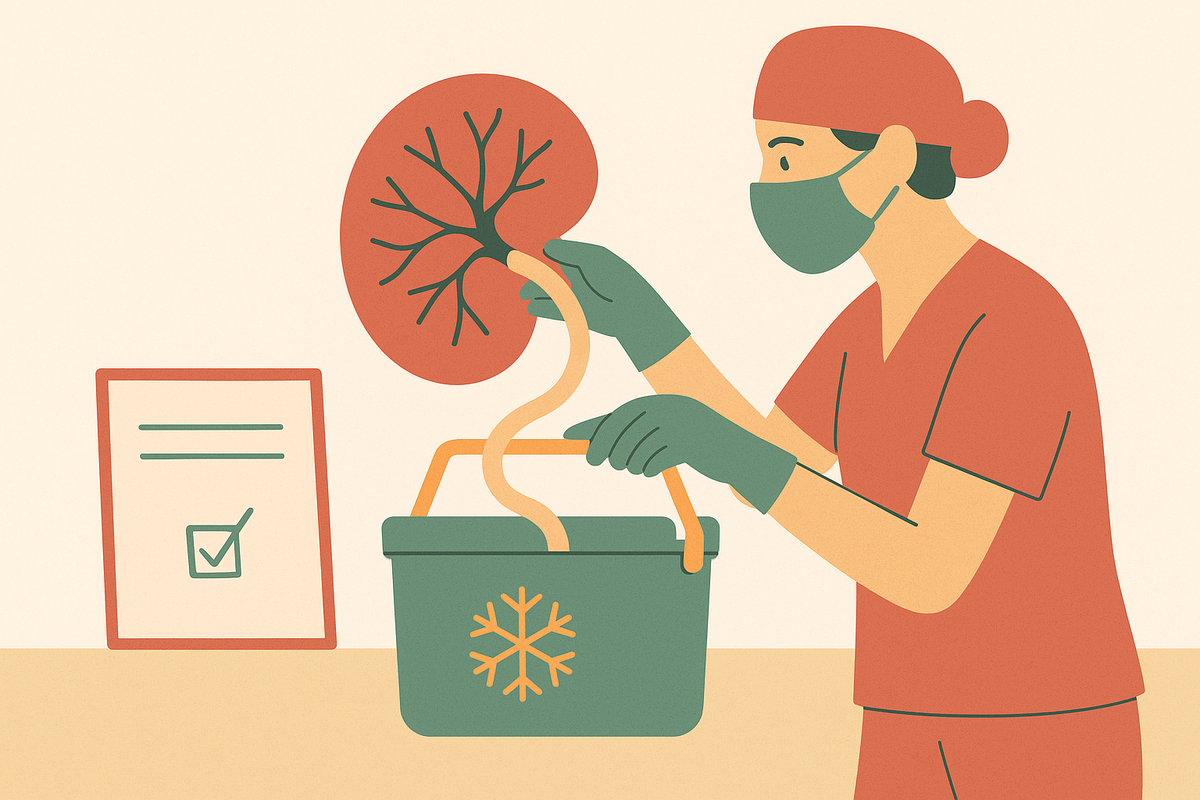
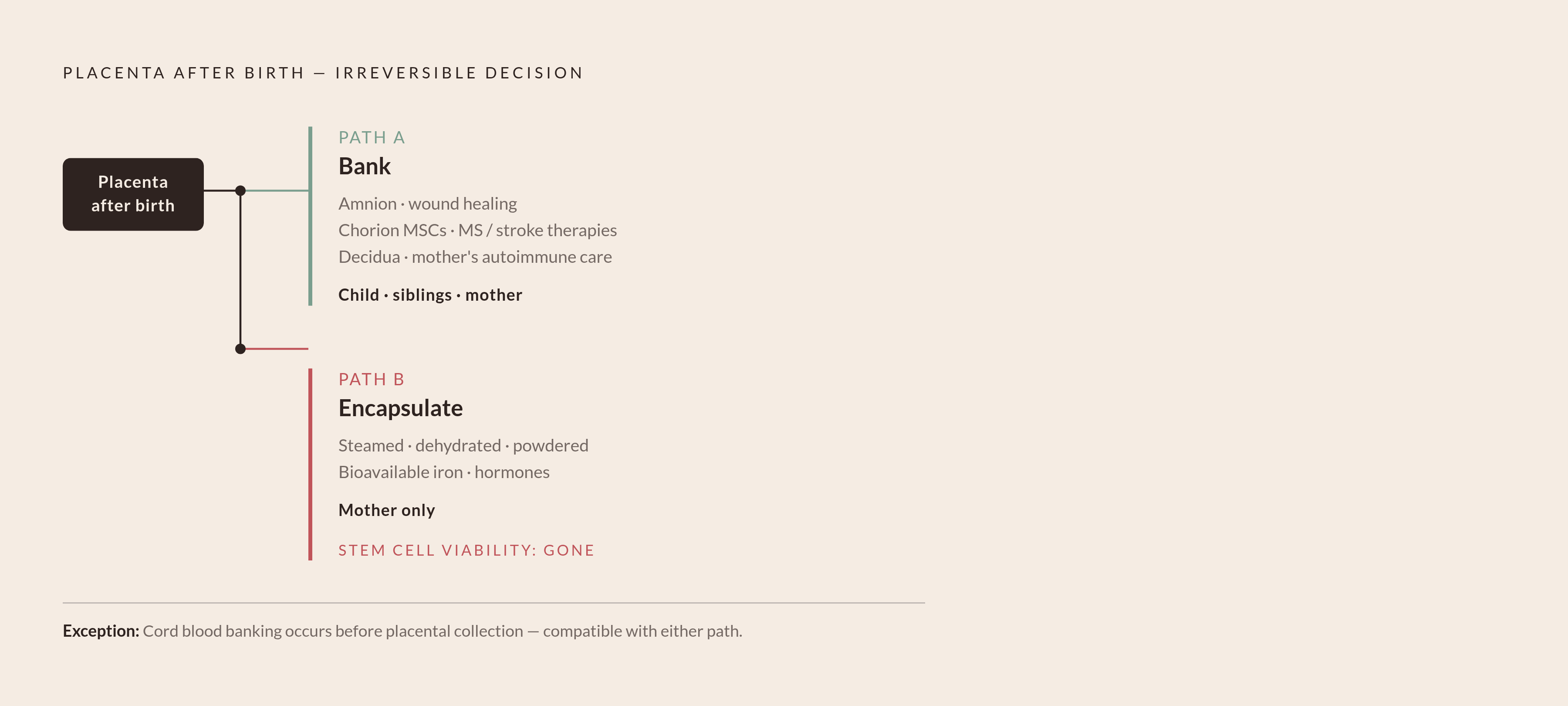
The placenta is the one organ the body builds for a single pregnancy and then discards, a dense network of blood vessels that functions as the fetus's lungs, kidneys, and liver until birth, which is also why its prints show the branching "tree of life" pattern parents frame on paper. That single organ is not uniform tissue. It separates into layers with distinct biological identities, and each layer is the reason a different post-birth option exists. The amnion carries wound-healing and anti-inflammatory properties and already has a place in eye surgery and burn treatment. The chorion holds a concentration of mesenchymal stem cells, the cells responsible for tissue repair and regeneration. The decidua is the only portion of the afterbirth built from the mother's own cells rather than the baby's, which is what gives it separate relevance to her own future health. This structure explains why the spectrum of options is not a single choice scaled up or down. Processing a placenta for consumption, through steaming and dehydrating, destroys the stem cells that make banking useful, which is the reason encapsulation and tissue banking can't both be done with the same organ.
Earth burial and tree planting as the oldest and most culturally widespread form of placenta honoring
Burial is the practice with the longest and widest documented history of any option on this list, recorded across societies and centuries in forms specific enough to count as evidence that treating the placenta as waste is the historical outlier. Among New Zealand Māori, the placenta, called whenua, is gifted back to Papatūānuku, the earth mother, and planted with a tree on family land. In te reo Māori, the word for land and the word for placenta are the same word, a linguistic fact that states the bond between child and land more directly than any ceremony could. Parents choosing burial today tend to replicate that intentionality on a smaller scale: in a study of contemporary families who buried the placenta, every participant chose a specific tree or shrub for the yard, often buying one for the occasion, usually something fruit-bearing, and treated the act as a ceremony that closed out the birth. Some providers have formalized that ceremony into a service. The Birth Passage markets placenta planting events that can include a tree of the parent's choosing, an earth mandala built around the burial site, the telling of the birth story, a gathering of community as witness, and the revealing of the baby's name. None of this reads as a fallback for parents who skipped something else. It reads as its own complete ritual, with its own structure and its own meaning attached to each step.
Placenta art prints and cord keepsakes as a way to preserve the memory without consuming or banking the organ
A placenta print transfers the vascular branching of the organ, the same "tree of life" pattern, onto acid-free paper, producing an image that holds up as a physical record of the connection between parent and baby. Some prints are made from the placenta's own blood with no additives; others use food-grade dye in a color the parent picks, and the finished print ends up framed or tucked into a box of other birth keepsakes depending on the family. The umbilical cord itself can be shaped while still pliable and then dehydrated into a keepsake, commonly a heart or a spiral, giving parents a second physical object distinct from the print. The practical value of this option sits in its timing: a print or cord keepsake can be made before encapsulation even begins, so it doesn't compete with other choices the way banking competes with consumption. It stands as one of the most combinable items on the entire spectrum, layering easily onto encapsulation, tinctures, or nearly anything else a family chooses. Providers already build their offerings around that combinability. Holistic Heritage Birth Services and Journey Within Birthing Services both offer prints meant for framing alongside their other placenta services, and Golden Lotus Doula Services in Pittsburgh offers a choice between a natural blood print and a food-grade dye print, bundled with a cord keepsake and encapsulation in the same package.
Tinctures and salves as wellness-oriented options that extend the placenta's use beyond the early postpartum weeks
Tinctures and salves come out of the same wellness thinking that drives encapsulation, but they're built for a different clock. A tincture is made by soaking a small portion of the processed placenta in high-proof alcohol, which yields a shelf-stable liquid extract that can last for years rather than weeks. Because it keeps, parents often set it aside for later hormonal shifts, weaning, the return of menstruation, or stretches of emotional strain well past the newborn stage, rather than using it in the first postpartum weeks the way capsules are used. Since it's typically prepared from the same placenta already set aside for encapsulation, it functions as an add-on rather than a separate decision competing for the same tissue. A salve takes a different route: dehydrated placenta powder gets infused into plant-based oils and beeswax, producing a topical product applied to cesarean scars, perineal soreness, hemorrhoids, cracked nipples, and even a baby's diaper rash or minor skin irritation. Holistic Heritage Birth Services and Holistic Birth & Beyond both list salves as an add-on to their encapsulation packages rather than a standalone product. The evidence behind both follows the same shape as the evidence behind encapsulation generally: parents report results, but the clinical literature supporting those reports in any systematic way is thin, and that gap applies equally to tinctures and salves as it does to capsules.
Encapsulation as the most widely chosen option, what it actually involves, and what the evidence does and does not support
Encapsulation is the process most parents already know by name, and it remains the reference point against which every other option on this list tends to get measured. The placenta is steamed, dehydrated, ground into powder, and packed into capsules the mother takes over the following weeks. Two methods dominate current practice. The Traditional Chinese Medicine method steams the placenta gently, often with ginger, lemon, and cayenne or chilli added for warmth, before it's sliced and dehydrated, following the concept that the body needs its heat and vital energy restored after birth. The raw dehydration method skips the steaming step entirely and sends the placenta straight into the dehydrator, aiming to preserve as much of the native enzyme and hormone content as possible. Because no formal regulatory standard governs the process, most encapsulators fall back on USDA meat safety guidance, which calls for dehydration at a minimum of 160°F to destroy foodborne pathogens. What research has actually confirmed is narrower than what marketing around encapsulation often implies: encapsulated tissue does contain bioavailable iron, trace minerals, and hormones including progesterone and estradiol. What the research has not shown is that taking those capsules prevents postpartum depression, increases milk supply, or restores energy in any way that holds up across studies. Researchers who have looked closely attribute the benefits many mothers report to placebo effect, not to a demonstrated pharmacological action, even though the subjective reports themselves are common and consistent. Encapsulation for consumption is not recommended in specific situations: an active uterine infection such as chorioamnionitis during labor, a placenta sent to pathology for analysis, or one that wasn't stored at the right temperature after birth. Providers have built out the category well past plain capsules. Holistic Birth & Beyond offers encapsulation alongside a dozen placenta-powder truffles in milk or dark chocolate, along with cord keepsakes, prints, salves, and tinctures as add-ons to the same order.
Placenta Banking's Evidence Base, and What It Requires Parents to Give Up
Placenta banking stands apart from every other option on this list because its underlying science is still moving. The mesenchymal stem cells concentrated in the chorion have drawn serious clinical research attention for their immunomodulatory effects and their potential to calm inflammation in autoimmune and degenerative disease. That interest has already produced trial data rather than just laboratory speculation. A phase 1 trial published in Scientific Reports tested placenta-derived mesenchymal stem cells in patients with secondary progressive multiple sclerosis and found the transplant procedure safe and feasible. As of June 2026, a Phase I/IIa trial at Chinese PLA General Hospital is recruiting patients to study human placenta-derived 3D mesenchymal stem cells as a treatment for acute ischemic stroke. Hundreds of other trials are investigating placental tissue across conditions from stroke and heart disease to osteoarthritis and inflammatory disorders. None of this should be confused with a treatment already sitting on pharmacy shelves. The therapies currently cleared for use are amniotic membrane tissue grafts, used for eye conditions, wounds, and ulcers, and those are tissue grafts, not stem cell therapies, a distinction that matters to anyone reading banking marketing material. What a family can actually preserve breaks down by layer: the amnion for its wound-healing and anti-inflammatory properties, the chorion for its store of mesenchymal stem cells, and the decidua, the only layer carrying the mother's own cells, which one bank, Cells4Life, describes as potentially useful for the mother's own future autoimmune care. Banking also reaches further than encapsulation in who it can serve. Encapsulation benefits only the mother who consumes the capsules, while banked tissue could serve the child, a sibling (the amniotic membrane carries low immunogenicity, so it can be used by someone other than the baby it came from with minimal rejection risk), and, through the decidua, the mother herself. The trade-off is absolute rather than partial. Heat and most forms of processing destroy stem cell viability. Once a placenta has been steamed, dehydrated, or turned into capsules, its value for any future cell-based therapy is gone, so banking and encapsulation can't both be done with the same placenta. Parents do get one piece of flexibility: cord blood collection happens before the placenta itself is collected, so a family can bank cord blood and still decide what to do with the placenta afterward without the two choices colliding.
The Medical Community's Objections to Lotus Birth
Lotus birth asks parents to leave the umbilical cord uncut entirely, letting the placenta stay attached to the baby until the cord separates on its own, a process that unfolds over several days, during which the placenta is salted and packed with dried herbs daily to slow decomposition. Parents who choose it tend to describe the placenta as a companion organ the baby releases in its own time, a framing that treats the attachment itself as part of a gentle, unhurried transition out of the womb rather than a medical event to be managed. The objections from medical bodies are specific rather than general. The American Academy of Pediatrics states that leaving the cord uncut carries no clear evidence-based benefit and may raise the risk of neonatal sepsis, a risk tied directly to the necrotic umbilical and placental tissue the baby remains attached to for days. The World Health Organization does not support the practice either, and instead points parents toward delayed cord clamping as the alternative with actual evidence behind it. That leaves lotus birth as the option where the distance between its stated intent and the clinical case against it is widest, and where any parent considering it needs to weigh a philosophy of gentleness against a specific, named infection risk rather than a vague caution.
Sources
- Placenta Banking vs Encapsulation: The 2026 Guide for Parents
- Complete Evidence-Based-Guide-Placenta-Encapsulation-Options: Benefits, Safety & More
- Placenta Encapsulation - NH & MA - Holistic Birth & Beyond
- Placenta Encapsulation {+ other options} — Holistic Heritage Birth Services
- More Than Clinical Waste? Placenta Rituals Among Australian Home-Birthing Women - PMC
- Placenta Banking vs Placenta Encapsulation