Regulatory Classification of Placenta-Derived HCT/P Products
Misclassifying placenta products under FDA's tiering system costs companies months and millions.

Placenta-derived products sit inside one of FDA's most misread classification schemes, and getting it wrong costs companies real time and real money. The rule that governs them, 21 CFR Part 1271, sorts human cells, tissues, and cellular and tissue-based products (HCT/Ps) into tiers based on risk, and where a product lands decides whether it needs a full biologics license or almost no premarket review at all. CBER runs that framework, drawing authority from Section 361 of the Public Health Service Act and, for higher-risk products, Section 351 and the Food, Drug, and Cosmetic Act. Placental tissue, amniotic membrane, and umbilical cord tissue all count as HCT/Ps under 21 CFR 1271.3(d); amniotic fluid does not, since the rule excludes secreted or extracted human products, and that exclusion can push it into drug regulation under stricter terms than the tissue sitting next to it on the same lab shelf.
Companies that build an entire launch plan around Section 361 can find that a processing step they treated as routine has already pushed them into Section 351. Get the product identification wrong at the start, and every decision downstream follows the wrong track.
The tiered, risk-based structure that governs everything downstream
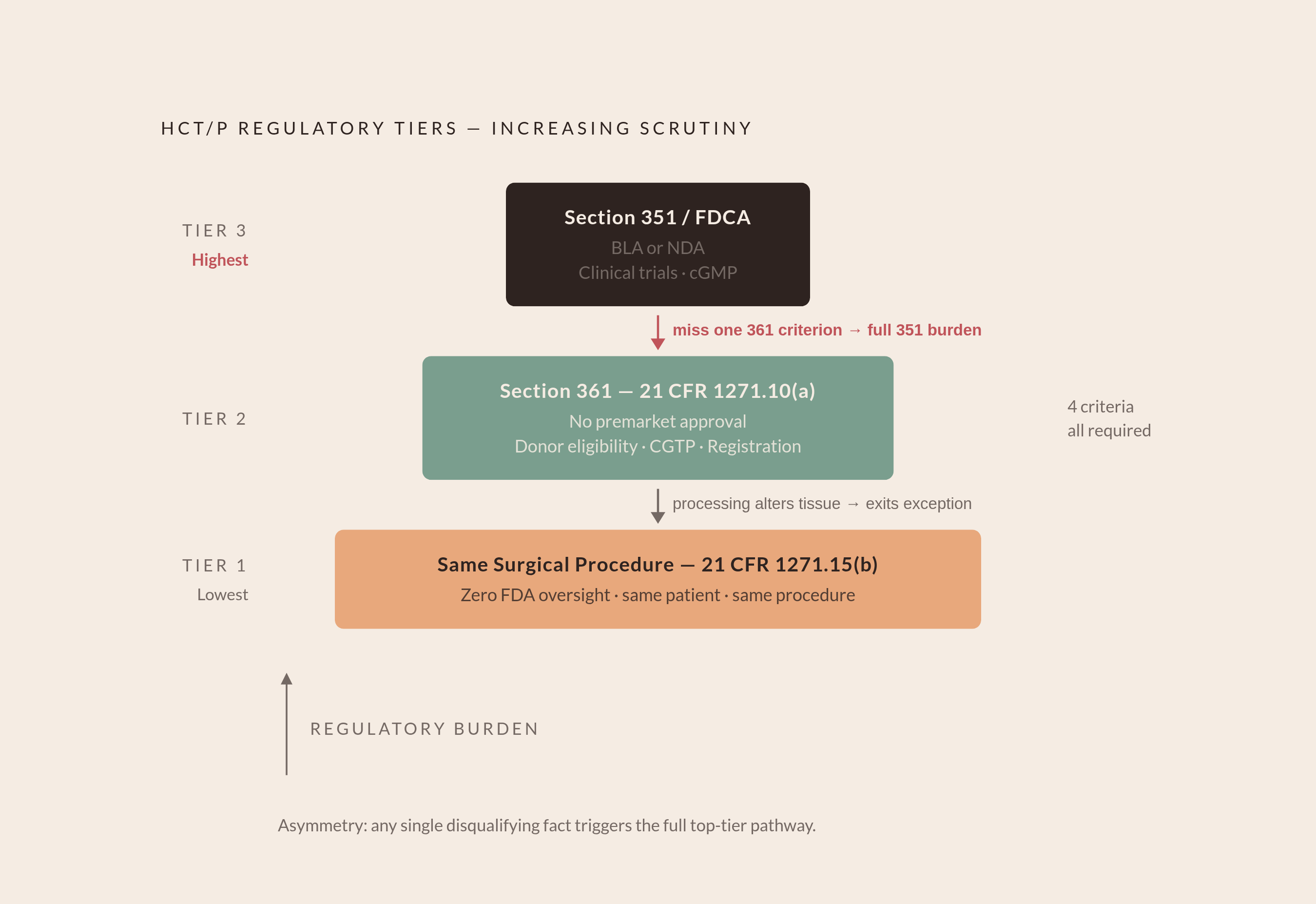
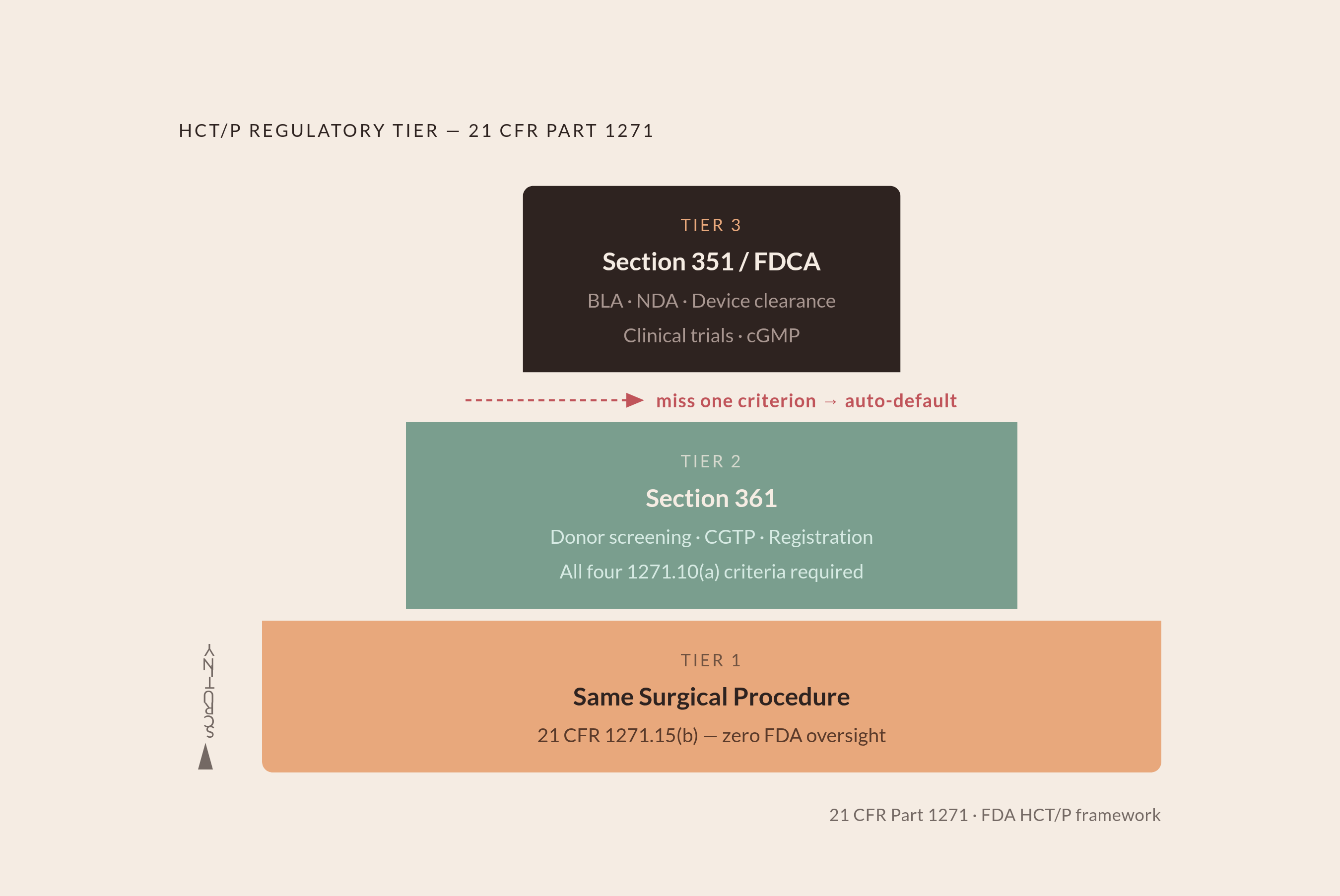
FDA didn't write one standard and apply it evenly. It built three tiers, and scrutiny scales with how far the product has moved from its original biological state.
At the bottom sits the narrowest carve-out in the whole framework: tissue removed from a patient and put back into that same patient during the same surgical procedure gets no FDA oversight at all, under the "same surgical procedure" exception in 21 CFR 1271.15(b). This exception is tight on purpose. The tissue that comes out has to be the same tissue that goes back in. Processing that changes it in any real way breaks the exemption, and the Ninth Circuit spent real effort in 2024 confirming just how little room that leaves.
The middle tier is the Section 361 pathway. Products that check every box in 21 CFR 1271.10(a) can reach the market without premarket approval, though they still answer to donor eligibility rules and current good tissue practice (CGTP) requirements. The top tier, governed by Section 351 and the FDCA, catches products that miss even one of those boxes; those need a biologics license, drug approval, or device clearance before they touch a patient.
The more a product is manipulated, the further it drifts from what nature built, and the more evidence FDA wants before it goes near a patient. For a company handling birth tissue, the question isn't abstract. It's which tier a specific product sits in, and what it takes to keep it there.
What the Section 361 pathway requires and what it actually allows
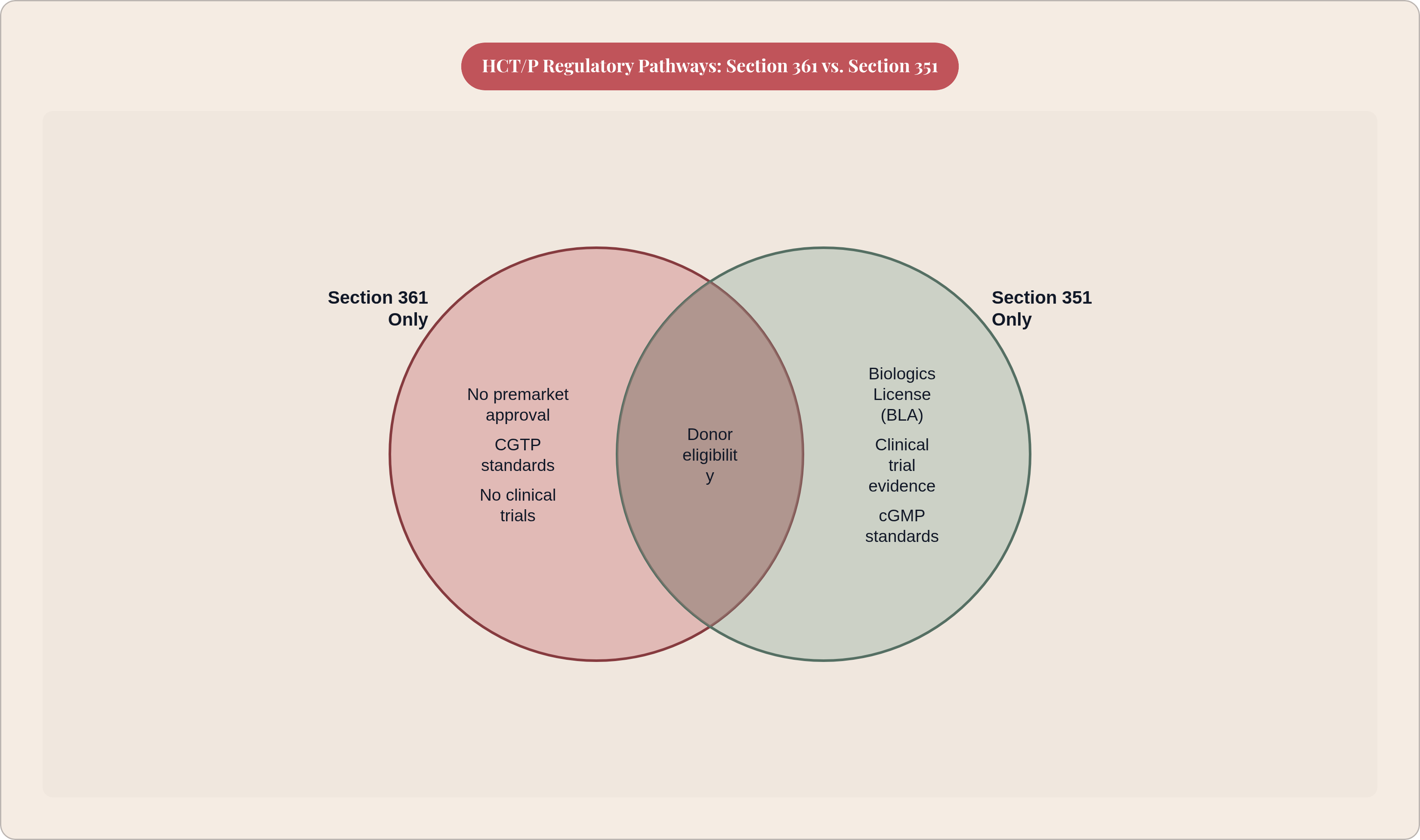
Section 361 lets a product reach the market without FDA premarket review, but only if it satisfies all four criteria in 21 CFR 1271.10(a) at once. Miss one, and the product falls into the 351 track by default. There's no appeal built into that math.
The tissue must be minimally manipulated, meaning processing didn't change its original relevant characteristics. It must be used homologously, meaning it does in the recipient roughly what it did in the donor. It can't be combined with another article except in narrow cases, and it can't have a systemic effect or depend on the metabolic activity of living cells for its main function, unless it's for autologous use, use between close relatives, or reproductive purposes.
Clear all four, and the product still isn't free of oversight. Donor eligibility screening and testing apply under Subpart C, CGTP rules apply under Subpart D, and the company still has to register and list with FDA.
The appeal of 361 is obvious. No clinical trials, no biologics license application, no premarket submission, and a timeline that's a fraction of the 351 route. I think that's exactly why so many companies treat it as a default assumption rather than something they prove out, product by product, claim by claim. FDA's enforcement record over the past year shows how often that assumption falls apart on contact.
How "minimal manipulation" works — and how amniotic membrane products fail it
Minimal manipulation isn't judged by one universal yardstick. Structural tissues, like amniotic membrane, get measured against whether processing changed the characteristics tied to reconstruction, repair, or replacement. Cellular and non-structural tissues get measured against whether processing changed their biological characteristics. FDA's July 2020 guidance on minimal manipulation and homologous use lays out the framework, and it rewards a slow read, not a skim for the bullet points at the top.
Amniotic membrane is a structural tissue, and its relevant characteristics are physical: integrity, tensile strength, its ability to act as a barrier. Convert that membrane from a sheet into an injectable, flowable product, and those characteristics disappear along with the original form. FDA cited exactly this failure in October 2024 warning letters to Amnio Technology and Pinnacle Transplant Technologies over PalinGen® Flow®, and again in January 2025 against BioStem Life Sciences on the same grounds. Turning a sheet into an injectable is more than minimal manipulation, full stop, and no amount of careful labeling changes that.
Other processing choices trip the same wire. Enzymatically isolating cells out of placental tissue counts. So does expanding or culturing those cells afterward. FDA isn't asking whether the finished product might help a patient; it's asking whether the processing left the tissue able to do what it naturally does.
How "homologous use" is determined for placenta-derived tissues
Homologous use asks a narrower question than most companies assume. Whatever function the product performs in the recipient has to be a basic function it performed in the donor, and the analysis starts with the donor's biology, not the intended clinical benefit. Companies tend to reverse that order: start from what they want the product to do, then work backward to justify it. That's usually where the trouble starts.
For amniotic membrane, FDA has already defined the donor-side functions. Acting as a selective barrier for nutrients moving between the outside world and the womb. Protecting the fetus from the surrounding maternal environment. Serving as a covering that encloses the fetus and holds fluid in place. Reducing scarring isn't on that list. Neither is promoting angiogenesis, or modulating inflammation, or accelerating wound healing, a point FDA made explicit in a December 2025 warning letter to BioXtek LLC.
Compare that with a use that does qualify: placing amniotic membrane on the eye's surface to cover and protect it during repair. That mirrors the donor function almost exactly, which is why ocular applications tend to clear this bar when wound-healing claims don't.
Marketing copy matters here more than most legal teams expect. Skye Biologics described its products as supporting "tissue remodeling while modulating scarring and inflammation," and FDA used that exact language to classify the products as drugs and biological products under Section 351. Intended use isn't read off some internal intent document; it's read off the labeling, the sales materials, whatever a rep says to a surgeon on a call. Say the wrong thing in a brochure, and the regulatory pathway shifts underneath the product without anyone touching the manufacturing process at all.
What the Section 351 pathway demands when a product does not qualify for 361
Fail any 361 criterion, or work with amniotic fluid, which never qualifies as an HCT/P to begin with, and the product needs one or more of the heavier pathways: a Biologics License Application under Section 351 if it fits the definition of a biological product, a New Drug Application or Abbreviated NDA under the FDCA if it's regulated as a drug, approval or clearance as a medical device, or some combination pathway if it crosses categories.
What 351 asks for that 361 never did: actual clinical evidence of safety and efficacy, usually from controlled trials, FDA review and sign-off before a single unit ships commercially, and manufacturing held to cGMP standards rather than the lighter CGTP bar.
Evolutionary Biologics Inc. shows how bad this gets when the failures stack. In a December 2024 warning letter, FDA classified the company's EVO JEL™ (derived from umbilical cord) and EVO HYBRID™ (derived from umbilical cord, placental tissue, and amniotic membrane together) as HCT/Ps, drugs, and biological products, all at once. Three frameworks, three sets of paperwork, three separate lines of enforcement exposure, running at the same time.
None of this makes 351 a dead end. It's the right route for placental products that are genuinely novel and genuinely more than minimally manipulated. It just demands a development timeline measured in years, not months, and a budget that looks nothing like the 361 pro forma most founders walk in with.
Baseline compliance obligations that apply regardless of which pathway a product takes
Some obligations don't care which tier a product lands in. Donor eligibility determination is required before distribution for almost every HCT/P, with narrow exemptions for autologous use or sexually intimate partners, under Subpart C of Part 1271. That means screening for relevant communicable disease agents and diseases, and testing every donor for HIV-1 and HIV-2, hepatitis B, hepatitis C, and Treponema pallidum. Products that are viable and leukocyte-rich need extra testing, for HTLV-1, HTLV-2, and CMV.
CGTP rules under Subpart D cover processing, storage, labeling, and distribution for every 361-pathway product. Records tied to a specific HCT/P have to be kept for at least ten years after the product was administered, or, if that date isn't known, ten years after distribution, disposition, or expiration, whichever comes latest. Ten years is a long stretch to keep a filing system honest, and plenty of companies don't plan for it until an auditor asks.
CBER updated its draft guidance on donor eligibility determinations in January 2025. Treat it as the current standard for screening and testing protocols, not a future one to get around to eventually.
One deficiency shows up again and again in recent warning letters: companies failing to validate aseptic processing, including failing to write and follow procedures for validating aseptic and sterilization processes under 21 CFR 211.113(b). It shows up across both amniotic fluid and umbilical cord product lines, and it's the kind of gap an auditor spots in an afternoon. For birth tissue banks and other organizations working at the point of collection, these obligations start at procurement. They don't wait for distribution.
How recent warning letters reveal where the 361 criteria break down in practice
FDA sent a cluster of warning letters to placenta-derived and birth-tissue companies across late 2024 and into 2025, and the pattern across them says more than any single letter does on its own.
Three failure modes keep showing up. Processing that turns a structural tissue into an injectable is one: the sheet-to-flowable conversion that hit Amnio Technology and Pinnacle Transplant Technologies in October 2024 and BioStem Life Sciences in January 2025. Intended-use claims that reach past donor function into wound healing, inflammation modulation, angiogenesis, or tissue remodeling are another, the issue behind letters to Skye Biologics in December 2024, BioXtek LLC in December 2025, and Frontier Biologics in November 2024. Amniotic fluid products marketed as though they were HCT/Ps, when the regulation says outright they can't be, close it out; FDA specifically called out Frontier Biologics' Purified Fluid Allograft as neither an HCT/P nor a qualifying 361 product.
These failures stack. Evolutionary Biologics didn't just miss one classification; it landed in three at once, HCT/P, drug, and biological product, which means three separate sets of exposure rather than one. A warning letter doesn't automatically kill a product line, but it does create serious regulatory exposure for the company and its product line. The volume and consistency of enforcement from late 2024 into 2025 says plainly that FDA treats birth tissue classification as something it's actively watching, not a corner of the rulebook it's letting slide.
How the Ninth Circuit's 2024 SVF ruling tightened the boundaries of the same surgical procedure exception
In September 2024, the Ninth Circuit ruled unanimously in U.S. v. California Stem Cell Treatment Center, Inc. that a same-day stromal vascular fraction procedure counted as a drug under the FDCA and didn't qualify for the same surgical procedure exception under 21 CFR 1271.15(b). The court's reasoning tracked the exception's own text closely: the tissue removed and the tissue implanted have to be the same tissue, not merely tissue from the same source that's been altered along the way.
That ruling reaches well past stromal vascular fraction. It confirms, at the appellate level, that processing which changes a tissue's biological character breaks the same-day exception even when the source patient and the recipient patient are identical. For placenta-derived products, the reasoning lands the same way it did in the warning letters: form matters, characteristics matter, and calling something "the same tissue" doesn't hold up if the processing between removal and reimplantation changed what that tissue actually is.