Chain of Custody Documentation for Perinatal Biological Samples
Broken records from collection to use can destroy a perinatal sample's legal and clinical value.
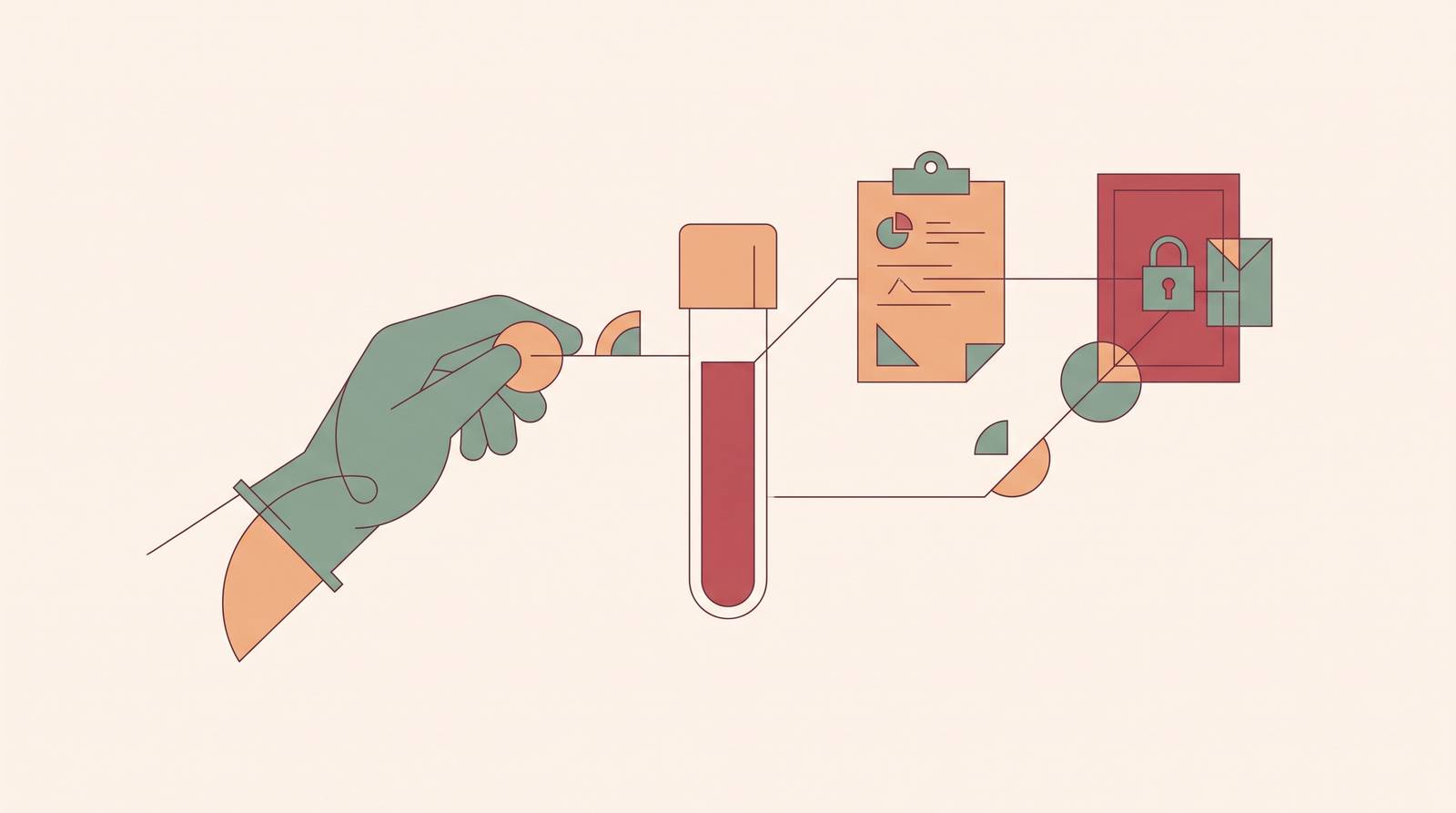
Chain of custody documentation for perinatal biological samples means keeping a complete, unbroken record of every hand that touches a specimen, every place it moves, and every condition it sits under, from the moment of collection to the moment it's used, stored, or destroyed. Get one link wrong and the sample's legal or clinical value can collapse, even if the biology inside it is perfectly sound.
Chain of custody, or CoC, differs from simple sample tracking in a specific way. It's a chronological account of procurement, custody, control, transfer, analysis, storage, and disposition. Every entry in a proper CoC log answers who handled the sample, what they did, when, where the sample was at that moment, and how the action was carried out. A defensible record also needs the sample ID, the custodian's name, the storage location, the SOP the handler followed, any deviation from that SOP, the environmental conditions at the time, and enough metadata for an auditor to rebuild the whole sequence later without guessing.
Here's the distinction that actually matters, and the one people get wrong most often: sample tracking tells you where something is, while chain of custody tells you who's accountable for it at every point along the way. A lab can know exactly which freezer a vial sits in and still have no idea who moved it there, when, or whether the cold chain held during transport. Most integrity failures live in exactly that gap, between location and accountability.
Perinatal samples raise the stakes higher than almost any other specimen category, because they're collected at a moment in biology that never repeats. A blood spot taken 24 to 48 hours after birth, a cord segment clamped at delivery, a first stool passed within days of birth: none of these can be recollected if the paperwork falls apart. Miss the window and the sample is gone for good.
The range of perinatal specimen types and what makes each one a distinct custody challenge
Dried blood spots from newborn screening are the most widely collected perinatal specimen in the country. They're taken 24 to 48 hours after birth, with results usually back within five to seven days. The National Academies Press reported in 2025 that more than 98% of infants born in the U.S. get this screening, and it flags over 7,000 infants a year for conditions that need fast treatment. Working through the physical form itself clarifies the custody structure: a top copy carries demographic information only, while the bottom "kit" copy holds the actual dried blood spots. Once the lab punches holes out of that bottom copy to run the panel, whatever's left over, the residual spots, becomes a second custody object in its own right — a distinction that's easy to miss on first read but matters once you trace where those leftovers actually go. Those leftovers carry real legal and ethical weight, and their location and any future use need tracking separate from the original screening record.
Meconium forms from swallowed amniotic fluid over roughly the last half of pregnancy and comes out as the newborn's first stool. Its detection window stretches back about 20 weeks into gestation, far longer than what you'd get from maternal blood or a newborn's urine. Collecting it isn't invasive, but timing makes it tricky: it can pass before or during delivery, or come out in pieces over several days, which makes a clean, testable sample harder to pin down than it sounds.
Umbilical cord tissue holds onto drugs the mother used during the third trimester, and it flags babies at risk of neonatal abstinence syndrome. Compared to meconium, it has real advantages: available right after birth, more of it to work with, and uniform enough in composition that collection stays consistent. Cord blood specimens have to be processed within one hour of collection, per the HANC/ACTG-IMPAACT Laboratory Manual, and that one-hour clock puts real pressure on how fast the paperwork has to move too.
Placental tissue is even less forgiving on time. Per the ClinicalTrials.gov protocol NCT01954342, collection should happen within 60 minutes of delivery. A single placenta can yield several distinct specimen types: basal plate, villous tissue, chorionic plate, plus cord blood drawn from the placenta itself (averaging around 50 mL). Sitting with that list for a moment raises an obvious question: does one placenta mean one custody record, or several? The specimen types are different enough, in composition and downstream use, that each one likely needs its own record rather than one blanket entry for "the placenta."
Amniotic fluid and neonatal hair round out the picture. A ResearchGate paper from March 2025 lists these matrices, alongside dried blood spots, meconium, cord tissue, and placental tissue, as the full toolkit researchers use to characterize fetal drug exposure. Line up these five specimen types side by side and the design problem becomes obvious: the collection window, the physical form, and the downstream use of each type all pull toward different priorities. A single generic intake form doesn't serve a 60-minute placental collection and a five-day newborn screening turnaround equally well.
How the regulatory and accreditation landscape shapes documentation obligations
No single federal rule governs chain of custody for every perinatal specimen type. Practitioners have to stack several frameworks on top of each other instead, and those frameworks overlap without lining up perfectly.
The Common Rule, codified at 45 CFR 46 and specifically §116, governs informed consent whenever identifiable biological specimens get used in research. Biobanks have to attach a consent form to each sample spelling out its intended use, which makes consent itself a custody document, not just an ethics formality.
CLIA sets specimen integrity and identification rules for clinical labs that function as a de facto chain of custody requirement. Once a research sample crosses into clinical testing, documented custody stops being optional and becomes a standard item any quality-system audit will check.
The CAP Biorepository Accreditation Program builds explicit chain-of-custody standards right into its accreditation checklist for any biorepository handling human specimens. Meanwhile, ISO 20387 §7.5 (traceability) and FDA 21 CFR Part 11 (electronic records) overlap in a way that matters a lot for digital systems: an audit trail satisfying both proves exactly who touched a sample and when. That overlap is where electronic CoC tools earn their keep.
The ISNS 2025 General Guidelines for Neonatal Bloodspot Screening, published in June 2025 in the International Journal of Neonatal Screening, gives programs a framework and checklist for building or evaluating a newborn screening operation. Custody elements run through its essential-elements checklist rather than standing apart as their own section. None of these frameworks was written with the others in mind, so reconciling them, deciding which rule governs which sample at which point, falls on whoever runs the program.
The three custodial tiers in a multi-site protocol and what each one is responsible for documenting
Standard multi-site clinical trial protocols, of the kind registered under ClinicalTrials.gov NCT06481579, split custody responsibility into three tiers, and each tier owns a different slice of the record.
The site investigator is tier one. They keep full traceability of every sample from collection through storage at the site, right up until it ships out or gets disposed of, and they record all the processing details along the way.
The sample receiver, usually a central lab or biorepository, is tier two. They own traceability once the sample arrives, covering storage and use during that period, and they log receipt, onward shipment, use, or disposal.
The sponsor, or whoever they delegate the job to, is tier three. Their oversight runs across the entire lifecycle, enforced through internal procedures, site monitoring, audits, and contract terms placed on any outside lab providers.
One boundary is worth naming directly: the HANC/ACTG-IMPAACT rule holds that movements within the same lab don't need chain-of-custody tracking. Only transfers between clinics, processing units, and labs, plus the release of results back to the clinic, need a documented entry. That distinction tells a program exactly where to stop logging every internal shuffle and start logging real handoffs.
The three-tier model looks clean on paper, but it breaks down at the edges. The MCW Maternal Research Placenta and Cord Blood Bank's experience with affiliate hospital expansion shows what happens when a consent and tracking process built at a main campus gets dropped into a satellite site without adjustment: gaps open up fast. Their experience also surfaces something easy to overlook: consent for a perinatal biobank carries ongoing weight rather than functioning as a one-time administrative box to check. It's pregnancy-specific, has to be obtained fresh for each pregnancy, and typically needs staff trained specifically for that conversation, with the midwifery team's agreement secured before anyone even approaches the patient.
The handoff events where custody breaks — and what documentation must capture at each one
Collection is the first custody event and the one that matters most, because everything downstream depends on getting it right. The record has to capture who collected the sample, the exact time and location, the method used, and the condition of the specimen the instant it left the patient.
For placental and cord specimens, the clock is unforgiving. With a 60-minute window for placental tissue and a one-hour processing limit for cord blood, documentation has to start the moment collection happens, not get filled in later from memory.
Labeling matters just as much as timing. NHS cord and placenta donation protocols use unique barcoding at the point of collection, which anonymizes the donor while still preserving a traceable link between donor and specimen. Working through why that design works, it satisfies privacy rules and chain-of-custody rules at the same time, without one undercutting the other, which is harder to pull off than it sounds.
Every physical handoff between custodians after that needs a dated, signed record: what was transferred, in what condition, to whom, and under what environmental controls, meaning temperature and packaging method. Storage transitions count as custody events too. A freezer transfer, a shipment on dry ice, a thaw-and-refreeze cycle: each one gets its own log entry, because each one can change the specimen's integrity and what the eventual test result actually means.
Deviations are where a lot of CoC records fall apart under audit. A proper deviation entry states what was supposed to happen, what actually happened, who made the call to deviate, and what assessment followed to check whether the specimen was still usable. Skip any one of those four pieces and the record won't hold up.
The residual dried blood spot problem shows all this in miniature. Once the initial newborn screening panel runs, whatever's left of the blood spot card becomes its own physical object with its own custody history going forward. Its existence, its location, and any secondary use it's put to all need tracking separate from the original screening record, because from that point on it's a different asset carrying different stakes.
When perinatal samples cross into forensic territory and why that changes documentation requirements
Neonatal drug testing can shift from routine clinical management into forensic territory without much warning, because a positive result can end up supporting a legal action. The Journal of Analytical Toxicology noted in March 2024 that chain of custody is "often desired" for exactly this reason, even when the test wasn't ordered with litigation in mind.
In many states, physicians are legally required to notify child protective services when a newborn shows signs of prenatal exposure to illegal substances, though the exact requirements vary state by state. A positive meconium or umbilical cord tissue screen can trigger a legal process directly, sometimes before anyone involved has decided how carefully the sample needs documenting. Frontiers in Pediatrics recommended in 2023 that under these conditions, testing procedures build in documented chain of custody along with automatic confirmation testing of any presumptive positive.
Most institutions sit in a gray zone here. ARUP Consult points out that because umbilical cord tissue and meconium screens are usually ordered for clinical and social management, not law enforcement, chain of custody may not be strictly required by law, but local authorities and state statutes have to be checked, and that check itself should be written down. Working through the ARUP position a step further: where a formal chain of custody isn't available, or where a result looks questionable, comparing the test result against the patient's known history, checking for expected substances alongside the target analytes, can back up the credibility of a result. That comparison is a useful fallback when it works, but it only works if the documentation was solid from the start.
USDTL frames the practical answer plainly: to protect the hospital, chain of custody should start at collection, before anyone knows whether a result will end up contested. Any institution that waits until a case starts to look forensic has already missed its chance to build an unbroken chain. The decision to document rigorously gets made at the moment of collection, not after a lawyer gets involved.
How digital systems — LIMS, barcoding, and electronic audit trails — turn CoC requirements into operational practice
A laboratory information management system gives a program one time-stamped, user-attributed record of every sample event, replacing paper logs that get altered, misplaced, or left half-filled-out. That's the core function, and it's what makes the rest of the compliance picture workable.
Electronic audit trails do double duty on the regulatory side. The same log that satisfies FDA 21 CFR Part 11's rules for electronic records also satisfies ISO 20387 §7.5's traceability requirements, so one system clears two separate regulatory bars at once instead of requiring parallel paperwork.
Barcoding at the point of collection, the same approach used in NHS cord and placenta protocols, ties a physical specimen to its electronic record from the very first custody event. Every entry made after that traces back to a known origin instead of a guess. IoT-enabled cold-chain sensors add another layer: logging temperature continuously through storage and transport turns what used to be a blind spot in paper-based custody, the unwitnessed storage period, into a documented, auditable stretch of the record.
Compare what a generic LIMS covers against what perinatal specimens actually demand, and a handful of gaps show up fast. It has to support pregnancy-specific consent records that expire and need renewal for each pregnancy. It needs to track sub-aliquots and residual portions, like leftover dried blood spots, as distinct custody objects that still sit under the same donor record. Deviation logging has to live inside the sample event record itself, not get bolted on as a separate form nobody fills out consistently, and multi-site access controls need to mirror the three-tier custodial model directly: site investigators see their own samples, receivers see what's been transferred to them, sponsors see the whole lifecycle.
Even the best digital system has a seam where it meets the real world. Collection events in delivery rooms and operating theaters almost always happen before anything gets entered into a LIMS, and the paper form or barcode label generated in that first moment is the actual first custody document, with everything recorded afterward only as accurate as that first entry was. Some platforms are built specifically for perinatal and maternal-fetal sample workflows, aiming to close the gap between what happens on the delivery floor and what an audit trail can later prove in the lab. Whether one of these tools is worth adopting comes down to a narrow question: does it treat pregnancy-specific consent, sub-aliquot tracking, and deviation logging as first-class fields, or did someone bolt them onto a system built for an entirely different kind of sample?