Building a Hospital Placenta Procurement Program From Consent to Cold Chain

Birth tissue, in regulatory and clinical practice, refers to gestational tissue donated at the time of delivery of a living newborn. The mother is the donor; the newborn is not affected, and no tissue is taken from the infant.
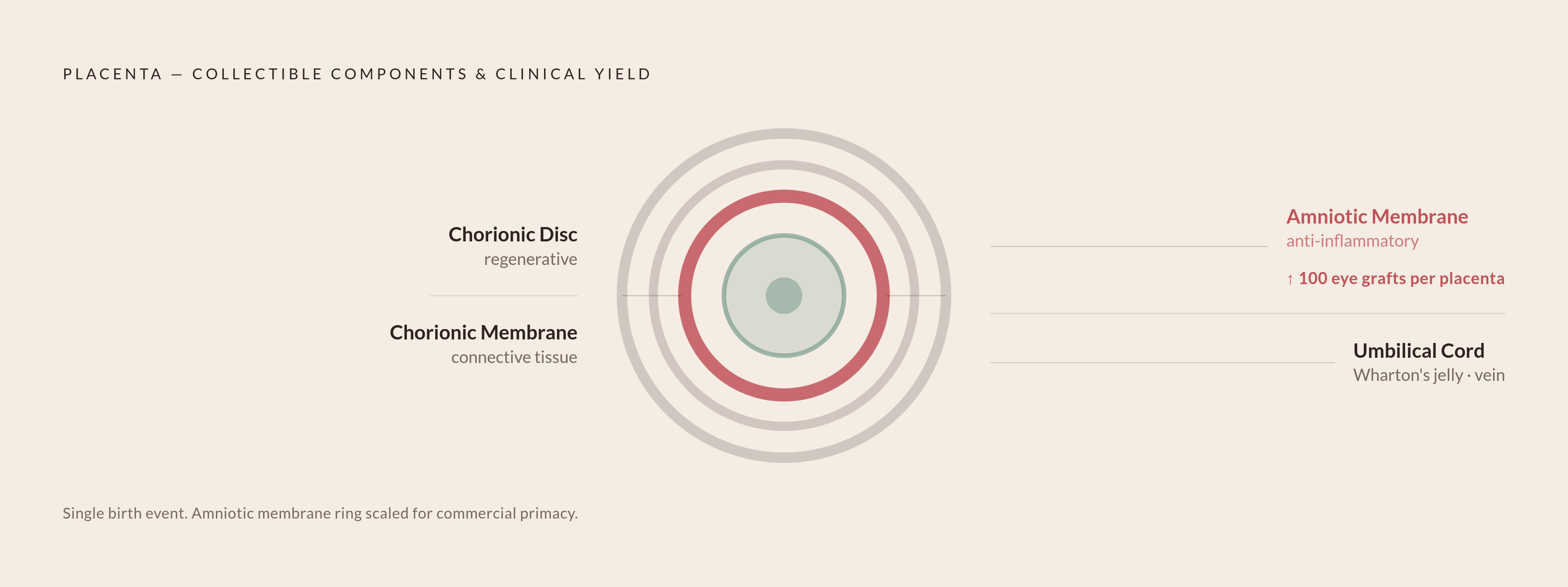
The collectible components from a single birth event are more varied than most hospital administrators realize. The placenta and placental chorionic disc are the primary structures. Within and surrounding those sit two anatomically distinct but physically conjoined layers: the amniotic membrane, which faces the fetus, and the chorionic membrane, which faces the uterine wall. Each carries different biological properties and serves different downstream processing applications. The umbilical cord, including umbilical vein tissue and the gelatinous connective tissue known as Wharton's jelly, rounds out the collectible profile. Amniotic fluid falls outside this scope; the FDA has stated it does not meet the HCT/P definition under 21 CFR 1271.3.
The amniotic membrane commands the most clinical and commercial attention, and for good reason. It carries natural anti-inflammatory, anti-scarring, and anti-microbial properties, and is rich in growth factors, collagen, and cytokines that support tissue regeneration. Its primary clinical indications span chronic wounds, burns, diabetic ulcers, and ophthalmologic surgery. A single placenta can yield up to 100 eye grafts, which is not an abstraction; it is the economic and logistical reality that shapes how tissue banks and hospital partners structure their programs.
The scope decision a hospital makes at program outset, specifically which components to collect, carries real consequences. That choice directly shapes downstream processing requirements, cold storage specifications, and which tissue bank partners are operationally relevant. A program designed only for amniotic membrane procurement has meaningfully different infrastructure needs than one designed to collect the full birth tissue package, and collapsing that distinction is how institutions end up mid-implementation with mismatched partner agreements and storage equipment that does not fit the protocol. This determination belongs in the initial planning phase.
The Regulatory Framework That Governs Every Operational Decision Downstream
Placental tissue intended for implantation or transfer is classified as a Human Cells, Tissues, and Cellular and Tissue-Based Product (HCT/P) under FDA jurisdiction, regulated by the Center for Biologics Evaluation and Research (CBER) through 21 CFR Parts 1270 and 1271. That classification governs procurement, processing, and distribution decisions from the first consent conversation to final allograft release.
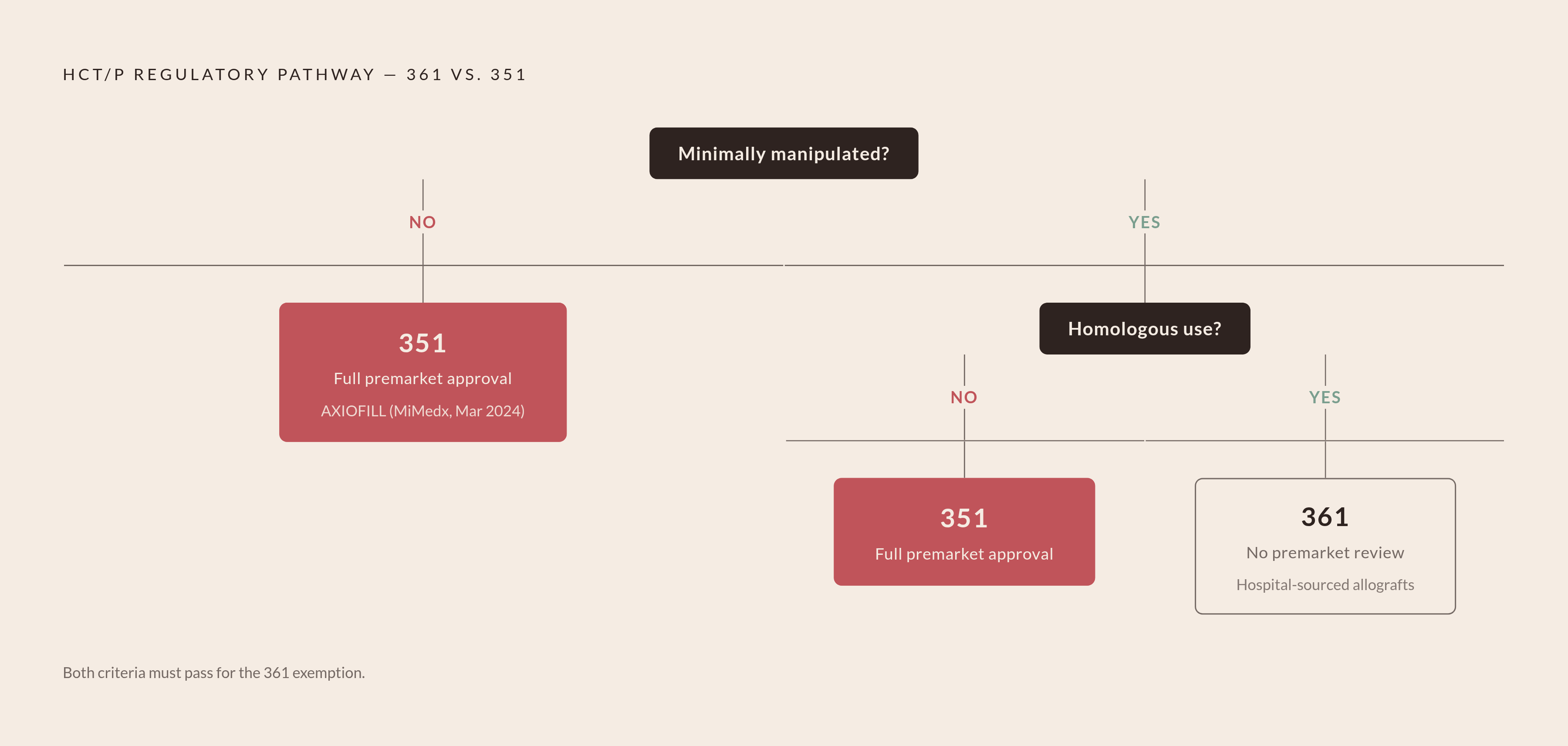
Two regulatory pathways exist, and the distinction between them is not merely academic. The 361 pathway applies to products that are minimally manipulated and used in a homologous fashion, meaning the tissue performs the same basic function in the recipient as it did in the donor. Products qualifying under 361 require no premarket review, which is why the vast majority of hospital-sourced amniotic allografts target this pathway. The 351 pathway applies when a product does not meet those criteria; under 351, the tissue is regulated as a drug or biologic and requires full premarket approval. The practical weight of this distinction became visible in March 2024, when the FDA designated MiMedx's AXIOFILL as a 351 biologic, prompting legal proceedings. Processing choices at every stage, including choices made at the hospital level before tissue ever reaches the bank, determine which pathway applies.
Three FDA final rules apply to all HCT/P establishments without exception: registration and product listing with FDA, donor screening and infectious disease testing requirements, and adherence to current Good Tissue Practices (cGTPs). The deviation reporting obligation under cGTPs is precise: all deviations related to distributed HCT/Ps must be investigated, and those affecting core cGTP compliance must be reported within 45 days of discovery. That 45-day window is not a guideline; it structures the entire documentation architecture of the program, because traceability is what makes a timely investigation possible at all.
AATB accreditation adds a second compliance layer. Federal law does not mandate it, but several states do, and tissue bank partners effectively require it as a condition of engagement. AATB standards cover record management, screening, retrieval, processing, quarantine, labeling, storage, and distribution. A standards change worth noting: donor screening and eligibility criteria must now be established by the tissue bank's medical director, removing a prior provision that allowed a contracted physician to fulfill this role. Hospitals entering a partnership structure need to verify explicitly which entity bears that medical director responsibility, because regulatory accountability follows the party performing each function.
Building Institutional Buy-In Before a Single Consent Form Is Printed
Programs that stall at launch almost always trace the failure to the same gaps: no clear ownership of the Donor Risk Assessment Interview process, no designated staff responsible for prenatal outreach, and no written protocol governing the handoff from operating room to cooler. These are organizational failures, not regulatory ones, and they are preventable only if the right conversations happen before program design begins.
The stakeholder map for a viable program includes at minimum four constituencies. Labor and delivery nursing staff are the frontline of donor interaction; they need clear role definition and scripted protocols, not general orientation sessions about the value of tissue donation. Obstetrics and maternal-fetal medicine physicians determine eligibility criteria in practice, and their comfort with the program workflow during scheduled cesarean sections is foundational to the program's viability. Hospital administration and legal must review tissue bank partner agreements, including how liability is allocated and where institutional compliance obligations begin and end. Some institutions also route the program through an IRB or ethics committee, even when operating entirely within existing FDA and AATB frameworks; that review, if required, must happen before staff training or partner agreements are finalized, not alongside them.
Tissue bank partner selection belongs in this phase, not after program design is complete. The tissue bank typically bears responsibility for donor eligibility determination through its medical director, for processing, and for downstream distribution. Partners with existing infrastructure for birth tissue programs, including protocol templates, staff training resources, and medical director oversight, substantially reduce the burden on smaller institutions that cannot build those functions internally.
Designing a Consent Process That Is Both Compliant and Operationally Workable
The standard approach, approaching a patient the morning of her scheduled cesarean for history, consent, and DRAI within a compressed and emotionally charged window, is workable but not ideal. The best-designed programs introduce donation during prenatal OB visits, having the patient sign a pre-consent form that is then validated at delivery. This reduces day-of burden, increases participation rates, and sets accurate expectations before the patient arrives in a hospital gown. Staff time in the OR suite is finite and high-stakes; every element of consent that can be handled earlier should be.
Regardless of timing, what informed consent must cover is defined by regulation and ethics. The process must communicate that there is no risk to the mother or newborn, no impact on the delivery process, and no cost to the donor. Confidentiality of medical records and donation information must be addressed. The voluntary nature of donation, including the right to withdraw, must be explicit. Under the 361 pathway's homologous use framework, the consent must also disclose that the tissue will not be used for the donor's own benefit.
The DRAI is a structured medical and behavioral risk questionnaire, analogous in design to blood donation screening, required by both FDA regulation and state law. Staff conduct and document it after informed consent is obtained, but final donor eligibility determination belongs to the tissue bank's medical director. The handoff protocol here must be written and trained; who documents the DRAI, where that documentation goes, and what triggers a hold on collected tissue all require defined answers before the first retrieval.
One eligibility gate deserves attention during prenatal outreach. Most programs restrict donation to planned cesarean deliveries because the controlled surgical environment is what makes sterile intact retrieval operationally feasible. Vaginal deliveries present conditions that preclude reliable sterile collection, and setting this expectation during prenatal conversations prevents late-stage disappointment and the waste of staff time that comes with preparing for a donation that cannot proceed.
Donor Screening and Infectious Disease Testing Requirements
FDA mandates minimum infectious disease testing for all HCT/P donors, and the list is specific. Every birth tissue donor must be tested for HIV types 1 and 2, Hepatitis B, Hepatitis C, and Treponema pallidum. For viable, leukocyte-rich HCT/Ps, the panel expands to include HTLV types 1 and 2 and CMV. These are floors, not ceilings. Well-designed programs routinely add West Nile Virus, Toxoplasma, and Parvovirus, even though none of those are universally mandated, because the cost of an incremental test is far lower than the cost of a post-distribution safety investigation.
The donor eligibility review is not a single test result but a composite determination drawn from four sources: DRAI documentation, medical and social history review, informed consent documentation, and a medical records review confirming no elevated risk of transmissible infectious disease. The tissue bank's medical director reviews and signs off on all four components, per current AATB standards.
Quarantine protocol sits at the intersection of testing requirements and cold chain design. No tissue is released for processing until eligibility is confirmed, and that quarantine window, spanning the period from collection through test result receipt and medical director sign-off, has direct implications for how long tissue must be held and at what temperature. Cold chain infrastructure must be sized and validated accordingly; this is not an afterthought.
Every screening result, every test report, every medical director sign-off must be traceable forward to the specific allograft it clears. When a deviation occurs and the 45-day reporting clock starts, that traceability is what makes the investigation possible at all.
Processing Protocols and What Happens Between Delivery Room and Tissue Bank
The boundary between hospital responsibility and tissue bank responsibility is not self-evident. Leaving it ambiguous in the partner agreement is a reliable path to a compliance problem, and in the author's experience, ambiguity here is where most first-year programs develop their first deviations.
The hospital's scope is defined: sterile retrieval at the time of the cesarean section, initial packaging, labeling, placement into temporary cold storage, and handoff to the tissue bank's courier. Everything beyond that, including formal processing, quarantine management, testing coordination, final eligibility determination, allograft preparation, and distribution, belongs to the tissue bank. The partner agreement must specify this boundary explicitly.
Sterile retrieval in the OR is where the program's integrity is either established or forfeited. The retrieval kit, typically provided by the tissue bank partner, contains a sterile collection vessel, labeling materials, and chain-of-custody documentation. Staff must be trained on sterile handling technique; a contaminated tissue cannot be processed regardless of how clean the donor's serological profile is, and contamination at collection forfeits the yield entirely. There is no recovery from a contaminated specimen.
The minimal manipulation imperative applies at the hospital level as much as at the processing level. Gross manipulation of the tissue at the hospital stage, including cutting, shaping, or handling it in ways inconsistent with homologous use preparation, can complicate the tissue bank's 361 classification for that specimen. Hospital staff collect and preserve; they do not process. That boundary must be written into the training protocol.
Labeling at the point of collection is the first link in a chain that must remain unbroken. Each specimen requires a donor identifier, date and time of collection, and the name of the collecting staff member, all traceable forward through the entire processing and distribution chain. Labeling errors are deviations, and if the tissue has been distributed by the time the error is identified, the 45-day reporting requirement applies.
MiMedx had supplied over 3.0 million allografts through December 31, 2024. Each one of those allografts started exactly where this discussion does: a retrieval kit, a trained nurse, a labeled collection vessel, and a sterile field.
Cold Chain Requirements From OR to Tissue Bank Custody
Biological activity degrades outside controlled temperature ranges. Growth factors, collagen, and cytokines in amniotic membrane tissue are sensitive to temperature excursions in both directions, and microbial contamination risk accelerates if the cold chain fails before tissue reaches the processing facility. There is no tolerating a break in this chain.
Three temperature zones require specific, validated management. Immediately after collection, tissue goes into a cooler with wet ice or refrigerant packs, with the precise temperature range defined by tissue bank protocol rather than nursing discretion. At the hospital, pending courier pickup, tissue must be held in a validated refrigeration unit with logged temperatures and controlled access; a standard break-room or medication refrigerator does not meet this standard, regardless of how well-intentioned the staff managing it are. During transport to the tissue bank, validated cryo-shipping containers or refrigerated courier services carry the tissue, with a temperature monitoring device included in every shipment and chain-of-custody documentation traveling alongside.
Running parallel to the physical chain is a documentation record that must account for time of collection, time of placement into cold storage, temperature log readings at the hospital, time of courier pickup, and tissue bank receipt confirmation. A temperature excursion at any stage is a deviation; if the tissue has been distributed downstream, the 45-day reporting clock applies.
The hospital's infrastructure requirements to support this are concrete: a validated cold storage unit located in or near the labor and delivery suite, calibrated temperature monitoring with log retention, trained staff who understand both the physical handling protocol and the documentation obligations, and a clear written procedure for courier handoff that specifies who hands off, what documentation transfers, and what happens if a pickup is delayed. Facilities that already manage blood products and surgical tissue have the institutional muscle memory for this. The standards translate directly, and so do the consequences when they are not met.