GMP Facility Design for Perinatal Cell Processing Labs
Contamination rates vary sharply by perinatal tissue type and demand separate facility zones.
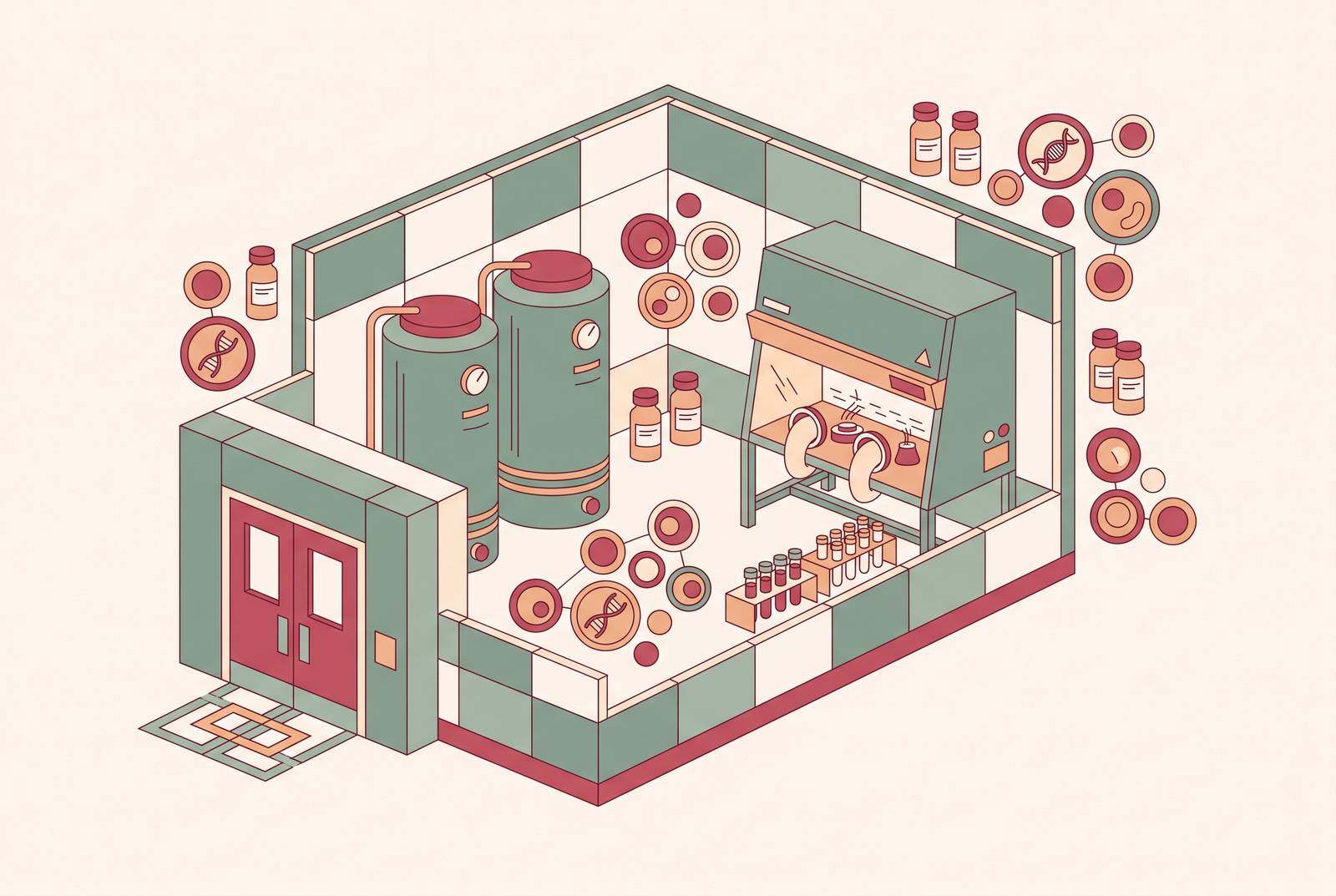
Perinatal cell processing facilities have to be built around a fact that most GMP guidance never states plainly: the source material dictates the room. Placental and cord-derived tissues carry a contamination profile unlike almost anything else in cell therapy manufacturing. A facility that treats every perinatal tissue type the same way has made its first mistake before the ribbon-cutting, and it usually finds out the hard way, when a batch fails release testing and someone has to explain why.
Perinatal tissue, meaning umbilical cord, placenta, amniotic membrane, and amniotic fluid, gets collected at delivery, non-invasively, from material that would otherwise get thrown away. There's no donor procedure risk, and unlike bone marrow or fat-derived cells, perinatal cells don't carry the age-related decline you see in older donors. Cord-derived mesenchymal stromal cells (UC-MSCs) expand faster than bone marrow MSCs while matching them on surface markers, differentiation, and immune regulation. Cord blood and tissue banks are also showing up more as starting points for iPSC generation, since the cells are immature and come with a known donor history attached. Cell and gene therapy manufacturing hit USD 7.28 billion in 2022 and is headed toward USD 47.1 billion by 2030; ASGCT counted 2,041 therapies in active development as of Q4 2025, with 46 already FDA-licensed. This field has no room left for shortcuts in facility design, and the room the tissue gets processed in has to match its actual bioburden, not a category label on a form.
How placental contamination data should shape facility assumptions from the start
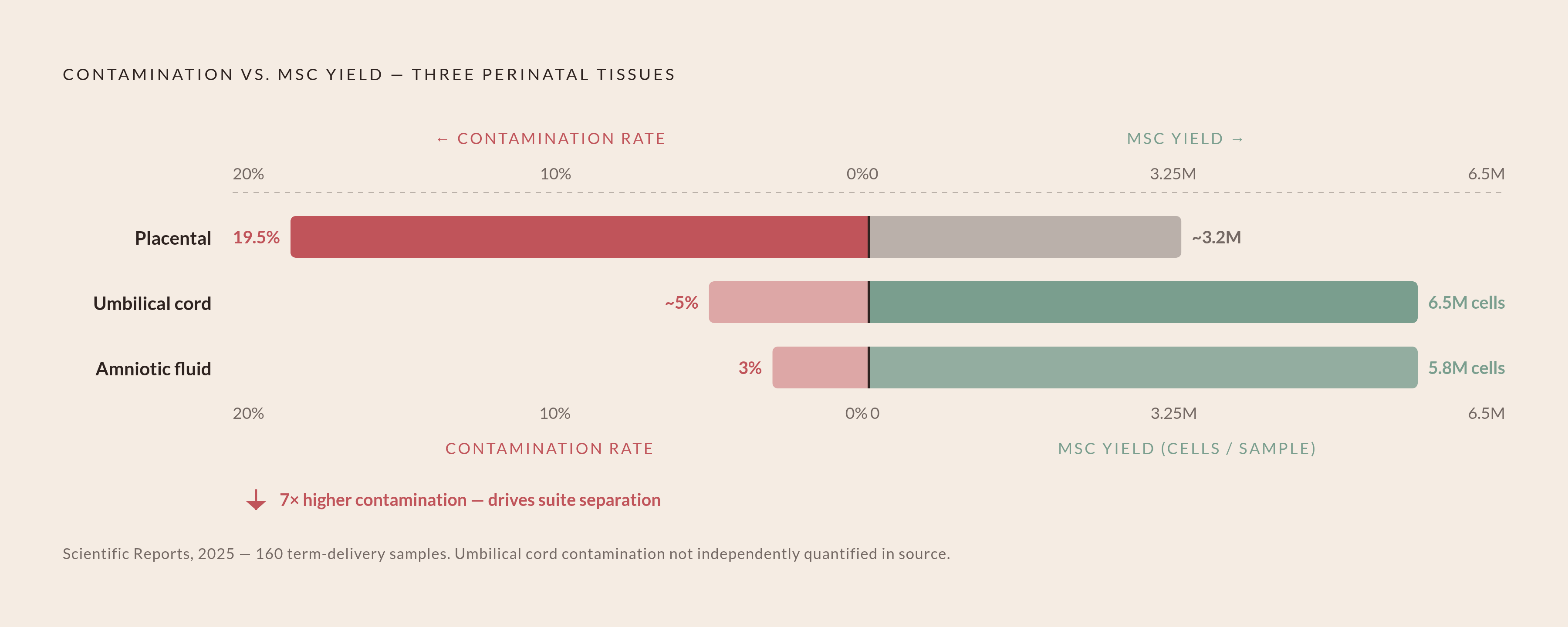
A 2025 study in Scientific Reports, built on 160 term-delivery samples, gives the clearest side-by-side comparison of perinatal tissue types under GMP conditions available right now. Placental tissues showed microbial contamination rates of 18 to 21 percent, while amniotic fluid, drawn from the same broad category of source material, came in at just 3 percent. That's a substantial gap, from tissue collected within the same broad delivery context.
Yield doesn't line up neatly with those numbers, and that's the part planners tend to miss. Umbilical cord tissue produced the highest MSC count, averaging around 6.5 million cells per sample, with amniotic fluid close behind at approximately 5.8 million. Tissue type was the strongest predictor of yield in the study (β = 0.61, p < 0.001). Cord tissue gives you both high yield and moderate risk; amniotic fluid gives you decent yield and low risk. Placental tissue may still be worth using depending on the application, provided the facility treats it accordingly rather than lumping it in with everything else labeled "perinatal."
A facility processing more than one perinatal tissue type cannot run placental tissue and cord tissue through the same suite, on the same air, using the same anteroom sequence, and call itself compliant just because both happen to be perinatal. An 18 to 21 percent contamination rate demands physical or procedural separation from lower-bioburden operations. Every zoning decision later in this piece assumes that separation already exists, and it should exist before the first air handler gets specified.
The regulatory frameworks that apply to perinatal cell processing and what they require of a facility
In the U.S., FDA regulates perinatal tissue products as human cells, tissues, and cellular and tissue-based products (HCT/Ps) under 21 CFR Parts 1270 and 1271, with the Center for Biologics Evaluation and Research (CBER) running the show. That framework calls for establishment registration, donor eligibility determination, written procedures for current good tissue practice (CGTP), reporting of adverse reactions and deviations, and proper labeling. Allogeneic products, cells taken from one donor and given to a different recipient, face tighter scrutiny than autologous products, because the regulatory concern is stopping communicable disease from passing between two people.
Most perinatal MSC programs land somewhere specific, though. If a product is "more than minimally manipulated," or gets used for something other than its original biological function, it crosses into IND/BLA territory, and the full weight of 21 CFR Part 211 cGMP facility requirements kicks in. Expanding cells in culture is widely treated as more than minimal manipulation, so most perinatal MSC therapies end up subject to full cGMP requirements whether the sponsor anticipated it or not.
The EU works differently. EudraLex Volume 4, Annex 1, revised with provisions effective August 25, 2023 (some transition provisions run to August 25, 2024), governs sterile medicinal product facility design. Advanced Therapy Medicinal Products (ATMPs) sit at an intersection of GMP standards, biosafety rules, and clinical practicalities, and EU guidance often assumes these facilities get built next to hospitals. No single EU regulation is written just for cell and gene therapy; Annex 1 combined with ISO 14644-1 forms the working standard everyone builds against instead.
ISO 14644-1:2015 defines nine cleanroom classes based on the maximum number of airborne particles allowed at various sizes. Cell therapy manufacturing generally sits within ISO classes 5 through 8, and ISO 14644-2 (2015) sets the requalification schedule: every six months for ISO Class 5, every twelve months for Classes 7 and 8, plus continuous particle monitoring during any critical operation. The ISPE Good Practice Guide on HVAC, now in its second edition (2024), is the industry's working reference for classification, air change methodology, containment design, and qualification, and it lines up FDA Part 211, EU Annex 1, and ISO 14644 into one approach.
A perinatal lab processing allogeneic, more-than-minimally-manipulated MSCs has to satisfy CGTP donor documentation, Part 211 cGMP facility standards, ISO cleanroom classification, and Annex 1 environmental monitoring, all inside the same footprint, and the building has to make all four work at once. That's a taller order than it looks on paper, and most first-time planners underestimate it.
Cleanroom classification and how to assign grades to specific perinatal processing steps
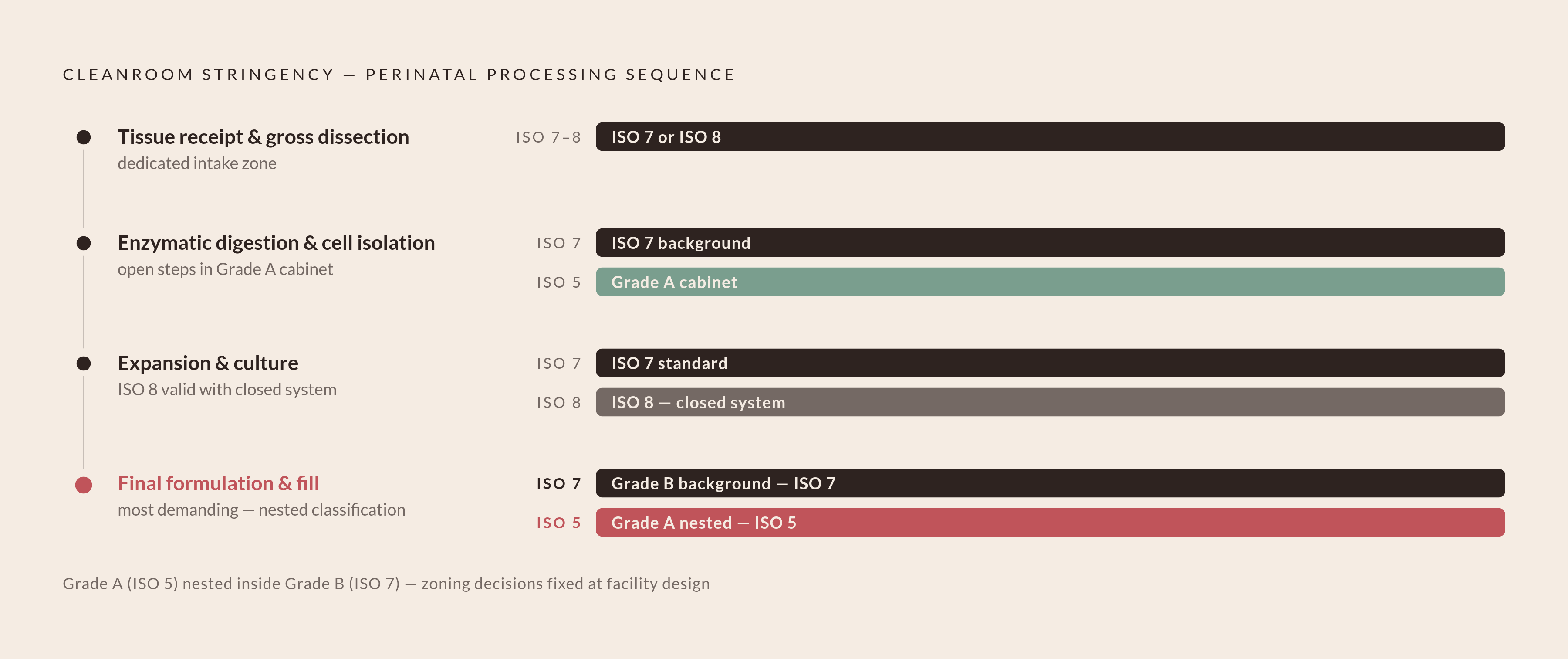
The EU grading system and ISO classes map onto each other directly: Grade A equals ISO 5, Grade B equals ISO 5 at rest and ISO 7 during operation, Grade C corresponds to ISO 7 and ISO 8 conditions, and Grade D equals ISO 8. Grade A, the tightest classification, applies to critical open manipulations like aseptic filling and final product handling, and it needs localized unidirectional airflow hoods that deliver ISO 5 conditions right at the point of work.
Grade B, or ISO 7, covers cell culture and prep of critical materials. That room has to sit at positive pressure relative to the ISO 8 anteroom next to it, which in turn has to be positive relative to unclassified space outside the suite. An ISO 7 lab may include a Class II A2 biosafety cabinet, giving operators a localized ISO 5 zone for open cell manipulation. Both FDA's CAR-T guidance and EU GMP Annex 1 allow a Grade D (ISO 8) background for processes run inside a fully validated closed system, which matters for perinatal facilities using closed bioreactors to expand cord tissue.
Applied to actual workflow steps, the grading gets concrete fast. Tissue receipt and gross dissection can technically happen in ISO 7 or ISO 8 space with the right containment, but given the 18 to 21 percent placental contamination rate, a dedicated intake zone at a lower grade, one that doesn't share airspace with culture suites, beats saving square footage. Enzymatic digestion and cell isolation belong in ISO 7 with a Grade A biosafety cabinet for the open steps. Expansion and culture run at ISO 7, though a closed system may justify dropping to ISO 8, and final formulation and fill need Grade A nested inside a Grade B background.
Two real facilities show what this looks like at very different scales. Children's National Hospital built a facility in 2021 with a single 134-square-foot ISO 8 anteroom serving as bi-directional gowning space, feeding two ISO 7 suites totaling 318 square feet, small, but fully compliant for a smaller perinatal operation. UCI's GMP facility, finished in 2024, runs closer to 7,700 square feet across seven manufacturing rooms at BSL-2. That's what a multi-product, multi-client campus looks like once perinatal processing gets its own dedicated suites inside a much bigger building.
Zoning for multi-tissue workflows and the segregation logic that prevents cross-contamination
Unidirectional flow of people, materials, and waste is the single most important contamination control decision in the whole layout, and it gets designed in on day one or not at all. Retrofitting directionality after construction is expensive and rarely complete, since ductwork and corridor placement don't move easily once the building is occupied.
The perinatal-specific version of this problem comes straight back to the contamination numbers. Placental tissue at 18 to 21 percent contamination cannot share a processing suite or an anteroom sequence with cord tissue or amniotic fluid operations without creating real cross-contamination risk. There are a few ways to solve it: dedicated processing rooms assigned by tissue type, time-segregated scheduling with full decontamination between runs, a physical airlock separating high-bioburden intake from low-bioburden intake, or, on larger campuses, some mix of the three.
Personnel flow needs its own logic too. Gowning airlocks should be dedicated, with gowning steps sequenced to match the classification level being entered, and clean corridors and dirty corridors have to stay separate, so someone exiting a clean processing area never has to walk back through the material intake path to leave. Two-stage gowning paired with unidirectional flow keeps incoming operators, consumables, finished product, and waste on physically distinct paths.
Material flow follows the same principle. Raw materials and components should enter through interlocked pass-through chambers, static or dynamic, where the interlock physically stops both doors from opening at once, and surface decontamination happens before anything crosses into classified space. Uncleaned incoming tissue and cleaned, sterilized items need to stay apart at all times, and dynamic pass-boxes, airlocks, and separate air handling units are what make that separation real instead of aspirational.
One multi-product cGMP cell therapy center managed a 40 to 45 percent increase in usable cleanroom space within an existing building by installing two cleanroom suites, one ISO 7 and one ISO 8, separated by two-stage gowning and unidirectional flow. Retrofits can work, evidently, but only when the zoning logic is disciplined from the start rather than patched in after the fact. Waste egress deserves its own mention here: routing for biological waste from high-bioburden tissue processing should be planned so that clean and dirty paths remain physically distinct throughout the facility.
HVAC design requirements that maintain the pressure cascade across perinatal processing zones
EU GMP Annex 1 (2022) sets a minimum pressure differential of 10 to 15 pascals between adjacent zones of different classification, with alarm limits set both above and below the validated target. Grade A areas need unidirectional airflow moving at 0.36 to 0.54 meters per second, and the pressure differential between adjacent zones of different classification must meet the 10 to 15 pascal minimum specified by Annex 1. Critical Grade A rooms typically need 400 to 600 air changes per hour just to keep that airflow continuous.
HEPA filtration is required across every classified area, and temperature and humidity have to be watched on an ongoing basis, not spot-checked once a shift. Pressure sensors need to link to alarms at every airlock and every zone boundary, with dampers and controls that adjust supply and exhaust volumes automatically to hold set points through door openings and normal process swings. Annex 1 (2022) is explicit that this monitoring has to run through a building management system (BMS) with automated alarming; manual, periodic pressure checks no longer cut it.
There's a wrinkle specific to perinatal work that doesn't show up in most HVAC textbooks. If placental tissue intake sits in its own dedicated, lower-grade room, as it should given the contamination numbers, the airflow relationship between that room and adjacent ISO 7 suites warrants careful design to prevent microbial aerosols from drifting outward. That reverses the normal positive-pressure cascade at that particular zone boundary, and it has to get built into the HVAC design on purpose, not patched in once someone notices the risk during commissioning.
Requalification gets triggered by filter replacement, duct modification, any change to a BMS set point, or anything else touching the facility's validated state. The requalification schedule runs every six months for ISO 5 (roughly Grades A/B) and annually for ISO 7 and 8 (roughly Grades C/D). The ISPE HVAC Guide stays the primary reference for documenting and qualifying all of this, keeping FDA Part 211, Annex 1, and ISO 14644 pointed the same direction.
Documentation, monitoring, and qualification as built-in features rather than post-construction additions
Environmental monitoring has to be part of the design from the start, since sensor placement, alarm thresholds, and data capture routes are architectural decisions, not IT afterthoughts. The requirement for continuous particle monitoring during critical operations means sensor placement and monitoring equipment locations need to be addressed early in the design process, before construction decisions foreclose options.
Donor eligibility documentation under 21 CFR Part 1271 requires written procedures covering every step from tissue receipt through processing. CGTP compliance means the physical layout needs dedicated, secure space for quarantining untested tissue and for labeling operations that won't let samples get mixed up. Chain of custody matters enormously for perinatal tissue: placenta and cord material collected at delivery has to stay traceable through every step that follows. Good facility design supports that by giving intake, quarantine, processing, QC hold, and release each a distinct spatial identity, so a handoff is a handoff, not a guess.
Deviation and adverse reaction reporting obligations push the same logic into access control. Controlled access paired with an audit-trail-capable BMS means any environmental excursion gets logged automatically, with a timestamp and a zone identity attached, instead of relying on someone remembering to write it down at the end of a long shift.
Qualification runs in a fixed sequence: design qualification, installation qualification, operational qualification, performance qualification. Each phase needs documentation that traces straight back to the original design intent, and building that traceability in early cuts down on the requalification burden every time something changes down the line. Change control follows the same rule: any modification to HVAC, room classification, or workflow routing triggers requalification. Planning for flexibility up front, modular wall systems, ductwork that can be rerouted without tearing into the building, cuts down on disruption as perinatal cell programs scale from research volumes to clinical volumes to commercial volumes, which they often do, usually faster than anyone on the planning team expected.
A compliant perinatal processing lab throws off its own proof, in pressure logs, particle counts, temperature records, personnel access logs, running whether or not anyone is watching. Getting the zoning wrong at the start means no amount of paperwork fixes it later, a lesson most people in this field only need to learn once.