Biorepository LIMS Requirements for Perinatal Sample Tracking
Standard biobank software fails when tracking samples from two linked patients across one delivery.

Perinatal biorepositories collect what would otherwise land in a medical waste bin: cord blood, placental tissue, umbilical cord segments, maternal blood drawn mid-labor. None of it happens on the biobank's schedule, and delivery doesn't ask permission or set its clock around anyone else's convenience, so the specimens trace back to two people, mother and neonate, who show up in hospital records as two completely separate medical record numbers. A LIMS built for oncology tissue banking was never designed to hold that shape, and the cracks show up fast once a perinatal program tries to force its data into a system built around one subject, one sample history.
The scale involved is not small. Columbia runs a standing longitudinal biobank under its PNBB program, enrolling pregnant women and their offspring and collecting maternal urine and blood, cord blood, and placental tissue across pregnancy and beyond. The Medical College of Wisconsin Tissue Bank draws from two hospital locations and has consented more than 2,500 participants. Baylor's PeriBank goes further, targeting placenta, cord blood, maternal blood, and paternal blood on every delivery, with enrollment starting at labor and delivery presentation itself. Each of these programs treats the dyad as the organizing unit rather than a standard biobank with an extra sample type bolted on. The LIMS underneath has to be built for that from day one.
The sample portfolio and why collection timing is a LIMS variable, not just a protocol note
A perinatal biobank's specimen list reads differently than a typical repository's. Maternal blood splits into whole blood, plasma, and buffy coat, maternal urine stands alone, and fetal cord blood again fractionates into whole blood, plasma, and buffy coat, while placental tissue is sampled from both the fetal and maternal sides and umbilical cord segments round out the list. Each type carries its own collection logistics, and those logistics don't line up with each other.
The MGH COVID-19 perinatal biorepository put numbers on this, and the spread tells you something. Urine collection succeeded 99% of the time, maternal blood came in at 91%, placenta at 96%, and umbilical cord blood at 93%, while breastmilk and maternal stool landed at 22% and 30%. The gap reflects the physical reality of collecting certain specimen types in the hours around delivery, more than any lapse in staffing or consent. A LIMS that treats every specimen type as equally likely to show up on time will overpromise what a program can actually deliver to researchers.
Timing windows make this worse. Cord blood has an "ideal" standard: venipuncture and processing within 30 minutes of delivery, alongside a "standard" pathway that allows refrigeration and stretches the processing window to 24 hours. Placenta needs immediate refrigeration at 4°C until it's processed. These thresholds decide whether a sample is even usable for certain downstream analyses, so a LIMS needs to enforce them as structured, mandatory fields, not optional notes a technician skips at 2 a.m. when the unit is short-staffed.
Obstetric variables sharpen this further. Cord blood collected in utero differs from cord blood collected ex utero, vaginal delivery yields higher cord blood volumes and higher counts of total nucleated cells, CD34+ cells, monocytes, and granulocytes than cesarean delivery does, and gestational age matters just as much as whether the pregnancy is singleton or multiple. Every one of these has to be captured at the specimen level and linked to it permanently, because a researcher pulling a cohort five years from now needs to filter by delivery mode or gestational age without re-reading free-text notes on every sample in the freezer.
The mother–infant dyad as the central data-architecture problem
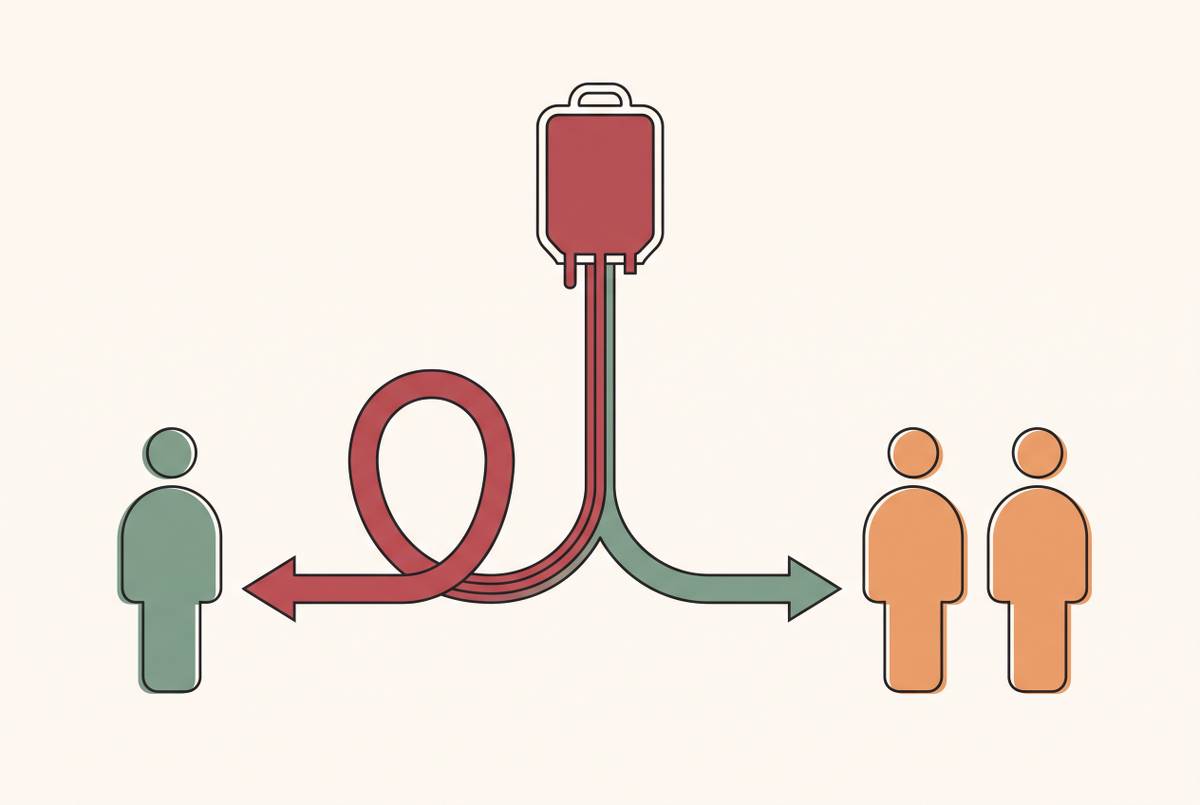
Two subjects, two medical record numbers, one biological event. That's the structural fact a perinatal LIMS has to represent, and it doesn't fit a data model built around a single patient generating a single specimen history.
Baylor's PeriBank handles this by indexing all data and biospecimens under the maternal subject ID, while still supporting queries across maternal, paternal, neonatal, and other linked attributes, so a researcher can pull a cohort by any combination of sample type and clinical feature. The scale this reaches is considerable: the PHARMO Perinatal Research Network has captured roughly 542,900 pregnancies across 387,100 mothers between 1999 and 2017, with mother-child linkage available for about a quarter of those pregnancies and follow-up running nearly 20 years for both mother and child. Managing that volume of longitudinal linkage by hand, cross-referencing records manually, simply isn't an option. The relational structure has to sit in the schema from the start.
Enrollment design has a measurable effect on how much of this data actually gets captured. At MGH, switching to a unified consent strategy covering the whole dyad, instead of mother and infant separately, raised enrollment from 5 to more than 8 dyads per week, and pushed average sample collection from 7 to 9 samples per woman. Data architecture and enrollment workflow are coupled tighter than most programs assume; a clunky consent process shows up downstream as missing samples.
What this demands is a genuinely hierarchical model: one maternal participant record, linked to one or more neonatal records, linked in turn to one or more gestational episodes, since a mother may appear in the system for multiple pregnancies over the years and each has to stand as its own episode rather than a duplicate entry. Every aliquot needs a subject-level tag marking it maternal or neonatal, plus a linkage key connecting it to its counterpart from the same delivery, and the model has to support additions years after the index event, because longitudinal follow-up means new specimens and new clinical data attach to a record opened long ago. Most general biobank LIMS platforms ship with a flat, sample-centric schema, and forcing this hierarchy on top of it through workarounds accumulates error the longer the program runs.
Consent management when the patient population and the pregnancy are both time-bounded
Pregnant persons, fetuses, and neonates count as vulnerable research populations, so additional safeguards against coercion and undue influence aren't optional add-ons. The UCLA Perinatal Biospecimen Repository protocol makes capacity-to-consent assessment a core safeguard for exactly this reason.
Consent here is pregnancy-specific rather than participant-specific. A woman who consents to a biobank program during one pregnancy has to consent again, separately, for any pregnancy after that. The LIMS has to version consent by gestational episode, not by participant record, a distinction most general-purpose consent modules never bother with because most research populations don't repeat this way.
Withdrawal rights make the requirement heavier. Participants can withdraw at any point, and when they do, the system has to immediately restrict access to every linked specimen and data point, not just the record where the withdrawal got logged. Think about what that means for a dyad: if maternal consent gets modified or revoked, that change has to propagate automatically to every neonatal specimen tied to that mother. A LIMS storing consent only at the individual sample level can't do this reliably, because there's no structural path from the maternal decision to the neonatal record. Somebody would have to catch it by hand, and manual catches fail once volume climbs.
Storing consent versions, approval dates, and usage restrictions directly against each specimen record also speeds up audit and ethics review, since reviewers see the governing consent instantly instead of requesting document retrieval from some separate file system. On top of that, PHI controls need role-based access so identifiable maternal and neonatal fields stay visible only to authorized personnel, kept apart from the de-identified datasets researchers actually work with.
The two-plane aliquot hierarchy perinatal repositories require
Standard biobank tracking follows one hierarchy: primary specimen, aliquot, derivative. Perinatal repositories need that same hierarchy running twice, once for the maternal subject and once for the neonatal subject, with specimens from the same delivery event staying cross-referenceable no matter how far their processing chains diverge.
One delivery can generate maternal plasma aliquots, cord blood plasma aliquots, and several placental tissue sections, each spinning off its own derivative chain, and all of it has to stay queryable as a single delivery event when a researcher wants the full picture. That means batch processing documentation with parent-child linkage preserved at every aliquoting, pooling, or derivative-creation step, along with a processing history on each aliquot covering who handled it, when, how much time passed between collection and processing, and what tube type got used, since something as small as a PAXgene tube for RNA stabilization changes what that sample is even good for later.
Freeze-thaw cycling deserves its own counter, tracked per aliquot rather than per storage location, with threshold alerts built in. The degradation data backs this up: more than 10 freeze-thaw cycles trigger severe damage, with roughly 70% of biomarkers altered and enzyme impairment across the board, and even 5 or fewer cycles measurably affect enzymes, with about 43% showing change. Storage duration piles on top of that; at temperatures below -20°C, enzyme alteration rates climb from around 20% at 1 to 5 years of storage to 55% past the 10-year mark. None of that matters if the freeze-thaw count lives in a lab notebook instead of the LIMS. At this level of detail, the system has to answer three questions on demand: where is this aliquot, what shape is it in, who touched it last.
Cold chain monitoring as a data integrity requirement, not a hardware problem
Some perinatal specimens punish you for a lapse in temperature. RNA-containing samples need freezing immediately after collection, which makes tube type and time-to-freeze mandatory metadata, not a nice-to-have note in the margin.
The freeze-thaw numbers from the last section only matter if the LIMS logs cycle counts automatically. Manual logging defeats the whole point, since the value of tracking freeze-thaw cycles is catching degradation before it ruins a sample, and a spreadsheet updated at the end of a shift catches nothing in real time.
A cold chain system worth using connects to temperature sensors and data loggers across freezers, refrigerators, and transport containers, and it fires automated alerts on excursion tied to the specific specimens affected, not a generic alarm on the storage unit. For multi-site networks like PeriBank or the two-hospital MCW model, monitoring has to span locations instead of stopping at one repository's door, which means shipment orchestration, pack-out workflows, manifests, receipt confirmation, and discrepancy capture on every inter-site transfer. Storage mapping needs to reach down to freezer, shelf, rack, box, with live location tracking instead of a static inventory sheet updated once a quarter.
The audit trail underneath all of it has to be tamper-proof. Temperature excursion records can't be edited after the fact; they can only be annotated with a corrective action note. An editable excursion log defeats the reliability the audit trail exists to guarantee.
The regulatory framework a perinatal LIMS must be built to satisfy
ISO 20387:2018 is the international standard for biobanking, covering personnel competence, biological safety, infrastructure management, environmental parameters, and quality management. A LIMS supporting a perinatal biobank has to produce documentation satisfying every one of those categories, not just the ones easy to automate.
CAP's Biorepository Accreditation Program audits biorepositories, and a LIMS supporting a perinatal biobank must be able to produce the documentation such reviews require. FDA 21 CFR Part 11 governs electronic records and signatures, and validating a LIMS under that framework requires documented qualification testing covering installation, operational performance, and real-environment performance.
HIPAA and GDPR intersect in ways specific to perinatal data. GDPR imposes restrictions on data processing scope and retention, which creates tension with perinatal biobanks that often collect specimens under a broad future-research mandate, meaning the LIMS needs field-level access controls and de-identification workflows built in from the start rather than added later. Given that some perinatal networks follow participants for nearly 20 years, retention policy management is something the system manages continuously as records age, not a setup task finished once at launch.
Across all four frameworks the thread is the same: electronic signatures, role-based access control, tamper-proof audit trails. Miss any one of those three and the LIMS can't be validated against any of the four regimes. That makes them baseline requirements, not advanced features.
EHR integration and why perinatal biobanks cannot afford a data silo
Biospecimen data is only as useful as the clinical context sitting next to it, and gestational age, delivery complications, maternal diagnoses, neonatal outcomes don't originate inside the LIMS. They live in the EHR.
The obstetric parameters from earlier, delivery mode, collection method, gestational age, need to flow from the EHR into the LIMS automatically at intake. Re-keying that by hand is where errors creep in; manual data entry workflows run error rates between 18% and 40%. At that rate, a meaningful chunk of the cohort metadata researchers rely on to filter samples is just wrong.
Integration targets for a perinatal repository typically include EHR systems like Epic for maternal and neonatal clinical records, REDCap for research data capture and study management, and genomic data platforms downstream as consumers of biospecimen-derived results. The standards making this connectivity work are HL7/FHIR for clinical data exchange, OMOP for common data model harmonization, and MIABIS for biobank-specific metadata interoperability. A researcher-facing request portal, where investigators search available specimens by delivery mode, gestational age, sample type, or consent status without asking staff to run a manual query, is what turns this integration into something people actually use day to day.
Barcode scanning tied to label printers at the point of collection closes the last gap. The specimen gets accessioned the instant it's labeled, which kills the delay between physical collection and system registration, and that delay is exactly where perinatal workflows see their worst concentration of errors.
What to evaluate when selecting a LIMS for a perinatal biorepository
A platform that handles oncology tissue banking well isn't automatically qualified for perinatal work. The dyad linkage model and per-pregnancy consent versioning this domain demands are specific enough that generic biobank credentials don't transfer. Evaluators should test for them directly instead of assuming a mature LIMS vendor already solved the problem somewhere along the way.
The questions worth putting to any vendor are specific ones. Can the data model represent a maternal subject linked to one or more neonatal records across multiple gestational episodes, instead of forcing each pregnancy into a fresh, disconnected participant record? Does consent cascade automatically from the maternal record to every linked neonatal specimen the moment status changes, or does that depend on a staff member remembering to update both sides? Can the system enforce collection timestamp fields and flag any cord blood specimen that blows past the 30-minute ideal or 24-hour standard window, instead of accepting a timestamp as free text nobody ever checks? Does freeze-thaw cycle counting run at the individual aliquot level with configurable threshold alerts, or only at the storage-unit level, where individual sample history gets lost in the shuffle?
These questions fall directly out of what the specimen portfolio, the dyad structure, the consent rules, and the regulatory frameworks already demand. A perinatal biobank evaluating LIMS platforms is really asking whether a vendor built for this exact relational and temporal mess, or whether what's on offer is a general biobank tool with a perinatal label stuck on after the fact. Ask a program five years in how much of their mother-infant linkage actually lived in the system, and how much of it lived in a lab manager's memory. Too often it's the second one, right up until that person leaves.