Cord Blood Unit Release Criteria and Quality Control Testing
How accreditation bodies set the baseline standards cord blood banks must meet before release.

Two accreditation bodies set the floor for cord blood banking in the U.S.: NetCord-FACT and AABB. Neither is a federal mandate, but NMDP membership requires accreditation by one or the other, so in practice, neither is optional. The current NetCord-FACT standard, the eighth edition (Version 8.2, released November 2024), treats collection, processing, testing, banking, listing, search, selection, reservation, release, and distribution as one continuous workflow. No department owns a separate checkpoint; the whole chain answers to the same standard.
The two bodies organize their requirements differently, and the difference is not cosmetic. AABB builds its standards around quality system essentials and inspects accredited facilities every two years, which gives banks more operational flexibility inside a strict quality framework. FACT organizes its standard around the actual workflow of banking and release, weights clinical outcomes more heavily, and will not inspect a bank until it already has a substantial number of units in storage. That filters out operations that haven't proven they can scale collection before anyone checks whether they can release safely, and many in the field give FACT accreditation extra weight in their evaluations for that reason, despite both being treated as equivalent in casual conversation about the industry.
None of this happens in a regulatory vacuum. FDA 21 CFR Part 1271 sits on top of accreditation, so a bank can be fully accredited by FACT or AABB and still has to satisfy Part 1271 on its own terms. The reach extends past U.S. borders: Australia's Therapeutic Goods Administration and Switzerland's Swissmedic both mandate or follow NetCord-FACT standards, making these rules closer to a global baseline than a parochial American one.
These standards are floors, described in their own text as minimum guidelines. A bank or a country can, and often does, add requirements on top of them. For anyone evaluating a cord blood bank from the outside, accreditation is the most useful available proxy for whether release criteria clear that floor. It says nothing about how far above it a given bank actually operates, and assuming otherwise, treating accreditation as a ceiling rather than a floor, is where most misplaced confidence in this industry comes from.
Donor eligibility screening as the first gate before any cell testing begins
Before a single cell gets counted, FDA rules under 21 CFR Part 1271 Subpart C require a formal donor eligibility determination for every allogeneic HPC, Cord Blood donor. This is statute, and it does not bend for a unit with otherwise perfect cell counts. Because the donor, the infant, is a month old or younger, the birth mother stands in for testing purposes, and a maternal specimen gets collected at delivery or within a defined window around it.
The infectious disease panel is fixed by regulation: HIV types 1 and 2, tested by both serology and nucleic acid testing; hepatitis B, through HBsAg and Anti-HBc; hepatitis C, through Anti-HCV and NAT; syphilis, through Treponema pallidum serology; and HTLV types 1 and 2, required specifically because the unit is rich in viable leukocytes. Cytomegalovirus gets tested too, but on an entirely different rule: a reactive CMV result does not disqualify the unit the way a reactive HIV or hepatitis result would. It has to be disclosed so the transplant team can weigh it against the patient's own status, but the unit stays eligible regardless of the result.
The framework isn't settled law, either. In January 2025, the FDA issued updated guidance aimed at cutting HIV, HBV, and HCV transmission risk from HCT/P donors, and separately proposed expanding donor eligibility through individual donor assessment rather than blanket category exclusions.
One requirement gets overlooked because it has nothing to do with cell biology: the donor eligibility summary has to travel with the unit at all times after manufacture, under 21 CFR 1271.55. A documentation gap blocks release on its own, even when every cell count and sterility result is clean. Outside observers often assume biology trumps paperwork here, but the rule holds regardless: a unit from an ineligible donor never enters allogeneic banking in the first place, and no cell dose number rescues it after the fact.
Pre-cryopreservation cell dose testing: TNC and CD34+ thresholds
Cell dose gets judged on two numbers, total nucleated cell count (TNC) and CD34+ cell dose, and the mistake banks and even some clinicians make is treating TNC as a stand-in for CD34+ when it's really just a rough proxy. In a study of 794 cord blood units, TNC count was the single best predictor of clinically meaningful CD34+ content, with an area under the ROC curve of 0.828. That figure sounds solid until it's paired with the prediction efficiency from the same study, 75.4%, which means roughly one unit in four would get sorted wrong if TNC were the only number a bank bothered to check. A bank that leans on TNC alone because it's cheaper or faster to run is accepting a one-in-four error rate on the number that most directly tracks engraftment. That's not a rounding error; that's a coin flip's cousin.
CD34+ cell dose is the number the transplant literature treats as the more direct predictor of engraftment, and that's the entire reason both metrics get measured rather than one standing in for the other. A bank that skips CD34+ testing to save time is gambling with the one number closest to the outcome that matters.
Thresholds shift with recipient weight and with whether the transplant uses one unit or two. Single-unit transplants generally set minimum TNC and CD34+ thresholds per kilogram of recipient body weight, so the same banked unit can clear the bar for a small child and fall short for an adult. Double-unit grafts have historically tolerated lower per-unit thresholds, though current guidance is pushing toward a higher minimum CD34+ dose per unit even there.
There's a built-in exception worth knowing. A unit with a solid CD34+ dose but a shortfall on TNC can still be considered if the CD34+/TNC ratio falls in an acceptable range, with the bank's accreditation status, its processing method, and the freeze year all factoring into that judgment call. None of it matters, though, if the unit fails a baseline viability floor before freezing; units below that line don't get banked for allogeneic release, full stop. A unit that looks fine on TNC alone can still get turned down, while a unit with a lower TNC but a strong CD34+ profile can still qualify. The ratio, weighed on its own terms rather than either number in isolation, is what a careful bank actually reads.
HLA typing requirements and how method choices affect transplant timelines
HLA typing is a characterization step. It lets a transplant physician match a banked unit to a specific patient's immune profile. Getting it wrong doesn't make the unit dangerous; it makes the unit useless for that particular patient while leaving it perfectly viable for someone else.
Release requires DNA-based typing, rather than older serological methods, at four loci: HLA-A, HLA-B, HLA-C, and DRB1. The European standard has moved to 8-allele typing across those same four loci at allele-level resolution rather than antigen-level, closing a gap where serology could miss a mismatch that finer typing catches.
Confirmatory typing is a hard requirement, and it happens twice: once as initial typing, once as confirmation. The confirmatory sample has to come from a segment physically attached to the unit bag, rather than a separate vial, so the result is guaranteed to reflect the unit actually being released. That confirmatory test has to run in an ASHI- or EFI-accredited lab.
The technology underneath this is shifting fast. Banks still running Sanger sequencing for confirmatory typing gain accuracy but spend more time on the result, and in transplant medicine time is not a neutral cost. NGS reads both coding and noncoding HLA regions at higher resolution, and as of 2023, half of all HLA typing submissions came from NGS-based methods, according to the EBMT Handbook 2024. NMDP's "Cure-Ready" program uses NGS for confirmatory typing straight from the attached segment, with release and potency testing already finished by the time a search coordinator finds the unit. That cuts out a wait that would otherwise delay release by a meaningful stretch of time, and for patients where weeks are the margin between remission and relapse, that saved time can matter as much as the typing result itself.
Non-inherited maternal antigen (NIMA) matching is under active study as a possible added compatibility dimension, but it isn't a universal release criterion yet, and it shouldn't be treated as one. Hemoglobinopathy screening, by contrast, is already required before release, to rule out sickle cell trait or other hemoglobin variants that could affect how the recipient does after transplant.
Microbial sterility testing: contamination rates, what drives them, and a faster testing approach on the horizon
Contamination is not a rare edge case in cord blood banking. It's routine enough that a bank without a clear disposition protocol is unprepared for its own normal operations. In a study of more than 10,000 cryopreserved samples collected over a decade, 8% tested positive for bacterial contamination, a rate close enough to other published figures in the field that it should be read as the baseline, not an outlier.
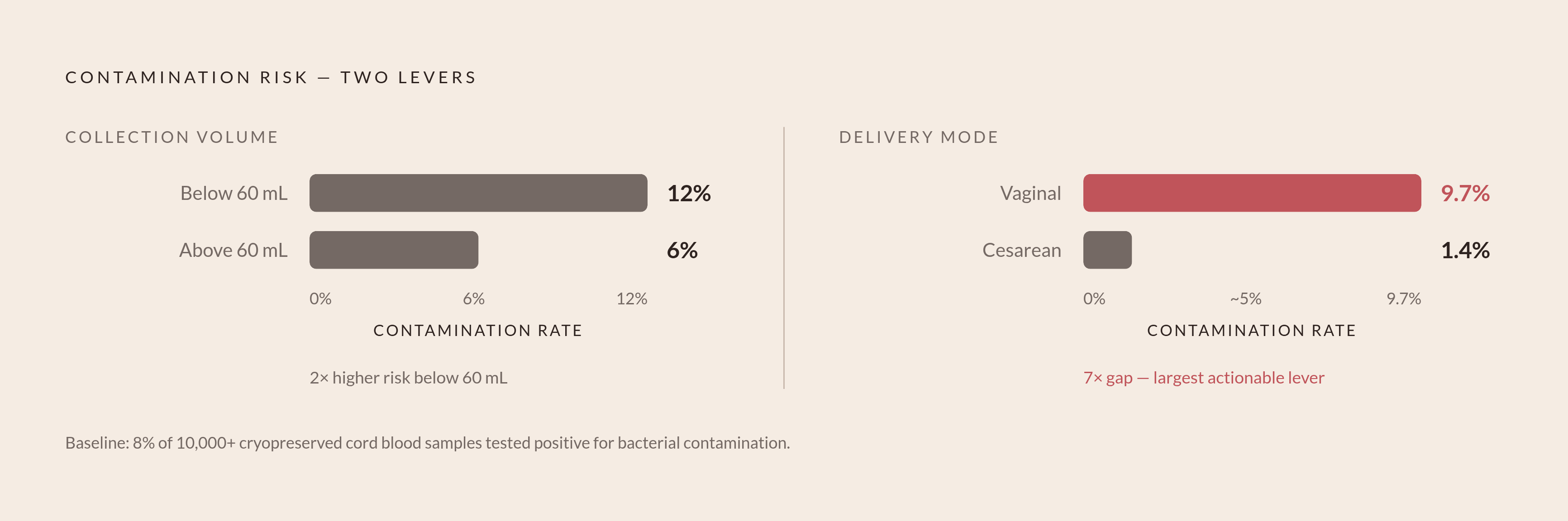
Two variables explain most of the gap between a contaminated unit and a clean one, and the data supports treating contamination as a controllable variable rather than simple bad luck. Collection volume is the first: units below 60 mL showed a 12% contamination rate, compared with 6% for units above that volume, roughly double the risk, likely because a smaller collection takes longer relative to volume and leaves the sample exposed longer. Delivery mode is the second, and the gap is bigger: 9.7% contamination for vaginal deliveries against 1.4% for cesarean deliveries. A collection team running one identical protocol for both settings is leaving risk on the table it doesn't need to accept, and the data says so plainly.
NetCord-FACT requires microbial screening to use a system validated for aerobic and anaerobic bacteria and fungi, and any organism that turns up has to be identified, with antibiotic sensitivity testing performed on it. Contamination gets characterized in detail, with follow-up testing rather than a simple flag-and-discard step. What happens next depends on the organism, the quantity, and how urgent the clinical situation is: a contaminated unit might still be released in a life-threatening scenario, with full disclosure to the treating physician, or it might be discarded outright. Either way, the decision path has to already be written into the bank's SOPs before the question ever comes up in a real case; deciding in the moment reflects a policy that was never written.
The practical problem is speed. Standard aerobic and anaerobic culture takes days to return a result, which stalls release clearance at the exact moment a patient may be waiting. A 2024 paper in Transfusion describes a molecular sterility assay built for faster quality release, evidence that the field is working to shrink that lag without giving up detection sensitivity. Contamination shows up in roughly one in twelve units, which makes sterility testing a routine catch rather than a rare event, and the method used to catch it has direct consequences for how fast a matched unit reaches a patient.
Post-thaw quality testing: what gets re-measured at the point of release and why viability at that moment is decisive
Clearing every pre-freeze checkpoint does not make a unit automatically releasable. Treating pre-freeze numbers as the final word is one of the more dangerous assumptions in this whole chain, and it deserves to be named directly rather than hedged around: a unit banked with excellent numbers years ago can still fail release today. Cryopreservation and storage can degrade cell viability between freeze and thaw, so post-thaw testing has to confirm the unit still meets potency standards at the moment it's about to be used, rather than at the moment it was banked.
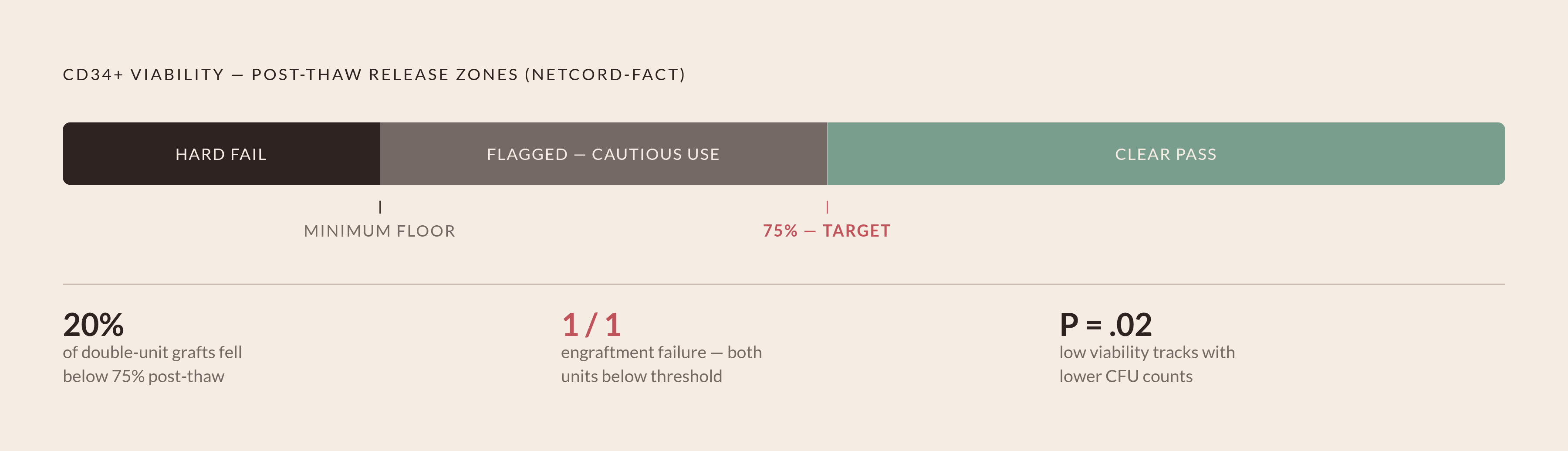
The standard post-thaw panel reconfirms ABO blood group, TNC, CD34+ and CD3+ cell number and viability, sterility, and colony-forming units (CFU). Of these, CD34+ viability is the number that decides the outcome. NetCord-FACT sets a minimum viability threshold for thawed segment CD34+ by flow cytometry, with a higher target preferred; units landing in the range between the minimum and that target get flagged for cautious use rather than an outright pass.
There's clinical evidence behind treating 75% as a meaningful line, not an arbitrary one. In a prospective analysis of double-unit transplants, 20% of units had post-thaw CD34+ viability below 75%. The one patient in that analysis whose transplant failed to engraft with either unit had both units sitting below that threshold, and low viability tracked with lower CFU counts at a statistically significant level (P =.02). That's the clearest available link between one specific number and one specific bad outcome, and it's not a coincidence worth waving off.
Viability alone doesn't confirm the cells are doing what they need to do, which is why the CFU assay exists as a separate measurement. It tests functional progenitor capacity, distinct from whether a cell's membrane excludes dye. A large analysis of more than 350 cord blood units found a median post-thaw CD34+ recovery of 101%, but the range around that median was extreme, with some units losing most of their CD34+ content and others appearing to gain content, an artifact of how counting methods behave at the extremes rather than actual cell growth. That spread is the whole argument for never skipping post-thaw testing, even on a unit whose pre-freeze numbers looked flawless.
Method matters here too. CD34+ and CD45+ content get measured by flow cytometry using the ISHAGE protocol, with viability calculated through 7-AAD dye exclusion; those are standardized choices that make results comparable across different banks rather than each lab inventing its own baseline. All of this testing happens on a segment, an attached sample tube, rather than on the unit itself, which is also where confirmatory HLA typing draws its sample. That preserves the full unit for transplant while still giving a representative read on its condition. A unit that fails post-thaw viability criteria does not get released, no matter how strong its numbers looked going into the freezer years earlier.
How the checkpoints fit together into a release decision and what it means when a unit clears all of them
Release is a determination, not a score to average your way past, and the most common misunderstanding of this whole system is imagining that a strong result in one category can offset a weak one in another. Every gate has to clear on its own terms, and a failure at any single point is a hard stop, unless the bank's own SOPs allow for a defined, risk-managed exception, such as releasing a contaminated unit in a genuinely life-threatening situation with full physician disclosure.
The gates interact, but not by canceling each other out. A unit with a borderline TNC count can still be released if its CD34+ dose and viability are strong, while a unit with excellent cell counts across the board gets held anyway if its donor eligibility paperwork is incomplete. No single strong result buys forgiveness for a failure elsewhere in the chain. Safety, potency, and identity-and-match are independent categories, and each one has to be satisfied on its own terms, rather than traded against the others.
Documentation is itself a release criterion, and it deserves to be stated as plainly as the biology: the donor eligibility summary has to accompany the unit at all times under 21 CFR 1271.55, and a missing or incomplete record blocks release exactly the way a failed sterility culture or a CD34+ viability result under 70% would. When a unit clears every gate, the donor screen, the cell dose thresholds, the HLA confirmation, the sterility panel, and the post-thaw viability check, what a transplant team is holding is the most that a layered, decades-refined testing system can currently promise: a unit that is safe to infuse, potent enough to have a real chance at engraftment, and matched to the one patient who needs it.