Scaling Perinatal Biobank Operations from Single Site to Network
Networks must standardize specimen collection before governance or data systems.
A perinatal biobank collects tissue from more than one biological subject at once, on a clock measured in hours, and the leap from a single hospital doing this well to a network of hospitals doing it together is where most of these efforts stall. Scaling from one site to many is not a matter of adding more freezers and more consent forms. It is a matter of solving four operational problems in a specific order, and getting that order wrong is what turns a promising network into a pile of samples nobody can legally or scientifically compare. Most networks get this backwards: they chase governance agreements and shiny data platforms before anyone has agreed on what tube the cord blood goes in, and that mistake is nearly impossible to undo later. This is the wrong order, full stop, and the historical record on multi-site cohorts backs that up.
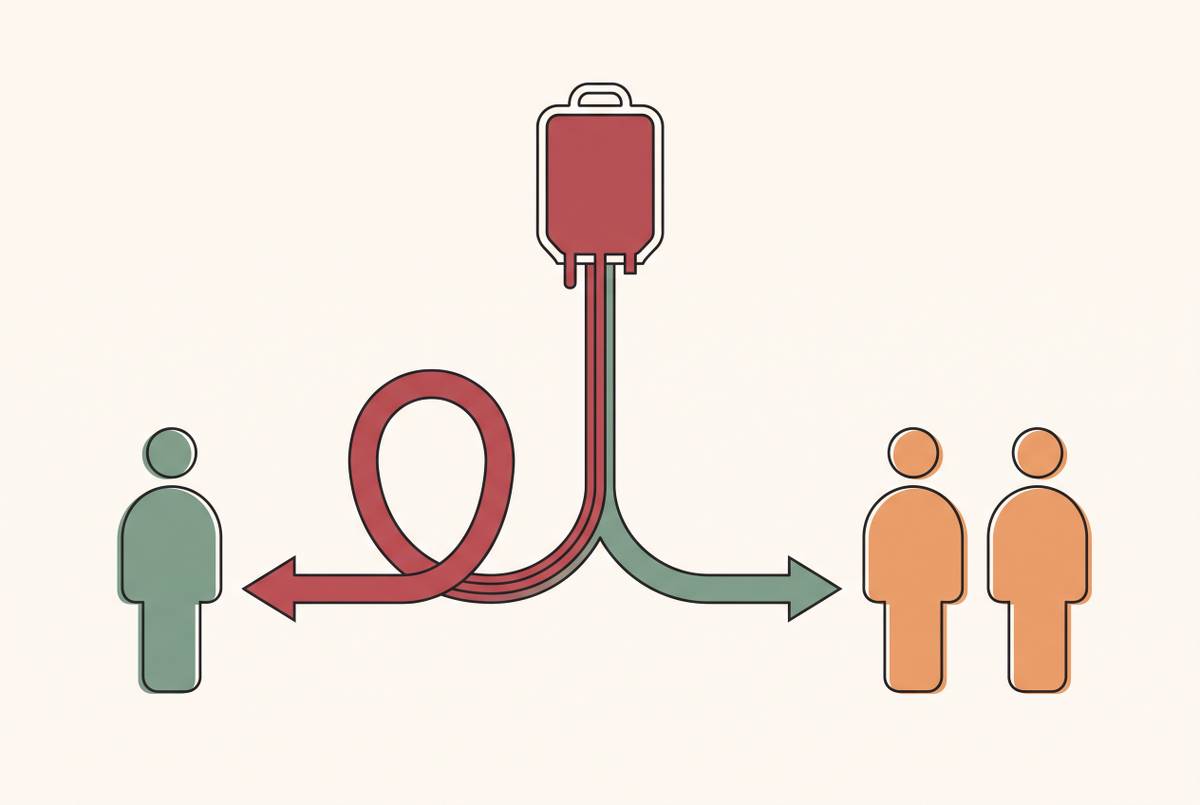
Perinatal collection differs from biobanking in general in ways that matter for sequencing. A cancer biobank collects tissue from one patient on a schedule that can often bend around convenience. A perinatal biobank collects from a dyad, sometimes a triad, mother, partner, and fetus or neonate, and the specimens involved include maternal blood, placenta, cord blood, amniotic fluid, colostrum, microbiome swabs from stool and vaginal and oral and skin sites, urine, saliva, and hair. Each of those has its own rules for how fast it needs processing, what it needs to be stored in, and what it can support downstream once someone wants to run genomic, epigenomic, transcriptomic, metabolomic, proteomic, or cell-free nucleic acid analysis on it years later. Miss the birth, and the sample is gone for good; there is no rescheduling a placenta. That urgency is manageable at one site with one team, but multiply it across a dozen hospitals and the same urgency becomes the thing that breaks protocol consistency, because local staff will always make a judgment call rather than wait on a distant approval chain.
The stakes are rising because the underlying market is rising with them. Global biobanking was estimated at $76.2 billion in 2024 and is projected to reach $164.5 billion by 2034, growing at roughly 8.1% a year. Perinatal collection is a fast-growing, specialized slice of that market, pulled into the same wave of AI-driven analytics, automated processing, and cloud-based lab management tools sweeping the rest of the sector. Those tools were mostly built for simpler specimen types, though, and a perinatal network has to bend them to fit placenta sections and cord blood and stool swabs, not the other way around.
What the single-site model looks like at its best — and where it breaks
The UK Baby Bio Bank is a useful reference point for what a well-run single-site, or tightly clustered, operation looks like. It holds 54,000 biological samples from 2,515 pregnancies, drawn from three London hospitals, Queen Charlotte and Chelsea, Chelsea and Westminster, and St Mary's, which together deliver around 13,000 babies a year. All of that material is stored at UCL Institute of Child Health, with a full duplicate copy kept at St Mary's. Redundant storage like that is achievable precisely because the geography is compact and the governance sits under one roof. The Newcastle 1000 cohort tells a similar story from the recruitment side: as of July 2024, it had enrolled 1,040 women, 684 partners, and recorded 922 infant births, all under one coordinated team.
One team can hold the line on SOPs, staff training, chain-of-custody, and consent under one institutional review board. There is no negotiation about whose freezer policy wins, because there is only one.
That coherence is exactly what breaks under expansion. Duplicate storage across distant sites stops being logistically realistic. Each new hospital brings its own IRB, its own staff training baseline, its own institutional habits about what counts as an acceptable delay before a sample gets discarded. And because the collection window is so tight, local staff need the authority to make judgment calls without waiting for central sign-off, which is necessary but is also the exact mechanism by which protocols drift apart. The COPPER survey, conducted in 2024, found 24 U.S. perinatal biobanks with participant counts ranging from 30 up to 40,000, some holding more than 600,000 pregnancy biospecimens. That spread is not a sign of a maturing field, whatever the raw sample counts might suggest. It is evidence that no shared standard exists yet. The very things that make single-site biobanks work, tight quality control, one consent form, one clear owner of the data, are the things a network has to rebuild from scratch at distributed scale, and most rebuild them in the wrong order.
Why sequence matters: the order in which networks solve operational challenges determines whether they hold together
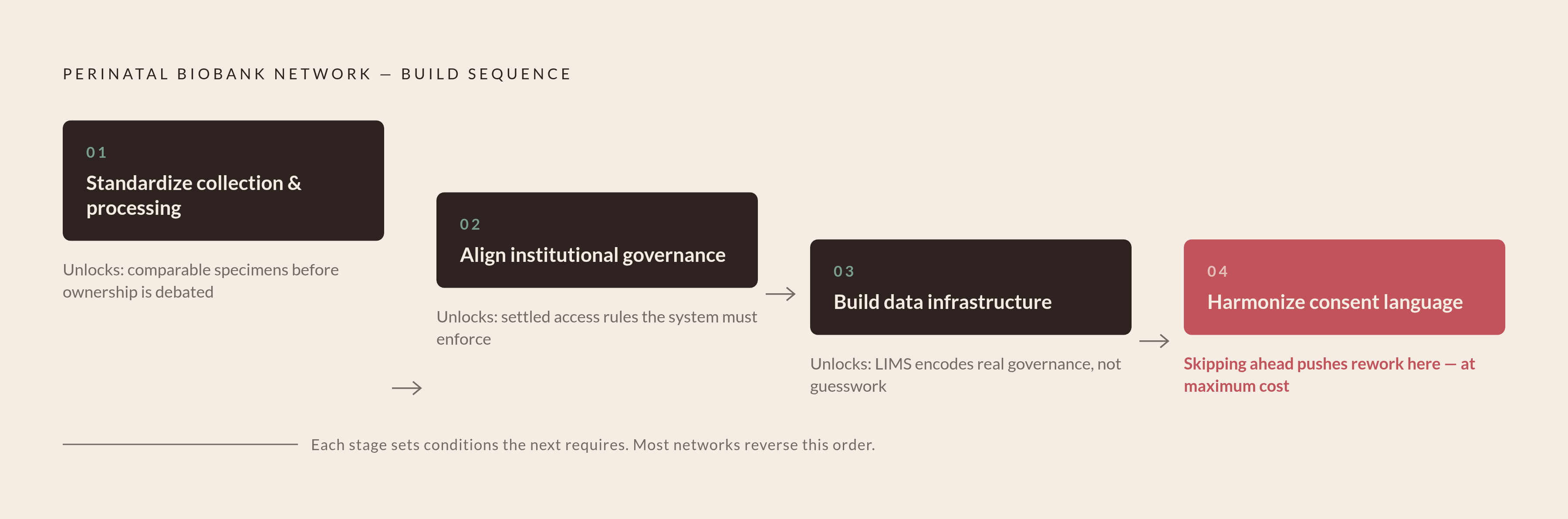
Multi-site perinatal collection is not new, and the historical record is instructive about what order things need to happen in. The Collaborative Perinatal Project enrolled more than 55,000 pregnant mothers across 12 U.S. sites between 1959 and 1965, and it worked because data collection protocols were agreed upon before any site started enrolling. The NICHD Neonatal Research Network, started in 1986, followed the same logic: multiple centers were needed for statistical power, and that power depended on shared protocols being locked in before the network went live, not negotiated after the fact.
Get the order wrong and the failure modes are predictable. Networks that hammer out governance agreements before standardizing collection protocols end up with airtight legal terms covering specimens that were never comparable to begin with, a bit like signing a detailed contract for goods nobody checked were the same size or grade. Networks that build data infrastructure before consent language is harmonized build systems that cannot legally move the very data they were designed to store. Networks that try to harmonize consent before governance is settled run into IRBs at different sites imposing conflicting constraints on the same form, forcing a rewrite anyway.
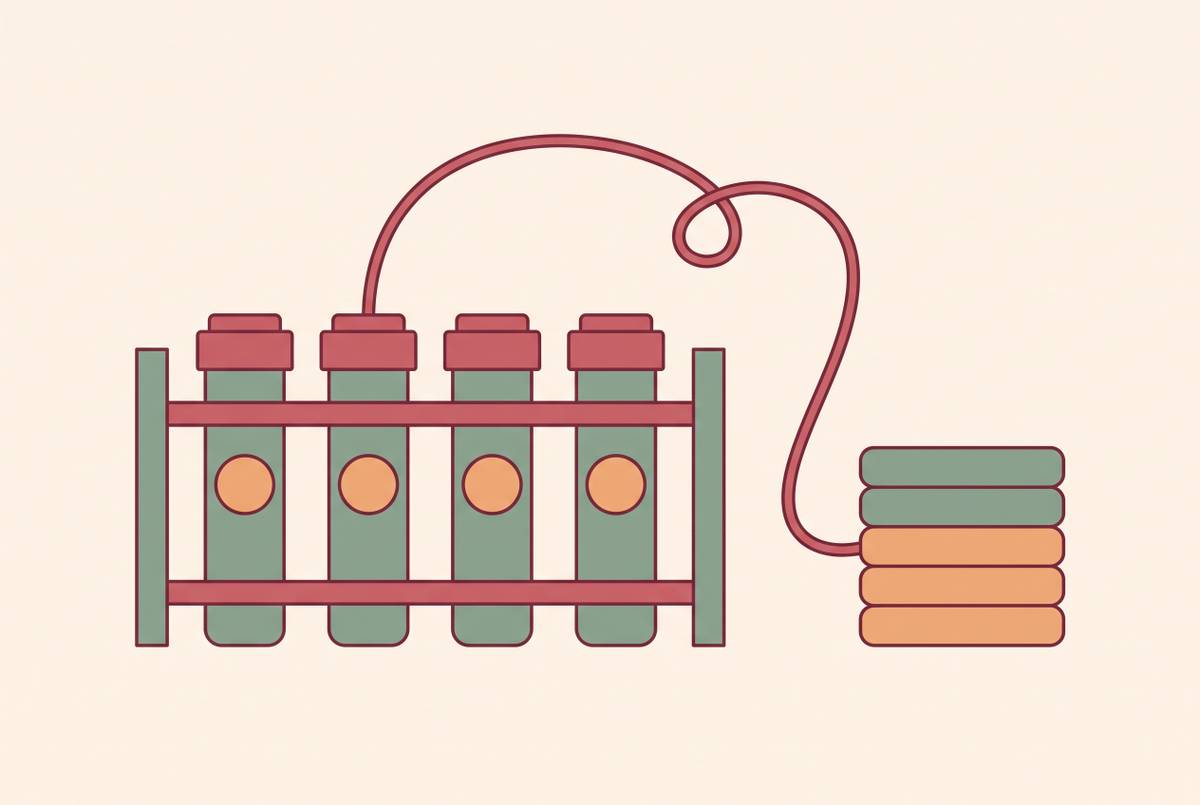
The correct order is not up for debate: standardize collection and processing first, align governance second, build data infrastructure to match that governance third, and harmonize consent language fourth. Each stage sets up the conditions the next one needs, and skipping ahead does not save time, it just moves the rework downstream to a point where it costs more. COPPER's own finding, that no centralized database of residual pregnancy or pediatric specimens currently exists for other researchers to use, is a direct symptom of this sequence getting skipped or done out of order across the field.
Standardizing collection and processing protocols across sites before anything else
The basic problem is mundane and unforgiving: different sites default to different tube types, different centrifugation times, different aliquot volumes, different rules about freeze-thaw cycles. None of that shows up as a governance problem or a data problem at first glance. It shows up earlier, as specimens that are scientifically incomparable before anyone even asks who owns them.
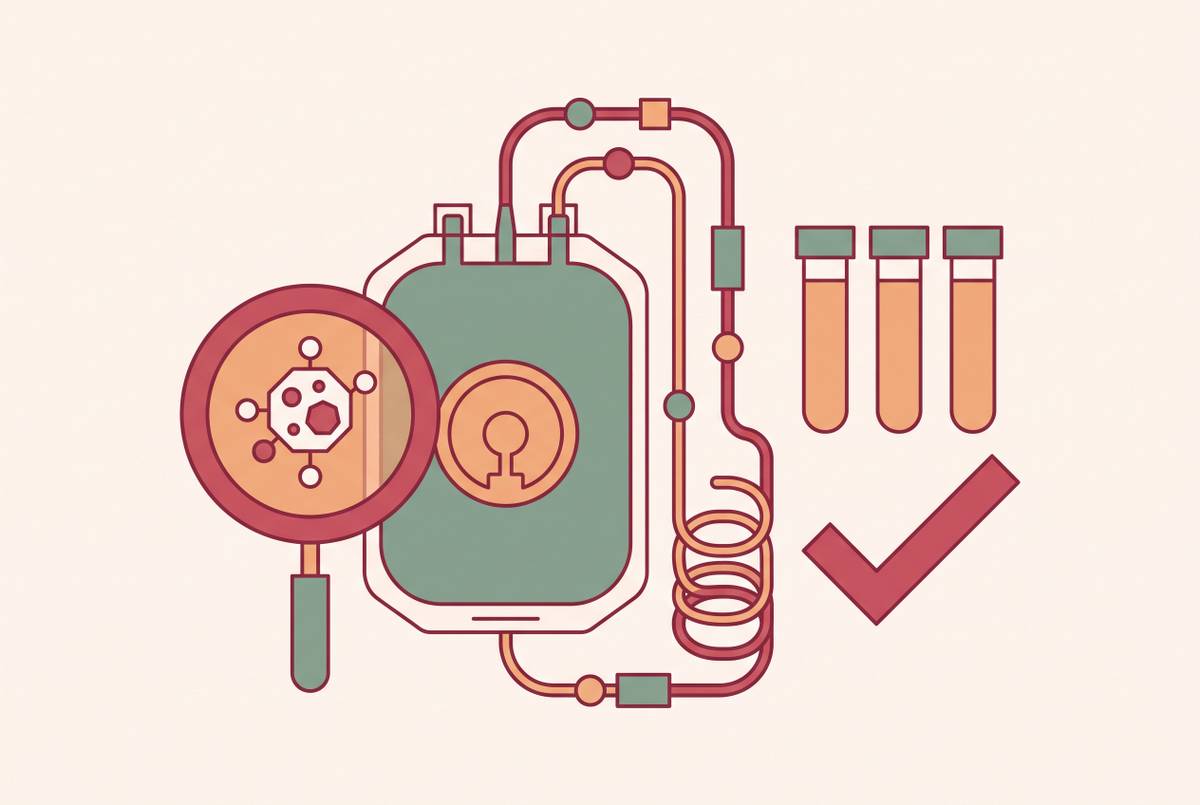
Perinatal SOPs have to cover the antepartum, intrapartum, and immediate postnatal windows, and placenta and cord blood collection has to be coordinated with labor and delivery staff whose job is the birth, not the biobank. A workable network SOP has to spell out, for every specimen type, the tube and anticoagulant to use, the maximum time allowed before processing, the aliquot volume and count needed for each downstream analytical platform, the cold chain requirements from the delivery room to the freezer, including the walk between buildings or floors, and documentation that feeds directly into each site's laboratory information management system.
Accredited quality standards give networks a meaningful enforcement mechanism here, because they set a floor that a third-party auditor checks rather than relying on voluntary adherence. A network that requires such accreditation as a condition of joining has a real lever; a network that just asks members to follow best practices is relying on good faith, and good faith is not a control. Any network still treating best-practice guidance as sufficient is making a bet it will eventually lose.
Experience across multi-site networks has shown that SOP variation is one of the biggest operational barriers to scaling up fast. One fix that has proven useful: build the SOP working group around senior collection staff from each site, not just the principal investigators, because floor-level variation is exactly what gets missed when only PIs are in the room drafting policy on paper.
Aligning institutional governance before the network processes its first shared sample
Governance in a network is not one agreement, it is a stack of them. Who holds legal title to the specimens and the data derived from them. Who has the authority to approve or deny an access request for pooled samples. How intellectual property that comes out of network samples gets attributed and split. What happens to a site's samples if that site gets removed from the network.
A cross-network analysis of five biobank members under the BioSHaRE-EU collaboration found that even established, experienced biobanks did not line up on the terms governing researcher access, ethics approvals, and commercialization — and they still did not line up.
Material Transfer Agreements are the standard legal tool for moving biospecimens across sites, and they cause trouble precisely because they tend to get written on demand rather than in advance. Across the field, MTAs drafted on demand rather than in advance have consistently emerged as a source of operational friction. The fix is to template and pre-negotiate MTAs at the point the network forms, not scramble to draft one the day a sharing request lands. Two broad paths to harmonizing access across networks have been discussed in the field: a single centralized application that covers multiple biobanks at once, or mutual recognition, where approval at one member site creates a presumption of access at the others. Mutual recognition scales better as networks grow, since centralized application review becomes a bottleneck once enough sites join, and any network planning for more than a handful of members should build toward mutual recognition from day one rather than treating it as a later upgrade.
NICHD's COPPER project, funded under the MPRINT grant, exists specifically to build the coordination infrastructure the field lacks right now, which is itself confirmation that governance gaps at the network level are structural, not incidental. Perinatal governance also carries a wrinkle general biobanks rarely face: specimens from a pregnant person involve at least two biological subjects, and a governance framework has to say, explicitly, how consent and data rights for the fetal or neonatal subject get handled as that child grows up and becomes able to make those decisions for themselves.
Building data infrastructure that reflects the governance model, not the other way around
Every vial needs a traceable history, from the moment of collection through processing, storage, and any shipment out. That is the baseline a laboratory information management system has to hit before anyone even starts talking about network-level interoperability.
At network scale, the requirements stack higher. The system has to support searching for samples across sites without exposing site-level data to people who are not authorized to see it. It needs audit trails that satisfy every participating institution's IRB and whatever regulatory regime applies. It has to enforce the access permissions written into the governance agreements as actual system behavior, not just as a policy document sitting in a drawer somewhere. And it has to handle metadata for wildly different specimen types in the same system: a maternal blood aliquot, a placenta section, a microbiome swab, each with its own fields and its own storage logic.
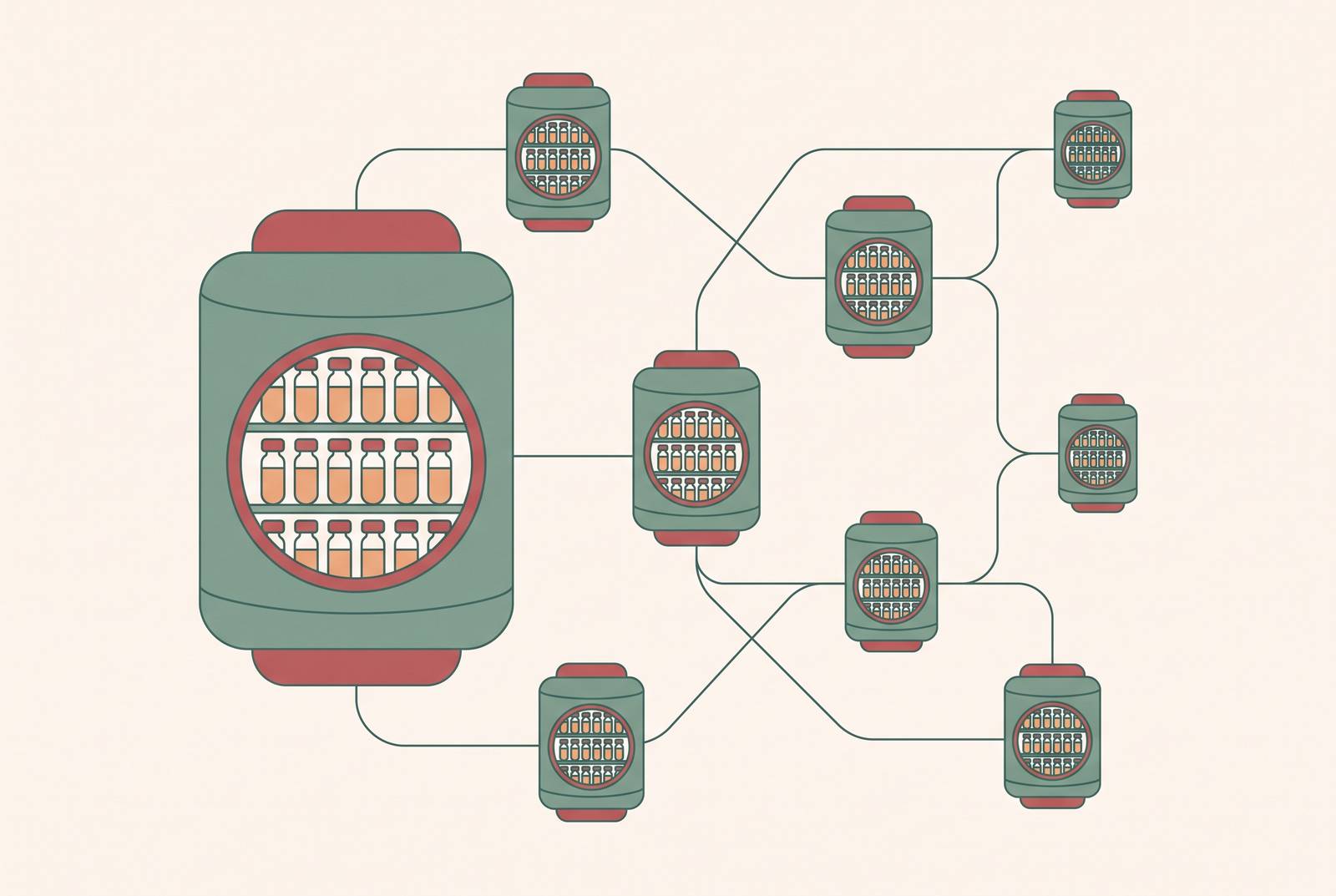
COPPER's goal of a usable, cross-network database of maternal and child specimens is the functional target here. Without that shared data layer, even samples collected under identical protocols and covered by identical consent language remain undiscoverable to an outside researcher who has no way of knowing they exist. AI-driven analytics and cloud-based management tools are spreading across biobanking broadly, and for a perinatal network the real payoff is federated queries across sites without physically centralizing the data, which in turn simplifies what the governance layer has to enforce.
Timing the purchase matters more than it might seem, and this is where networks lose money for no good reason. A LIMS chosen before governance terms are settled will almost certainly need expensive reconfiguration once access rules and data-sharing terms are actually agreed on. Governance decisions come first; system selection comes second, never the reverse. Vendors differ a lot in how well they handle multi-site setups, federated access controls, and perinatal-specific metadata, so evaluation criteria should be written against the network's own governance model, not against a generic feature checklist built for a different kind of biobank.
Harmonizing consent across sites without collapsing into the lowest common denominator
Consent rules vary by jurisdiction and shift over time; what counts as valid broad consent in one state or country can require active re-consent in another. Layer perinatal specifics on top of that: consent gets obtained from a pregnant person in the middle of a high-stress clinical encounter, and consent for the fetal or neonatal participant is implied through the parent's signature but may need revisiting as that child ages, depending on local rules.
The most common failure mode, and the one worth naming directly, is defaulting to whichever site has the most restrictive consent language and applying it network-wide. That approach feels safe. It is wrong, and it is wrong in a specific, costly way: it tends to produce consent forms so narrow that the samples cannot be used for any future research beyond what was specified at enrollment, which quietly destroys the longitudinal value that makes a perinatal biobank worth building in the first place. A more workable approach is tiered consent: broad future-use permission as the default, with site-specific restrictions layered in as addenda and recorded in the governance layer so the LIMS can enforce them sample by sample rather than form by form.
Data protection law adds another layer that cuts across all of this. GDPR in European contexts and HIPAA in U.S. contexts set different rules for how linked genetic and health data can be stored, moved, and de-identified, and a network spanning both jurisdictions has to map where those two frameworks actually intersect, not just satisfy each one separately as a checkbox exercise. Networks also need to decide, in advance, which future uses, commercial licensing, international data transfer, a new analytical method not anticipated at enrollment, trigger a requirement for active re-consent. That trigger logic belongs in the governance documents and the LIMS data model both, not left as a judgment call for whoever happens to field the request later.
The economics of running a perinatal biobank network sustainably
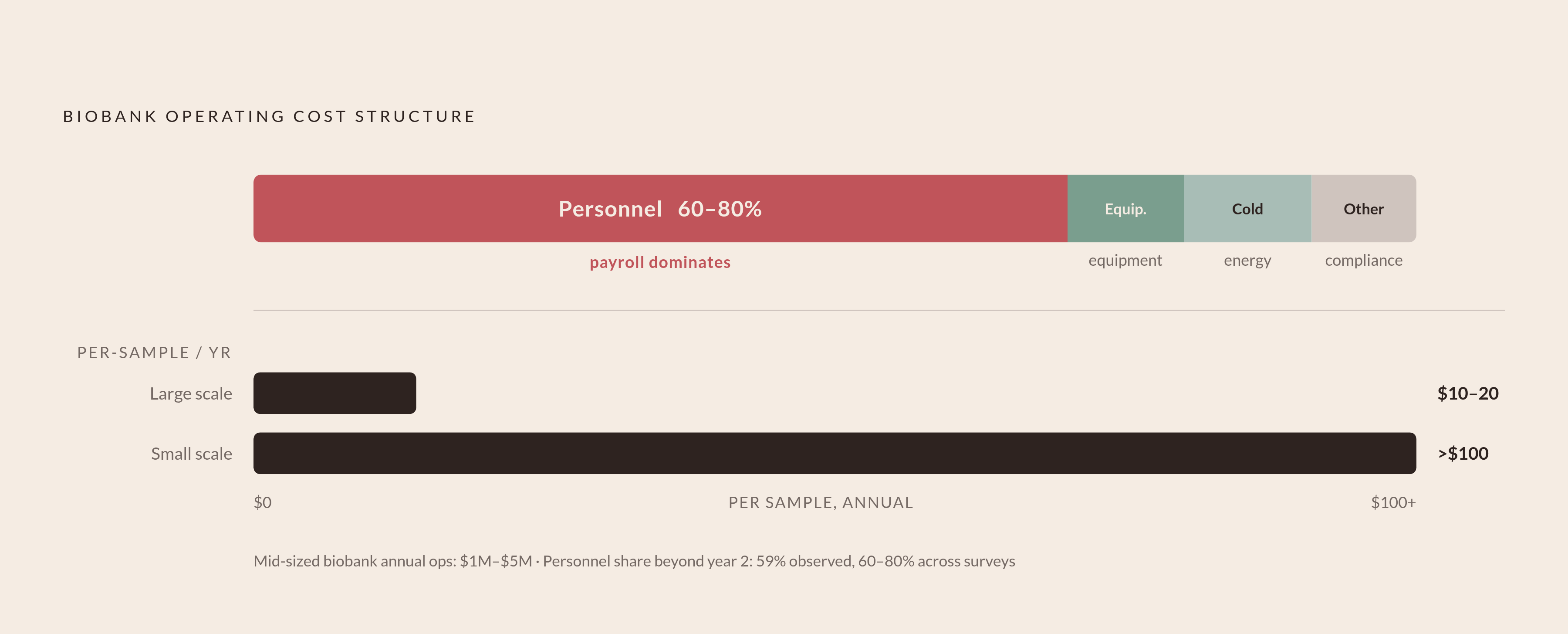
Money in biobanking is mostly a personnel story, and anyone budgeting a network around equipment costs is budgeting for the wrong thing. Beyond the second year of operation, payroll accounts for 59% of operating expenditure at a typical biobank, and broader survey data puts the personnel share somewhere between 60% and 80% of total operating costs. At network scale, staffing costs multiply roughly in line with the number of sites, while efficiencies from shared infrastructure take much longer to materialize.
Year one looks different: most start-up funding gets consumed by equipment, inventory systems, and facility build-out, which is why capital and operating budgets need to be modeled separately. Over a long horizon, 15 to 20 years is a reasonable planning window given how long these cohorts need to stay useful. Ongoing costs for a mid-sized biobank, personnel, cold storage energy, and regulatory compliance under frameworks like GDPR and HIPAA, land somewhere between $1 million and $5 million a year, and a network running several sites multiplies that base cost without a proportional increase in grant revenue to match.
Scale does help, eventually. Large biobanks can get per-sample annual costs down to $10 to $20, while smaller operations without network-level volume can run past $100 per sample. Aggregating volume across a network is the main lever for pulling per-sample costs down toward the $10-to-$50 range that larger operations already enjoy. But the sector's real vulnerability is funding structure, not scale. Most biobanks run on short-term grants rather than durable revenue, and survey respondents have described operating at a critical staffing minimum where any funding gap threatens continuity. A network that expands its footprint on the assumption that grant renewal will keep arriving on schedule is taking on real risk, and that assumption is exactly the one that tends to be wrong.
Diversifying revenue is less optional than it sounds. Charging industry users more than academic users is a position 92.3% of biobank respondents in one survey said they supported, and a tiered fee schedule along those lines lets a network cross-subsidize academic access using industry revenue. Charging for data access and bioinformatics services, not just for physical specimens, opens a second revenue stream that does not require shipping tissue at all. Consortium membership fees, structured to give pharmaceutical and diagnostics partners a defined level of access in exchange for sustained funding, give a network something closer to a recurring budget instead of a series of grant cliffs. None of this replaces getting the operational sequence right; it just determines whether a well-sequenced network can afford to stay open long enough for the science to pay off.