Cord Blood vs Bone Marrow as a Stem Cell Source for Transplant
Cord blood's immature immune cells fight leukemia better but engraft slower than bone marrow.
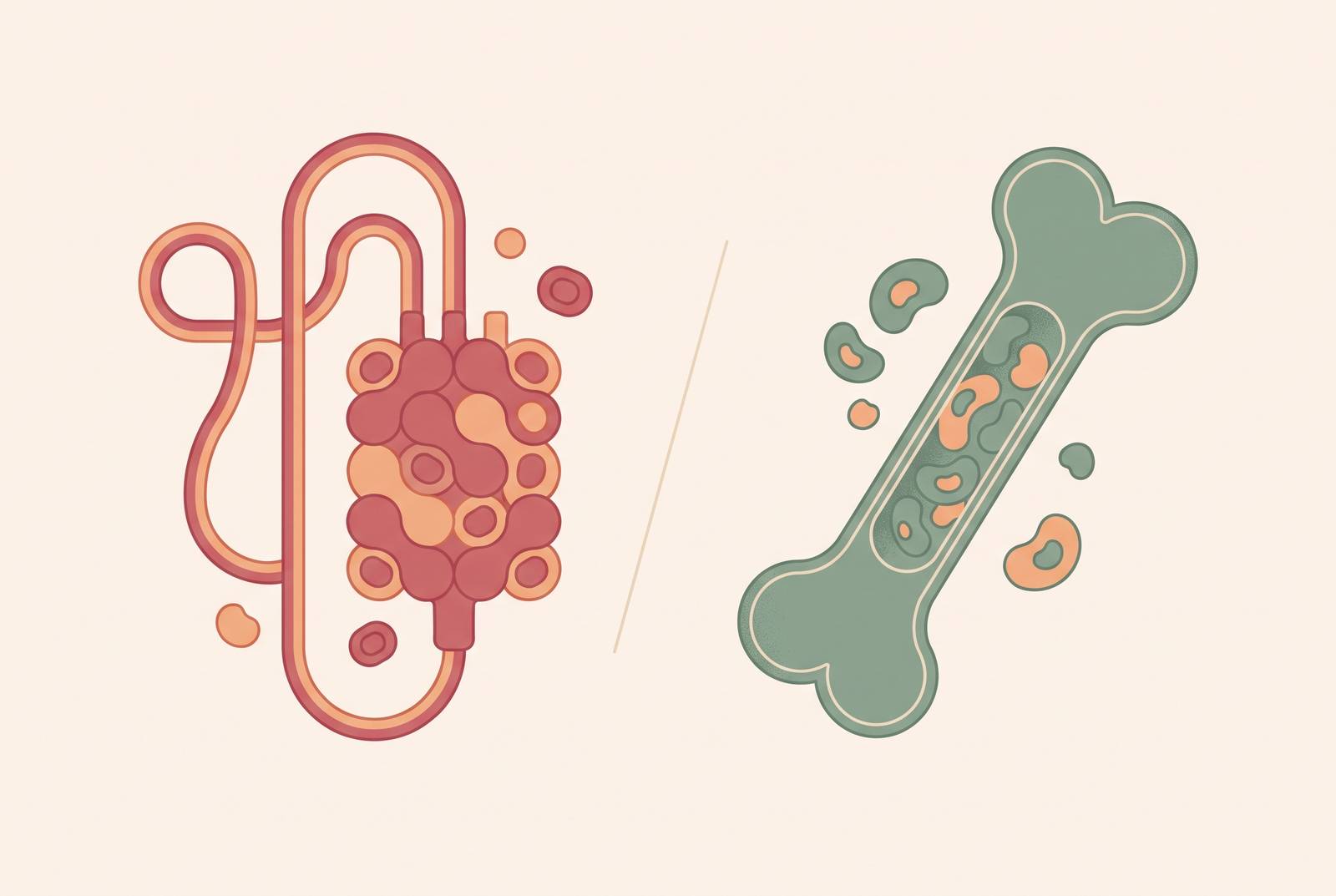
Cord blood and bone marrow are not interchangeable sources of transplantable stem cells. They differ immunologically from the moment of collection, and that difference determines which patients are better served by one source over the other.
Different immunological niches of cord blood and bone marrow as stem cell sources
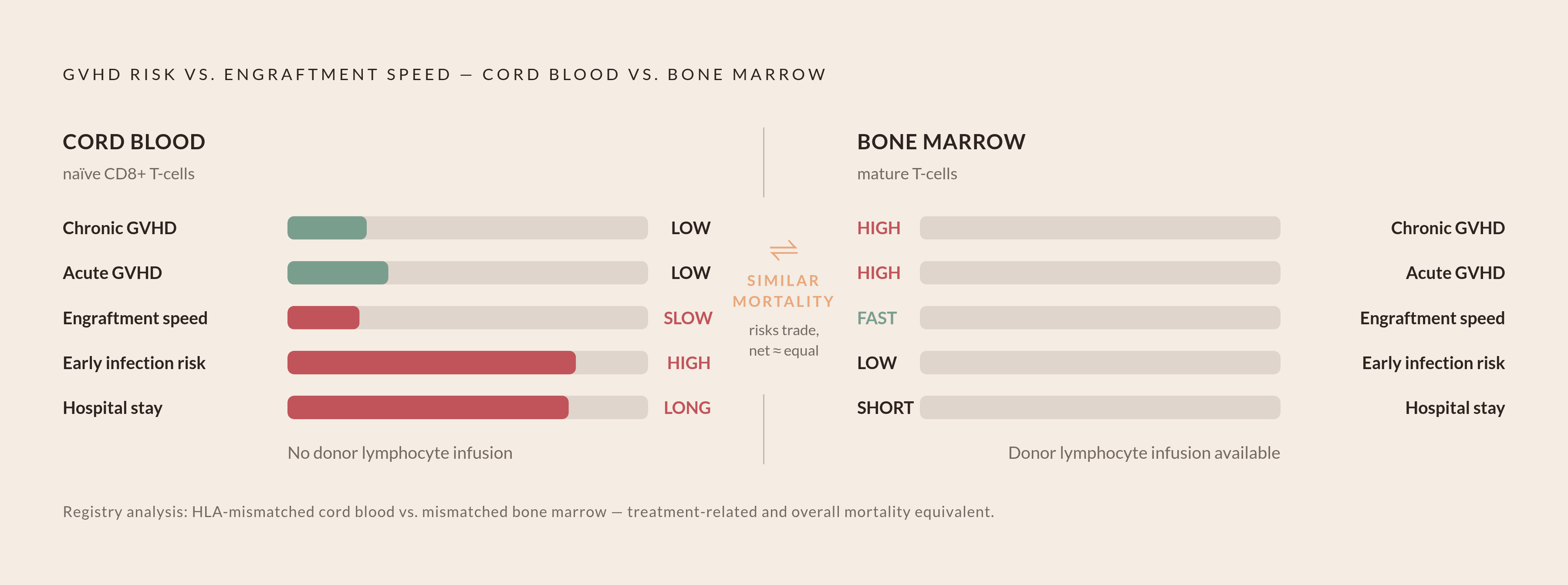
The character of a graft is set before a transplant ever happens, at the moment the cells are collected. Cord blood's lymphocytes, particularly its naïve CD8+ T-cells, are immunologically young. They haven't yet been shaped by exposure to a lifetime of pathogens. That lets them differentiate quickly into tumor-directed killer cells without the sustained tendency to attack unfamiliar tissue that comes with a mature immune repertoire. Bone marrow carries that mature repertoire. Its T-cells reconstitute a patient's immune system faster after transplant, but they also carry the experience of having already learned to recognize foreign tissue, and that experience makes them more likely to treat the recipient's own body as a target. This single distinction, naïve cells versus experienced ones, explains two things at once: why cord blood causes less chronic graft-versus-host disease, and why it takes longer to engraft. It also explains why cord blood can cross HLA barriers that bone marrow cannot. Mismatch tolerance is built into cord blood's cellular biology, so a degree of HLA mismatch that would provoke severe graft-versus-host disease from bone marrow is far better tolerated when the graft comes from cord blood. Clinicians have known this for decades. The first cord blood transplant was performed in 1988 by Gluckman and colleagues, on a pediatric patient with Fanconi's anemia, and the biological insight behind that transplant has only been reinforced by nearly forty years of subsequent use.
The engraftment-versus-GVHD trade-off that defines the comparison
The immunological immaturity that makes cord blood gentler on the recipient's tissue is the same property that slows the recipient's recovery. Reduced graft-versus-host disease and delayed immune reconstitution come from the same cellular fact, and a patient cannot get one without accepting some of the other. Part of the liability is structural rather than technical: a cord blood unit simply contains fewer total nucleated cells than a bone marrow harvest, and no improvement in collection technique changes that. Lower cell dose means slower, less reliable engraftment, and slower neutrophil recovery means patients spend more time without adequate infection defenses, which shows up clinically as longer hospital stays and a higher burden of early infection. Bone marrow runs the equation the other way. Its faster engraftment cuts down on that early infection risk, but the more mature immune cells it carries are also more likely to attack the recipient's tissue, producing higher rates of both acute and chronic graft-versus-host disease. Cord blood carries one more structural disadvantage: once infused, there are no leftover donor lymphocytes to draw on later if the disease relapses, a tool called donor lymphocyte infusion that bone marrow donors can often still provide. Combined approaches using umbilical cord blood alongside peripheral blood stem cell transplantation, with lymphocyte infusion added afterward, are beginning to offer partial workarounds, but the workaround is new and limited, not a settled solution. A registry analysis in a major medical journal found that HLA-mismatched cord blood and mismatched bone marrow had similar treatment-related mortality and overall mortality, so cord blood's advantage on graft-versus-host disease roughly offsets its disadvantage on engraftment, even in mismatched cases. Each source carries its own advantage in this trade-off. Which one serves a given patient better depends on what that patient's disease, body, and circumstances actually require.
Cord blood's anti-tumor biology for high-risk malignancy patients
If a patient faces high-risk or treatment-refractory leukemia, the calculation shifts in cord blood's favor. The same naïve CD8+ T-cells responsible for cord blood's lower rate of chronic graft-versus-host disease are also capable of rapid differentiation into tumor-killing cells, producing a graft-versus-leukemia effect that persists even when graft-versus-host disease stays low. That combination, strong tumor-fighting activity without the tissue damage that usually accompanies it, is the biological reason cord blood performs as well as it does in difficult cases. A retrospective study out of Tokai University, published in Leukemia & Lymphoma, looked at adults receiving reduced-intensity conditioning for high-risk acute myeloid leukemia and myelodysplastic syndromes. Two-year overall survival with cord blood transplantation, using ultra-low-dose methotrexate, came out significantly higher than with matched related donors, matched unrelated donors, or mismatched related donors, and cord blood stayed independently linked to better overall and disease-free survival after adjusting for other variables. Neutrophil and platelet recovery were comparable across all donor types in that study, which hints that appropriate conditioning protocols can narrow cord blood's engraftment disadvantage considerably. A single retrospective study doesn't settle the question on its own, but it fits a broader pattern. A 2024 analysis presented at a major hematology conference found that among AML patients who hadn't achieved remission before transplant, cord blood produced better five-year leukemia-free survival and a lower cumulative incidence of relapse compared with matched related donor transplantation. A 2023 review in Frontiers in Pediatrics found that patients with detectable minimal residual disease before transplant had lower relapse rates with cord blood than with other stem cell sources. The obvious objection is that a well-matched bone marrow donor also delivers a graft-versus-leukemia effect, so why accept cord blood's slower engraftment? Well-matched donors are frequently unavailable for exactly the patients this section describes, and cord blood's anti-leukemia activity appears to hold up even across HLA mismatch. That gives cord blood a real advantage precisely in the cases where bone marrow matching breaks down.
Patient size and age as determinants of source viability
A cord blood unit arrives with a fixed number of stem cells, set at the moment of collection, and that number creates a hard ceiling on who can use it. Successful engraftment depends on delivering a minimum number of nucleated cells per kilogram of the recipient's body weight, and a bone marrow harvest can be scaled up to meet a larger patient's needs in a way a single cord blood unit cannot. Adults and larger adolescents generally need more cells to engraft reliably than a typical cord blood unit contains, so engraftment failure is a meaningfully higher risk for bigger patients. Children have historically been the more natural cord blood candidates for exactly this reason: their lower body weight lets a single unit clear the dose threshold without difficulty. That doesn't rule cord blood out for adults with high-risk disease or no matched donor. Clinicians have developed two technical responses to stretch its reach. Double-unit cord blood transplantation, infusing two units at once, has become standard practice when no single unit carries an adequate dose, but two units don't speed up engraftment compared with a single adequate unit. Ex vivo expansion of cord blood stem cells, grown outside the body before infusion, is still experimental and hasn't reached clinical standard of care. Cord blood holds a separate advantage in non-malignant metabolic diseases, where speed to transplant matters as much as cell dose. In these conditions, earlier transplant and higher donor chimerism are tied directly to how much of the missing enzyme the graft can deliver, and cord blood's status as an immediately available, pre-screened product can make it the faster path to transplant when timing affects outcome.
The donor-availability gap and cord blood's structural necessity
For a large number of patients, the choice between cord blood and bone marrow isn't a clinical preference at all. It's a question of what's actually available. HLA matching probability tracks closely with ancestry: a well-matched unrelated donor can be found for a majority of patients with European ancestry, but for only about a fifth of patients with non-European origins. That gap has shaped who ends up using which source. Unrelated-donor bone marrow recipients have historically skewed heavily European, while cord blood recipients have skewed toward non-European ancestries in the majority. Cord blood's tolerance for HLA mismatch, the same biological property discussed earlier, is what makes it usable in exactly the cases where bone marrow matching fails: mismatch that would cause severe graft-versus-host disease from bone marrow is better tolerated from cord blood. A 2024 study reported in AJMC found that cord blood transplantation remains vital for patients without a matched donor, particularly racial and ethnic minorities, even as overall cord blood transplant volumes have declined in the face of competing options. Scale matters here too. An international cord blood inventory lists more than 800,000 cord blood units available for allogeneic use, and another major registry adds hundreds of thousands more through the C.W. Bill Young Cell Transplantation Program. You get a stockpile of pre-banked, pre-tested grafts sitting ready for use, and bone marrow simply cannot offer that at the same speed. Bone marrow requires finding a willing donor and coordinating a live collection at the time of need. Cord blood is already banked, already tested, and ready to ship, so when a patient's disease moves faster than a donor search can keep up, that logistical difference becomes real clinical urgency. Cord blood's immunological character is fixed at the moment of collection, and that principle guides how banks like Anja approach preservation, aiming to capture and maintain cord blood's native cellular state at birth.
The haploidentical challenge and hybrid approaches
The live debate in transplant medicine today is cord blood against haploidentical bone marrow, a half-matched graft from a family member, and the evidence doesn't settle cleanly in either direction. Haploidentical transplantation has grown quickly as an option for patients without a fully matched donor, since nearly every patient has a half-matched relative somewhere in the family, and it now competes directly with cord blood for the same pool of patients. The CTN-1101 trial, run by the Blood and Marrow Transplant Clinical Trials Network between 2012 and 2018, found that two-year overall survival was lower after cord blood transplant than after haploidentical grafts. A 2025 registry-based follow-up of adult transplant recipients found that haploidentical use climbed sharply starting around 2013, and five-year survival was higher after real-world haploidentical bone marrow transplant than after the double cord blood transplant done in the original trial. Cord blood's supporters point out that it still carries a distinct graft-versus-leukemia advantage, and that it often serves minority patients better, since not every patient has a willing or suitable haploidentical family donor to call on. A phase 3 trial led by Yu S. and colleagues, published in The Lancet, found that combining haploidentical and cord blood transplantation, a "haplo-cord" approach, produced meaningfully better disease-free survival at one year and overall survival at three years, 80.5 percent, compared with haploidentical transplant alone, with better safety across patient subgroups. That result points toward a hybrid approach that may capture strengths from both sources, though it has not yet become standard of care. Because of haplo's rise, cord blood now faces real structural pressure. Annual cord blood transplant volumes in North America and Europe have fallen sharply, and public cord blood banks are under financial strain as disposal rates for collected units stay high while transplant demand drops. Still, the strongest argument for cord blood hasn't gone away: accumulating evidence continues to show reduced relapse, an absence of chronic graft-versus-host disease, and improved overall survival in very high-risk leukemia compared with adult donor transplantation, advantages that haploidentical transplant alone does not fully match.
The source decision in practice
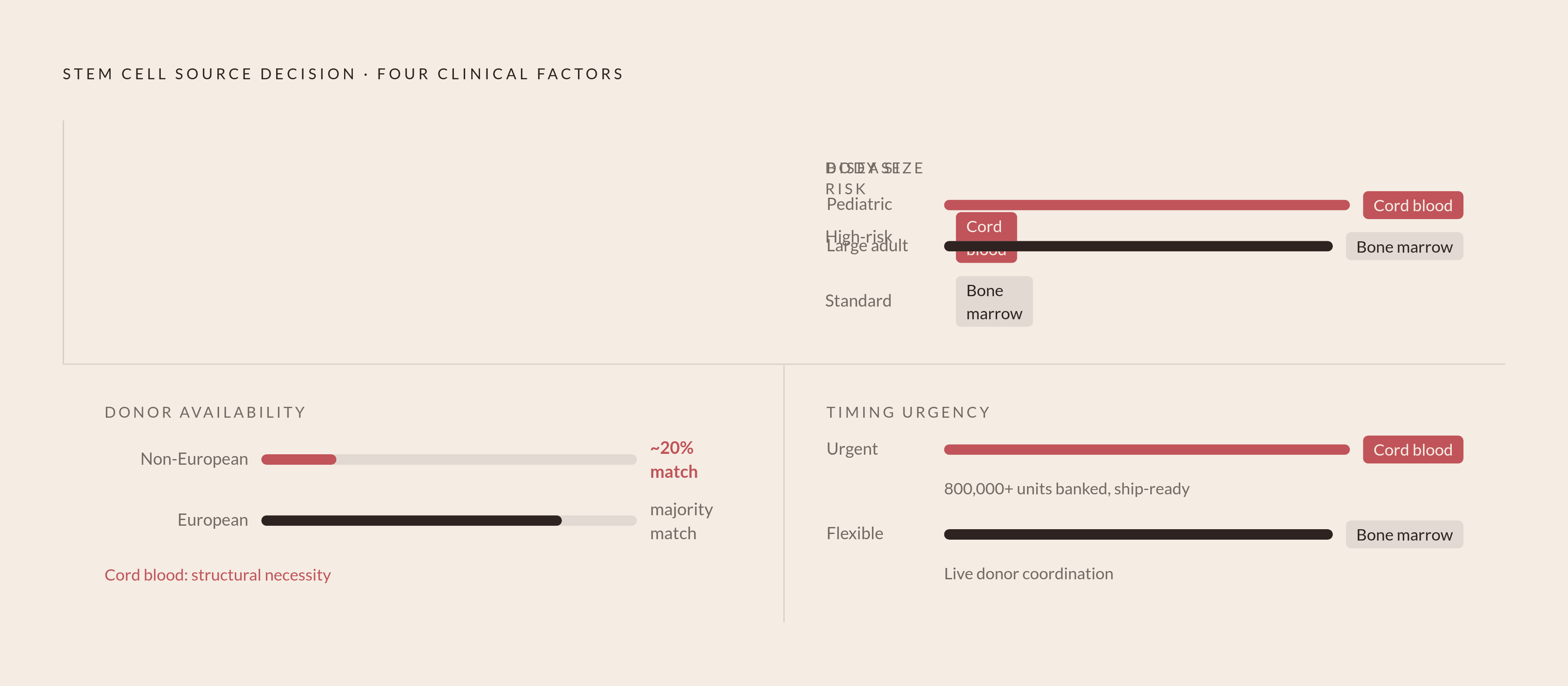
None of this adds up to a ranking where one source beats the other across the board. It's a matching problem, where a patient's disease risk, body size, ancestry, and donor availability each point toward the source whose trade-offs fit their actual situation. Cord blood tends to fit best when disease is high-risk or refractory, where its graft-versus-leukemia advantage and low rate of chronic graft-versus-host disease carry the most weight. It also fits when no well-matched unrelated donor exists, a circumstance that disproportionately affects patients of non-European ancestry; among patients with hematological malignancy generally, only about 30 percent have a matched sibling donor available. It fits when speed matters clinically, since a banked cord blood unit is ready immediately, but bone marrow needs a donor to be located and coordinated. And it fits non-malignant metabolic disease, where early transplant and high chimerism are tied directly to enzyme delivery, along with pediatric patients whose smaller body weight lets a single unit meet the dose threshold without complication. Bone marrow tends to fit best when a well-matched donor, related or unrelated, is actually available, because matching eases both the graft-versus-host-disease risk and the cell-dose constraint at once. It also fits when rapid engraftment is the overriding priority, as in standard-risk disease where early infection risk outweighs the risk of relapse, and when the patient is a larger adult for whom cord blood cell dose can't clear the threshold without resorting to double-unit infusion or experimental expansion. The haplo-cord hybrid approach addresses both sets of concerns for some patients, though it depends on having both a haploidentical family donor and a suitable cord blood unit on hand, a combination that won't be available to everyone. For families thinking ahead of any of this, the structural cell-dose limitation built into cord blood, and its downstream effect on engraftment speed and hospital stays, is part of why banking a unit at birth matters: a family that preserves cord blood early keeps the option of using its own cells later, without depending on the kind of donor-pool scarcity that constrains so many patients described above. Private banking through providers such as Anja, which stores both cord blood and placental tissue, preserves a biologically matched, family-specific unit that is ready to use the moment a transplant is indicated, without the HLA matching uncertainty or the delay of a donor search. A privately banked unit also offers a sibling or self-match at a depth of HLA compatibility that public registry units typically cannot provide. Banking cord tissue and placental tissue alongside cord blood further expands the volume of stem cells a family has access to, which speaks directly to the cell-dose constraint that limits cord blood's use in larger patients. For a patient who already has a banked unit in hand, the decision between cord blood and bone marrow stops hinging on what's available and starts resting on what the disease and the conditioning protocol actually call for, which is the decision this entire comparison has been building toward.
Sources
- Don't Cut the Cord: Why Umbilical Cord Blood Still Deserves a Place in Transplantation - PMC
- Cord blood versus bone marrow/peripheral blood stem cell transplantation under reduced-intensity conditioning in high-risk acute myeloid leukemia and myelodysplastic syndromes - PubMed
- Cord blood versus bone marrow/peripheral blood stem cell transplantation under reduced-intensity conditioning in high-risk acute myeloid leukemia and myelodysplastic syndromes: Leukemia & Lymphoma: Vol 67, No 3
- Outcomes after Transplantation of Cord Blood or Bone Marrow from Unrelated Donors in Adults with Leukemia
- Comparison of Outcomes of Haploidentical Peripheral Blood Stem Cell Transplantation Supported by Third-Party Cord Blood Versus Human Leukocyte Antigen-Matched Sibling Peripheral Blood Stem Cell Transplantation in Hematologic Malignancy Patients
- Transplants of unrelated cord blood or sibling allogeneic peripheral blood stem cells/bone marrow in adolescent and young adults with chronic myeloid leukemia: comparable outcomes but better chronic GVHD-free and relapse-free survival among survivors with cord blood