Haploidentical Stem Cell Transplant as an Alternative to Matched Donors
Half-matched family donors offer fast, equitable access where registry searches fail.
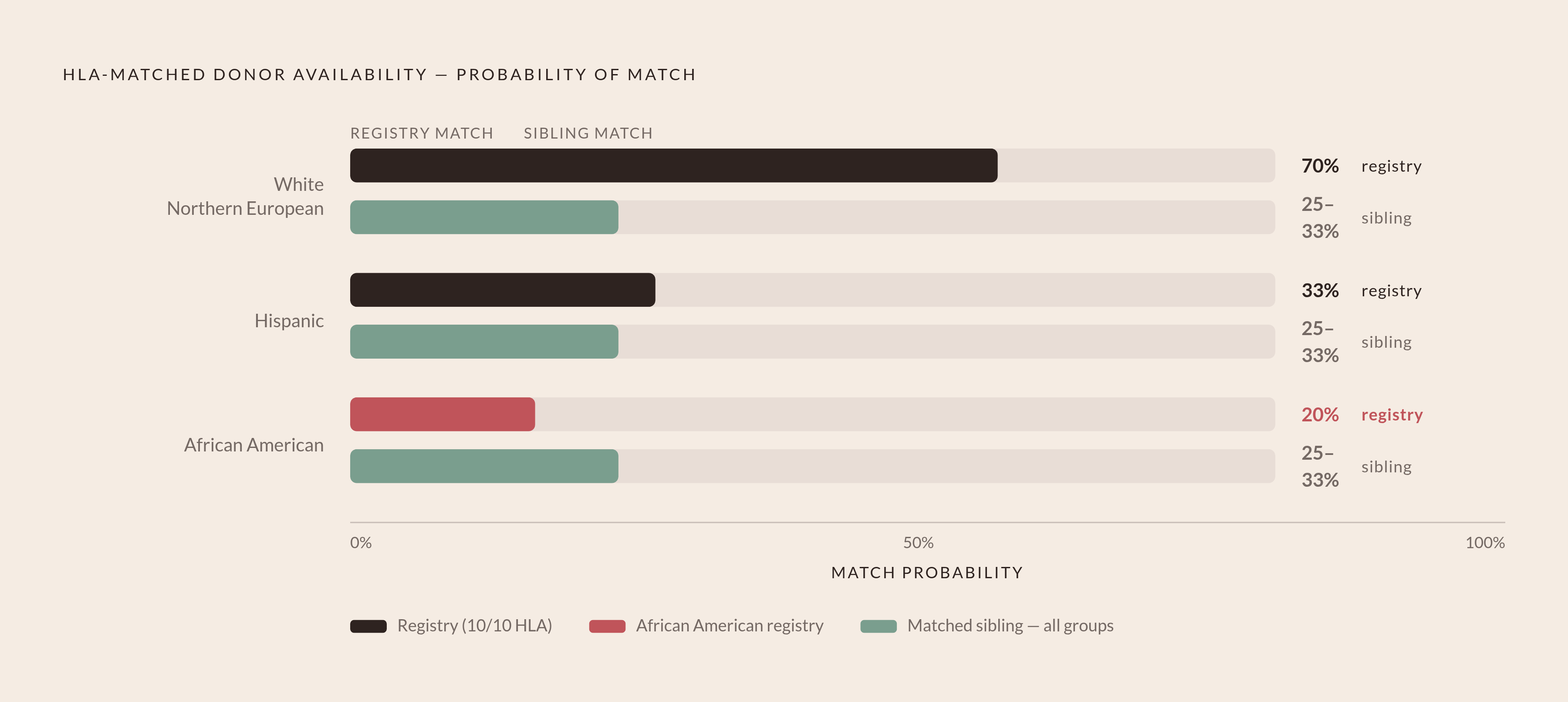
A patient diagnosed with leukemia today faces a search that depends heavily on who their parents are and where their ancestors came from. Matched sibling donors exist for only about a quarter to a third of patients, a limit set by small family sizes and by basic genetics: any given sibling has roughly a one-in-four chance of matching. Most patients, then, have to look past their own family, and that is where the registry system takes over, with wildly uneven results. For White Northern European patients, unrelated donor searches often succeed. The Frontiers systematic review puts matched unrelated donor rates for Caucasian patients somewhere between roughly three in ten and nearly four in five, a wide range but one that at least leaves most patients with a realistic shot. Hispanic patients have roughly a one-in-three chance of finding a match this way, and African American patients roughly one in five, figures that describe a system that fails most patients in these groups. The UK tells the same story in different numbers: Anthony Nolan's GIAS data show only about one in five patients from a minority ethnic background has a 10/10 HLA-matched donor on the registry, against roughly seven in ten White Northern European patients. Even when a match exists somewhere on a registry, the search itself takes time, often weeks, and for diseases that progress fast, those weeks can mean the difference between getting a transplant and not. The donor gap, then, runs along two separate fault lines at once: an inequality that falls by ancestry, and a race against disease that the registry model was never built to win.
How haploidentical transplantation structurally solves the availability problem
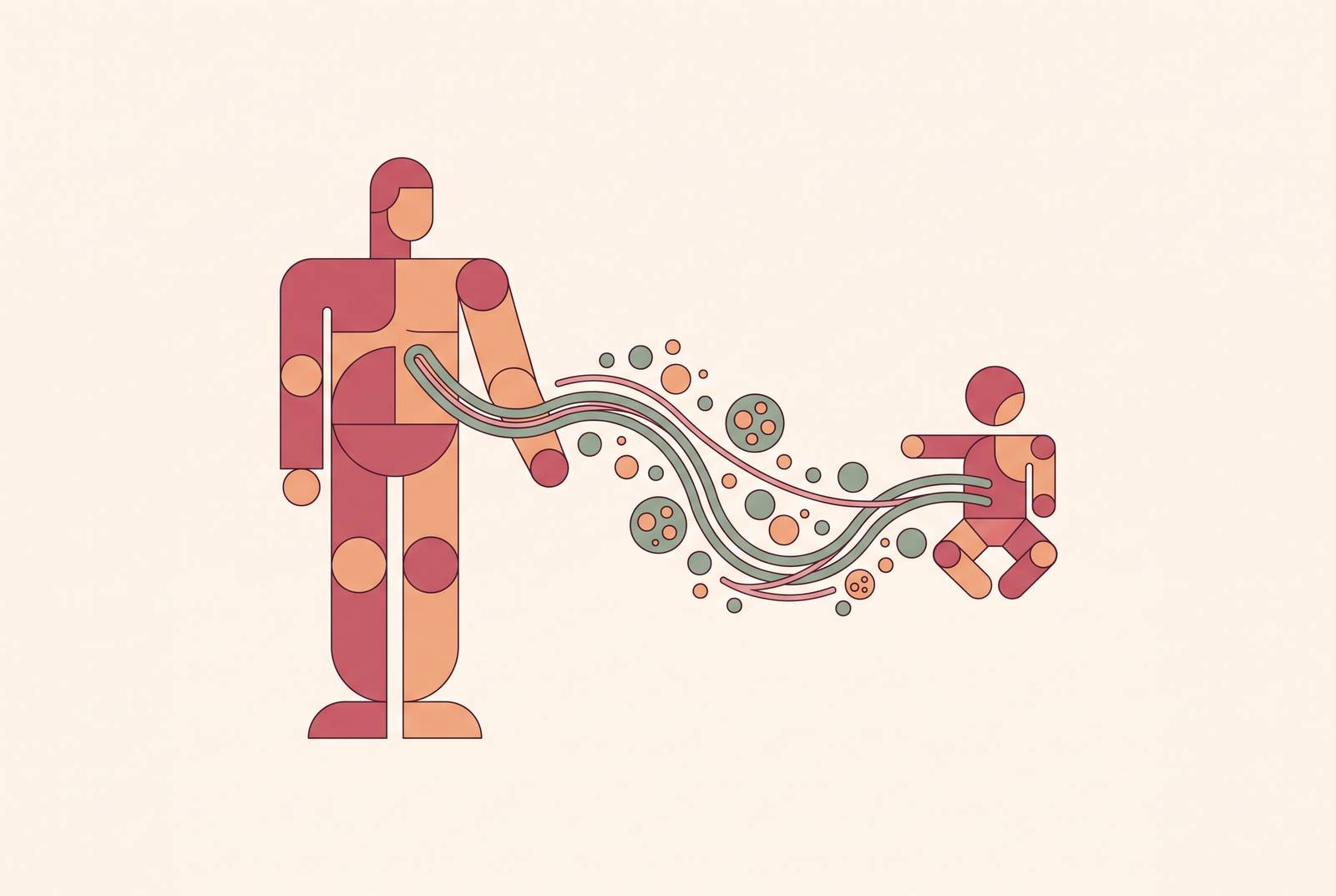
Haploidentical transplantation uses biology that virtually every patient already has access to, sidestepping the need for a registry match. Every biological parent is a half match, or haploidentical, to their child, and roughly half of all siblings are haploidentical to each other, so almost any patient has at least one candidate donor in the immediate family, and often several. Because that donor is already known and already willing, the transplant can typically proceed within days rather than the weeks or months a registry search demands, closing off the exact window where fast-moving disease outruns the matching process.
The reason this option sat on the shelf for decades had nothing to do with availability. It came down to biology: a half-matched graft provoked severe graft-versus-host disease and graft failure at rates that made the approach too dangerous to use broadly. The shift came with post-transplant cyclophosphamide, known as PTCy, and it selectively wipes out the rapidly dividing T cells that drive GVHD while leaving the regulatory T cells that promote tolerance largely intact. The mechanism works at the cellular level in a specific way: PTCy cuts down the proliferation of alloreactive CD4+ effector T cells, leaves the surviving alloreactive CD4+ and CD8+ effector cells functionally impaired, and allows CD4+ regulatory T cells to recover preferentially. That combination is what turned a half-matched graft from a near-certain complication into a workable transplant. PTCy also happens to be cheap and simple to give, requiring none of the specialized infrastructure that more complex GVHD-prevention regimens demand. Hospitals and health systems without the resources for elaborate prophylaxis protocols can still offer haplo-HCT to their patients.
The patient populations where haplo-HCT has moved from backup to primary option
Several distinct groups of patients now have enough outcome data behind haplo-HCT that doctors plan around it as a primary option rather than reaching for it only once other routes close.
Older adults, 60 and up, with hematologic malignancies make up one of the best-documented groups. A systematic review and meta-analysis in Frontiers, drawing on 16 studies, 18 cohorts, and 1,268 patients, set pooled survival benchmarks for this population: one-year overall survival of 62%, two-year survival of 53%, three-year survival of 45%, with three-year non-relapse mortality at 28% and relapse incidence at 32%. The spread across studies is large, and most of it traces back to a predictable mix: active or refractory disease, high-risk cytogenetics, and poor performance status going in. For this age group, the relevant comparison is haplo against no transplant at all, since an ideal matched donor rarely exists for a patient this age moving this fast.
Therapy-related MDS, historically one of the hardest subtypes to treat, shows a similar pattern. A 2024 study out of Peking University People's Hospital compared haplo-HSCT outcomes in therapy-related MDS against a matched cohort of de novo MDS cases and found three-year overall survival and disease-free survival statistically comparable between the two groups. Haplo-HCT, in other words, does not appear to penalize patients for having the harder-to-treat form of the disease.
Severe aplastic anemia presents its own version of the donor gap: only about one in four patients has a matched sibling donor, and finding a matched unrelated donor for ethnic minority patients is, as researchers at Princess Margaret Cancer Centre and Soroka Medical Center documented in 2024, a well-recognized problem. Their four-patient cohort, treated using the Hopkins PTCy protocol, showed full engraftment in every patient, complete donor chimerism by day 60, and only a single case of grade 2 acute GVHD with no chronic GVHD. The sample is small, but the signal is encouraging for a group with few other paths forward.
Severe sickle cell disease offers perhaps the clearest case for haplo-HCT as a first-line option. A 2025 ASH study tracked long-term outcomes and found that nine in ten patients stayed free of vaso-occlusive crises with stable donor chimerism, hemoglobin rose from a pre-transplant median of 8.2 g/dL to 14.3 g/dL afterward, and nine in ten patients were able to stop immunosuppression entirely, at a median of day +467. Gene therapy achieves comparable disease correction for sickle cell, but it can cost as much as $3.3 million per treatment. Haplo-HCT, using a family donor and an inexpensive prophylaxis drug, reaches patients that gene therapy programs simply cannot, including those in resource-limited settings where a systematic review published in Transplantation and Cellular Therapy specifically examined haplo-HCT's record in low- and middle-income countries. The combination of cheap PTCy and a family donor already on hand makes haplo-HCT, by a wide margin, the most workable allogeneic transplant option for health systems without the infrastructure to run a large unrelated donor registry.
Haplo-HCT outcomes versus matched unrelated donors under the same prophylaxis
Once both use PTCy, the honest comparison between haplo-HCT and matched unrelated donor transplant narrows considerably, and in some settings it disappears, though not everywhere.
The largest and most statistically powered dataset does not favor haplo-HCT. A Johns Hopkins analysis in Blood Advances, built on registry data for adults with acute leukemia or MDS, found haploidentical transplant came with worse overall survival (HR 1.15), worse GVHD-relapse-free survival, higher primary graft failure (HR 1.67), more grade 3/4 acute GVHD (HR 1.28), more moderate-to-severe chronic GVHD (HR 1.47), and higher non-relapse mortality (HR 1.34), compared to matched unrelated donor transplant. This is the strongest data point against treating the two platforms as simply equivalent.
Set against that, a 2025 propensity-score-matched study from the EBMT Global Committee, published in Bone Marrow Transplantation, looked at adults with relapsed or refractory ALL transplanted between 2010 and 2022 and found two-year overall survival nearly identical between the groups, 31.8% for haplo versus 29.2% for MUD, with comparable leukemia-free survival and relapse incidence. Haplo patients did see more severe acute GVHD, but the overall outcome held steady between the two donor types. That parity matters precisely because relapsed or refractory ALL is the population least able to afford a long registry search; a result that holds up under this kind of urgency carries real clinical weight.
A 2025 institutional cohort from MD Anderson Cancer Center, published in Blood Advances, compared 660 haploidentical transplant patients against 195 mismatched unrelated donor patients and found a hazard ratio for non-relapse mortality of 1.17 for haplo versus MMUD, a difference that did not reach statistical significance. That result points to near-equivalence between haplo-HCT and mismatched unrelated donor transplant under PTCy, which matters because MMUD, not a perfect 10/10 match, is the realistic alternative many patients actually face once a full match fails to turn up.
The most striking finding reverses the expected order. A study out of Heinrich Heine University Düsseldorf, published in EJHaem, followed 152 patients and found haploidentical transplant with PTCy produced better survival than transplant from a 9/10 mismatched unrelated donor. Cox regression singled out patients not in complete remission as the group that benefited most from a haplo donor. A half-matched family member, in this specific and clinically important subgroup, outperformed an unrelated donor who was supposed to be the closer match.
Early randomized data add a further layer. Some patients assigned to haplo in the trial did not end up receiving it, and the per-protocol analysis, which excludes those patients, shows outcomes nearly identical between the two arms once treatment was actually delivered as planned. Investigators now suggest further enrollment is unlikely to turn up a difference in relapse incidence, so this points toward a genuine randomized signal of parity once results are fully reported.
PTCy, applied to both platforms, appears to blunt the stronger graft-versus-leukemia effect that greater HLA mismatch in haplo-HCT was once thought to confer, since the mismatch itself drove more graft-versus-host disease along with it. Under PTCy, that leukemia-fighting effect may instead run through mechanisms independent of GVHD, which would explain the convergence of haplo-HCT's outcomes with MUD.
Donor age as a critical optimization variable in haplo-HCT planning
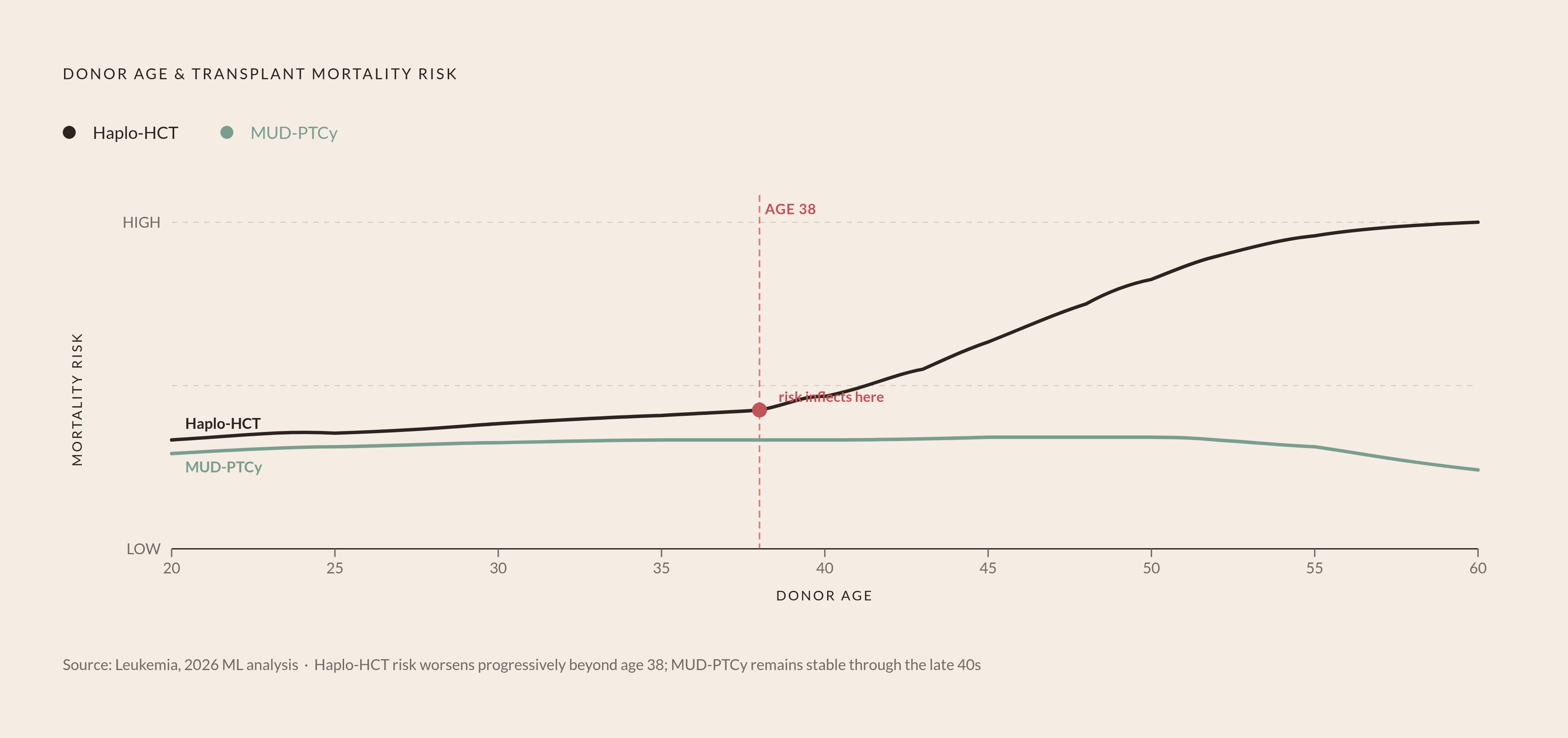
Haplo-HCT responds to donor age in a way that MUD-PTCy simply does not, and that difference turns donor selection within a family from a matter of convenience into a real clinical decision. A 2026 machine-learning analysis published in Leukemia found that outcomes in the haploidentical cohort crossed a critical mortality risk threshold once donor age passed 38, with results worsening progressively from there. MUD-PTCy showed nothing like this cliff: survival stayed strong across a broad plateau extending well into donors' late 40s, a far more forgiving curve than haplo-HCT's. The same analysis found MUD-PTCy independently associated with a survival advantage (adjusted HR 0.85, P=0.01), but the practical lesson for a family weighing haplo-HCT is to choose the youngest eligible donor available. A 2024 single-center study from the Medical University of Silesia, published in Annals of Hematology, backs this up with its own observational data, confirming that donor age shapes haplo-HCT outcomes under PTCy.
What this means in practice is straightforward. A patient whose eligible haploidentical donors include a parent in their 50s and a sibling in their early 30s now has an evidence-based reason to favor the sibling, rather than defaulting to whichever relative happens to be most available or most willing. It also changes how families should be counseled from the start: once a transplant becomes a possibility, younger relatives need to be evaluated early, and any logistical obstacles to their donation sorted out well before the transplant window narrows.
Where protocol refinement is actively narrowing the remaining gap
The haplo-HCT outcome data described above reflect protocols still under active revision, and every refinement moving through the pipeline points the same direction: toward narrowing whatever gap remains with matched unrelated donor transplant. PTCy dosing is one target. The standard regimen runs 50 mg/kg per day on days +3 and +4, and researchers are now testing lower doses aimed at cutting cardiotoxicity and other side effects without giving up GVHD control, a change that would widen the platform's safety margin. The timing of calcineurin inhibitor initiation and the composition of the conditioning regimen are also being adjusted, since both interact with how well PTCy works and both affect non-relapse mortality and relapse rates.
The spread of PTCy into matched unrelated donor transplant itself, the same prophylaxis backbone that underlies the randomized European trial discussed earlier, is a trend worth tracking. As MUD transplant adopts PTCy, the comparison between the two donor sources gets cleaner: whatever difference remains becomes more clearly a function of the donor relationship itself, not of mismatched prophylaxis regimens being compared apples to oranges.
The ACCESS trial, reported in December 2025, adds useful context. It enrolled 268 adults with blood cancers receiving stem cells from unrelated donors, 183 with a 7/8 HLA match and 85 with as few as 4 to 6 markers matched, and found one-year survival nearly equivalent between the two groups. That raises a real question about whether expanding mismatched unrelated donor registries under PTCy could become a second viable path running alongside haplo-HCT. For a patient with no usable unrelated donor and a young relative willing to donate, haplo-HCT remains the structurally stronger choice. For a patient where both options genuinely exist, the decision comes down to donor age and how active the disease is, not to a blanket rule favoring one platform over the other. An 80-case series combining haploidentical peripheral blood with unrelated cord blood units suggests another route to more reliable engraftment, pairing two donor sources together.
Cord blood banking and haploidentical transplant
Banking a newborn's cord blood creates a preserved, half-matched biological resource, immediately available to that child and potentially to siblings, built on the same genetic logic that makes family-based haplo-HCT work, held in reserve until needed. A sibling's banked cord blood is haploidentical to a patient for the same reason a living sibling donor is: it shares one HLA haplotype, and it can serve as a transplant source on its own or in combination with haploidentical peripheral blood stem cells, the approach described in the 80-case combined haplo and cord blood series mentioned above.
The donor-age findings give this option a particular kind of weight. Since outcomes in haplo-HCT deteriorate once a donor passes 38, a cord blood unit banked at birth is, by definition, sourced from the youngest possible point in that person's life and does not age the way a living donor does. For families with a history of blood disease in the family, or with ancestry that statistically lowers the odds of a future matched unrelated donor search succeeding, banking at birth is the one step that can be taken before any diagnosis forces a decision under pressure.
Anja Health stands out among banking options for families weighing this step, largely because of what it preserves and how it preserves it. Anja banks both cord blood and placental tissue, one of only a few providers offering placenta banking alongside cord blood, a combination that yields substantially more stem cells than cord blood collection alone. Its lab holds accreditation from a major blood bank association and draws on decades of experience in blood processing, the kind of clinical-grade standard that matters if a banked sample is ever actually called on for transplant. Anja was founded in memory of a sibling who needed cord blood stem cells and had no match because the family, being mixed-race, had not banked and could not find one through a registry, and the company's stated mission is to make cord blood banking affordable and accessible regardless of race, income, or socioeconomic status, directly addressing the same registry failure documented earlier in this piece for Hispanic and African American patients. Families weighing this option can look into kits directly through anjahealth.com.
If families are thinking ahead, banking a newborn's cord blood through an affordable service such as Anja creates a private option that sidesteps the registry bottleneck entirely, though it cannot be used until a sibling is old enough to donate or until the stored sample is confirmed to still hold viable, donor-appropriate stem cells. None of this amounts to a guarantee. Banked units have to clear minimum cell-count thresholds before they are usable in a transplant, and families considering this path should understand clearly what is being preserved, and under what conditions it would actually help.
Evidence and open questions
Haplo-HCT's immediate availability, a family donor typically reachable within days, reflects a broader change in how transplant medicine sources donors: a move away from dependence on large registries and toward using biology that already exists inside family units, the same logic that leads private cord blood and tissue banks to preserve that family biology as insurance at the one moment stem cells are most abundant and most viable. The evidence built up over the past several years supports treating haplo-HCT as a legitimate alternative, not a last-resort option. It offers near-universal donor access to any patient with living relatives, competitive outcomes in older adults, therapy-related MDS, severe aplastic anemia, and sickle cell disease where matched donors are scarce or gene therapy is out of reach, and outcomes roughly equal to, and in some disease-active subgroups better than, mismatched unrelated donor transplant. An early randomized trial points toward near-parity with a fully matched unrelated donor once both arms use the same prophylaxis, and donor age under 38 now gives families and doctors a concrete, evidence-backed factor to weigh when choosing among relatives.
What the evidence does not yet support is full equivalence with an ideal matched unrelated donor in every setting. The Johns Hopkins registry data still show worse survival and higher non-relapse mortality for haplo-HCT compared to MUD transplant in adults with acute leukemia or MDS, and that finding has not been explained away by any of the more favorable studies described above. Until the randomized trial reports its full results, that registry signal remains the most accurate summary of where the aggregate evidence stands. Several mechanistic and strategic questions stay open as well: whether PTCy, in eliminating GVHD-driven graft-versus-leukemia effect, also quietly reduces whatever leukemia-fighting advantage haplo-HCT's wider mismatch once offered; whether PTCy-enabled expansion of mismatched unrelated donor registries, the approach tested in the ACCESS trial, ends up complementing haplo-HCT or competing with it for the same patients; and whether reduced PTCy dosing can cut toxicity without giving up any GVHD control.
None of that unsettles the basic shift that has taken place. Haplo-HCT has moved from a last resort to a legitimate first-line alternative, particularly for patients who cannot find a matched donor fast enough, for minority patients the registry system was never built to serve well, and for diseases like sickle cell and severe aplastic anemia where a family donor is simply the most reachable curative path available. It is not the superior option in every single case, and the data no longer support treating it as the inferior one by default either.
Sources
- Frontiers
- Outcomes of Haploidentical Hematopoietic Stem Cell Transplantation in Low- and Middle-Income Countries: A Systematic Review and Meta-Analysis - Transplantation and Cellular Therapy, Official Publication of the American Society for Transplantation and Cellular Therapy
- The clinical outcomes of haploidentical stem cell transplantation (haplo-HSCT) for patients with therapy-related myelodysplastic syndrome: comparable to de novo myelodysplastic syndrome
- Haploidentical hematopoietic stem cell transplantation in adults with severe sickle cell disease: Long-term outcomes using a modified conditioning regimen with peripheral blood stem cells.
- Haploidentical Hematopoietic Stem Cell Transplantation for Patients with Severe Aplastic Anemia—Single-Centre Experience
- A single-center experience of haploidentical stem cell transplantation in hematological malignancies
- Donor’s age influences outcome in haploidentical hematopoietic stem cell transplantation with post-transplant cyclophosphamide - a single center experience
- Haploidentical peripheral blood stem cell transplantation combined with unrelated cord blood in hematologic malignancy patients: A report of 80 cases