How Long to Delay Cord Clamping for Maximum Stem Cell Transfer
Waiting 60 seconds instead of 30 nearly doubles stem cell transfer to newborns.
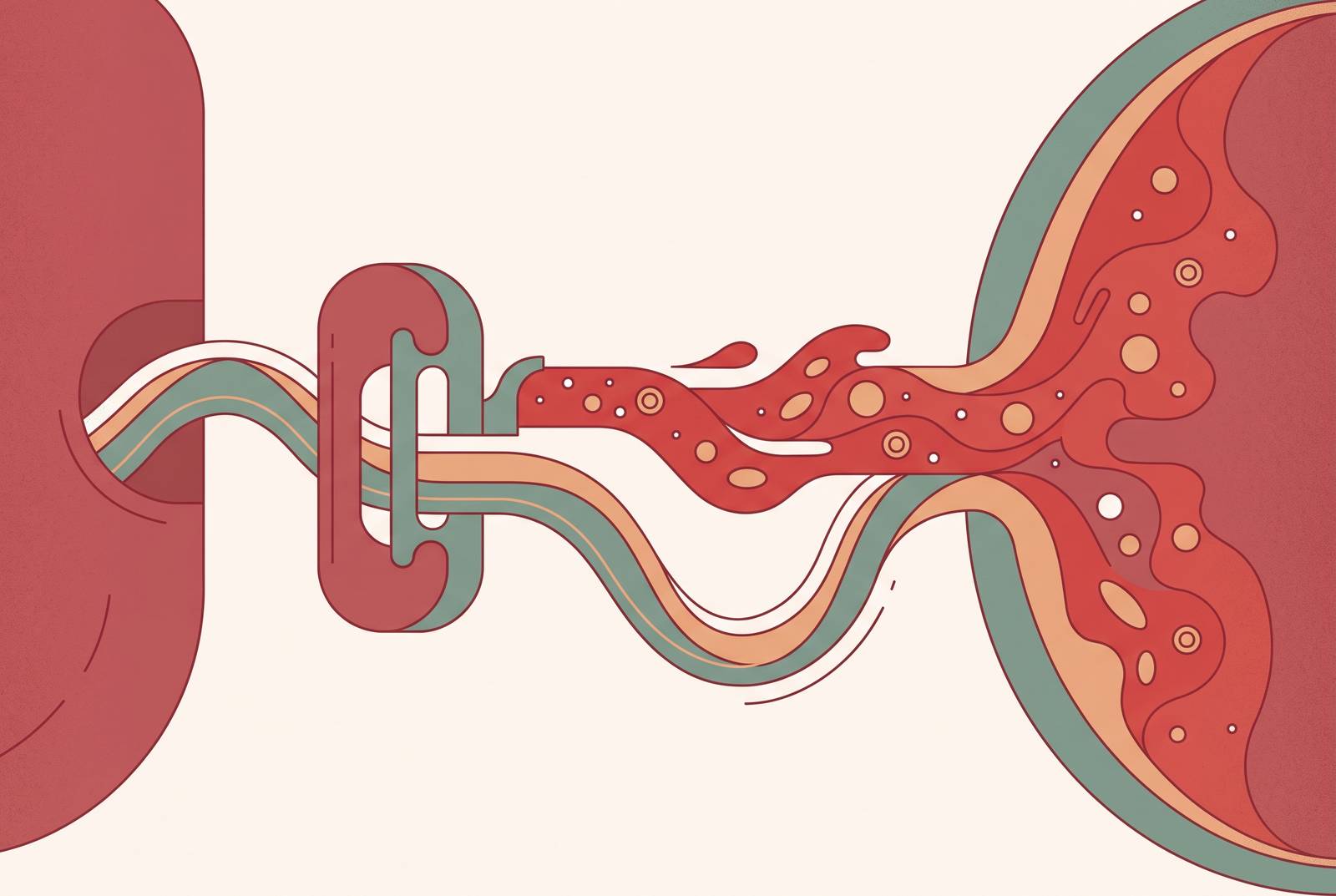
Birth does not end the umbilical cord's work. For minutes after delivery, the cord keeps moving blood, oxygen, and a population of stem cells from the placenta into the newborn, while the infant shifts from relying on the placenta to breathing air on its own. That blood carries red cells bound for the lungs, heart, and brain, along with a cargo of stem cells suited for tissue repair. Hematopoietic progenitor cells, endothelial precursors, and mesenchymal progenitors travel in that same stream. Cutting the cord early stops this transfer mid-course and leaves part of that payload behind in the placenta.
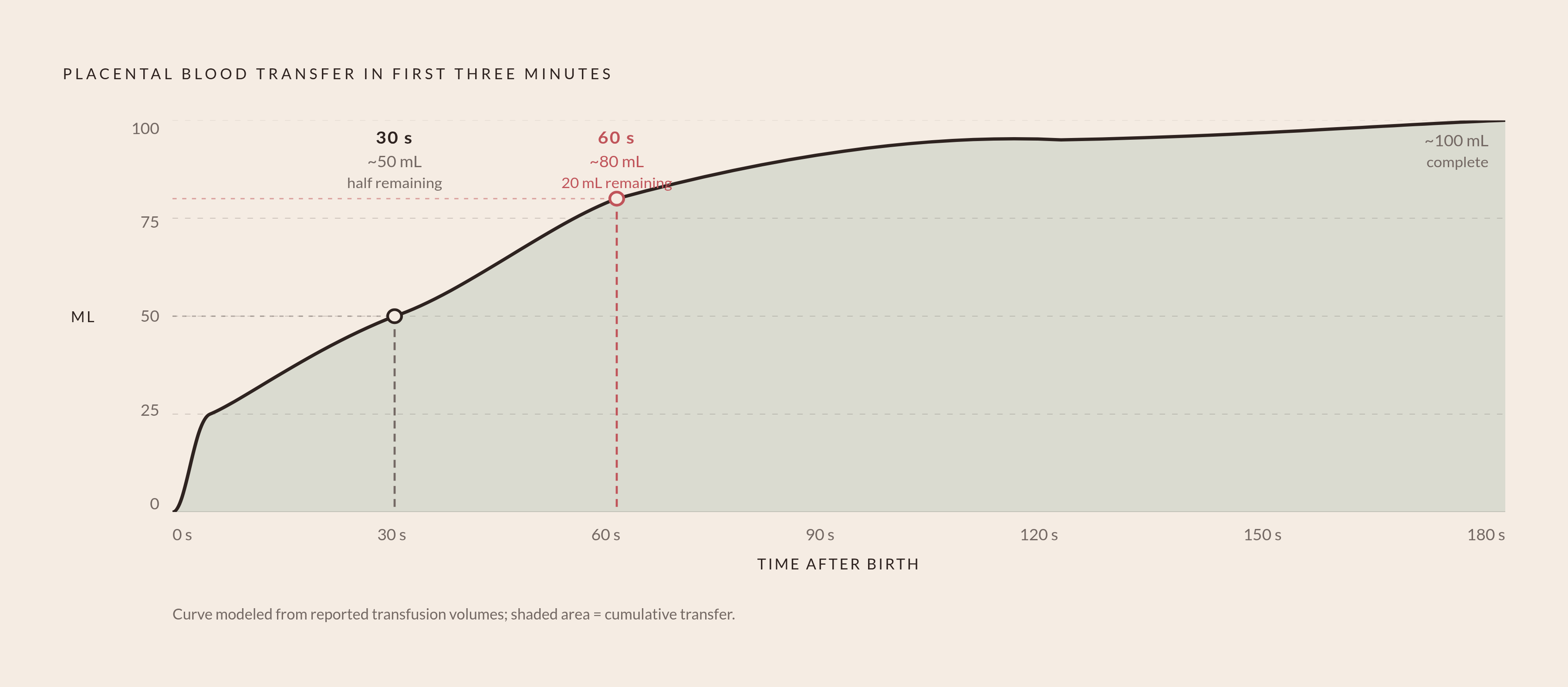
The transfer is not steady. Lawton and colleagues, writing in Neural Regeneration Research, describe it as following an exponential decay curve: roughly a quarter of the transferable blood volume moves in the first few seconds after birth, about half has crossed by 60 seconds, and flow stops in most infants within a few minutes. That curve is why the timing of cord clamping is not a matter of preference or convenience: a difference of thirty seconds, measured against a process that front-loads so much of its volume early and then tapers, can change how much of that stem cell payload actually reaches the baby.
Why 30 seconds is not enough for term infants
A study compared two clamping times in full-term newborns, and waiting past the shorter interval did not just produce a marginal improvement. It produces a different outcome. Infants whose cords were clamped at 60 seconds, rather than 30, showed significantly higher hemoglobin, hematocrit, total nucleated cell counts, and CD34+ hematopoietic stem cell counts. CD34+ is the marker clinicians use to identify hematopoietic progenitor cells, the cells that seed the immune system and give rise to every blood lineage the body produces. The same study found that CD34+ counts rose with gestational age within the term range, so the transfer is active and volume-dependent, not a fixed quantity delivered regardless of timing.
The decay curve explains why the gap between 30 and 60 seconds matters so much. At the earlier cutoff, roughly half of the transferable blood, and the stem cells riding in it, has not yet crossed from placenta to infant. By 60 seconds, that half has moved, and the window for transfer is still open. The 30-second mark has historically served as a floor in prior guidance from bodies including the American Heart Association, and some care teams have treated it as sufficient on that basis. The randomized comparison says otherwise: infants clamped at 30 seconds showed statistically inferior stem cell transfer, not a result comparable to the 60-second group.
2025 clinical guidance formally moved the minimum to 60 seconds
Clinical guidance has caught up to what the data already showed. The 60-second mark has moved from a research finding into a formal standard, and it replaces the older, looser 30-to-60-second range that let individual practitioners choose a number anywhere along that span. ACOG's updated guidance in 2025 anchors this shift, and it reflects a broader convergence among obstetric and neonatal bodies toward a single, defensible minimum rather than a range that allowed early clamping to pass as compliant. The direction of travel across guidance bodies points the same way: toward longer, not shorter, delay as the default.
That convergence matters for a simple reason. A range leaves room for practice to drift toward its lower bound, especially in a delivery room where time feels scarce. A randomized comparison showed inferior stem cell transfer below that mark, so a single minimum leaves less room for that drift.
What happens beyond 60 seconds
Sixty seconds is a floor, not a ceiling. The evidence points to two minutes or more as the window where gains in hemoglobin and blood volume reach their peak without adding meaningful clinical risk. Hemoglobin and hematocrit rise progressively the longer clamping is delayed, and the groups given the longest delays showed the strongest benefit. The risk that extended delay would cause polycythemia or hyperbilirubinemia severe enough to require phototherapy did not rise even at these longer durations.
The decay curve backs this up with real volume numbers. Roughly 80 mL of blood crosses from placenta to baby by one minute after birth, and that figure can reach approximately 100 mL by three minutes. The transfer is still meaningfully active well past the 60-second mark most guidance now treats as a minimum. Care teams do weigh practical objections to waiting longer, chiefly concern about a newborn losing body heat and the logistics of a busy delivery room, and these are real constraints. But the Malik et al. study found no significant rise in adverse outcomes at these extended durations, and the cord itself is long enough to allow immediate skin-to-skin contact and breastfeeding while it remains intact and uncut. So the practical barrier to waiting longer is lower than many delivery room routines assume.
Clamping Timing in Very Preterm Infants
If an infant is born before 32 weeks, the stakes around clamping timing rise sharply. Cord blood from very preterm birth carries a richer mix of stem and progenitor cell types than cord blood from a term birth, which makes every second of transfer window count for more in this population than it does for a baby born at full term. A longer placental transfusion in these infants also helps move immunoglobulins across from placenta to baby, support that matters most after the cellular injury, inflammation, and organ dysfunction that often accompany preterm delivery.
The composition of that transfer is not uniform across cell types, and it is not yet fully understood. In very preterm neonates who received delayed clamping, mesenchymal stem cells and hematopoietic progenitor cells were higher in cord blood than in those clamped immediately. Very small embryonic-like stem cells and late endothelial progenitor cells, by contrast, were lower in the delayed group. That split is a real finding that marks an active area of ongoing study. What is settled is the broader stake: for infants born this early, every stem cell that reaches the bloodstream instead of staying behind in the placenta carries more weight than it would for a term infant.
Intact cord resuscitation in very preterm infants: extending the delay without withholding care
The most common objection to delaying clamping in a compromised infant is that the baby cannot wait, that resuscitation has to start immediately and the cord has to come off the table. That assumption is being tested directly, and the evidence undercuts it. In trials of intact cord resuscitation, where a preterm infant is resuscitated while the cord remains uncut and attached to the placenta, the composite outcome of mortality, severe intraventricular hemorrhage, or bronchopulmonary dysplasia occurred in substantially fewer infants than in controls clamped early, an absolute risk reduction of close to a quarter of participants. Infants resuscitated with the cord intact also stabilized better in the delivery room, needed less positive-pressure ventilation, and had higher hemoglobin in the days following birth.
Guidance has started to reflect this. The 2025 ILCOR treatment recommendation now favors intact cord milking over early clamping for term and late preterm infants who remain non-vigorous despite stimulation, a reversal of a practice that guidance had not previously supported. But that recommendation carries a sharp boundary that matters clinically and should not get blurred. Intact cord milking in infants below 28 weeks is linked to a significantly higher rate of severe intraventricular hemorrhage compared with delayed clamping without milking, a difference flagged in Red Cross and ILCOR guidance. The distinction is between active milking, pushing blood along the cord by hand, and passive intact cord resuscitation, simply leaving the cord attached and uncut while resuscitation proceeds. If an infant is born before 28 weeks, among the most vulnerable, passive intact cord resuscitation is the approach the evidence supports. Milking is not.
The cord banking tension: delayed clamping reduces banked volume but may not reduce banking eligibility
Parents weighing cord blood banking against delayed clamping are often told the two goals work against each other. That tension is real in one specific sense: extending the delay before clamping does reduce the volume and total nucleated cell count of cord blood left available for collection afterward. That reduction is well established and should not be waved away as a minor cost.
But a reduced volume is not the same as an ineligible sample, and recent data narrows the gap between those two outcomes. A multicentre prospective feasibility study, conducted between November 2023 and December 2024 and published in Archives of Disease in Childhood, set a 3-minute delayed clamping protocol and then collected cord blood from near-term infants delivered by caesarean section after the cord was cut. Median umbilical cord blood volume came in at 72 mL. Only roughly half of those collections reached the common banking target of 70 mL or more. That is a meaningful shortfall, but it also means a 3-minute delay did not make collection a lost cause across the board; it made it a coin flip on hitting that specific volume target.
So families weighing this trade-off have an option beyond banking cord blood alone. Some banking services collect both cord blood and placental tissue, and placental tissue retains its own supply of stem cells regardless of how long clamping was delayed. For a family choosing that combined approach, a reduced cord blood volume from extended delay carries less weight in the overall decision than it would for a family banking cord blood by itself.
The variables that affect how much transfer occurs: position, delivery mode, and infant physiology
Published time windows describe averages, not guarantees. The same 60-second or two-minute delay can deliver different stem cell yields depending on how the baby is delivered, how the baby is positioned relative to the placenta, and whether the baby is breathing and moving vigorously on its own.
Delivery mode changes the mechanics of transfer. A vaginal birth benefits from uterine contractions that help push placental blood toward the baby; a caesarean delivery removes that gravitational and contraction-driven assistance. Delayed clamping remains possible and beneficial in both planned and emergency caesarean sections, but the transfusion dynamics differ without the compression that contractions provide during vaginal delivery.
Positioning matters too. Holding the newborn above the level of the placenta slows the rate of transfusion, while holding the baby at or below that level is associated with better transfer, a factor that becomes especially relevant during a caesarean delivery, where positioning is dictated by the surgical field. The infant's own physiology plays a role as well: a baby who is breathing actively and crying assists the shift of blood from placenta to body through the chest's own movement, while a baby with low tone may receive less transfer even with the cord left intact for the full interval. Uterotonic drugs given to manage the third stage of labor, commonly oxytocin, can strengthen uterine contractions and influence how quickly that placental transfusion proceeds.
Some situations override the case for delay. Maternal hemorrhage, placental abruption, placenta praevia, vasa praevia, a bleeding cord, or the delivery of monochorionic twins are circumstances where early clamping may be medically necessary regardless of the evidence favoring delay. These exceptions are narrow. In the overwhelming majority of births, delayed clamping is both feasible and beneficial, and the variables above should guide how a care team applies that delay, not whether they attempt it.
The emerging frontier: clamping keyed to infant physiology rather than a fixed clock
A fixed number of seconds is a practical stand-in for something the body does on its own schedule. The placental transfusion is self-limiting: the cord becomes pulseless once blood has equilibrated between placenta and infant, giving the process a natural endpoint that does not require a clinician to guess it in advance. Researchers are now testing whether clamping timed to that endpoint, rather than to a clock, produces better outcomes than any fixed window.
Ongoing trials are examining clamping triggered by the infant reaching regular spontaneous breathing, a heart rate above a set threshold, and adequate oxygen saturation, with a maximum delay of several minutes built in as a backstop. The logic is straightforward: if the transfusion stops on its own once equilibration is reached, waiting for the infant's own physiologic signals may capture the full biological benefit of the transfer without forcing practitioners to pick an optimal duration ahead of time.
Real gaps remain in what the evidence can currently support. No large randomized trial has confirmed the optimal cutoff beyond 60 seconds for maximum CD34+ and mesenchymal stem cell transfer in term infants, and most timing studies to date stop at the comparison between 30 and 60 seconds rather than testing longer intervals directly against each other. Long-term neurodevelopmental outcomes from extended delayed clamping in term infants also remain understudied. For parents and care teams making decisions now, the 60-second standard rests on solid evidence and marks a clear improvement over the historical practice of clamping within the first 15 to 30 seconds. Delays of several minutes appear safe based on the data available today. Physiologic clamping, keyed to the infant's own readiness rather than a stopwatch, is a promising direction that has not yet made its way into routine guidelines.
Sources
- Effect of different timings of umbilical cord clamping on the level of CD34+ cells in full-term neonates
- Duration of Cord Clamping and Neonatal Outcomes in Very Preterm Infants
- Effects of timing of cord clamping on neonatal hemoglobin and bilirubin levels in preterm and term infants—A prospective observational cohort study
- Enhancing endogenous stem cells in the newborn via delayed umbilical cord clamping
- Effect of different timings of umbilical cord clamping on the level of CD34+ cells in full-term neonates
- Delayed Umbilical Cord Clamping After Birth
- Volume of umbilical cord blood collection in the era of delayed cord clamping: a multicentre, prospective, feasibility study - PubMed