Cord Blood Banking Insurance Coverage Realities
Insurers deny coverage unless a family member already needs a stem cell transplant.

Most families who ask their insurer to cover cord blood banking are told no, and that answer is not the product of an adjuster having a bad day. Insurers define medical necessity in a way that private cord blood banking fails by design. Insurers classify the service as elective, something closer to a consumer purchase than a treatment, so the usual machinery of a health plan (deductibles, claims review, prior authorization) never really engages with it. The phrase many families hear in marketing, cord blood as "biological insurance" against future disease, is the same framing an insurer looks at and rejects outright: storing tissue against something that might happen later is precaution, and precaution sits outside what a health plan is built to pay for.
The medical necessity threshold, in the language insurers use
Insurers apply a specific test, and it has two parts: an identified recipient who needs a transplant now, or in the very near term, and a diagnosis already consistent with the kind of allogeneic transplant cord blood is used for. A family history does not satisfy it. A general wish to be prepared does not satisfy it. UnitedHealthcare's commercial medical policy (Policy 2026T0109BB, effective January 1, 2026) states that prophylactic collection and storage of umbilical cord blood is "unproven and not medically necessary" for a currently healthy individual banking toward some future, unspecified transplant, whether that future use would be autologous or allogeneic. TRICARE applies a version of the same rule: it covers cord blood banking only when a beneficiary actually requires a transplant of that cord blood, and it does not cover preventive harvesting or storage against possible future treatment. Insurers also look at whether a therapy is proven. A trial treatment, even one that represents a family's last remaining option, stays outside coverage until it clears regulatory approval and has evidence behind it. The two words that matter most here are "imminent" and "identified": a recipient has to exist, named and diagnosed, and the need has to be close at hand, not hypothetical.
The scenario where coverage is genuinely possible: directed banking with a sick sibling or family member
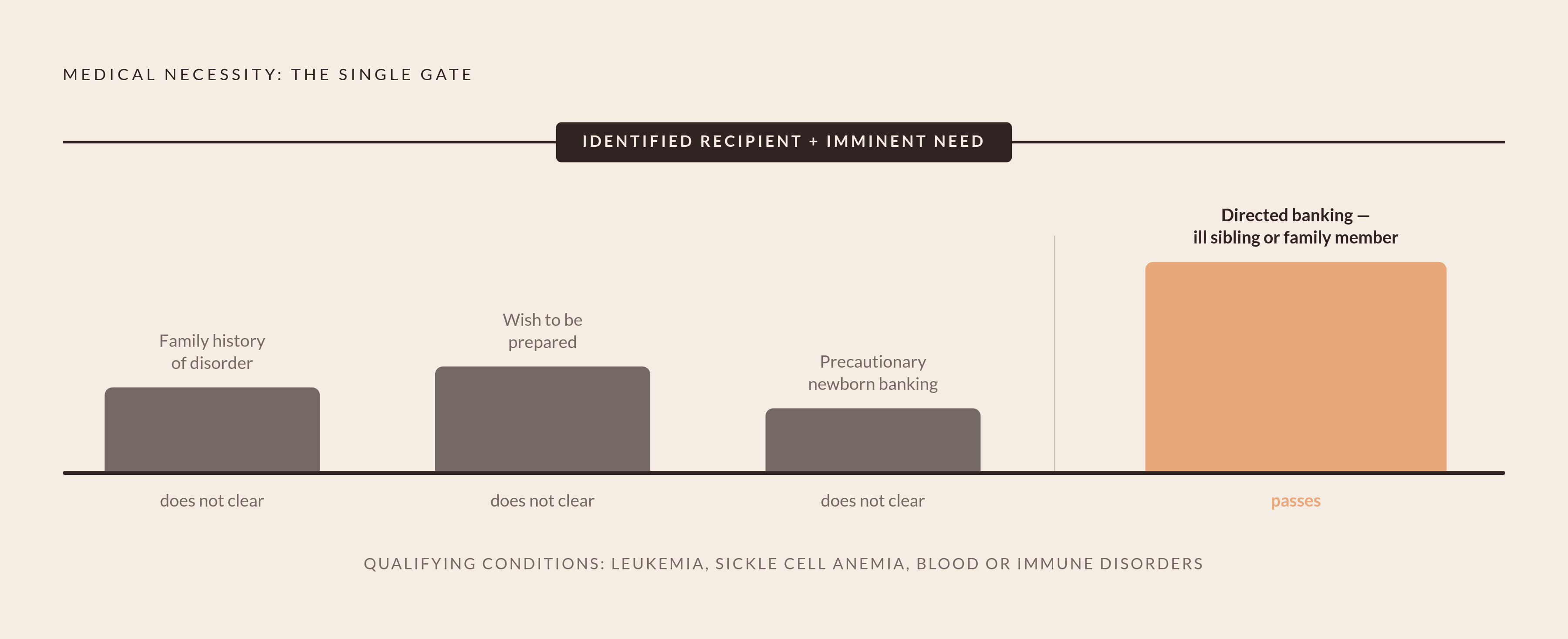
One situation clears that bar with some regularity: a family already has a child or other family member diagnosed with a condition that allogeneic stem cell transplant treats, and a newborn's cord blood is collected specifically as a potential match for that person. This is called directed or medical-need banking, and when it applies, the costs of collecting and storing that cord blood can be treated as part of the ill family member's broader health care costs. The conditions that typically qualify include leukemia, sickle cell anemia, and other blood or immune disorders where stem cell transplant is an established, approved treatment, not an experimental one. Families in this position need a physician's Letter of Medical Necessity, which functions as the anchor document for the whole claim, and many insurers will also require prior authorization before the baby is even born. Some insurers will consider these cases individually when a sibling already needs a matched stem cell source, but approval is never automatic. Families in this situation should contact their insurer well before delivery, since approval usually hinges on having the required paperwork in place.
Why family history alone does not clear the threshold
The most common misunderstanding among families comes from a family history of a treatable blood disorder. It feels like the kind of fact an insurer should care about, and in a sense it is, but it is not the fact insurers require. A known genetic risk, even a strong one, is still a risk rather than a diagnosis, and insurers do not pay to store tissue against something that has not yet happened to a specific, identified person. The logic of prevention is intuitive to most parents: why wait for a disease to appear when you could bank against it now? But insurance coverage turns on whether the disease has already materialized in someone who could use that cord blood, not on whether it might. A family with a documented history of leukemia sits in an uncomfortable middle ground: coverage feels like it should apply, and it is usually denied anyway, because no one in the family is currently diagnosed and in need of a transplant.
What the IRS standard and tax-advantaged accounts offer
The IRS applies a standard that mirrors the insurance test almost exactly. Tax-advantaged accounts and medical deductions are available for cord blood banking only when the banking is tied to an existing or imminent medical condition, not when it is done as a precaution. The IRS states that expenses for banking cord blood "to treat an existing or imminently probable disease may qualify as deductible medical expenses," while banking done as a precaution against a disease that might develop later does not meet the legal standard, which requires that the disease be at least imminently probable. In practice, this means HSA and FSA funds can be applied to cord blood banking costs once a physician provides a Letter of Medical Necessity, the same document an insurer would want for a coverage claim. That asymmetry is worth understanding before assuming any tax-advantaged account will help. HRA eligibility tends to be much narrower, because many HRAs are built only to reimburse costs already covered under the employer's health plan, things like copayments, so cord blood storage usually falls outside what they will reimburse. FSAs tend to be more forgiving, though employers can still exclude specific benefits from FSA coverage, so families should check their plan's actual terms. For the large majority of families banking purely as a precaution, none of this helps: they do not meet the IRS standard any more than they meet the insurance standard, and HSA or FSA funds are not available to offset the cost.
The legislative attempt to change the tax treatment
The current tax treatment is not something every lawmaker accepts as settled. H.R. 2810, the Family Cord Blood Banking Act, was introduced in the 119th Congress on April 10, 2025, by Rep. Jodey Arrington (R-TX). The bill would amend the Internal Revenue Code to treat amounts paid for private umbilical cord blood or cord tissue banking services as medical care expenses, which would open the door to deductions and tax-advantaged account use regardless of whether a current diagnosis exists. As of its introduction, the bill had been referred to the House Ways and Means Committee and had not advanced further. This is not the first time Congress has tried. A predecessor bill, H.R. 8882, was introduced in the 118th Congress on June 28, 2024, and referred to the same committee, also without passing. The 2025 reintroduction shows that political appetite for changing the tax treatment persists, but it changes nothing for families planning today. Until a bill like this actually passes, the IRS standard tied to an existing or imminent condition remains the rule families have to plan around.
The professional and scientific consensus that reinforces why insurers draw the line where they do
Insurers did not invent this threshold out of caution alone; it tracks closely with where the major medical and scientific bodies have landed on private banking. The American Academy of Pediatrics does not recommend routine private cord blood storage for low-risk families, pointing to a lack of scientific data supporting its use and to the fact that allogeneic transplantation is available through public banks when a match is needed. The American College of Obstetricians and Gynecologists holds the same position. The American Medical Association states that umbilical cord blood stem cells carry greater utility when donated to a public bank than when stored privately. The American Society for Transplantation and Cellular Therapy recommends public banking where it is possible and does not recommend private storage for personal use. This professional consensus matters for a reason beyond insurance policy: it means that advocacy for broader coverage faces a scientific hurdle, not just a political one. An insurer denying a precautionary banking claim is not acting against medical opinion; it is acting in line with it.
The stronger case for private banking
The strongest argument for private banking is that a sibling, or another family member, might benefit from a partial match, a use case the commonly cited autologous probability statistics do not capture at all, since those numbers describe only the odds that a child uses their own stored sample. Families of mixed race or ethnic background, who remain underrepresented in public cord blood banks, have a more rational basis than most for treating private storage as a hedge, since a matched public unit may be harder to find if one is needed urgently. One documented procedure uses one child's banked cord blood to treat a sibling through allogeneic transplant, particularly in cases where the sick child's own cord blood carries the disease and cannot be used on itself. None of this moves the insurance outcome. Coverage does not activate because a sibling might someday need a transplant; it activates only once that sibling is currently diagnosed and a transplant is imminent. The sibling-use argument is genuinely stronger than the autologous one in terms of probability, but it still has to pass through the same gate: insurers pay for treatment, not for preparation against treatment that may never become necessary.
Planning realistically around the cost without coverage
For most families, the practical reality is that private cord blood banking is an out-of-pocket expense from the start, and planning for it looks more like budgeting for a known cost than like filing an insurance claim. Payment plans offered by private banks, including AlphaCord, let families spread that cost across monthly or yearly installments instead of paying the full amount upfront, which tends to be the most workable approach for anyone without employer support or a qualifying medical need. Some employers do include cord blood banking as part of wellness or family planning benefits, so it is worth confirming the specifics of an employer's benefit package before assuming the full cost falls on the family. Nonprofit and research programs sometimes offer reduced-cost or free storage in exchange for participation in clinical research, an option families facing financial strain should look into before ruling out banking. For the smaller group of families who do meet the medical necessity threshold, where a family member is currently ill and a transplant is imminent, three steps matter most: get a Letter of Medical Necessity from the treating physician, get prior authorization from the insurer before the birth, and confirm whether the plan covers collection, processing, and storage as distinct costs or only the transplant procedure itself. Public cord blood donation remains free and contributes to a shared registry that any matched patient, anywhere, can draw from, and for families who cannot justify the cost of private storage, donation puts the tissue to use. Accreditation of the private bank itself also deserves attention, since transplant centers and insurers increasingly treat it as baseline documentation. Confirming what credentials and paperwork an insurer wants, ahead of delivery, is a far better use of time than discovering the gap after the baby arrives.
Sources
- Cord Blood Banking
- Umbilical Cord Blood Harvesting and Storage for Future Use Page 1 of 4
- Newborn Umbilical Cord Blood Banking and Donation: AAP Policy Explained - HealthyChildren.org
- Text - H.R.2810 - 119th Congress (2025-2026): Family Cord Blood Banking Act
- H.R.2810 - 119th Congress (2025-2026): Family Cord Blood Banking Act
- O F F I C E O F T H E C H I E F C O U N S E L DEPARTMENT OF THE TREASURY
- Family Cord Blood Banking Act