Hospital Placenta Release Policies and Patient Rights
Only three states have written placenta release into law; fifteen permit it in practice.
No federal law says who owns a placenta after birth. That question gets answered by a patchwork of a handful of state statutes, a larger group of states where release is merely tolerated, individual hospital policy, and whatever the delivering physician decides to send to pathology. Parents who assume this is a settled legal question, one with a clear yes or no answer, are the ones most likely to be blindsided at the bedside.
Part of the confusion traces back to OSHA. The agency classifies bodily tissue collected during diagnosis and treatment as human pathological waste, which has to go into a biohazard container. That's a workplace safety rule, aimed at protecting the people handling the material, not a rule about what happens to it afterward. But because OSHA is the only federal body that says anything at all about placental tissue, most states just borrow its language and call the placenta biohazardous medical waste by default, without ever legislating the disposition question directly.
The other federal statute that gets invoked, usually incorrectly, is the National Organ Transplantation Act. NOTA bans the sale of a specific list of organs and tissues, including kidneys, livers, hearts, and other enumerated items. Whether a placenta counts as one of those has never been tested in court, so there's genuinely no legal answer. What is clear is that NOTA forecloses any commercial transaction regardless, meaning a mother can take her placenta home but can't sell it. The ambiguity here isn't an oversight so much as a structural problem: the placenta doesn't sit neatly inside "organ," "tissue," "waste," or "personal property." It straddles all four categories, and each one is governed by a different body of law that was never written with the placenta in mind.
What the law actually says in the states that have written it down
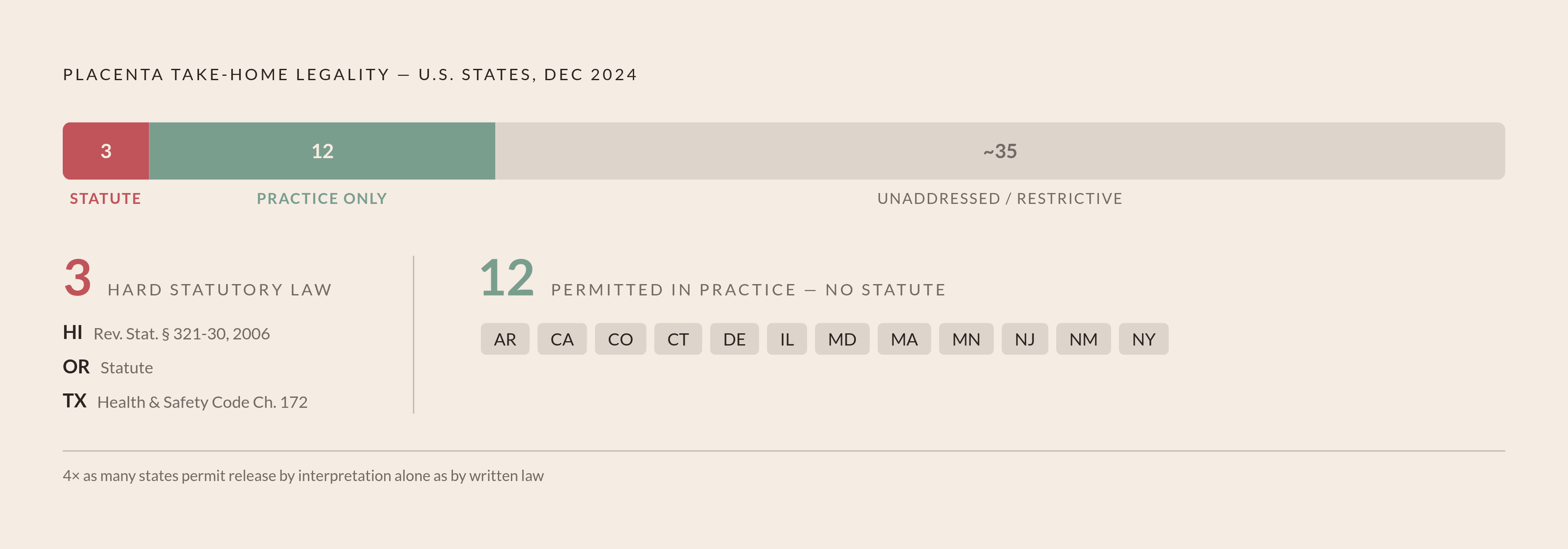
Only three states have put placenta release into actual statute: Hawaii, Oregon, and Texas.
Hawaii got there first. Under HI Rev. Stat. § 321-30, enacted in 2006, a hospital may release the placenta to the mother or her designee once appropriate testing rules out infection or hazard. The statute also directs the state health department to create a standardized release form spelling out safe handling measures.
Texas took a similar approach through Health and Safety Code Chapter 172. A hospital or birthing center has to let a woman take her placenta if she tests negative for infectious disease and signs a form acknowledging she's been educated on blood-borne disease risk, the danger of ingesting formalin, and proper handling procedure. The statute is explicit that this is for personal use only; sale is off the table.
Oregon also has placenta release codified into law, though the exact statutory language is worth pulling directly from the state code rather than relying on secondhand summary. What matters for parents is that Oregon joins Hawaii and Texas as one of only three states where this right doesn't depend on a hospital's mood or a nurse's familiarity with policy: it's written down.
Beyond those three, the picture gets fuzzier and, honestly, more interesting. As of December 2024, take-home release is either definitely or probably permitted in fifteen states: Arkansas, California, Colorado, Connecticut, Delaware, Hawaii, Illinois, Maryland, Massachusetts, Minnesota, New Jersey, New Mexico, New York, Oregon, and Texas. Notice the gap. Twelve of those fifteen have no statute at all. States like California, Colorado, Delaware, Illinois, Minnesota, and New York simply have hospitals that, in practice, read "medical waste" liberally enough to allow release anyway. That gap between three states with hard law and fifteen where release is merely probable is the whole story in miniature: this is a domain governed far more by interpretation than by legislation.
The legal principle that applies everywhere statutes are silent
Here's the principle that actually governs most of the country: releasing a healthy placenta to a healthy mother isn't prohibited by law in any U.S. state. Not one.
That matters because of a basic rule-of-law concept that a lot of parents don't think to apply outside a courtroom: anything not expressly forbidden is, by default, permitted. In a hospital that hasn't adopted a policy actively barring release, and where the placenta hasn't been diverted to pathology, it should be obtainable. The absence of a "yes" statute isn't the same as a "no."
The case most often cited to test this is Swanson v. Sunrise Hospital, decided in 2007. A Nevada court ruled in favor of the patient, ordering the hospital to release her placenta. It's worth being precise about what that ruling actually did, because it gets overstated constantly: it resolved a single case. The ruling resolved that individual dispute and has not been treated as establishing a broad binding precedent across jurisdictions. Swanson is persuasive, not binding, outside its jurisdiction. Still, it's useful precedent to raise in a conversation with a reluctant hospital administrator, because it shows a court has been willing to side with a mother on exactly this question before.
Massachusetts offers the clearest official articulation of the underlying logic. A Department of Public Health memo dated October 25, 2010, walks through 105 CMR 480.000, the state's medical waste regulation, and notes that the definition of medical waste covers only material that has been "discarded." A placenta a mother wants to keep hasn't been discarded, so retention by the patient isn't expressly prohibited under that framework. The department's actual recommendation is telling: rather than legislate the answer, it told each hospital to develop and publish its own policy on the patient's right to retain and take home the placenta. That's an official state health authority acknowledging, in writing, that this is a policy question dressed up as a legal one.
For a parent, understanding this principle changes the entire conversation. A hospital that hesitates or stalls isn't necessarily citing law. More often it's citing habit, liability anxiety, or a policy nobody's bothered to write down. Recognizing the difference is the first real tool a parent has.
How hospital policy functions as a hidden layer of placenta law
Law professor Mathilde Cohen has made the sharpest academic case for what's actually happening here. Writing in the Yale Journal of Law and Feminism, Cohen argues that the enormous variation in hospital-level policy amounts to a hidden body of placenta law, one that operates below the level of statute and almost entirely outside public view. Her broader argument centers on the gap between what the written law provides and what parents actually encounter when trying to exercise rights over their own placenta.
The variables that shift from one hospital to the next, even within a single state that supposedly has a uniform rule, are numerous. Whether the placenta is automatically routed to pathology. Whether it's kept sterile while a release decision is pending. Whether staff will hand it over at all, and if so, which staff member is responsible for supervising that handoff. Which forms need a signature, and how long the mandatory hold period runs before release is even possible. None of this is trivial, and none of it is standardized, even inside states like Texas that have an actual statute on the books.
Geography inside a state matters too. Rural hospitals and urban research hospitals in the same state often land on opposite ends of the spectrum, the research hospital more likely to have a pathology-heavy default, the rural facility more likely to hand the placenta over with minimal fuss. And nearly none of this is published anywhere a parent could find it in advance. The hidden-law problem Cohen describes isn't an accident of underfunded communications departments. It's structural: policy lives in internal documents, staff training, and institutional memory, not on a hospital's public-facing website.
Some states sit at the restrictive end of this spectrum, with environmental or waste regulations that classify obstetrical material in ways that make release procedurally difficult even where no one is trying to be obstructive, since the default disposal pathway is baked into regulation rather than hospital discretion.
Texas, despite having a statute, still shows how much policy detail sits underneath the law. At Baylor Scott and White Hospital, patients are expected to bring their own cooler and sign a release of liability at admission. At Georgetown Hospital, a St. David's facility, the placenta is refrigerated and held for 24 hours before release. Neither of these details comes from the statute. Both come from internal policy that a parent would only learn by asking directly.
And there's a hard limit to all of this that no amount of preparation solves: an emergency delivery involving EMS technicians who dispose of the placenta on scene leaves no realistic recourse, even in a state where the legal right to retain it exists on paper. A statute guarantees a right. It doesn't guarantee compliance in the moment.
The pathology detour and how it can override a parent's plan
Even a mother with a signed release form and a cooler in the car can lose her placenta to pathology. Depending on the hospital, the share of placentas sent for pathological exam ranges from roughly 20 percent to 47 percent, sometimes higher, and that range alone tells you how inconsistently the decision gets made from one institution to the next.
Two separate studies illustrate just how uneven compliance with clinical guidelines actually is. One estimated that only 49 percent of placentas meeting criteria for pathology exam were actually sent. Another put appropriate submission at 82 percent. Read together, those numbers don't point to a system that's simply cautious or simply lax: they point to a system where the outcome depends heavily on which hospital, which physician, and which shift a mother happens to deliver on.
A 2023 expert consensus paper in the American Journal of Obstetrics & Gynecology lays out the conditions that should trigger a full pathology exam: pregnancy loss, maternal infection, suspected abruption, fetal growth restriction, preterm birth, nonreassuring fetal heart testing that leads to urgent delivery, preeclampsia with severe features, and neonates showing early signs of multiorgan system failure. None of these are exotic complications. Several, like preterm birth and preeclampsia, are common enough that a meaningful share of deliveries will trigger at least one.
For placentas that aren't flagged for pathology at the moment of delivery, the recommended practice is to hold them refrigerated for at least 72 hours, in case an indication for testing emerges afterward. That 72-hour window matters enormously for a parent hoping for release, because it means the placenta isn't necessarily gone the moment delivery ends. It's sitting somewhere, waiting.
Whether a placenta goes to pathology at all is, in most cases, a call made by the delivering physician. There's no national mandate requiring universal examination. Clinical guidance places responsibility on the obstetrician to coordinate between a family's request and the pathology department, and specifies that a released placenta needs to go into a biohazard bag inside a leak-proof container and stay refrigerated throughout.
The detail parents most often miss: a pathology order and a release request aren't mutually exclusive. Pathology examining the tissue doesn't automatically mean the tissue is destroyed afterward. The right question isn't whether pathology has claimed the placenta. It's whether the hold ends when the exam does, and whether release remains possible once testing wraps up.
What requesting release actually looks like: paperwork, timing, and what to bring
The American Placenta Practitioners Association describes a workflow that shows up, in some version, at most cooperative hospitals. A release waiver gets signed during triage and filed in the chart before delivery even begins. Once the baby arrives, staff double-bag the placenta. It's then released to a partner or support person, who takes on responsibility for storage and handling from that point forward. Most patients bring their own cooler, though some hospitals will make ice available.
The form itself often carries a title like "Consent to Release Products of Conception," with the placenta falling under that broader umbrella rather than getting its own dedicated paperwork. It's worth asking specifically whether that's the document in use, since staff won't always volunteer the name.
There's a framing point worth raising directly with hospital staff, one the APPA makes explicit: releasing the placenta soon after birth actually reduces the hospital's own liability exposure, since it shortens the window during which the tissue sits in the building requiring storage and monitoring. Framed that way, a release request looks less like a demand on the hospital and more like it's doing the hospital a favor. That reframing tends to land better with administrators than an appeal to personal preference alone.
Massachusetts DPH's memo lays out, in concrete terms, what a compliant hospital policy needs to include. Written authorization and consent from the mother. Clear documentation that the tissue in question isn't being treated as medical waste. A container that's labeled, secured, and leak-proof. Measures to prevent putrescence during transport. Safe-handling instructions, including hand-washing and food-preparation guidance if the placenta is going to be consumed. And counseling that any placenta stored in formalin or a similar fixative must never be eaten.
That same memo also draws a firm line on when release shouldn't happen at all: documented or suspected chorioamnionitis, documented or suspected active bacterial infection including bacteremia. Hospitals may also decline release for mothers with documented blood-borne viral infections such as HIV or hepatitis B or C. These aren't arbitrary restrictions; they track directly to the infection-risk concerns that motivate the entire biohazard framework in the first place.
Practically, the logistics come down to three things: bring a cooler with ice, confirm the hospital's hold-time requirement before admission rather than after, and make sure the release waiver is sitting in the chart before labor gets intense enough that paperwork becomes an afterthought. One placenta encapsulation provider serving North Carolina, South Carolina, and Virginia, Wombmart, notes that hospitals are increasingly building standardized release processes as requests become more common, and recommends checking with hospital administration, the maternity department, or the head of OB or pathology directly, rather than relying on the bedside nurse or attending physician, who may simply not have the current policy memorized.
How to build a release request that holds up under pressure
Start the conversation before the third trimester, not during it. Call the hospital's maternity or OB department directly and ask, specifically, for the placenta release policy in writing. Don't settle for a vague "yes, that's usually fine" over the phone; ask whether a written policy exists at all.
A few questions are worth asking pointedly, rather than generally. Does the hospital have a written policy on file? Which department actually initiates the paperwork, admissions, triage, or OB nursing? Is there a mandatory hold period, and if so, how long? Under what circumstances does the placenta get automatically routed to pathology? And if it does go to pathology, can it still be released once the exam is complete?
Put the request into the birth plan itself, signed before labor starts, so the right doesn't hinge on someone remembering a verbal conversation in the middle of delivery. It's also worth naming a specific support person whose job, among the chaos of the delivery room, is placenta logistics alone: receiving the double-bagged tissue, managing the cooler, and reminding staff of the documented request if it gets overlooked in the moment.
If a hospital pushes back and the state in question has no explicit statute, the rule-of-law principle from earlier becomes the strongest tool available: absence of prohibition is permission, and Swanson v. Sunrise Hospital is a real precedent to cite if a conversation stalls. That said, rights on paper have limits that no amount of preparation eliminates. Emergency deliveries, EMS involvement, or an unplanned transfer to a different facility can make even a signed, filed birth plan unenforceable in the moment. A brief contingency conversation with the care provider ahead of time, about what happens if delivery doesn't go as planned, is worth having precisely because it's the scenario a birth plan can't fully cover.
Confirming the release plan with the hospital before birth day, rather than during labor, is the single factor most likely to determine whether the request actually succeeds.
What the medical evidence says about consuming the placenta, and what it leaves open
Placentophagy, the practice of eating one's own placenta, has picked up momentum in recent years, driven partly by ancient cultural traditions and partly by modern interest in postpartum mood and energy. The cultural weight behind it is real and long-standing.
Medical anthropologists Daniel Benyshek and Sharon Young examined this cross-culturally in a 2010 study, surveying placenta-related traditions across 179 societies. Among the 109 communities that observed some ritual around the placenta, researchers documented 169 distinct disposal methods, including burial, incineration, placement in a specific meaningful location, and consumption. That range underscores how culturally variable and deeply rooted these practices are; consumption is one option among many, not a universal default.
Preparation methods vary widely too: raw, cooked, roasted, dehydrated, encapsulated, blended into smoothies, or reduced to tinctures. Research published in the American Journal of Obstetrics and Gynecology identifies encapsulation, typically after steaming and dehydrating the tissue, as the most commonly used method today.
The clinical evidence, however, doesn't support the wellness claims attached to the practice. AJOG's research found no clinical evidence of benefit from placentophagy in humans, and no indication that placental nutrients or hormones survive encapsulation in amounts sufficient to help a mother postpartum. The Cleveland Clinic, in guidance updated in May 2025, states plainly that placenta consumption isn't a safe or recommended practice and carries no proven health benefit.
The clearest warning sign came from the CDC in 2017. A case published in the CDC's Morbidity and Mortality Weekly Report (June 30, 2017, 66(25):677 to 678) described a newborn who developed a serious Group B Strep infection traced back to the mother's consumption of encapsulated placenta. The CDC's resulting recommendation was direct: avoid placenta capsules, because the encapsulation process doesn't reliably eradicate infectious pathogens.
Underneath all of it sits a regulatory vacuum. The placenta encapsulation industry isn't regulated by the FDA, so there's no guaranteed standard for handling, preparation, or contaminant screening across providers. That gap doesn't mean the practice is inherently unsafe in every instance, but it does mean a parent is relying entirely on an individual provider's own standards, not any external oversight.
None of this settles the question of whether a family should encapsulate or consume their placenta; that remains a personal decision, often tied to real cultural or emotional meaning. What the evidence does settle is that the decision should rest on accurate information rather than marketing claims, and that safe handling from the moment of hospital release through final preparation matters regardless of what a family ultimately decides to do with the tissue.
Sources
- Hawaii Revised Statutes § 321-30 (2025) - Human placenta. :: 2025 Hawaii Revised Statutes :: U.S. Codes and Statutes :: U.S. Law :: Justia
- Memorandum to CEOs of hospitals licensed to provide maternal and newborn services regarding the release of placenta to patients after childbirth | Mass.gov
- Your Placenta Rights under US State Laws
- Placenta Encapsulation FAQs ⋆ APPA
- ajog.org
- ncbi.nlm.nih.gov
- BILL ANALYSIS
- Placenta, Hospitals and Everything you Should Know