Placenta Encapsulation vs Placenta Banking: What Each Forecloses
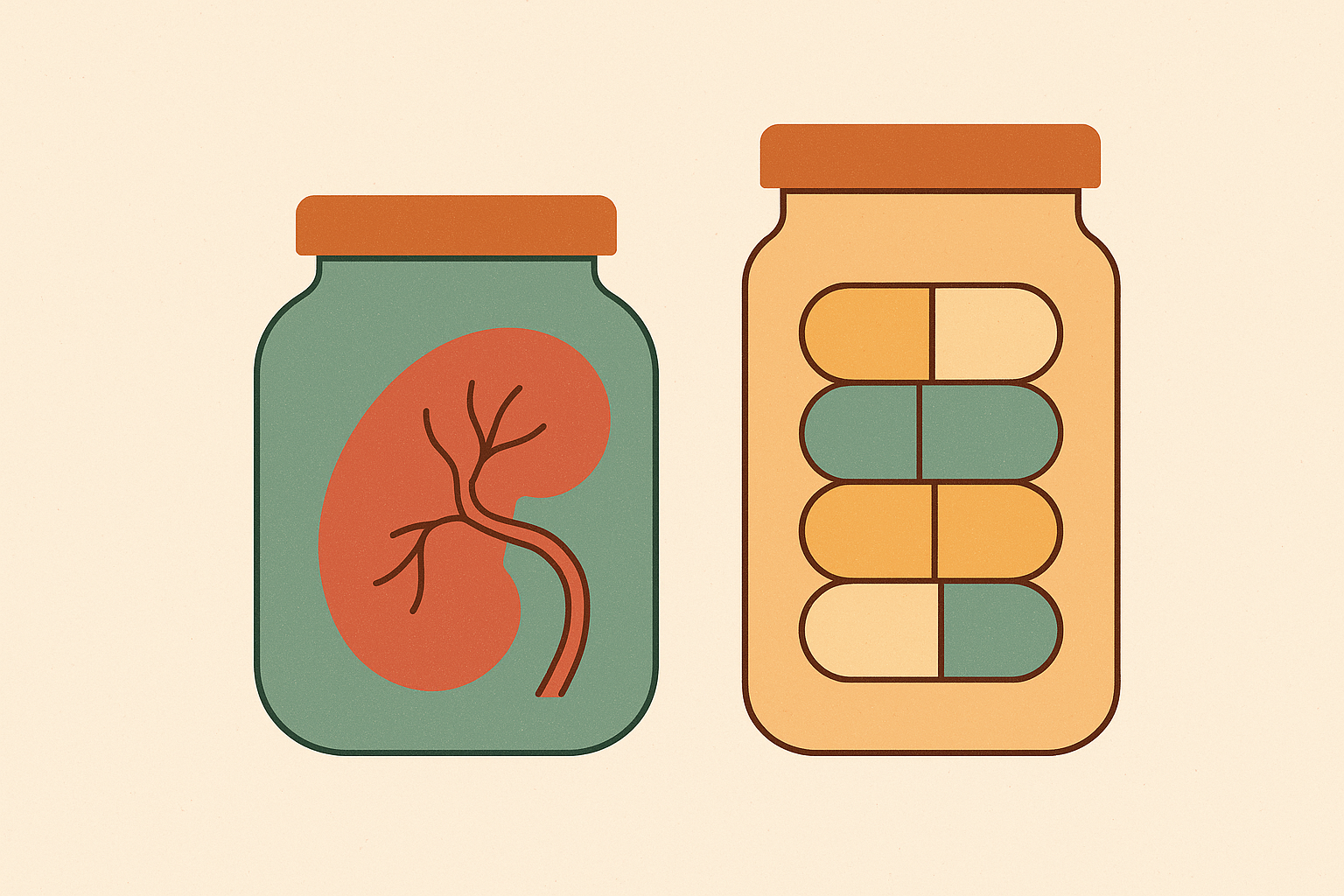
Two very different groups want this organ, and they want it for opposite reasons. Wellness advocates want to dry it and grind it into capsules, while stem cell labs want it frozen at -196°C within hours of delivery. Both camps are working with real material, even though almost nothing overlaps in what they're trying to get out of it.
Consider what's actually in there. The placenta holds iron, zinc, selenium, copper, and manganese, plus amino acids, proteins, and hormones built up over nine months. Whether any of that survives drying and grinding is a separate question, and a genuinely contested one; the tissue going in is not nutritionally inert, whatever happens to it afterward.
The cell side is where this gets interesting. Placental tissue carries more mesenchymal stem cells than bone marrow does, and it holds hematopoietic stem cells too. A standard cord blood draw yields around 1.8 million CD34+ cells on its own; pull placental blood into that same draw and the number climbs. The amniotic and chorionic layers add growth factors and anti-inflammatory proteins on top. Amnion-derived cells have been used on burns, wounds, and ulcers since the early 1900s, so the clinical relationship with this tissue is over a century old, long before wellness culture noticed it existed.
A bind sits at the center of all this. Dry the tissue and the stem cells die, and freeze it and whatever nutritional value the capsules were supposed to carry is gone. There's no split-the-difference option, no partial credit, and that's exactly why this decision carries more weight than most people walk in expecting.

What placenta encapsulation actually involves and what it claims to deliver
Mechanically, this isn't complicated. The placenta gets dried, ground into powder, and packed into capsules meant to be taken daily through the postpartum weeks.
Two prep methods split the market, and each one trades away something the other keeps. The traditional Chinese medicine method steams the placenta before drying it, which cuts bacterial load but takes hormone content down with it. The raw-start method skips the steam, so more hormone survives, but the bacterial count runs higher. One placenta usually yields 200 to 300 capsules, which works out to roughly a daily dose across much of the fourth trimester.
The claims made for encapsulation are claims, not settled fact, and that distinction matters. Mood support gets top billing: the theory is that leftover progesterone and estradiol in the capsules blunt the baby blues. Beyond that, advocates point to iron replenishment for recovery energy, oxytocin release to speed uterine healing, and a boost to milk supply.
Historically, the practice traces back to traditional Chinese medicine, but its spread through Western birth culture is recent, and it owes far more to Instagram and word of mouth than to any clinician's recommendation. No state or federal agency regulates it in the U.S., and doulas, midwives, and standalone encapsulation services do the work, with nobody checking their sourcing, hygiene, or prep standards.
What the clinical evidence actually shows about encapsulation's claimed benefits
A 2018 review in the American Journal of Obstetrics & Gynecology went looking for clinical benefit from placentophagy in humans and came up empty. The conclusion didn't hedge: encapsulation doesn't preserve nutrients or hormones in amounts large enough to plausibly help postpartum recovery.
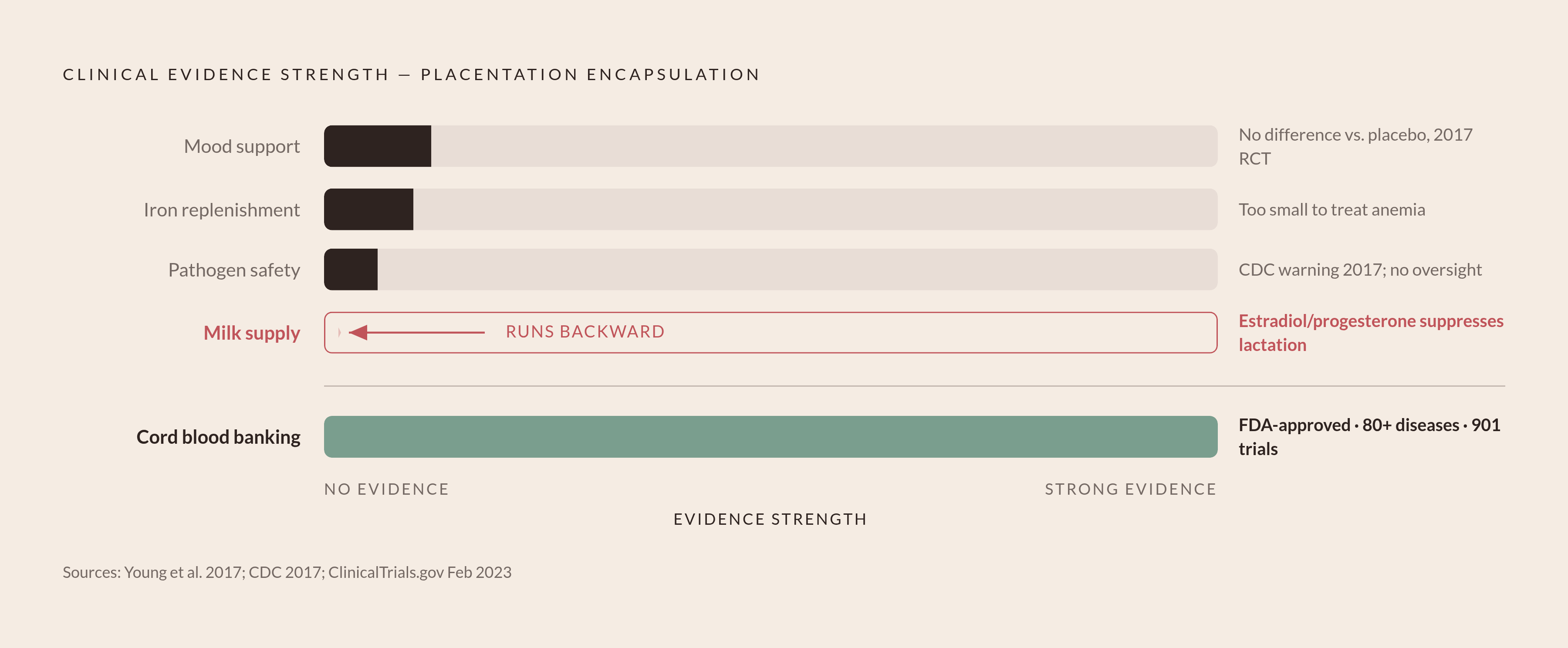
Mood is the claim advocates lean on hardest, and it's also the one that falls apart fastest under study. A 2017 trial in Women and Birth found no meaningful difference in postpartum depression scores between women taking placenta capsules and women taking a placebo. A 2020 review in Archives of Women's Mental Health went further, saying plainly that far more rigorous research is needed before anyone calls the psychological benefit real. Researchers at UNLV did find small shifts in circulating hormone levels among women taking the capsules, but those shifts never turned into a measurable clinical outcome. That gap, between a number on a lab report and something a mother actually feels, is the whole story here.
Iron follows the same pattern. Nobody disputes the placenta contains iron, but the UNLV team found the amount surviving encapsulation too small to treat postpartum anemia, or to move energy levels in any way a new mother would actually notice.
Milk supply is where the evidence runs backward. The estradiol and progesterone left in placental tissue may interfere with milk production in the first postpartum month, rather than boosting lactation. That's the opposite of what most people taking the capsules are hoping for.
Line these findings up and the pattern is hard to miss: the benefits people cite most often are the ones with the thinnest, most contradicted evidence behind them. Families choosing this route give up a biological resource they can never get back, in exchange for outcomes that clinical research keeps failing to confirm.
The safety concerns the evidence does support for encapsulation
Safety is where this gets uncomfortable, and there's no point softening it. In 2017, the CDC issued a warning after a newborn in Oregon developed a Group B Strep infection possibly tied to the mother's placenta capsules. The agency's advice was direct: avoid placenta capsules, because encapsulation doesn't reliably kill pathogens.
A later study of tens of thousands of birth records found no increased risk of NICU admission, hospitalization, or infant death in the first six weeks tied to maternal placenta consumption. That's a fair point, since the Oregon case hasn't repeated at scale, and one incident shouldn't stand in as a verdict on an entire practice.
Even so, the underlying risks don't go away just because they haven't shown up in a larger dataset yet. The placenta isn't sterile, so bacterial or viral contamination stays a live possibility. Across pregnancy it also filters and concentrates environmental toxins like mercury and lead, so whatever the mother was exposed to can end up more concentrated in the tissue than in her own blood. Add a thromboembolism risk tied to the estrogens in the tissue, and the safety profile stops looking neutral.
The regulatory gap makes it worse. No U.S. body, state or federal, oversees encapsulation providers. Europe took a different road: the European Food Safety Authority classified human placenta as a "novel food," a designation that effectively shut down commercial encapsulation services there starting in July 2014. In the U.S., quality depends entirely on which provider a family happens to land on, and that matters more, not less, when the underlying evidence is already this thin.
What placenta banking preserves and what it is already being used for
Banking runs on the same logistics as cord blood banking. Collection happens in the delivery room, a courier gets the sample to a lab overnight, and it goes into cryogenic storage to wait for a use that may or may not ever come.
Cord blood stem cells are already FDA-approved to treat more than 80 diseases, and a cord blood draw contains roughly ten times more stem cells than a comparable bone marrow harvest. Placental tissue adds something cord blood doesn't have on its own. Placenta-derived mesenchymal stem cells proliferate faster, expand more easily in culture, and carry a lower rejection risk than adult-derived stem cells. They're also immunoprivileged, with low levels of HLA-ABC and no HLA-DR at all, which opens the door to non-matched, allogeneic use; cord blood's hematopoietic stem cells, by contrast, need HLA matching first. The amniotic and chorionic layers bring in still more cell types, with a real clinical track record in wound care and eye treatment.
Because the placenta carries both maternal and fetal tissue, one banked sample isn't locked to the baby it came from. It might help a sibling, a parent, even a grandparent, and that widens who a single collection could someday serve.
Storage holds up over time too. Cord blood units have been thawed and transplanted successfully after eighteen years in the tank, and nobody actually knows the ceiling; liquid nitrogen likely keeps cells viable for decades past that mark. The science keeps moving as well. As of February 2023, 901 registered clinical trials in the U.S. were testing mesenchymal stem cell applications across neurological disease, heart disease, autoimmune conditions, and cancer.
The honest limitations of placenta banking that families should weigh
Banking has real ceilings, and pretending otherwise doesn't help anyone deciding whether to spend the money.
Autologous use, treating a person with their own banked cells later on, runs into a hard wall with genetic disorders. Sickle cell disease and thalassemia live in every cell in the body, including the ones sitting frozen in storage, so a banked sample carrying the same mutation can't cure the disease it's made of.
The usage numbers back this up. Over the past twenty years, the U.S. has seen just over 400 autologous cord blood transplants, against more than 60,000 unrelated donor transplants worldwide. That gap is wide enough that both the AMA and the AAP have warned families against treating private banking like biological insurance.
A live disagreement also exists in the research world over whether banking placenta tissue adds much on top of banking cord tissue. Cord tissue already carries plenty of mesenchymal stem cells, and some researchers think the cells from cord tissue and placental tissue are functionally interchangeable, which raises a fair question about whether the extra cost of banking the placenta buys anything real. The counterargument holds that banking both simply means more cell types and more total volume, which widens the range of treatments a family could reach for later. Separating fetal cells from maternal cells inside placental tissue is also technically hard, and that difficulty may cap how the tissue actually gets used for years to come.
Public banking is worth a mention here too. Public cord blood banks take donations at no cost and make the cells available to any matching patient anywhere, not just the donor family. For a family that finds the price of private banking hard to justify against low odds of personal use, donating publicly grows the treatment pool for strangers instead of one household. The cost itself isn't small either: private banking runs an enrollment fee plus an annual storage bill, year after year, and that ongoing cost deserves to be weighed honestly against the realistic odds the sample ever gets used.
How delayed cord clamping interacts with both decisions
Delayed cord clamping is standard practice now for a simple reason: it's good for the baby, since more blood and more stem cells cross over before the cord gets cut, instead of staying behind in the placenta.
That benefit for the baby comes at the expense of collection volume. The longer the cord stays attached, the less blood is left to draw and bank. Delayed clamping and maximum collection pull in opposite directions, and current medical guidance settles the argument in favor of the baby: cord blood collection should never compromise obstetric or neonatal care, and it shouldn't change standard delayed-clamping practice, except in rare cases involving directed donation for a known medical need already in the family.
In practical terms, a family planning to bank needs to talk with their provider about clamping timing well before delivery, not while it's happening. Nobody's suggesting a family skip delayed clamping to chase a bigger sample. The point is understanding, ahead of time, how much blood realistically will be left to collect once clamping is delayed, and whether pulling placental blood into the draw alongside cord blood closes some of that gap. Encapsulation skips this tradeoff entirely, which is one more reason the banking decision has to be settled long before anyone's in a delivery room trying to negotiate it in real time.
What families who choose banking should know about selecting a provider
Banking is a service business, and providers vary in ways that actually matter. Some collect cord blood only, while others add cord tissue, placental tissue, or some combination of the three, and processing methods and storage setups differ from company to company as well.
A handful of questions are worth asking any provider before signing anything. What tissue does the kit actually collect: cord blood, cord tissue, placental tissue, amniotic membrane, some mix? How fast does the sample move from delivery room to lab, and who handles transport? What does the family pay up front versus every year after, and what happens to the sample if the company gets bought out or folds? Is the lab AABB accredited, which is the benchmark worth checking for in the U.S.?
The market is growing and going international, with providers expanding placenta banking access across more countries every year, and that alone says this isn't some fringe experiment anymore. Some companies now bundle cord blood and placenta collection into a single kit, which cuts down the coordination headache of managing two separate collections during labor.
Whichever provider a family lands on, the last step is logistics, not paperwork. Confirm with the hospital and the birth team, in advance, that someone on staff knows how to receive and handle the kit correctly. That handoff happens mid-labor, under time pressure, and it only goes smoothly if everyone agreed on the plan weeks earlier.
Making the choice with both doors visible before birth
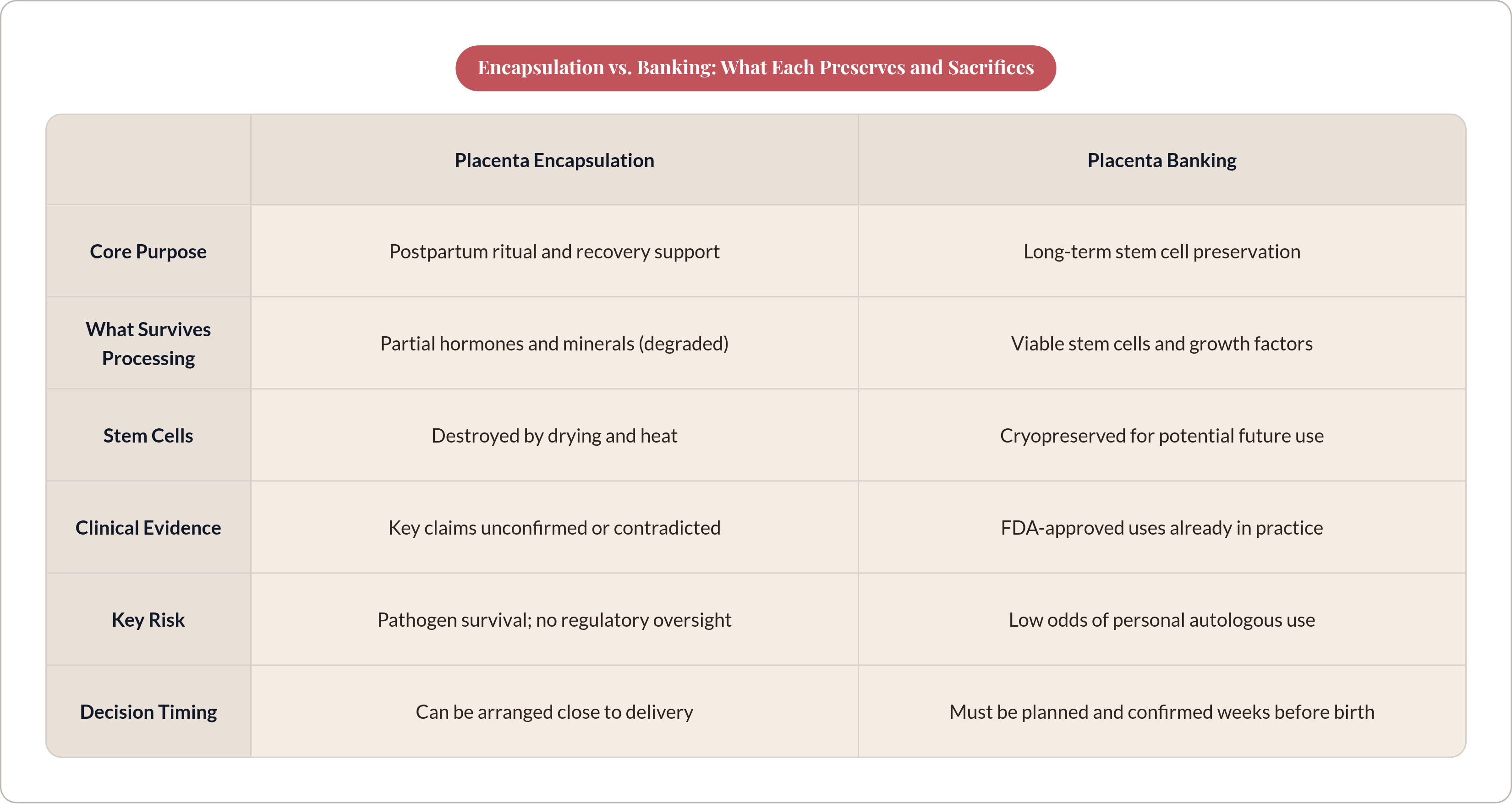
Encapsulation sells a postpartum ritual wrapped in a biological story, and the story doesn't hold up under clinical study, mood support least of all. The safety risks are real in a market nobody regulates, and the stem cells are gone the moment the tissue gets dried out.
Banking offers cell preservation tied to treatments already FDA-approved, backed by a research pipeline that keeps growing. Families who choose it take on a real bill and low odds they'll ever use their own sample, with zero postpartum benefit attached to the wait.
These two options aren't mirror images of each other, and treating them like a simple either-or misses what's actually being traded. Banking is a bet on the future, grounded in treatments already in clinical use today and hundreds of active trials pushing the science further. Encapsulation promises relief within weeks of birth, and its central claims keep failing to hold up every time someone actually studies them.
A family's evidence alone won't settle this, and it shouldn't have to. A family focused on postpartum support, even support that leans more on tradition than proof, and wary of what private banking costs, will land somewhere different than a family thinking about long-term preservation and the chance to help a sibling or parent years down the line. Both instincts make sense, and they're just answering different questions.
Timing isn't up for negotiation, though, and this gets decided before birth, full stop. There's no pause button once labor starts, no chance to change course after the placenta has already been processed one way. Families leaning toward banking should find a provider that collects the full range of tissue, confirm collection logistics with the birth team well before the due date, and walk in knowing exactly what they're keeping and what they're giving up. The window opens once, and then it closes, and it stays closed.