How Cord Blood Banking Went From One Transplant to a Global Industry
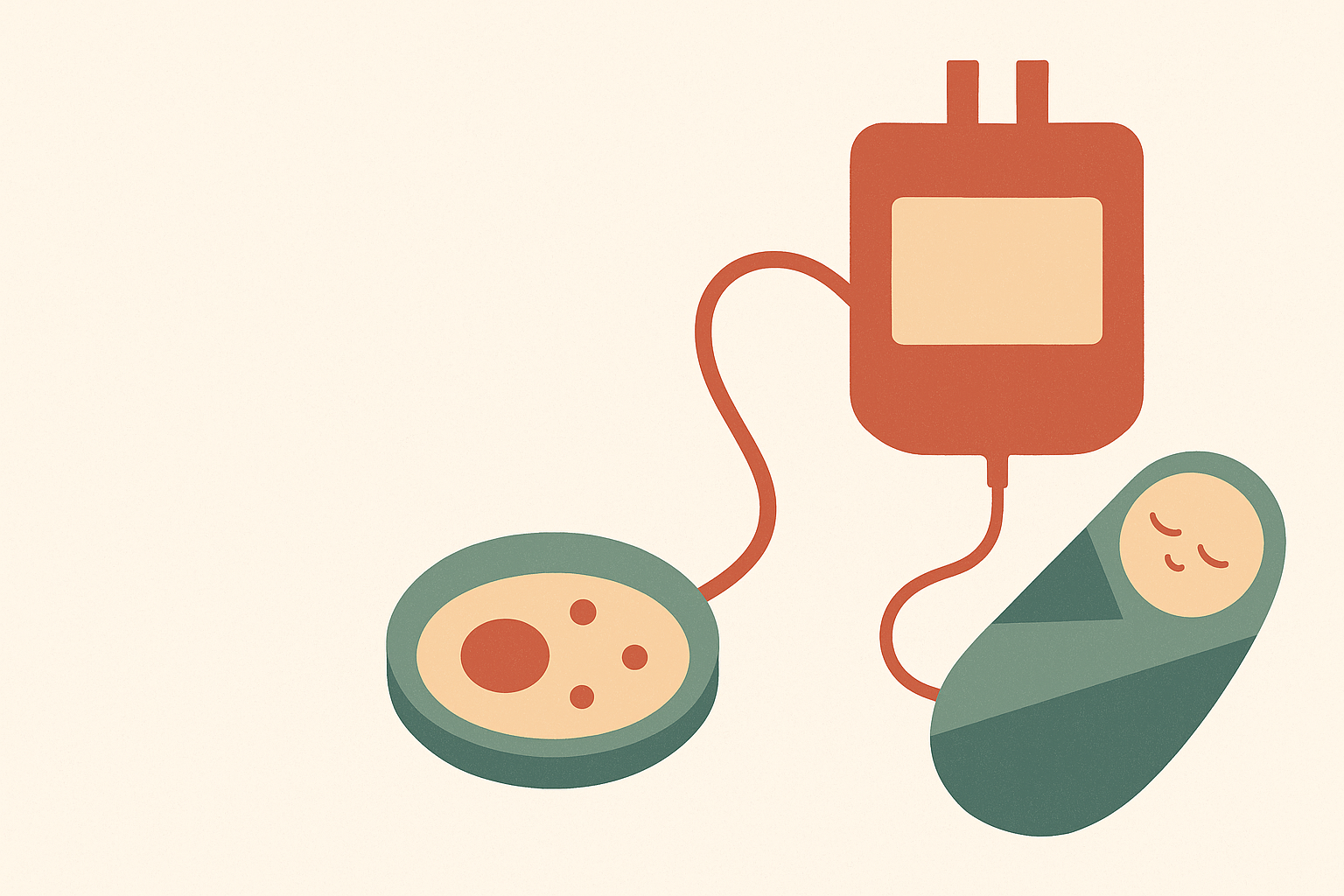
Cord blood is the blood left in the umbilical cord and placenta after a baby is born. It carries hematopoietic stem cells, the cells that make new blood and immune cells, and for most of medical history nobody wanted it. It went in the trash. This is the story of how that changed: how one transplant in Paris in 1988 turned discarded tissue into a global industry now valued in the tens of billions of dollars, and why the science, the regulation, and the business model still don't fully agree with each other.
The delay in noticing cord blood's value wasn't laziness. Stem cell science itself was young, and bone marrow was already the working donor source for transplant medicine, so there was little reason to look elsewhere. A 1974 paper first floated the idea that cord blood might contain stem cells of its own; it wasn't a clinical claim, just a hypothesis that opened a door. Lab work over the following years showed cord blood stem cells behaved a lot like bone marrow stem cells, which made the swap plausible on paper. But cells behaving well in a dish don't tell you what happens in a sick child. That proof came later, and it came from Paris.
The 1988 Paris transplant that changed everything
By the time the first real transplant happened, the commercial engine was already running ahead of the clinical evidence. Ted Boyse and Judy Bard at Memorial Sloan Kettering, working with Hal Broxmeyer at Indiana University, had formed a company called Biocyte and patented a method for freezing and banking cord blood, before anyone had proven the treatment worked in a patient. That's worth sitting with: the business case preceded the medicine.
The patient was a child with Fanconi anemia, a bone marrow failure disease where a matched-related donor was the only real shot at a cure. Dr. Eliane Gluckman performed the transplant in Paris, using cord blood instead of marrow, and it worked. It was the first time cord blood had been shown to rebuild a person's blood and immune system.
The logistics were almost comically thin for something this consequential. Broxmeyer flew the frozen sample to Paris himself, carrying it in a dry shipper, with one airplane seat booked for him and another for the cord blood unit. He landed the day of the transplant. There was no margin, no backup plan, just a man and a cooler and a very sick child waiting on the other end.
What made the result matter beyond the single case was a specific clinical finding: cord blood transplants produced lower rates of acute graft-versus-host disease than bone marrow did. GVHD, where donor immune cells attack the recipient's body, was and is a leading cause of transplant failure. That difference gave cord blood a real clinical argument, not just a proof-of-concept story. Still unanswered: would it work with donors who weren't blood relatives, in diseases beyond Fanconi anemia, at any kind of scale.
How the early 1990s turned a single result into a repeatable procedure
The harder test came in 1993, at Duke University, where doctors performed the first unrelated-donor cord blood transplant on a four-year-old boy with T-cell leukemia, using a unit from the New York Blood Center. A related donor shares genetic material with the patient, which lowers the odds of rejection. An unrelated donor doesn't, so this was the transplant that actually tested whether cord blood could work the way bone marrow registries worked, matching strangers to strangers.
It succeeded, and that success mattered more than the Paris transplant in one specific way: it meant patients without a matched family member now had a second path forward. Over the next two years, more transplants followed the same pattern, and cord blood stopped being a single remarkable case and became a real clinical option. Doctors started using it for blood cancers, congenital immune disorders, bone marrow failure syndromes, hemoglobin disorders like thalassemia, and inherited metabolic diseases.
None of that was possible without inventory sitting in a freezer somewhere, ready before a patient needed it. Treating unrelated patients meant you needed stored units on hand, which meant you needed banks, plural, built with the explicit purpose of serving people who hadn't been born yet.
Building the first banks: public, private, and the regulatory scaffold
Dr. Pablo Rubinstein opened the first public cord blood bank in 1992 at the New York Blood Center, paid for by the NIH's National Heart, Lung and Blood Institute. The mission was straightforward: make units available to whoever needed them, matched or not, related or not.
The private side showed up on almost the same timeline, actually a bit earlier in one case. Companies built around the idea of storing a family's own cord blood for that family's possible future use started forming in the late 1980s and early 1990s. Public and private banks were never really competing for the same job. One was optimizing for how many strangers a unit could help. The other was selling a kind of biological insurance policy, one family, one unit, one bet on a future that might never arrive.
The federal government caught up to what was already happening on the ground. The FDA started the Cord Blood Transplantation Study in 1996, running through 2004, to standardize how donors were screened and how units were frozen and stored. In 1998, the National Marrow Donor Program built a national search system so a hospital anywhere in the country could look for a matching public unit. None of this was glamorous. It was collection protocols, storage temperatures, paperwork, and search databases, but it's the unglamorous work that turns a single good result into something an entire supply chain can run on.
What four decades of transplants actually look like in aggregate
Tens of thousands of cord blood transplants have been performed worldwide since Paris, treating blood cancers, metabolic disorders, immune disorders, and some neurological conditions. As of 2024, public banks around the world hold hundreds of thousands of stored units. Private banks hold many millions more. That gap tells you almost everything about which track grew faster and why.
Most of those many millions of private units will never be used. Private storage is a precaution, not a plan, and the vast majority of families who pay to store never call the bank back asking for a release. But those units, sitting in liquid nitrogen year after year, are what fund the private industry's freezers, labs, and staff.
Adoption varies enormously by country, and the differences aren't about the science, they're about policy and culture. China performs more cord blood therapies annually than the rest of the world combined. In Singapore, roughly 30% of births in 2021 involved cord blood banking. In the United States, the rate is closer to 3% of births in a given year. Same biological material, same basic technology, wildly different behavior depending on where you're born.
How a medical niche became a multibillion-dollar market
Nobody agrees on exactly how big this market is, and the disagreement itself is informative. Precedence Research put the global cord blood banking market at $17.67 billion in 2024, projecting growth to $28.83 billion by 2034. ResearchAndMarkets put the 2024 figure at $32.2 billion, heading to $47.9 billion by 2030. That's nearly double Precedence's number for the exact same year, which tells you the two firms are drawing the boundary of "the market" in very different places, one counting core banking services, the other folding in a wider slice of the cell therapy business.
Take any single number here as a rough signal of scale and direction, not a precise measurement. What both estimates agree on is that the market is large, it's growing, and it's pulling in serious capital. North America led global market share in 2024, at 40.5%, on the back of healthcare infrastructure and consumer awareness in the U.S. and Canada. Asia Pacific is growing faster than anywhere else, pushed by rising birth rates, expanding insurance coverage, and growing familiarity with stem cell therapy in China and India.
The business logic underneath all of it is simple: collect an upfront fee, then bill an annual storage fee, year after year, on millions of units. Whether those units are ever medically used barely factors into the revenue math. It's a subscription business wearing a lab coat.
The consolidation wave that reshaped who owns the industry
At its most fragmented, roughly 500 operators were competing for this business worldwide. Consolidation over the last five or six years has pulled that number down to around 450, but the more telling figure is this: the top ten operators now control more than 80% of the global market. Fragmentation gave way to scale fast.
Europe's cord blood banking landscape has largely rolled up into one dominant player, built through mergers and through absorbing assets left behind after a major competitor's 2019 bankruptcy. In the U.S., a large reproductive health and genetics company bought one of the country's best-known private banks in 2018, in a deal worth hundreds of millions of dollars, folding cord blood storage into a broader portfolio of newborn and genetic testing services and now managing more than a million units. Latin America has its own consolidator spanning Mexico, Colombia, Brazil, and Peru, with hundreds of thousands of units under management. In Asia, one holding company controls well over a million units across several markets through a mix of subsidiaries and acquisitions. India's largest stem cell bank stores hundreds of thousands of units on its own.
This is what happens in most subscription-revenue industries once they mature: early fragmentation gives way to whoever can process, store, and stay compliant at scale, and smaller players either sell or fold. For a family choosing where to store their child's cord blood today, that consolidation changes the decision. There's more financial stability behind the big names, but less competition pushing prices down or service quality up. Independent, dedicated cord blood banks still operate in this landscape, and they remain a legitimate option for families who'd rather work with a specialist focused entirely on cord blood than a division inside a larger reproductive-services conglomerate.
The structural tension between public and private banking that never resolved
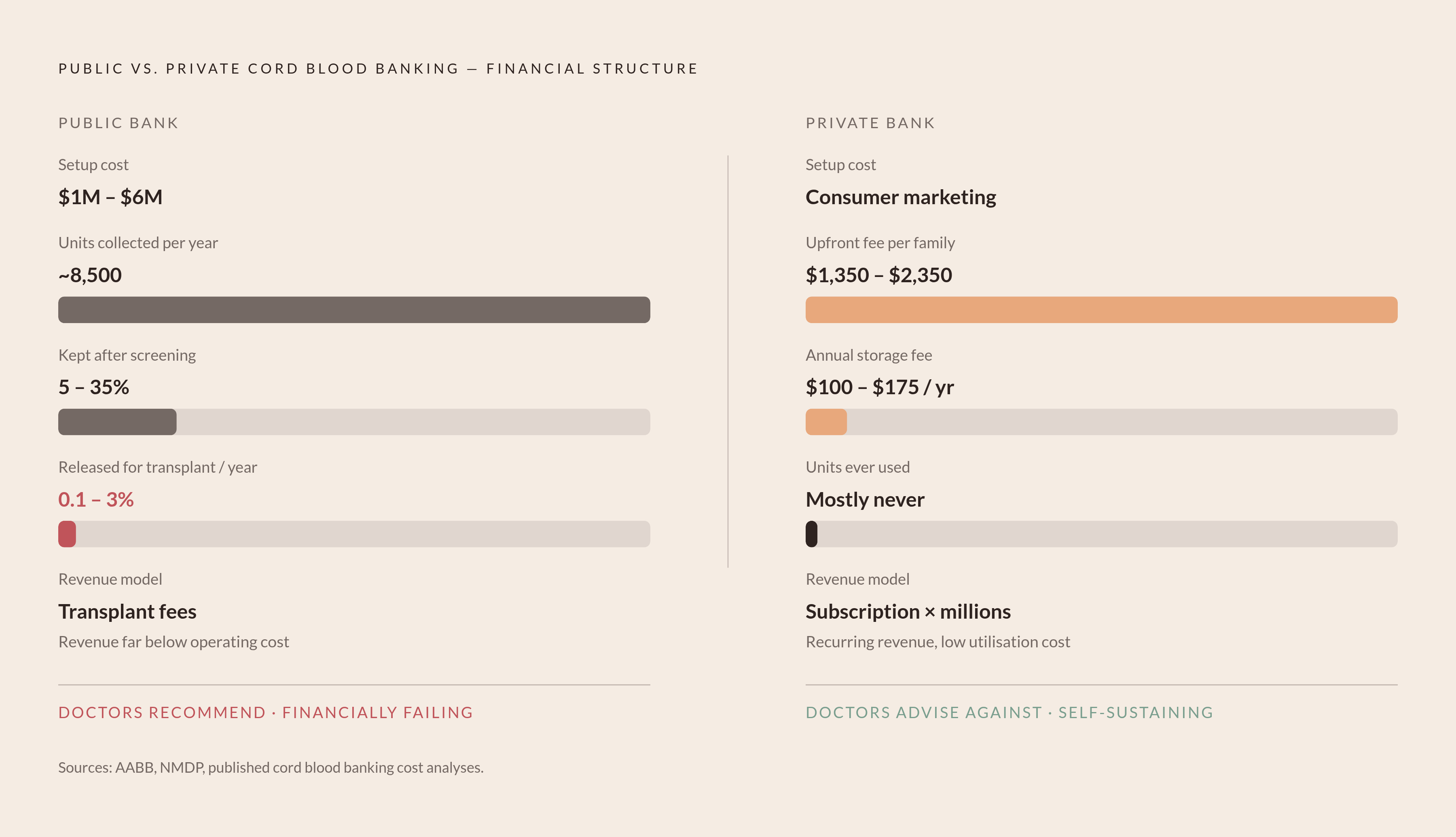
Public banks give cord blood away, free to any patient anywhere in the world whose tissue type matches. The American College of Obstetricians and Gynecologists endorsed this as the preferred model for transplant and immune therapy use back in 2019. Private banks charge families upfront, typically $1,350 to $2,350 for collection and processing, then $100 to $175 a year to keep the unit frozen, marketed as insurance against a future the family hopes never comes.
Here's the part that doesn't get said enough: public banking is financially brutal. Setting up processing, testing, storage, and licensing runs a bank somewhere between $1 million and $6 million. A mid-sized public bank might collect 8,500 units a year, but after quality screening, it keeps only 5% to 35% of them. Of what's actually stored, only 0.1% to 3% gets released for a transplant in any given year. The money that comes back from those releases doesn't come close to covering what it cost to build and run the operation. Government subsidies, grants, and donations fill the gap, and none of those funding sources are reliable or growing.
The quiet consequence is that public banks in multiple countries have stopped collecting new donations altogether. They're just managing what they already have, running down the clock on existing inventory rather than expanding it. It's a contraction that's happening mostly out of public view, since nobody holds a press conference to announce they've stopped doing something.
A hybrid model has started to emerge as a partial answer, blending private storage with an opt-in option to release units for public use, or splitting inventory so some units stay private while others go into the shared pool. Hybrid banks are projected to grow at a strong compound annual rate between 2023 and 2030. But the core tension hasn't gone away: the model that pays for itself is the one doctors recommend against for most families, and the model doctors recommend is the one that keeps running out of money.
How regulation and accreditation set the quality floor, and why the floor is uneven
The FDA classifies cord blood as a Human Cell, Tissue, and Cellular and Tissue-Based Product under Title 21 CFR Part 1271. For use in transplants between unrelated people, it also counts as a biological product, which means it needs a Biologics License before release. That's a meaningfully high bar, and public banks have to clear it. Private family banks don't. They only need to register with the FDA and submit to occasional surprise inspections, a far lower standard given that they're handling the same biological material.
Voluntary accreditation covers part of that gap, though not evenly. AABB accreditation is the baseline most established banks carry. FACT accreditation, from the Foundation for the Accreditation of Cellular Therapy, goes considerably further, auditing an entire program against clinical-use standards. It costs more to get and more to keep, and plenty of banks skip it.
A few states raise the bar on their own. New York, New Jersey, and California all require extra accreditation before a bank can legally collect cord blood from a patient in that state, no matter where the bank itself is headquartered. The American Academy of Pediatrics updated its policy in 2017 to require every banking program, public or private, to meet FACT standards or their equivalent, and to require any physician who gets a referral fee from a private bank to disclose it and file a yearly conflict-of-interest statement. The upshot for a family comparing banks: meeting FDA registration is a floor, not a credential. The real signal is FACT accreditation, state licensing where it applies, and whether the doctor recommending a bank is getting paid to do so.
The clinical criticism that private banking has never fully answered
Both ACOG and the AAP have said plainly that routine private cord blood storage isn't something they recommend for the general public. Their guidance carves out one real exception: when a family already has a child with a condition that a sibling's cord blood might treat.
The core biological problem is this: cord blood can't treat the same child's own genetic disease. Sickle cell disease and thalassemia come from mutations present in every cell that child has, including the ones sitting frozen in the bank. Storing your own cord blood to treat your own genetic disorder is storing the same defect you'd be trying to fix. A related problem shows up with certain leukemias, where the disease may already exist at a level too low to detect at birth, meaning the stored unit could reintroduce the very cancer it was meant to cure.
Even public banks, working with donated samples and strict screening for cell count and volume, end up discarding about 80% of what gets collected, because it doesn't meet the bar for clinical use. Not every unit of cord blood is usable, no matter who's collecting it or why. None of this erases the real, documented value cord blood has shown in treating a sibling or an unrelated patient with a non-genetic condition; the criticism isn't that cord blood lacks value, it's about who benefits from storing it and under what circumstances. Framed honestly, private storage is a narrow hedge against a specific set of scenarios, not a general medical safety net for a healthy child.
The competitive pressure from haploidentical transplants and what it means for cord blood's future
Bone marrow transplant medicine has moved in a direction that puts real pressure on cord blood's future role. Haploidentical transplants, using a half-matched donor, usually a parent, have become a favored option among oncologists treating blood cancers, and the appeal is obvious once you think about it: almost every patient has a parent available immediately, with no need to search a national inventory and wait for a match. Improvements in post-transplant drug protocols have also closed much of the GVHD gap that once gave cord blood its clearest advantage over bone marrow.
The data from transplant registries tracking global activity reflect that shift, with cord blood's share of total transplants declining as haploidentical procedures have grown. That doesn't mean cord blood is obsolete. It still matters most for patients, often children, with rare genetic and metabolic diseases where a half-matched parent isn't a safe substitute, and it remains the fastest option when a patient needs a transplant quickly and no adult donor is ready. But the era when cord blood was the default answer to "no matched donor" is over, and the industry built around it, public and private alike, is now competing for relevance in a transplant landscape that has other, faster options on the table.