Placenta Banking for Autologous vs Allogeneic Use
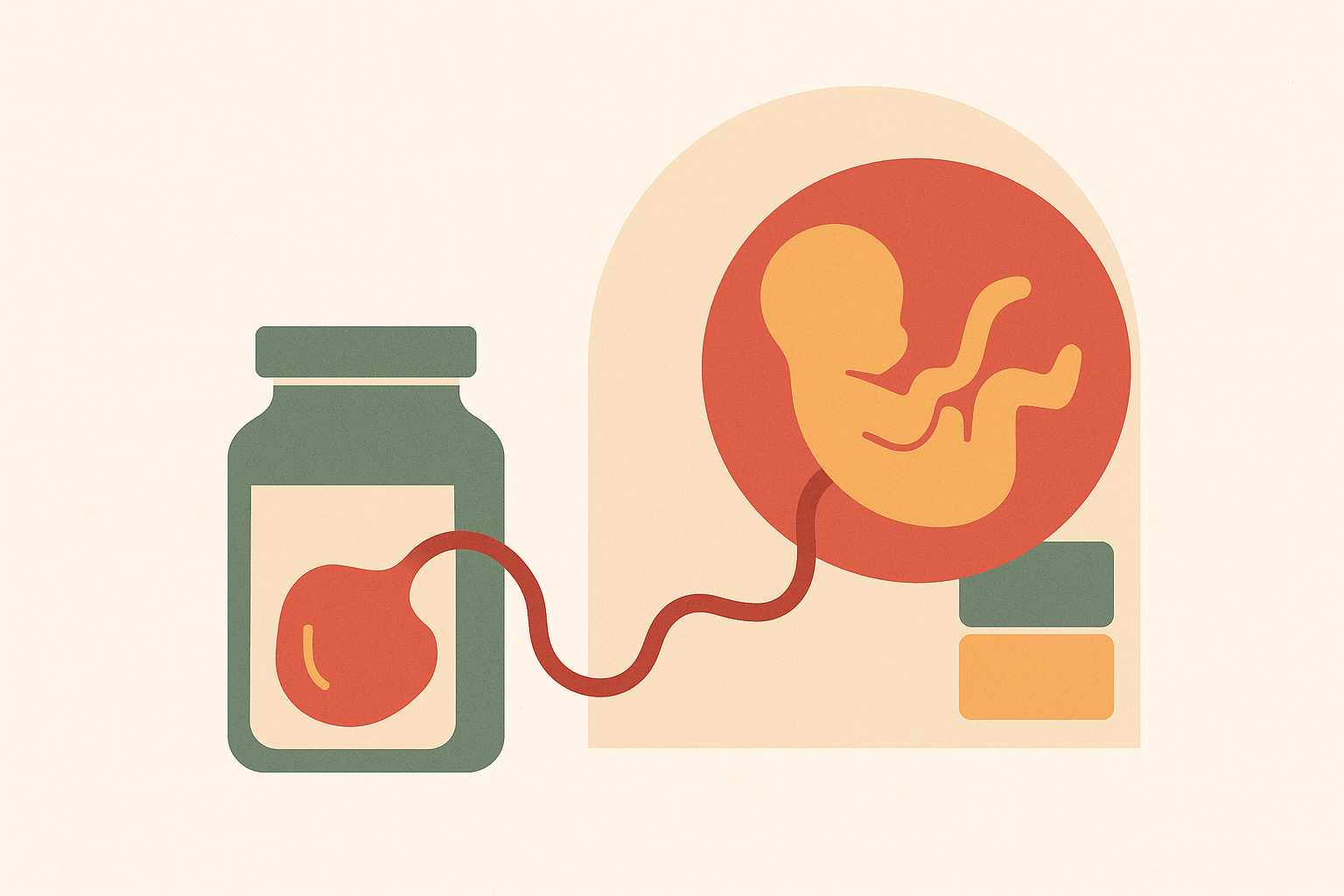
Two stem cell populations live in the placenta, and which one you bank, and for whom, sets up two different bets. One bet is personal: the cells are meant to come back to the same body they came from. The other is collective: the cells go into a shared pool for whoever needs a match. Autologous versus allogeneic sits underneath every banking decision a family makes, and the pamphlet from the maternity ward rarely explains the difference well enough for anyone to actually weigh it.
Start with the biology, since the marketing skips it. Mesenchymal stem cells, MSCs, live in the placental tissue itself, in the amnion and chorion layers, and researchers have spent years studying them for tissue repair, regeneration, and immune modulation. Hematopoietic stem cells, HSCs, concentrate in cord blood, and they've been the basis of FDA-approved treatments for blood and immune disorders since 1988. HSCs are the older, better-proven of the two. The placenta itself is a strange organ: it carries a maternal side and a fetal side at once, so a single collection pulls cells for the mother and cells for the baby in the same five minutes after birth. No needles near the newborn, but the window shuts fast and it does not reopen once the cord is cut and the placenta is delivered. Placental MSCs also land in a useful middle zone: more adaptable than adult stem cells, without the ethical weight that comes with embryonic ones. Two origins, maternal and fetal, two cell types, MSC and HSC, sitting in one organ at the moment of birth. Cord blood banking alone never had to carry this much complexity.
How autologous and allogeneic use differ as concepts before banking enters the picture
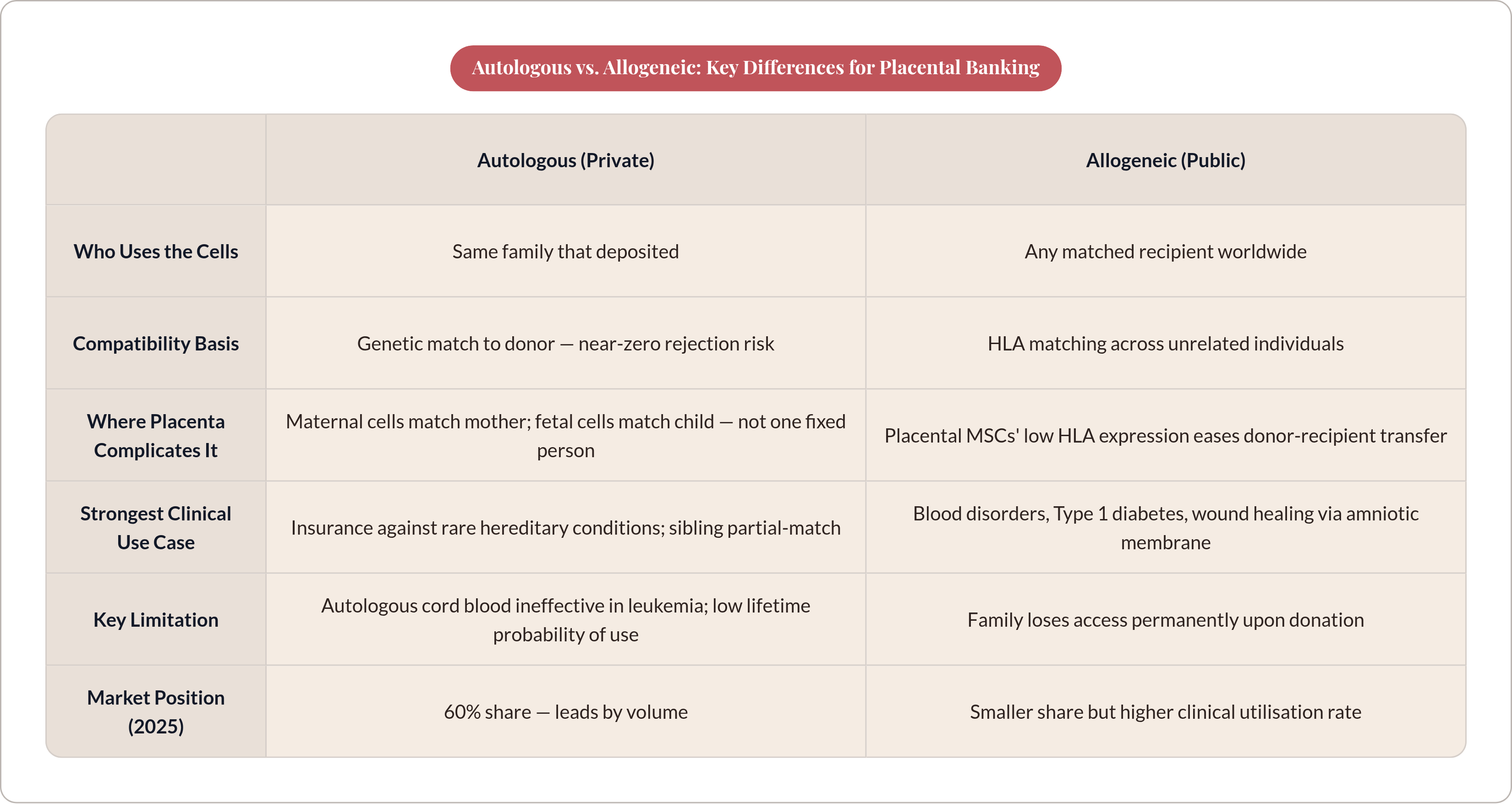
Autologous means the cells came from the same person who will eventually use them. The immune system reads them as self, so rejection risk is close to zero. Allogeneic means the cells came from someone else, related or not, and immune compatibility becomes the whole question the treatment rides on.
Those two paths pull banking in opposite directions. Autologous storage only has to serve one person, so preserving that individual's own material is the entire job. Allogeneic storage has to work for strangers it hasn't met yet, so the priority shifts toward broad availability and low immune reactivity instead. The placenta throws in a complication cord blood alone doesn't have: since the organ is part maternal, part fetal, "autologous" stops meaning one fixed thing. It depends whose cells you mean, the mother's or the child's.
Private banking as the autologous model and who it actually covers
Private banks store placental and cord tissue only for the family that paid to deposit it. Textbook autologous, on paper. But the brochures throw the term around loosely, and it's worth being precise about who actually matches what.
Placental tissue MSCs, the maternal component, match the mother genetically. Cord blood and cord tissue HSCs, the fetal component, match the baby perfectly and match siblings or parents partially. So one collection can serve several people in the family, just at different levels of match strength.
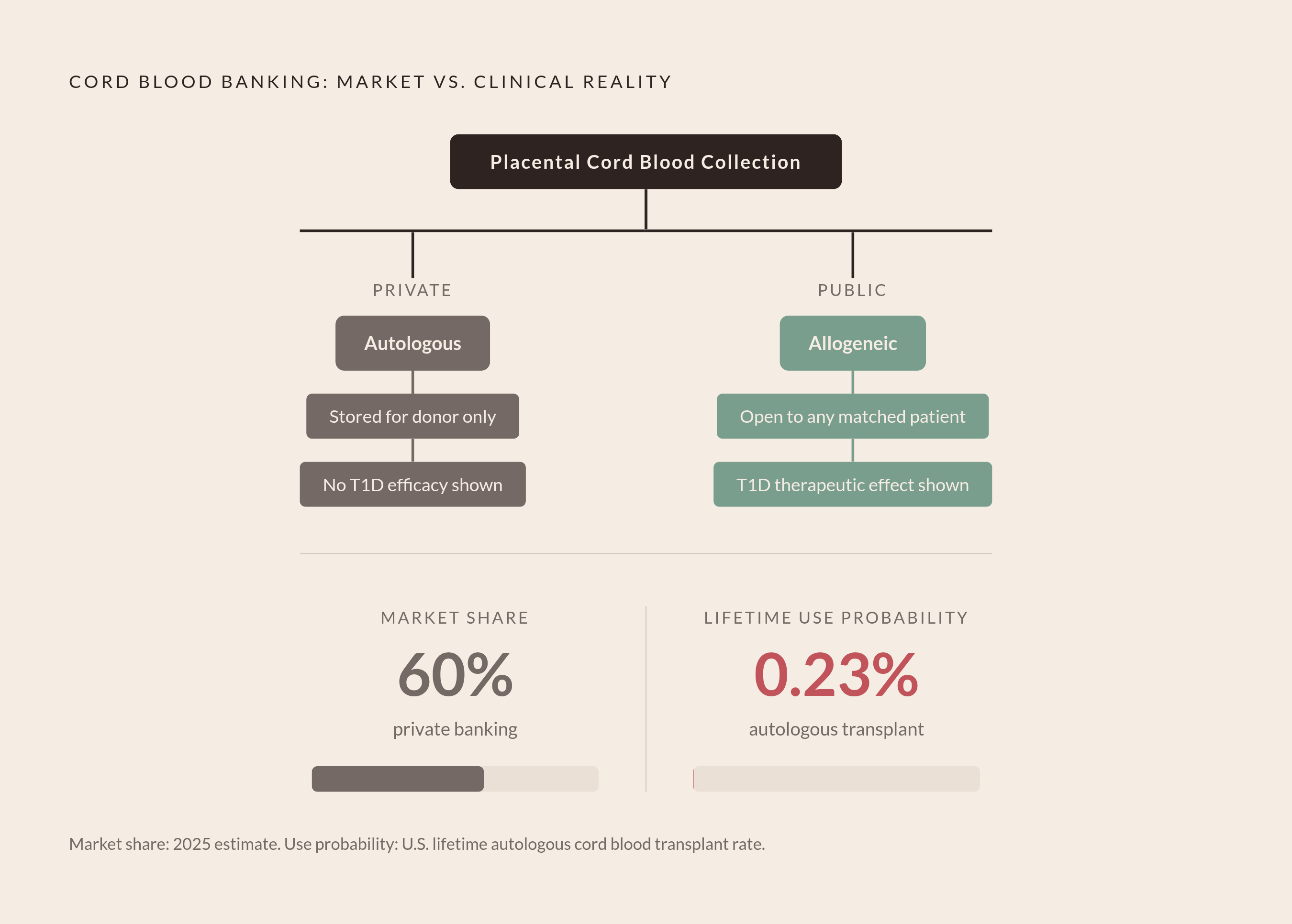
Now the numbers. Research published in Biology of Blood and Marrow Transplantation puts the lifetime probability of any autologous stem cell transplant in the U.S. at roughly 0.23%. That figure covers every currently approved indication and every stem cell source. It would rise if new therapies clear FDA approval, and it climbs further once you count sibling or parental use, since private banking in practice isn't purely autologous at all.
Leukemia is where autologous use fails even when the diagnosis lines up. Pre-leukemic mutations can already sit in banked cord blood before anyone's diagnosed, and relapse rates run high enough that clinicians generally reach for allogeneic transplants in acute leukemia no matter what's sitting in the family freezer. So the real pitch for private banking is insurance against long odds, held against an option that can't be recreated once the delivery window closes. It still lands with people. Private family banking held 60.15% of the stem cell banking market in 2025, according to Mordor Intelligence, low individual odds notwithstanding.
Public banking as the allogeneic model and what makes it clinically distinct
Public banks take donated placental and cord blood units, strip the identifying information, and make the unit available to whoever matches it. The family gives up exclusive access. In exchange, the unit joins a registry that can reach anyone.
Clinical use runs higher on the public side, and by a wide margin. Allogeneic transplants drawn from public registries outnumber autologous cord blood cases substantially, and the research literature on cord blood transplantation skews heavily allogeneic as a result.
Type 1 diabetes makes the point concretely. Allogeneic cord blood has shown a therapeutic effect. Autologous cord blood has not. The disease's own immune context explains why: donor cells do work the patient's own cells simply can't, since the patient's immune system is what's attacking the pancreas in the first place. Cerebral palsy doesn't split so cleanly. Both autologous and allogeneic cord blood have shown benefit there, one of the few conditions where the two models aren't clearly separated.
Amniotic membrane, a layer of the placenta, already works as a real example of allogeneic donation in clinical use today. It's rich in cytokines and growth factors, gets applied in wound healing and pain reduction, and carries almost no immunogenicity, so donor-to-recipient transfer skips the rejection problems other tissue transfers run into. Public placenta banking also does something structural: it helps close a documented shortage in bone marrow stem cell supply, giving patients without a matched donor another route to a match. That shortage is real and isn't shrinking fast. A Nature review counts roughly 450 public and private cord blood banks worldwide, a number that still trails demand, especially for patients from underrepresented ethnic groups who already struggle to find an HLA match.
Why placental MSCs are biologically suited to allogeneic use in ways that other stem cell sources are not
Immunoprivilege is the concept doing the work here. Fetal placental MSCs express low levels of HLA class I and skip HLA class II, HLA-DR, almost entirely, and those are the exact surface markers a recipient's immune system uses to flag foreign cells for attack. An unrelated recipient's immune system is far less likely to go after placental MSCs than it would cells pulled from most other adult donor sources.
That's a real structural edge over bone marrow MSCs, which need an invasive harvest and come in limited supply. Fetal placental MSCs expand across many generations without much senescence, the cellular aging that limits how far a cell line can be grown, which makes them a supply that can genuinely scale for allogeneic use rather than staying a boutique product for the few.
Exosomes push the advantage further. These are nanovesicles that placental MSCs release naturally, carrying proteins, lipids, and microRNAs as cargo. They aren't living cells and carry fewer surface antigens, so they trigger even less immune response than transplanting the parent cell would. That opens a real possibility: off-the-shelf, cell-free therapies built from donor placentas, cheaper and simpler to give at scale than transplanting cells directly. One well-matched donor placenta could generate therapeutic material for several unrelated patients, at a scale private banking's one-family-per-unit model was never built to reach.
Where placental MSC clinical trials currently stand, and what conditions they target
Nearly all the clinical evidence on placenta-derived MSCs so far comes out of allogeneic trial designs, not autologous ones. The trial landscape tells you which model researchers have bet on, and it isn't close.
Early-phase trials in secondary-progressive multiple sclerosis have investigated placenta-derived MSC transplants, with primary endpoints focused on safety and tolerability. Researchers have noted exploratory signals of clinical and immunological benefit, but early-phase studies aren't built to measure efficacy, so that question sits with later trials.
Separate early-phase trials in COVID-19 ARDS have tested allogeneic placenta-derived MSCs in ICU patients, with results pointing toward the approach being safe and feasible. Nothing more than that, yet.
Both trials are Phase 1, and Phase 1's job is safety, not proof the therapy works. Efficacy is a Phase 2 and Phase 3 question. The mechanistic thread running through MS, graft-versus-host disease, and inflammatory lung injury alike is the immunomodulatory property of MSCs: their ability to dial down inflammation in autoimmune and inflammatory conditions. What doesn't exist yet is any head-to-head trial pitting autologous against allogeneic placental MSCs directly. The field is inferring from two parallel tracks, not from a study that put them side by side.
Hybrid banking models and what they suggest about how the field is evolving
A growing number of banks now offer a middle path: families bank privately and keep priority access, but units that go unused get released to public registries after a set period or under specific conditions.
This solves a real tension. The units public registries need most, particularly from underrepresented ethnic groups, for the sake of matching diversity, are often the exact units families in those same groups are most motivated to keep for themselves. Verified Market Research frames hybrid models as part of a broader shift toward healthcare that's "patient-centric and community-focused," language that marks a real pivot away from the pure private-insurance pitch these banks used to lead with.
The placenta's dual structure makes hybrid banking work in a way cord blood alone never could. Maternal cells and fetal cells are biologically distinct, so banking both from a single delivery gives a family autologous coverage for the mother through placental MSCs, plus autologous-for-the-child and partial-match coverage for siblings through cord blood and cord tissue. One collection, two purposes, no forced choice at the delivery bed. Market data backs the trend up: private banking still leads at 60.15% share in 2025, but the fastest growth is happening in Asia-Pacific, at a projected CAGR of 16.67% through 2031, where family size and healthcare infrastructure are pushing hybrid arrangements forward faster than anywhere else.
What families are actually deciding when they choose how to bank
Underneath all of it, the decision comes down to who you want to preserve access for, and how sure you need to be about compatibility before you commit money and tissue to one path.
A few variables actually move that answer. A known hereditary condition in the family that might benefit from stem cell therapy tips things toward private banking. An ethnic background underrepresented in public registries makes the allogeneic match problem genuinely harder, so banking privately guarantees at least a partial match within the family when a public search might turn up nothing. Maternal health belongs on this list too, since placental tissue MSCs match the mother rather than the child; banking that tissue is a decision about her, separate from whatever gets decided about the baby's cord blood.
Donation carries a cost that's easy to overlook. Give a unit to a public bank, and access is gone for good. It might save a stranger's life. It might sit unused. Either way, there's no opting back in later. Private banking carries its own honest cost: holding a unit doesn't guarantee a clinical indication will ever arise for it, and that 0.23% lifetime autologous transplant probability is worth weighing against what storage fees add up to over eighteen or twenty years.
The pipeline is still the open question. Active research into placental MSCs for autoimmune disease, neurological repair, and cell-free exosome therapies means families banking today may end up holding material against indications that lack FDA approval now but could earn it inside the storage window. Some banks already offer both cord blood and placental tissue collection at once, maternal and newborn samples taken side by side in the same delivery. That arrangement lets a family cover the autologous case and the partial-match allogeneic case together, without forcing an either-or decision in the delivery room.