Autologous vs Allogeneic Cord Blood Transplant Decision Criteria
Disease biology, not patient preference.
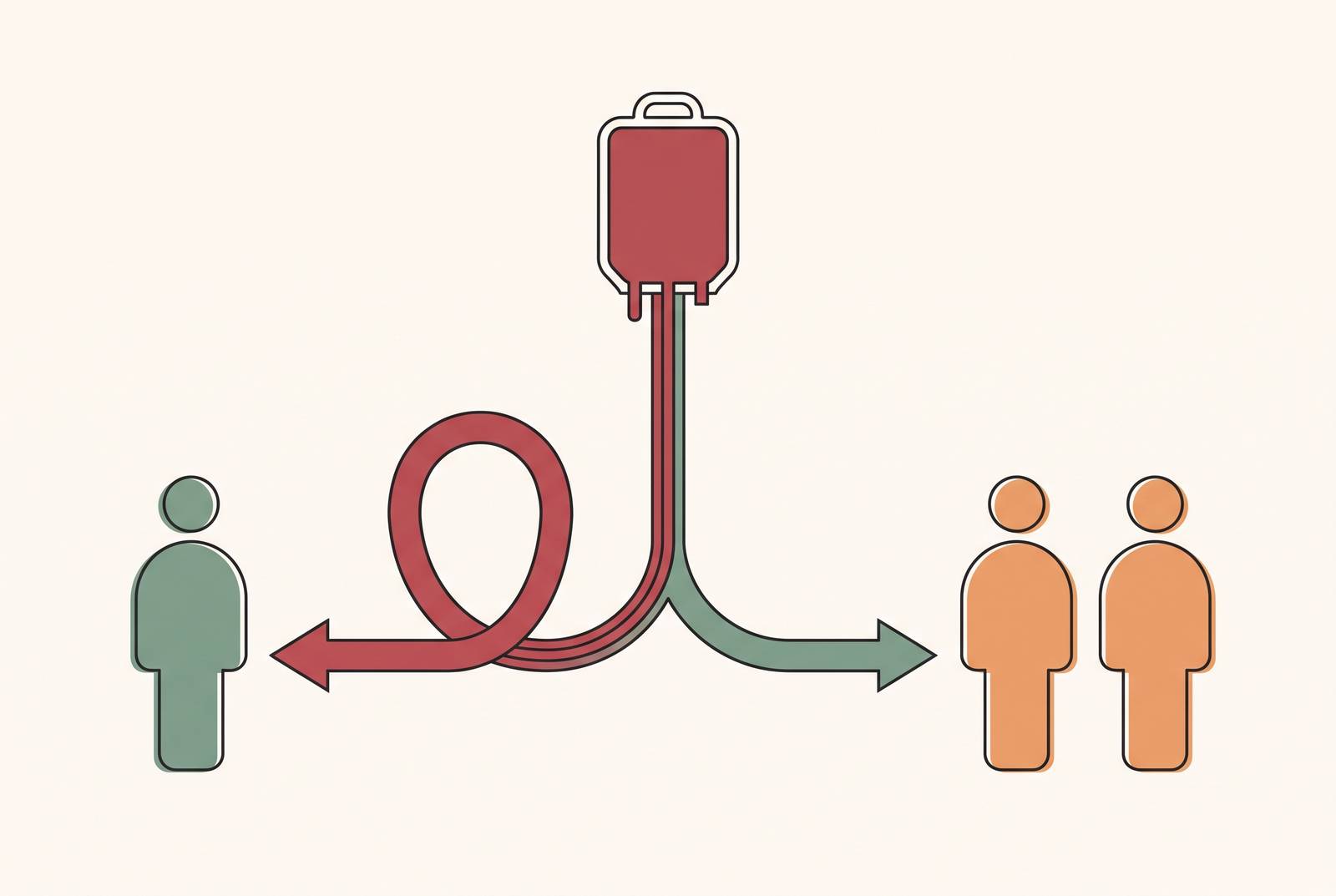
Families facing a stem cell transplant decision often frame it as a single choice: autologous or allogeneic, the patient's own cells or a donor's. That framing misses what actually separates the two approaches. Autologous and allogeneic transplant exist to do different jobs, and which job a patient needs is decided by the disease itself, not by preference or convenience. The two paths converge only for a narrow band of conditions where either approach can reasonably work. For everything else, the disease has already made the decision before a patient or family gets involved.
Autologous hematopoietic stem cell transplant, in mechanistic terms, is high-dose chemotherapy paired with marrow rescue. The patient's own previously collected cells restore blood production after chemotherapy wipes it out, but they add no anti-tumor immune effect of their own. Allogeneic transplant adds something autologous transplant structurally cannot: a donor-derived immune system that can continue hunting malignant cells after the chemotherapy has done its part. That immune activity is called the graft-versus-leukemia, or graft-versus-lymphoma, effect, and it comes bundled with a real cost, graft-versus-host disease and a heightened infection risk, a tradeoff described in an August 2026 state-of-the-art review in the Journal of Clinical Medicine.
For malignancies where leftover disease is the main danger after chemotherapy, the choice of graft type is really a choice about whether that ongoing immune surveillance is needed. For non-malignant conditions, that question doesn't apply at all, and the decision turns entirely on safety and how reliably the graft will take hold. Families researching cord blood most often treat private autologous banking as if it could stand in for allogeneic transplant planning, and that's the single most common misunderstanding they run into. The two serve different biological purposes, and no amount of careful banking changes that.
The graft-versus-leukemia effect and why it cannot be reproduced with the patient's own cells
The reason allogeneic transplant cures hematologic malignancies rests on a specific biological event: donor immune cells recognize residual malignant cells in the recipient's body as foreign and destroy them. That recognition is what autologous grafts cannot provide, by definition, because the donor and the recipient are the same person, and a person's own immune cells were already circulating in that body before transplant without clearing the disease.
Graft-versus-leukemia and graft-versus-host disease are two outputs of the same donor immune activity, one aimed at malignant cells and the other at healthy recipient tissue. Researchers have not yet found a reliable way to fully separate the beneficial immune response from the harmful one, and that unsolved problem is why allogeneic transplant carries a level of expected morbidity that autologous transplant does not, a point the 2026 Journal of Clinical Medicine review returns to directly. Leukemia and lymphoma are particularly responsive to this immune-mediated attack, which is part of why the graft-versus-tumor effect ranks among the most clinically important advantages allogeneic transplant holds over autologous transplant for these diseases.
A second problem compounds the first when autologous transplant is considered for leukemia specifically. Cells collected from a patient and banked for later use may already carry pre-malignant changes, invisible at the time of collection. Reinfusing those cells risks reintroducing the very disease the transplant is meant to treat. Donor cells from a healthy, unrelated or related individual carry no such risk, because they never passed through the patient's body. That contamination risk, paired with the absence of any graft-versus-leukemia effect, is why autologous transplant is excluded from the curative pathway for most leukemias, and it sets up a different question: where autologous transplant still makes clinical sense.
Diseases that do not require GVL
Autologous transplant is the right tool for a specific set of problems where the donor immune response that defines allogeneic transplant simply isn't needed. Certain lymphomas in chemosensitive remission, multiple myeloma, some solid tumors, and a number of autoimmune conditions fall into this category. In each case, the goal of transplant is to deliver chemotherapy at a dose the body couldn't otherwise survive, then rescue blood production with stored cells. No ongoing immune surveillance against residual disease is required, so there's no reason to accept the risks that come with a donor graft.
This tradeoff appears directly in outcomes. Treatment-related mortality after autologous transplant runs materially lower than after allogeneic transplant, a gap the 2026 Journal of Clinical Medicine review documents as one of the clearest clinical justifications for choosing autologous transplant whenever the graft-versus-leukemia effect isn't medically necessary. Choosing autologous transplant for these conditions is the appropriate match between mechanism and disease. The same logic extends into non-malignant territory, where researchers are evaluating autologous cord blood for regenerative and neuroprotective uses in neurological conditions, an area governed by a different set of biological mechanisms, and one this piece returns to later.
The 2026 review frames this as clinicians increasingly asking not whether to transplant at all, but which donor, which conditioning regimen, which bridging therapy, and which maintenance plan after transplant fit a given patient. But that framing only holds once the disease biology has settled whether autologous or allogeneic transplant applies. Once a patient's disease has pointed toward the allogeneic path, a new and more granular set of decisions begins.
Donor selection criteria for the allogeneic pathway once GVL is established as necessary
Deciding that a patient needs the graft-versus-leukemia effect doesn't end the decision-making there. It opens a new layer of choices, each one tied to a specific, measurable factor that affects outcome. HLA matching between donor and recipient sits at the center of this, alongside donor age, CMV serostatus, and sex mismatch, where a female donor paired with a male recipient carries a higher risk of chronic graft-versus-host disease. In haploidentical transplants, clinicians also screen for donor-specific anti-HLA antibodies, since their presence raises the risk of graft failure.
For years, the order of preference among donor types followed a fixed hierarchy: an HLA-identical sibling first, a matched unrelated donor second, and any alternative donor, including haploidentical relatives and cord blood, a distant third. That hierarchy has flattened considerably with the adoption of post-transplant cyclophosphamide, a conditioning approach that the 2026 Journal of Clinical Medicine review found has brought outcomes across matched sibling, matched unrelated, and mismatched alternative donors much closer together. Cord blood sits inside this newly flattened landscape as one alternative donor source among several, and a direct comparison of cord blood allogeneic transplant against mismatched unrelated donor transplant with post-transplant cyclophosphamide in acute myeloid leukemia speaks to exactly where cord blood lands among those alternatives.
This matters because a large share of patients never get the option of a perfectly matched sibling donor. HRSA Blood Stem Cell data show that 75% of patients who need a transplant don't have a fully matched donor in their own family, so the alternative donor landscape, cord blood included, matters to most people walking the allogeneic path. Decision-making in this space has also become more dynamic than it once was. Measurable residual disease monitoring now feeds directly into timing and donor choice, turning what used to be a single pre-treatment decision into a process that responds to how a patient's disease is actually behaving, a shift the 2026 review describes as part of modern transplant practice.
Where cord blood fits as an allogeneic source
Within the alternative donor landscape, cord blood occupies a specific and well-defined position. It tolerates a greater degree of HLA mismatch than an adult unrelated donor would, while still preserving the graft-versus-leukemia effect that makes allogeneic transplant curative. So cord blood can be a clinically viable option if a patient lacks a matched donor, and it carries particular weight for patients from ancestry groups still underrepresented in adult donor registries, where a closely matched unrelated adult donor can be far harder to find.
The tradeoff that comes with cord blood in this role is engraftment speed. Compared with peripheral blood stem cells, unmanipulated cord blood units have historically recovered neutrophils and platelets more slowly, and that delay has long been the central limitation clinicians weigh against cord blood's matching flexibility. So when you compare cord blood allogeneic transplant against mismatched unrelated donor transplant with post-transplant cyclophosphamide in acute myeloid leukemia, you get a concrete head-to-head picture of how cord blood performs against the current standard, in exactly the setting where the graft-versus-leukemia effect matters most.
The broader transplant field has been moving even as these comparisons accumulate. The 2023 EBMT report documents an increased use of allogeneic transplant for myeloid malignancies and continued growth of CAR-T therapy, developments that have come partly at the expense of autologous transplant volumes. That is the backdrop against which cord blood, as an allogeneic source, both competes with other alternative donor options and complements them. Every discussion in this section concerns cord blood used in someone other than the person it came from, a publicly donated unit or a family member's unit used for a sibling, not the donor's own future use. That distinction is where the next, and most commonly misunderstood, question begins.
Privately banked autologous cord blood is not a substitute for allogeneic transplant in the malignancy setting
Families working with cord blood banks like Anja preserve cells at birth as an elective option, but the choice between autologous and allogeneic transplant later on is a separate, disease-driven medical decision that follows from the mechanisms described above. A privately banked unit, collected from a child at birth and stored for that same child's possible future use, cannot stand in for allogeneic transplant if that child later develops a hematologic malignancy. Two distinct mechanical problems explain why, and both were laid out earlier in this piece. A private autologous unit provides no graft-versus-leukemia effect, and it may carry pre-malignant cells that were already present in the child's blood at birth. These are precisely the two problems that make an allogeneic graft medically necessary for these diseases.
The absence of a graft-versus-leukemia effect from an autologous unit is a structural feature of using the patient's own cells, not a processing shortfall that a better lab or a more careful collection protocol could fix. The graft-versus-leukemia effect depends on donor immune cells recognizing the recipient's malignant cells as foreign, and that recognition cannot happen when donor and recipient are the same person, no matter how the sample was collected, frozen, or thawed.
Clinical guidelines reflect this distinction. The Optum clinical guidelines spell out, disease by disease, which transplant type counts as medically necessary and which does not, so you get a concrete picture of where clinical consensus has settled between autologous and allogeneic appropriateness. That consensus diverges in places from how private cord blood banking is sometimes marketed to new parents, and that divergence reflects documented disagreement among clinicians and professional societies about the strength of the evidence for malignancy indications, not an open scientific question still awaiting resolution. None of this makes private banking without value. It means the value lies elsewhere, in the applications the next section covers.
The emerging non-malignant case for autologous cord blood
Autologous cord blood has a genuine and separate line of evidence building around non-hematopoietic applications, particularly neurological conditions like cerebral palsy. The mechanisms under study here, paracrine signaling and immune modulation, have nothing to do with restoring blood production or mounting a graft-versus-leukemia response. They ask whether a child's own banked cells can support tissue repair or calm an overactive immune response in the brain, and that's a different question than the one malignancy treatment asks.
Research in this area has been expanding into populations it hadn't previously reached. The CORD-SaFe study, published in eBioMedicine in 2025, tested whether collecting, processing, and administering autologous cord blood was feasible in extremely preterm infants, a group where this kind of intervention had not been studied before. A 2026 individual-participant-data meta-analysis, cited in the Journal of Paediatrics and Child Health, suggests that researchers may eventually be able to identify which patients respond best to autologous cord blood therapy. If that kind of prediction holds up, clinicians could point specific at-risk families toward private banking with real confidence. Standardized criteria for identifying those best responders don't exist yet.
The honest state of the evidence sits between two extremes. Safety and feasibility in term and moderately preterm infants are established. Efficacy across broader populations is still being worked out, and the regulatory framework for these non-malignant, regenerative uses is substantially different from the one that governs transplant for malignancy. Families weighing private banking for these reasons are weighing a real but still-developing body of evidence, not a settled standard of care, and not a substitute for the kind of registry access that malignancy treatment depends on.
Applying these mechanisms to a banking or transplant decision today
The mechanisms covered in this piece point to a fairly direct framework for families trying to make sense of their options. If the concern driving the decision is future hematologic malignancy, leukemia or lymphoma, the asset that matters is access to a public allogeneic registry or a matched family donor, not a privately stored autologous unit. If the concern is a non-malignant or regenerative application, private autologous banking carries a real and growing rationale, with its strength conditioned on the specific disease in question and on the evidence base described above, which is still maturing.
Two circumstances currently make the case for private banking strongest. A family history of a non-malignant condition with established autologous cord blood evidence behind it is one. Membership in an ancestry group underrepresented in adult donor registries is the other, since a privately banked family unit can, in that situation, serve an allogeneic function for a sibling rather than an autologous one for the donor child, bridging exactly the matching gap described earlier in the donor selection discussion.
If a family is considering autologous cord blood banking, preserving a child's own cells at birth for possible future regenerative or non-malignant use, they should know the rationale rests on avoiding graft-versus-host disease and on the lower treatment-related mortality that comes with autologous procedures, so banking can be a reasonable hedge when the graft-versus-leukemia effect was never going to matter. Anja is one of the services operating in this space, collecting and storing cord blood at birth as an elective option that families weigh independently of the separate medical decision that follows if and when treatment becomes necessary. This piece has laid out the mechanism-level reasoning that should guide whichever decision a family reaches: what graft-versus-leukemia does, why autologous cells cannot replicate it, and where the evidence for autologous cord blood's other uses currently stands.
Sources
- The 2023 EBMT report on hematopoietic cell transplantation and cellular therapies. Increased use of allogeneic HCT for myeloid malignancies and of CAR-T at the expense of autologous HCT
- Indications for Autologous and Allogeneic Hematopoietic Stem-Cell Transplantation in Adults: State of the Art
- Frequently Asked Questions (FAQ) - Blood Stem Cell - HRSA
- Allogeneic hematopoietic cell transplantation with cord blood versus mismatched unrelated donor with post-transplant cyclophosphamide in acute myeloid leukemia
- Indications for haematopoietic cell transplantation and CAR-T for haematological diseases, solid tumours and immune disorders: 2025 EBMT practice recommendations