Why Cord Blood Banking Costs Differ So Much Between Banks
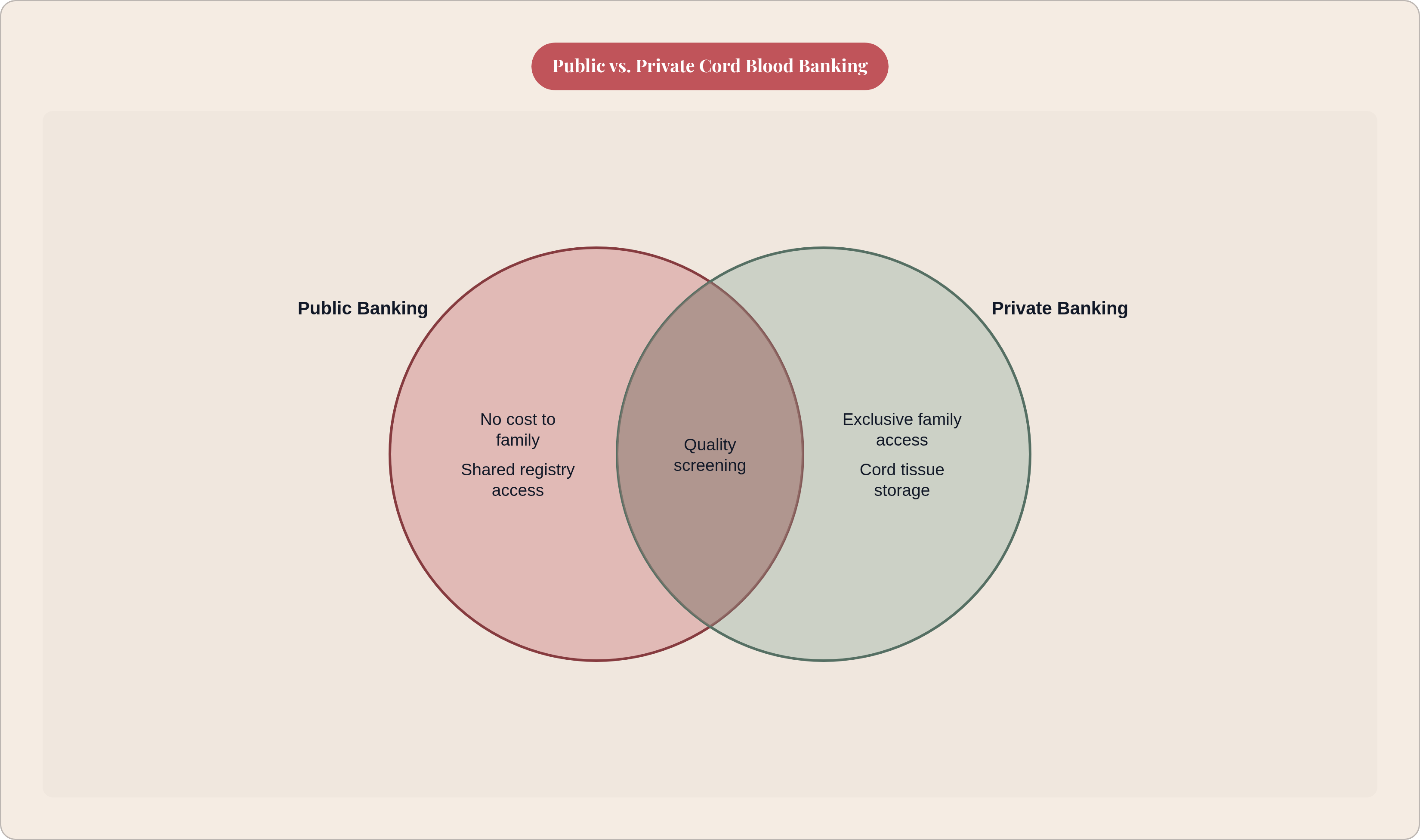
Public banks are free but discard most units; private banks charge thousands but guarantee access.

The first decision a family faces is whether to donate cord blood to a public registry or store it privately. That choice is the largest single variable in cost, because public donation carries no fee to the family.
Public banks operate on federal and private funding. A donated unit enters a shared registry and becomes available to any matched patient, functioning much like a public blood bank. No bill arrives. What does arrive is a complete relinquishment of rights to that unit, with no guaranteed access if a family member later needs it.
The economics on the public side are worth understanding plainly. Operating costs for nonprofit public banks run between $1 million and $6 million annually when processing, testing, storage, and licensing are fully accounted for. Those costs are absorbed by institutions and grants, not families. The tradeoff is approximately 70% of publicly donated units are ultimately discarded because they fail to meet clinical volume or quality thresholds. That's a high attrition rate, and it matters to the donation calculus in ways families rarely hear about before committing.
Private banking guarantees the family exclusive access to their unit. Upfront fees range broadly from $1,500 to $3,000 across the market, with annual storage fees typically running $150 to $300. The cost difference is real. So is the difference in what the family is actually purchasing: access, exclusivity, and a unit that wasn't discarded in the first round of quality screening.
The public versus private choice isn't purely financial. It's a decision about who the cord blood is for and how reliably it will be available if ever needed. What follows concerns families who have made the private banking decision and are now trying to compare banks on something more defensible than advertised price.
The three components that make up every private bank's price
Every private bank's total cost is built from the same three structural components: collection and shipping, processing, and ongoing storage. The variation in how banks price, bundle, and describe these components is itself a significant source of apparent price differences, and families who don't know to look for it will misread the comparison entirely.
Collection kit and shipping
The collection kit contains the specialized equipment a healthcare provider uses to collect cord blood at delivery. Some banks bundle this cost into the processing fee; others itemize it separately at $100 to $300. Neither approach is inherently superior, but itemized billing means families need to verify whether rush shipping fees or hospital-specific courier charges apply before enrollment. These are exactly the line items that generate surprises.
Processing fee
Processing is the largest upfront variable in private cord blood banking, ranging widely depending on the bank. It covers the lab work required to separate, characterize, and prepare stem cells for long-term cryogenic storage. This isn't a commodity step.
Specific quality testing carries known cost benchmarks: CD34 cell counts run approximately $150 to $200 per unit, nucleated cell recovery rate testing approximately $35 per unit, and bacterial and fungal contamination screening approximately $75 per unit. A bank that performs all three on every sample knows what it's storing. A bank that omits or shortcuts these steps will show a lower processing fee while storing a less thoroughly evaluated unit. The price difference reflects that directly.
Storage fees
Annual storage fees, typically in the low hundreds of dollars, cover cryogenic facility infrastructure, continuous monitoring, regulatory compliance, and the logistics of releasing a unit when needed. This component carries the longest financial exposure in the banking relationship. A low annual fee quoted at enrollment isn't necessarily the fee a family pays in year ten or year fifteen, and many contracts allow the bank to revise fees with limited notice.
The way these three components are packaged, whether bundled or itemized, annual or prepaid, is itself a major driver of apparent price variation between banks.
How fee structure alone can make identical services look very different in price
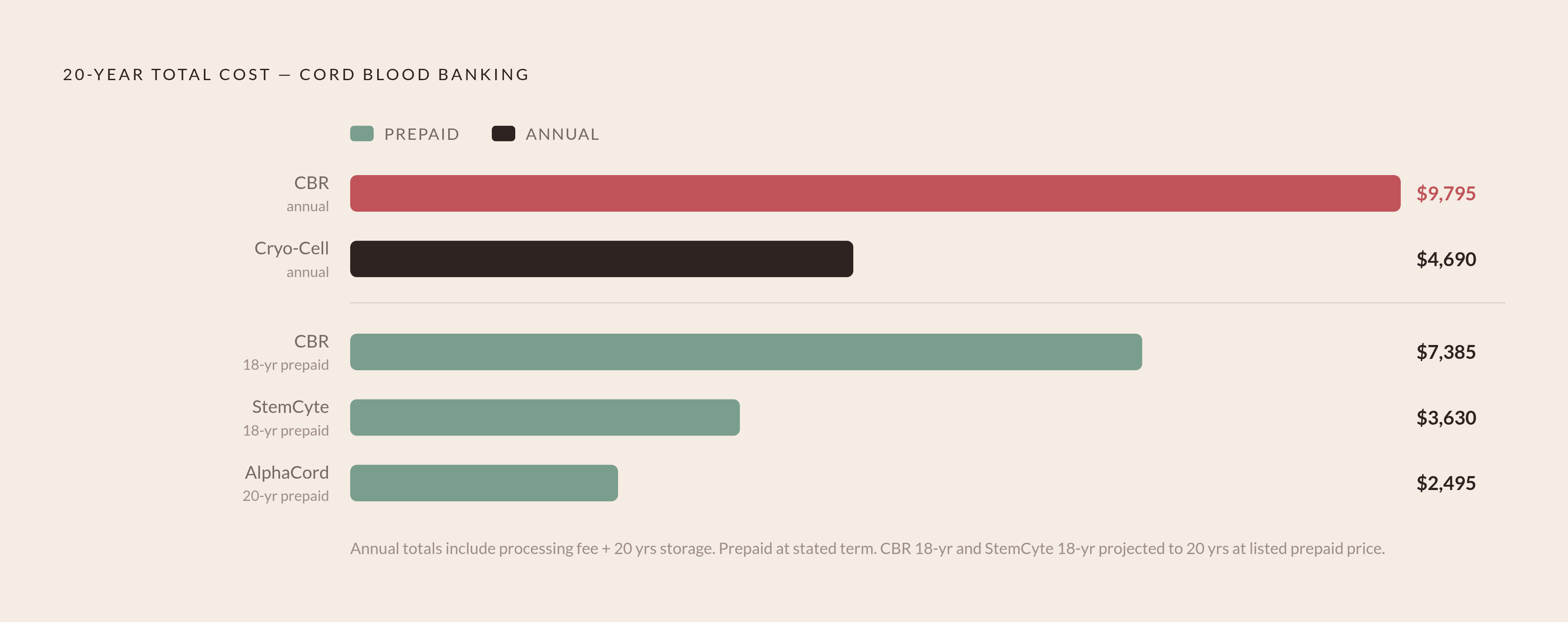
Two banks can charge for genuinely equivalent services and produce advertised prices that look nothing alike, depending entirely on how they structure fees across time.
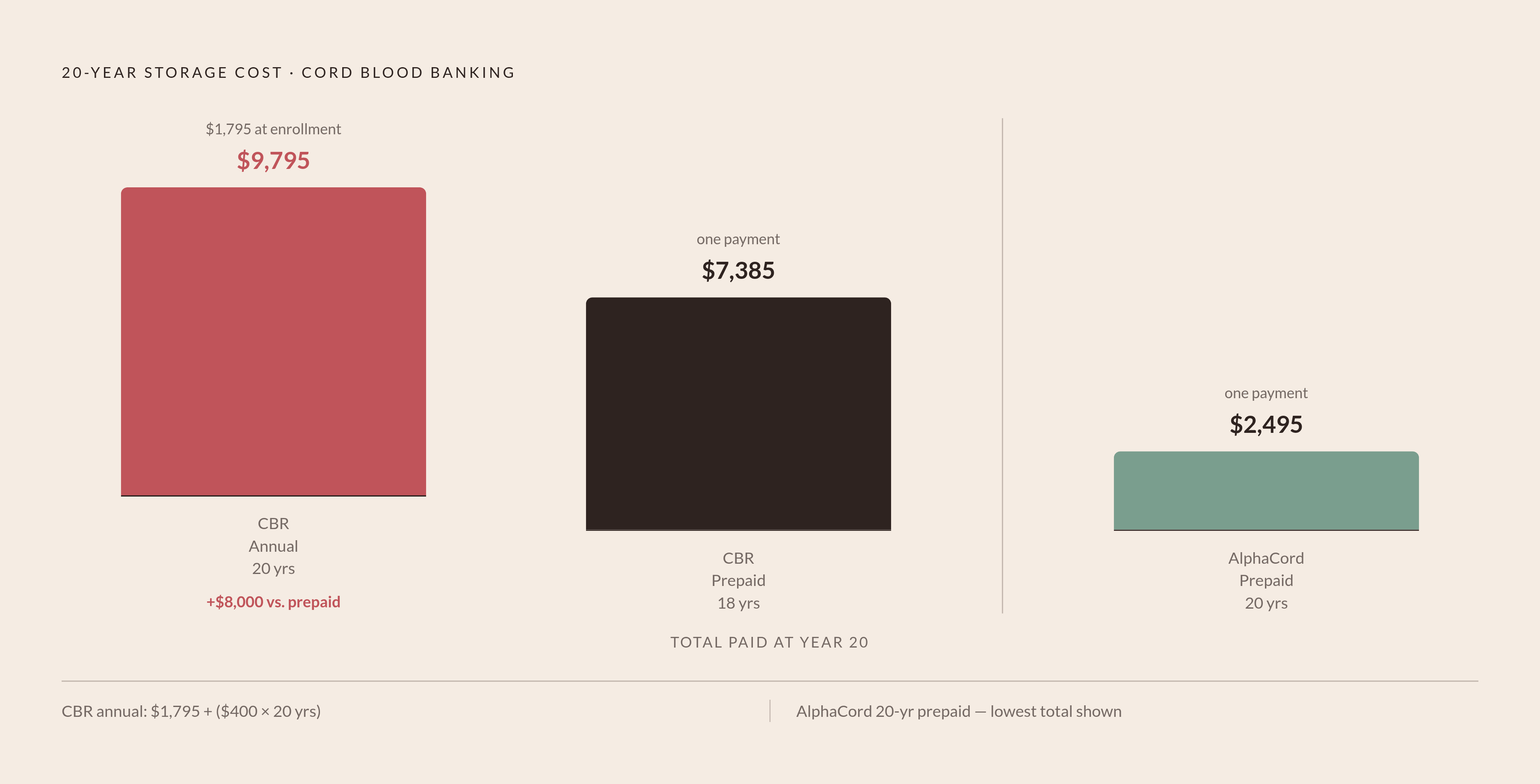
The annual model offers a lower sticker price at enrollment. Storage fees then accumulate over the life of the contract, and many agreements allow the institution to adjust annual fees at its discretion. A fee of $175 per year over a 20-year storage period totals thousands of dollars in storage costs alone, before processing is included. That figure is easy to underestimate at enrollment when the immediate out-of-pocket cost feels modest.
The prepaid model requires a larger upfront payment but eliminates exposure to future fee increases. Over a long storage horizon, prepaid plans frequently yield meaningful savings compared to annual billing, plus contractual price certainty.
Current pricing across U.S. private banks illustrates how wide the spread is in practice. Cryo-Cell offers processing from $710 with annual storage at $199. StemCyte prices processing at $795 plus $200 per year, or $3,630 for an 18-year prepaid plan. AlphaCord's first-year bundle starts at $995, then $150 per year, with a 20-year cord blood package from $2,495. MiracleCord offers a monthly plan from $99 per month with annual storage ranging from $165 to $330. CBR's most popular annual option starts at $1,795 upfront and then $400 per year; an 18-year prepaid runs $7,385; lifetime storage is $11,385.
A lower advertised price isn't always a lower lifetime cost. The comparison only means something when run over the same intended storage horizon, using the same fee model.
How processing method affects what families are actually buying for their money
Processing is where stem cells are separated, tested, and prepared for cryogenic preservation. The quality of this step determines the viability and therapeutic potential of the stored unit. Two banks charging very different processing fees aren't offering a premium and a discount version of the same thing; they're producing meaningfully different outcomes for the cells they store.
Two broad processing approaches exist in the market. Automated systems process samples faster and more consistently, reduce variability introduced by human technique, and suit high-volume operations. Cost efficiency flows to the bank, and some of that efficiency passes to families in lower fees. Manual processing is designed to maximize stem cell recovery from each individual sample. It's labor-intensive and more expensive, but the goal is a higher-yield unit rather than throughput.
The processing fee is, in part, a proxy for which of these approaches a bank uses. A $500 fee and a $2,000 fee reflect genuinely different methodological commitments. Families can't audit a bank's lab practices directly, which is precisely why accreditation carries such practical weight in this decision.
The quality testing steps — CD34 counts, nucleated cell recovery measurement, contamination screening — are where a bank's commitment to characterizing what it stores becomes visible in the pricing. A bank that performs all three is representing, in effect, that it knows what it stored and why it should be viable. A bank that skips steps isn't making that representation, regardless of what its marketing materials say.
What accreditation actually costs banks and why it affects what families pay
FDA registration is mandatory for all private cord blood banks operating in the United States. It's also the floor, not the ceiling. Processing techniques and quality standards above that floor vary considerably and aren't federally mandated to converge.
Two voluntary accreditation bodies define the quality standard above the regulatory minimum. The AABB focuses on quality management and technical standards, with evaluations conducted every two years. FACT emphasizes clinical outcomes and sets a meaningful barrier to entry: a bank must have stored at least 500 units before it's even eligible for inspection. These aren't nominal distinctions. They represent independent third-party verification that a bank's practices meet a defined and externally audited benchmark.
Accreditation carries direct operational costs that are absorbed into a bank's pricing structure. FACT charges a substantial one-time application fee. Annual accreditation fees run several thousand dollars annually for banks holding up to a certain number of units, and somewhat more for larger banks. A bank maintaining dual accreditation with both AABB and FACT absorbs both cost streams continuously.
A bank without accreditation isn't automatically providing inferior storage. But families don't have independent third-party verification of its practices. Accreditation status is one of the few pieces of objective information a family can verify before enrolling, and it often sits invisibly inside what looks, from the outside, like a simple price difference.
How bundled services, cord tissue, placenta, and exosomes, expand both scope and cost
The cord blood banking market has matured beyond cord blood alone. Banks now offer collection and storage of cord tissue, placental tissue, and in some cases exosomes alongside cord blood. Each addition is a distinct biological product with its own processing requirements, testing protocols, and storage volume. Each one adds cost, and it should.
Cord tissue contains mesenchymal stem cells, which differ from the hematopoietic stem cells found in cord blood. MSCs are the subject of active regenerative medicine research, and their therapeutic applications are distinct from those of cord blood. Public banks don't store cord tissue, making this a private-banking-only option by definition.
Bundled plans show clearly how service scope drives total cost. AlphaCord's cord blood and tissue bundle starts at a higher price point, compared to $2,495 for cord blood alone. That $1,200 difference reflects what a second distinct tissue type actually costs to collect, process, and store. Bundle discounts exist across most banks, with combined plans typically priced below the sum of each service purchased separately, but the absolute cost is still higher than cord blood alone because the scope of service is genuinely larger.
A cord-blood-only quote from one bank set against a bundle quote from another isn't a comparison of equivalent products. Families should decide which biological materials they want preserved before beginning price comparisons. Without that decision made first, the numbers don't mean what they appear to mean.
The questions that turn a price comparison into a like-for-like evaluation
A lower price can reflect any of several realities: a leaner and genuinely efficient operation, a less thorough process, fewer services, or simply a different payment model. The numbers alone won't tell you which. Only precise questions can.
On fee structure: what's the all-in cost over the actual intended storage period, not just the first year? Is the annual storage fee contractually fixed or subject to increases at the bank's discretion? Does the quoted price include the collection kit and courier, or are those billed separately?
On processing and quality: does the bank perform CD34 cell counts, nucleated cell recovery measurement, and contamination screening on every unit? What processing method does the bank use, and what cell recovery rates does it report as a typical outcome?
On accreditation and compliance: is the bank AABB-accredited, FACT-accredited, or both? When was the most recent review? Is the bank FDA-registered?
On service scope: does the quoted price cover cord blood only, or does it include cord tissue, placental tissue, or other products? When comparing bundle prices across banks, are the same biological materials actually included in each plan?
Two banks quoting very different prices are either selling genuinely different products, or they're selling essentially the same product under different payment structures and marketing framings. Families who enroll without asking these questions are making a significant long-term financial and medical decision on incomplete information. That's a poor basis for a decision that may span two decades. If you're committed to private banking, we've laid out the questions here — don't go into enrollment without them.