Cord Blood Banking Pros and Cons Without Family History
Private banking's value hinges on actual medical need, not just future illness risk.
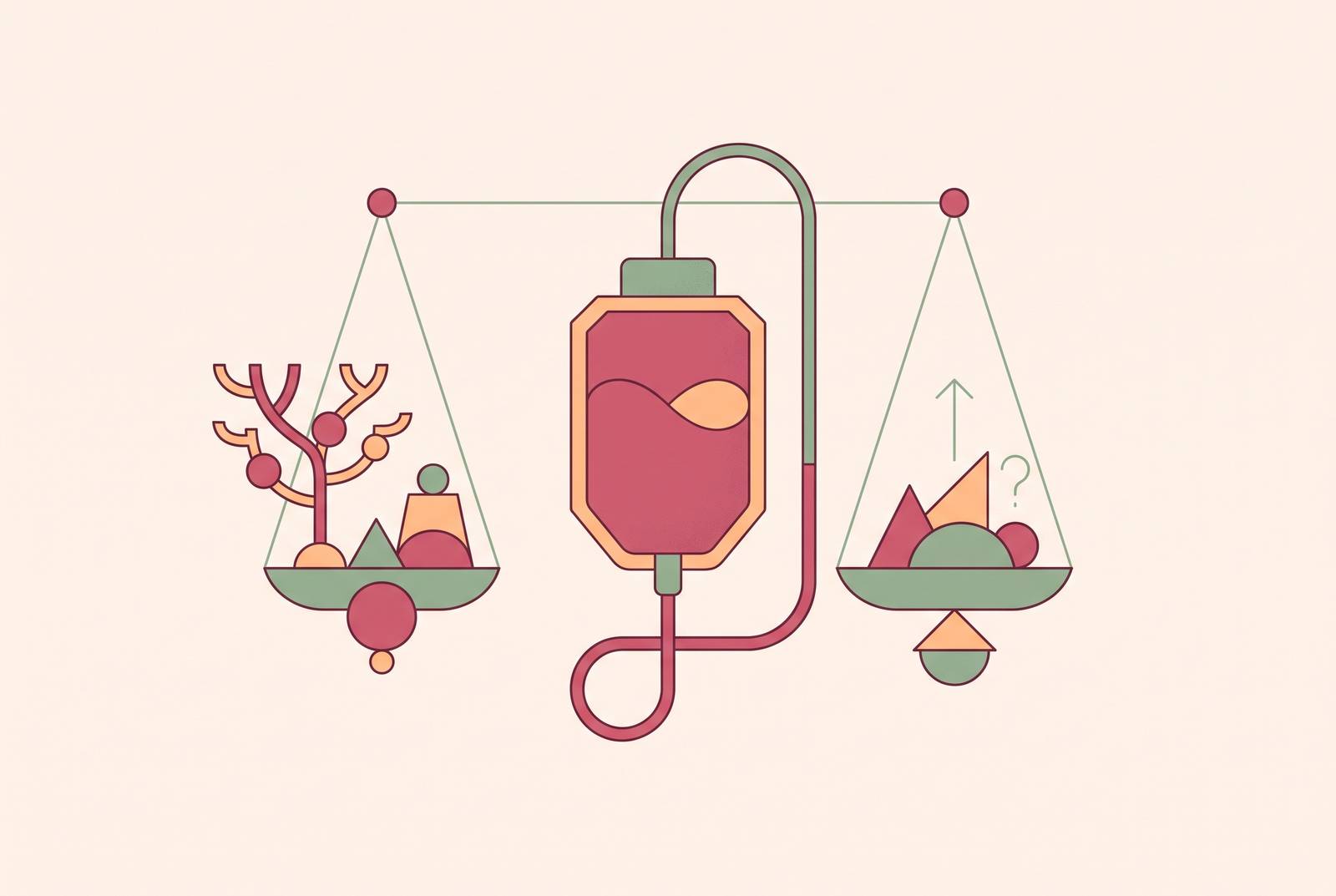
Cord blood banking without a known family history of blood or immune disorders is a decision about probability. Its value depends on who could use the stored cells, whether those cells would be suitable, and what access would otherwise be available. Understanding those limits, together with the costs and alternatives, gives families a sounder basis for deciding than the promise of protection alone.
What cord blood banking actually is and what the stored cells can treat
Cord blood banking collects and cryogenically stores hematopoietic stem cells from blood remaining in the umbilical cord and placenta after birth. This blood would otherwise be discarded as medical waste. Hematopoietic stem cells can grow into red blood cells, white blood cells, and platelets, so they can help rebuild the blood-forming system. ACOG lists applications including immune system disorders, genetic disorders, neurologic disorders, and blood cancers such as leukemia and lymphoma. These applications include established treatments as well as uses when other treatments have failed or within experimental research programs.
Cord blood cells need a less exact genetic match than bone marrow cells, so the risk of rejection is lower. Stored units are also immediately available rather than requiring collection when treatment is needed. However, a single cord blood unit contains relatively few stem cells, which can constrain its use in adults. Units from multiple donors can be combined when needed.
Why the case for private banking was built around families who already know their risk
Private banking has its clearest clinical justification when a family member already has a condition that stem cells could treat. Cleveland Clinic says that healthcare providers usually recommend private banking when a sibling has such a condition. ACOG identifies directed donation to a specific family member in need as a clear use case.
Families without that history face a different proposition, often described as “biological insurance”. The phrase suggests that the cells will be there to use if someone becomes ill, but there are important limits on who can use them. The AAP considers private storage as “biological insurance” unwise unless a family member has a current or potential need for stem cell transplantation. The AMA separately cautions against private banking. For families without a known need, the relevant question is whether the cells provide the kind of protection that the insurance analogy implies.
The autologous limitation: when a child's own stored cells cannot be used to treat that child
In an autologous transplant, the patient receives their own cells. ACOG explains that these cells cannot treat the child’s genetic disease because they carry the same causative genes. It also explains that the child’s own cells cannot treat their leukemia because the predisposition may already be present in those cells.
An allogeneic transplant instead uses another person’s cells and is far more common in practice. When the patient’s cells carry the problem, treatment requires a different person’s unaffected cells. A disease caused by a genetic mutation present at birth can therefore be precisely the situation in which the privately stored unit is unsuitable. This changes the benefit being considered: the stored cells may be more relevant to a sibling or another family member than to the child from whom they were collected.
How low the probability of use actually is, and what that number means for decision-making
For a child without a family history of blood or immune disorders, the likelihood of needing their own privately stored cord blood is very low. The AAP’s estimates vary widely because they look at different conditions and family circumstances. The clinical record also contains far fewer autologous cord blood transplants than unrelated donor transplants. Together, these points show why the existence of a possible treatment should not be confused with a substantial chance of personal use.
A low probability is not the same as no value. Families reasonably plan for unlikely events when their consequences would be severe. However, the relevant event is not simply a future illness, but an illness for which the stored cells would be an appropriate treatment. The decision therefore turns on whether the chance of that specific benefit justifies preserving the option.
The cases where no-family-history families may still have a stronger argument for private banking
Ethnic minority and mixed-race backgrounds can make a family-held unit a more relevant contingency. Public registries have a donor pool that skews heavily toward white non-Hispanic donors, leaving other patients with lower match rates. Hispanic individuals, for example, may have Indigenous, European, and African heritage in combination, making matching more complex within existing inventories. This access gap can strengthen the argument for private storage even without a diagnosed family condition. It does not, however, remove the need for the stored cells to be medically suitable.
Unknown medical background creates a different uncertainty. Parents who were adopted or who used a sperm or egg donor may not have a full account of the relevant genetic history. In those circumstances, “no known family history” does not establish that inherited risk is low. Donor-conceived children may also have genetic half-siblings, but their families may not know they exist, who they are, or where they live. Seeking a donation from those relatives at the point of need can involve logistical, legal, and ethical complications that cannot be resolved in an emergency.
These families face concerns that differ from having a family member who already has a condition that can be treated. They nevertheless give some families a more specific reason to consider private banking than general concern about future illness.
What public cord blood donation offers instead, and where it falls short
Public donation is the option most widely recommended for most families with no known risk. ACOG states that public banks do not charge for storage, screen donors for blood and immune disorders, and make donated cells available to any matching patient. Cleveland Clinic says that the FDA regulates public cord blood banks so they meet set standards. Donated cord blood may also be used in medical research.
That shared access means public donation is not a private reserve. The donating family may be unable to retrieve the unit if it has already been used for another patient or if the collected volume was insufficient for treatment. Collection is also unavailable at some hospitals, so families considering donation need to establish whether their delivery hospital participates well before the due date. Even where donation is available, registry matching remains more difficult for some ethnic minority and mixed-background patients. These are practical limits to plan around.
The cost structure of private banking and how to weigh it against the probability
Private banking has an upfront fee to collect and process the cells, plus a fee each year to store them. Over a twenty-year horizon, this becomes a meaningful multi-year expenditure that is typically not covered by insurance. ACOG notes that some private banks offer free storage when a family member has a disorder potentially treatable with stem cells. Known medical need can therefore change both the expected benefit and the cost of banking.
The useful comparison is between the cumulative expense and the probability of a suitable use. Whether that expense is proportionate depends on household finances and tolerance for uncertainty. Hybrid banking offers another model, in which cord blood is stored privately but made available for public use if the family does not need it. This model charges little to no fee and provides some private optionality without the full cost of exclusive storage.
What the emerging science on cerebral palsy and CAR-T therapies does and does not change
Two peer-reviewed meta-analyses published in Pediatrics and Cells in April and May 2025 found that children with cerebral palsy had significant gains in motor skills. The findings concern different cell therapies and should not be treated as interchangeable. The cord blood findings were on cord blood therapy, while the Cells paper looked at mesenchymal stromal cells from several sources, mostly cord tissue. Evidence for cord tissue cells is not automatically evidence for a privately stored cord blood unit.
The distinction between autologous and allogeneic treatment remains central to interpreting these developments. Promising uses that rely on allogeneic cells do not require the child’s own privately banked cells. Publicly donated units or matched unrelated donors could supply those cells, so progress may strengthen the case for banking broadly more than for exclusive family storage. Engineered immune-cell therapies also belong in the discussion of future medicine, but no specific finding on these therapies presented here establishes a benefit from retaining a child’s own cord blood.
Future autologous uses, including neurological repair, remain a plausible reason to preserve optionality if they do not treat the same genetic disease that the stored cells carry.
Quality and accreditation signals families should use when evaluating private banks
Families choosing private storage can use AABB or FACT accreditation as a sign of quality. It indicates independently audited standards for cord blood processing and storage, which are more useful selection criteria than marketing claims. Cleveland Clinic describes a regulatory distinction between public and private banks, stating that the FDA regulates public banks but does not regulate private banks.
ACOG advises arranging the contract, fees, bank notification, and collection kit before delivery, typically at least six weeks before the due date. Hospital collection availability, any separate collection fee, and compatibility with delayed cord clamping also need advance confirmation. A bank-blood-and-placenta model combines cord blood with placental blood and cord tissue banking to increase the volume and diversity of cells collected. Its relevance is the low-cell-count limitation of a single cord blood unit, especially for adult use. A larger and more varied collection addresses that constraint without removing the separate limits on autologous treatment.
How to think through the decision when no family history exists
The decision can be organized around four variables, which are registry match probability, completeness of medical history, potential use by existing relatives, and financial proportionality. Ethnic background affects how likely a family is to find a compatible donor in a public registry. The completeness of medical history matters because an unknown history is not equivalent to a known absence of inherited disease. Potential use by a relative matters because it changes the purpose of storage from a general precaution to a more specific contingency. Preserving that contingency must be weighed against its likely benefit in light of household finances.
ACOG, the AAP, and the AMA favor public donation for families without known risk, making that consensus a reasonable starting point. A family with a stronger access concern or genuinely uncertain medical background has a legitimate basis for weighing private storage differently. Public donation, exclusive private banking, and hybrid banking then represent different balances of access, cost, and beneficiaries. Emerging treatments can inform the judgment, but they remain separate from established uses and current suitability limits. A clear decision identifies who might benefit, whether the stored cells could serve that person, what alternatives exist, and how much preserving that option is worth to the family.