Reasons Families Decline Cord Blood Donation at Birth
Barriers like poor timing and limited hospital access keep most families from donating cord blood.

In the vast majority of American births, cord blood gets thrown away as medical waste. Some estimates put the figure above 95%, others closer to 97%, but the range hardly matters: nearly all of it is lost. That's despite a treatment history spanning more than 25 years and documented use against over 70 diseases. Many patients who need a stem cell transplant have no matching donor in their own family, which means public cord blood banks are often the only route to a cure they have. This isn't unique to one country, either: in Italy, a country with a well-developed public banking system, only about 1% of parents donate. The gap between what cord blood can do and how rarely it's given away is actually two problems. It's a stack of them, and most families never even see the stack before the moment to act has already passed.
Why parents who want to do the right thing often don't know what that is
Ask a parent whether they've heard of cord blood banking, and plenty will say yes. Ask them what it actually treats, or how donation differs from private storage, and the answers thin out fast. An integrative review of the research on this found exactly that pattern: awareness of the option is consistently higher than real understanding of what it's for. Parents know a word exists. They don't know what it means.
Part of the trouble is where information comes from. That same review described parents' sources as fragmented and inconsistent, with no one handing a family a single, coherent explanation. A 2026 study of pregnant Hispanic women at a university obstetric clinic found that only 31.4% had heard of cord blood banking at all, and 70% didn't understand its purpose even when they had. Among that same group, 91.3% named lack of knowledge as a barrier to donating, which is about as close to universal as a survey finding gets. A prior study at the same clinic, conducted with English-speaking women, found awareness at 58.9%. Still under two-thirds, but notably higher, which points to a language and outreach gap sitting on top of the general knowledge problem.
Parents consistently say they'd rather hear about this from a doctor or midwife than from a pamphlet or an ad. But the people best positioned to explain it aren't reliably doing so. Research on prenatal care providers has found strong, routine support for talking through delayed cord clamping during prenatal visits. Cord blood banking and donation, though, came up far less often in those same conversations. The awareness gap is also a healthcare provider problem. It's a structural gap in how prenatal care gets delivered.
Why timing makes cord blood decisions uniquely hard
Cord blood donation asks something odd of parents: make an informed, values-based decision at the exact moment you're least equipped to make one. Research on parental decision-making around donation (Grieco et al., 2018) frames this directly: the choice lands during labor and delivery, a period of emotional and cognitive overload unlike almost any other prosocial decision a person makes. Nobody's weighing pros and cons calmly at 2 a.m. mid-contraction.
Procrastination compounds it. Parents who say yes during pregnancy sometimes reverse course as delivery nears, or simply let the window close without deciding either way. A National Academies report found that nearly all women surveyed wanted this information before the third trimester, ideally folded into routine prenatal visit materials. Families are telling researchers, in effect, that the birth moment itself is too late to start the conversation.
Yet the system often waits anyway. A 2013 survey of public cord blood banking practices found that a number of banks surveyed were still collecting full informed consent and maternal health history during early labor, which is precisely the wrong time to ask someone to process paperwork and medical history questions. That same survey reached a sharper conclusion: the bottleneck wasn't donor willingness. It was the banks' own capacity to collect and process what parents were already offering. The Grieco et al. study adds a useful behavioral wrinkle here: outreach that approached parents closer to delivery, paired with repeated reminders, produced the strongest lift in donation rates. Timing the ask matters as much as the content of the ask.
The hospital access problem: donation requires being in the right place
Public banks cover the full cost of collection, testing, and storage. That's the good news. They only do this at hospitals they've partnered with, and most hospitals in the country aren't on that list. Collection tends to concentrate at large birthing hospitals in ethnically diverse urban areas, while smaller and rural hospitals are frequently left out.
Registration windows have also tightened, not loosened. As of 2016, the deadline moved from 36 weeks to 34. Walk-in donation, the kind that would catch families who didn't plan ahead, is the exception rather than the rule; the Cleveland Cord Blood Center is one of the few that allows it. In the Grieco et al. study, a meaningful share of women who consented to donate still couldn't, simply because of organizational constraints on the collection side. The bottleneck, the research suggested, was less about donor willingness than about the banks' own capacity.
Globally, the infrastructure isn't the issue: over 160 public cord blood banks operate across 36 countries, holding more than 731,000 stored units. The scale exists. What doesn't exist, at least not evenly, is access within one large country, and the hospitals left out of the network are disproportionately the ones serving the communities public banks most need for genetic diversity.
How private banking marketing pulls families away from public donation, and what it gets wrong
Private cord blood banking is a real industry, and it markets aggressively. Startup costs run roughly $1,000 to $2,000, with some sources citing processing fees between $1,500 and $3,000, plus recurring storage fees north of $100 a year. Health insurance typically doesn't touch any of it.
The pitch is emotional and simple: store your baby's cord blood as a kind of biological insurance policy. The medical reality undercuts that pitch in an important way. A child's own stored cord blood can't treat that child's genetic disease, because the cells carry the same genetic mutation causing the disease in the first place. It's also not useful for treating that child's own leukemia. Professional medical bodies, including ACOG and the American Academy of Pediatrics, have historically advised against private banking for low-risk families with no known condition in the family that a stem cell transplant could address. Some peer-reviewed research has gone further, characterizing marketing built around hypothetical future treatments as potentially misleading to the consumers reading it.
None of this means private banking has zero value. Families with a known medical need benefit from it, sometimes dramatically: more than 800 children have been treated using their own privately stored cord blood, and over 590 siblings have been treated with a family member's stored unit, according to figures from Parents Guide to Cord Blood. But that benefit concentrates narrowly, in families who already know they might need it. For everyone else, paying to store a unit that's statistically unlikely to ever be used comes at a real cost beyond the storage fee: a unit that could have gone into the public supply, and didn't.
Delayed cord clamping and the trade-off families are rarely helped to navigate
Delayed cord clamping is not a fad. A leading global health organization recommends waiting one to three minutes before clamping in all births, and two analyses covering more than 6,000 preterm infants found the delay cuts preterm death by 32%. That's a real, well-established benefit, and no honest conversation about cord blood should try to talk families out of it.
But delay has a direct cost on the donation side. Research has found that units collected after a delay of more than 60 seconds had drastically lower chances of yielding clinically useful cord blood. Past that 60-second mark, the odds of collecting a clinically useful unit drop sharply. A 2025 study suggests a middle path: delays somewhere between 30 and 120 seconds may be compatible with both the infant benefit and a usable donation. That nuance rarely makes it into the delivery room.
What families usually hear is a flattened version: delayed clamping is recommended, so donation is off the table. Providers, already stretched thin, rarely take the extra few minutes to explain that the two aren't automatically incompatible, or that a partial delay might preserve most of both benefits. This is the one barrier on this list that comes down to a straightforward tradeoff parents must weigh. It's a genuine trade-off, and it deserves an actual conversation, not a default outcome nobody chose on purpose.
Eligibility screening quietly disqualifies a large share of willing donors
Even when a family clears every prior hurdle, there's no guarantee the donation gets kept. Maternal health history screening disqualifies a meaningful share of prospective donors before collection even happens. A study of more than 10,000 deliveries at the Tzu-Chi Cord Blood Bank found that only 41.2% of collected units were eligible for transplantation at all.
Volume adds another filter on top of that. Public banks generally keep only units large enough to treat an adult patient, meaning somewhere in the range of one to two billion total nucleated cells, and that threshold means roughly 80% of donations received end up discarded anyway. Eligibility restrictions can mean a parent who genuinely wants to donate simply can't, whether because of health screening or because no participating hospital serves their area.
Almost none of this gets explained ahead of time. Families go through the registration process, sign the consent forms, deliver the baby, and only afterward learn the unit didn't qualify. That kind of after-the-fact rejection doesn't just waste one family's effort. It teaches them, and anyone they tell, that the system is unreliable, which stacks directly on top of the awareness and trust problems already working against donation.
Distrust and unequal awareness across racial and ethnic communities
The 2026 study of Hispanic women found that 63% of participants reported distrust of the donation process, and 20% cited outright fear about donating. These aren't fringe concerns buried at the bottom of a survey. They rank among the most commonly cited barriers in the study.
The consequence shows up in the numbers. Despite their population size, minority communities remain underrepresented in public cord blood registries. That underrepresentation isn't a bookkeeping problem. Genetic diversity in the registry directly determines whether minority patients can find a matching graft, and one large minority group, the largest in one big country, remains underrepresented despite its population size. The Health Resources and Services Administration has flagged this gap as an urgent priority.
Education, income, and family history of cancer all correlated with higher awareness in the 2026 study. That correlation says something uncomfortable: awareness itself isn't distributed evenly, and neither is trust. Distrust in communities with a documented history of mistreatment by medical institutions isn't irrational, and outreach that ignores that context, treating distrust as a communications problem rather than a legitimate response to history, will keep underperforming no matter how well-produced the pamphlet is.
What it would take for a family to actually donate, and where the current system falls short
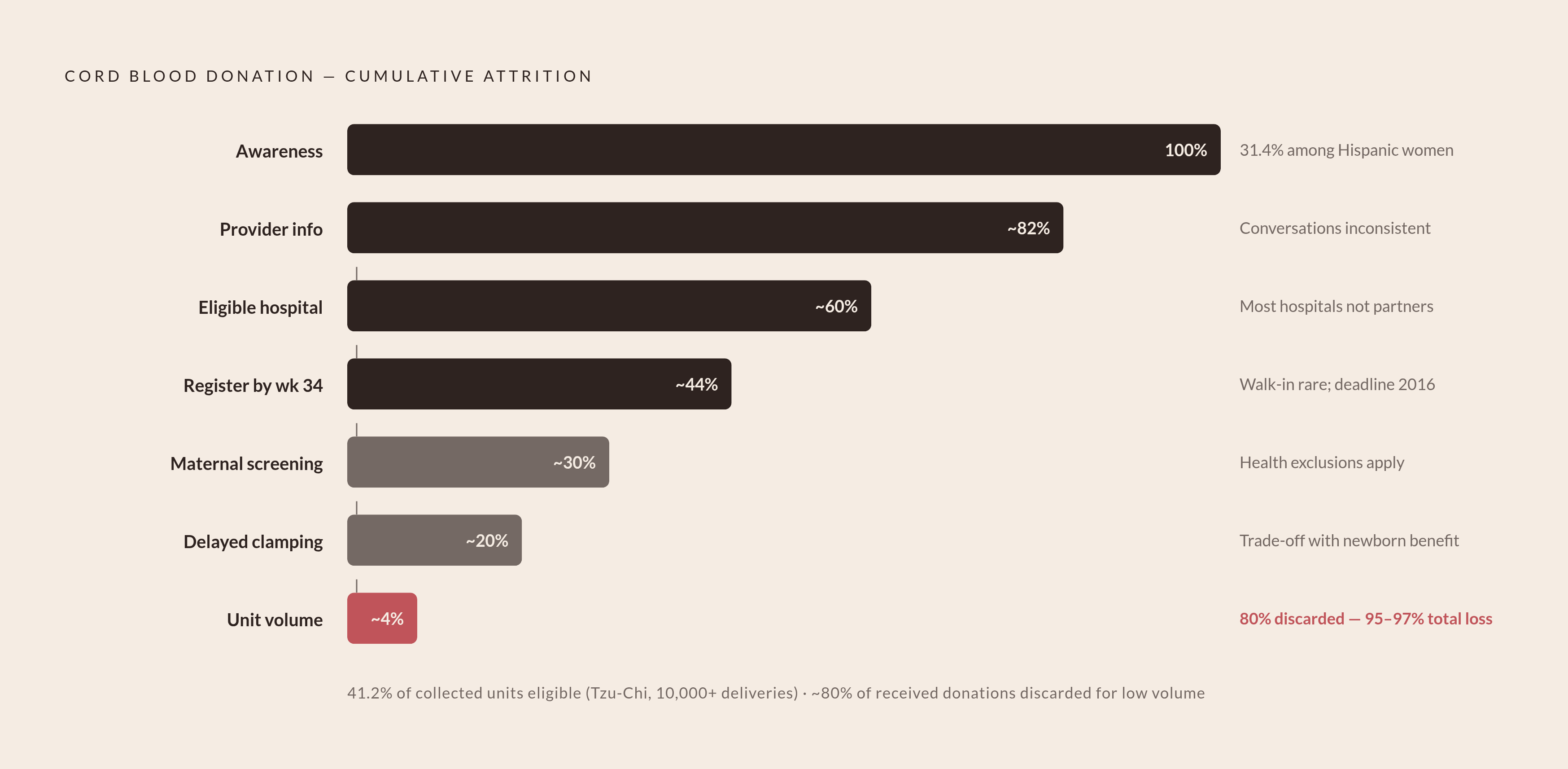
Walk through what actually has to happen for a donation to succeed. A family needs to learn about cord blood banking before the third trimester. They need accurate information from a provider, not a brochure from a private bank with something to sell. They need to deliver at one of the relatively few participating hospitals. They need to register by 34 weeks. They need to pass maternal health screening. They need to navigate the delayed clamping trade-off without being told the two options are simply incompatible. And at the end of it, the unit needs to be large enough to keep. Every one of those steps is a place where a willing donor quietly falls out of the pipeline.
Of all these steps, the research points to one lever with outsized effect: a real conversation with a care provider. Families say they want to hear it from their care team. Care teams, for reasons ranging from time pressure to simple habit, aren't consistently bringing it up. The Grieco et al. A randomized trial found that pairing information with soft commitments and reminders raised donation rates, so the system doesn't have to sit around waiting for families to independently seek this out and push through every barrier alone.
Some of the fix is organizational. Banks that dropped the registration friction, allowing walk-in donations instead of requiring weeks of advance paperwork, have shown that willing donors can be recovered simply by redesigning the process around them rather than around institutional convenience. Families heading toward delivery deserve a plain, honest account of both paths, public donation and private storage, what each one actually offers, what each one costs, and where delayed clamping fits into the decision. Organizations that treat cord blood and placental tissue as medically significant, rather than as leftover material to dispose of, are the ones equipped to make that account clear before the moment passes. Once the cord is cut and the unit is gone, there's no second chance to decide. The tragedy of the current numbers is that most families throw this away without ever facing a real choice. It's that most never got the chance to choose at all.
Sources
- Pregnancy: Should I Bank My Baby's Umbilical Cord Blood? | Cigna
- Motivating Cord Blood Donation with Information and Behavioral Nudges
- Misinformation in New York Times article about Cord Blood Banking
- Parents’ knowledge, awareness and attitudes of cord blood donation and banking options: an integrative review
- nationalacademies.org