How Old a Cord Blood Unit Can Be and Still Engraft
Decades of frozen storage don't diminish cord blood's transplant success.
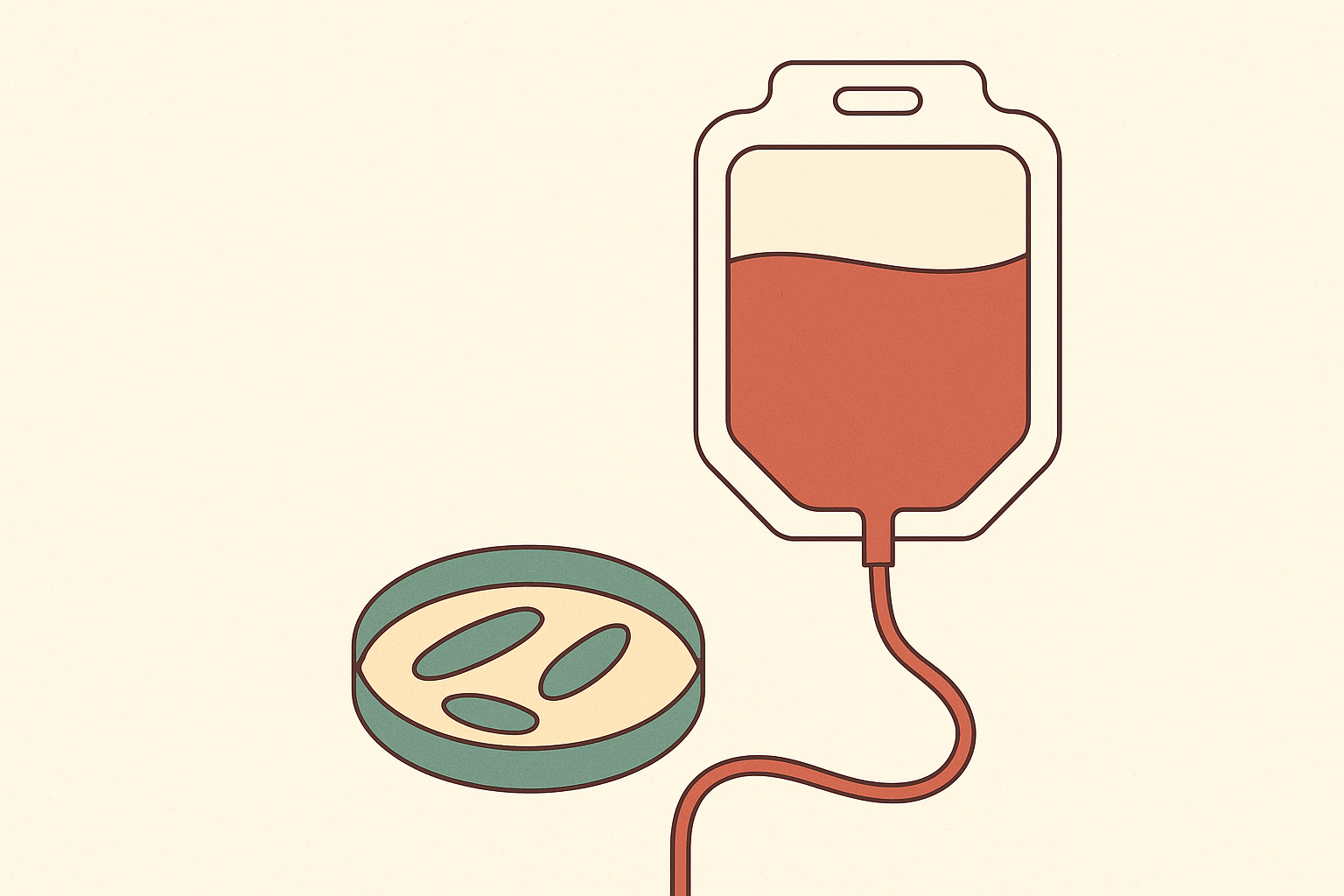
The physical logic of long-term cord blood storage begins with a controlled-rate cooling process that descends at approximately 1 to 2 degrees Celsius per minute. That deliberate pace allows intracellular water to migrate out of the cell before it can form damaging ice crystals. Dimethyl sulfoxide, at a 10% concentration, reinforces that protection by further suppressing crystallization. The unit ultimately reaches a final storage temperature of negative 196 degrees Celsius in liquid nitrogen, where enzymatic degradation effectively stops. Biological time is suspended.
What that means in practice is that the most consequential window for cell quality is not the storage period at all. The interval between collection and freezing matters far more. CD34-positive cell viability decreases by roughly 5% for each additional day a unit sits unprocessed before cryopreservation, moving from approximately 84% on day one to 74% by day three. Damage incurred before the unit enters storage is a larger threat to engraftment potential than anything that happens over subsequent years in nitrogen. Anyone who has spent time evaluating units for clinical use learns this early, and it reorients how you're thinking about the whole question of longevity.
Processing method also matters, and in ways that carry direct regulatory consequences. Whether a unit is stored unseparated or undergoes volume reduction, and whether that reduction is performed manually or through an automated system, affects both the cellular composition of what is banked and the length of the shelf life that accreditation bodies will certify. The evidence for this distinction becomes concrete when stability data from the José Carreras Cord Blood Bank are examined.
What early laboratory work showed about cells recovered after 15 and 23 years frozen
The foundational laboratory evidence on long-term cord blood viability comes from Broxmeyer and colleagues, who published in the Proceedings of the National Academy of Sciences in 2003 the results of testing units stored for an average of 15 years. Compared against the prefreeze values of the same units, recovered cells showed mean retention rates of 83% for nucleated cells, 95% for granulocyte-macrophage colony-forming units (CFU-GM), 84% for erythroid burst-forming units (BFU-E), and 85% for multipotential hematopoietic progenitors (CFU-GEMM). Those aren't survival statistics alone. Recovered colonies contained up to 292,500 cells each, meaning what emerged from storage was capable of robust proliferative expansion.
The same group extended their analysis, publishing in Blood in 2011 results from units stored up to 23.5 years. Recovery of granulocyte-macrophage and multipotential hematopoietic progenitors fell in the range of 80 to 100%, with extensive replating potential confirmed. These results are the culmination of a pattern established by earlier studies at shorter durations, including work by Seo, Lee, and Yamamoto that found no significant differences in total nucleated cell counts, CD34-positive counts, and viability at 1, 2, 5, and 10 years of storage, respectively.
One discordant finding deserves acknowledgment. A separate study reported declining total nucleated cell recovery, CD34-positive counts, and viability in units stored between 11 and 19 years in vapor-phase liquid nitrogen, as opposed to full liquid immersion. That distinction is material. Storage conditions, including the phase of nitrogen contact, are a variable independent of duration. The finding doesn't undermine the broader pattern; it refines it, indicating that the rigor applied to initial processing must extend through the entirety of storage.
The limitation of all laboratory work is the same. These studies confirm that cells survive and proliferate in vitro. Clinical confirmation that those cells engraft in patients comes from a different body of work entirely.
What transplant outcome studies show when old and new units go head to head
The New York Blood Center published an analysis in Bone Marrow Transplantation in 2014 comparing transplant outcomes in patients who received units stored for eight or more years, with a median storage time of 9.2 years, against those who received more recently banked units. Median time to absolute neutrophil count recovery was 25 days in the older-unit group versus 22 days in the newer-unit group. That three-day difference did not reach statistical significance. Graft failure among 28-day survivors was 8 of 36 in the longer-stored group versus 42 of 260 in the comparator group, with a p-value of 0.3. Overall survival at five years was 49% in both cohorts. Survival equivalence across a roughly eight-year storage gap is difficult to argue past.
A separate study, first presented at the 2013 American Society of Hematology meeting and subsequently published in Bone Marrow Transplantation in 2014, examined 86 patients who received units ranging from under one year to 12.2 years in storage, stratified into four quartiles by storage duration. Median time to neutrophil engraftment was 24, 24, 21, and 22 days across the four quartiles. There was no trend. Direct comparison of units stored five or more years against those stored fewer than five years showed equivalent outcomes, with similar acute graft-versus-host disease rates and overall survival across groups.
A 288-unit analysis published in Biology of Blood and Marrow Transplantation in 2014, covering units cryopreserved between 1992 and 2013 across a storage range of 0.08 to 11.07 years, found that storage duration had no measurable impact on total nucleated cell recovery, post-thaw viability, neutrophil engraftment, or platelet engraftment. A 2015 study in Bone Marrow Transplantation, examining 95 units, 42 of which had been cryopreserved for between 5 and 11.8 years, reached the same conclusion: long-term cryopreservation didn't affect viable total nucleated cell ratio after thawing or neutrophil engraftment.
A single null result can be explained away. Across independent research groups, different patient populations, and storage durations spanning more than a decade, it's a pattern.
How far validated stability data now extends — and what the newest evidence qualifies
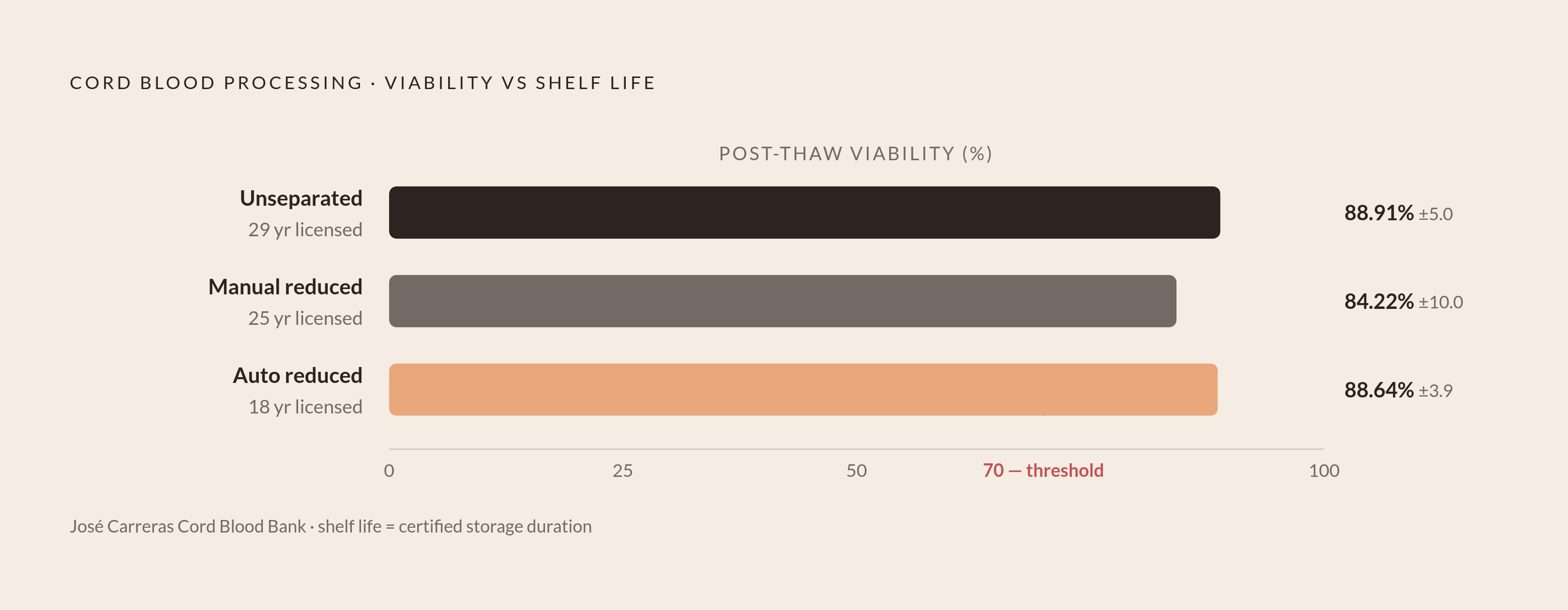
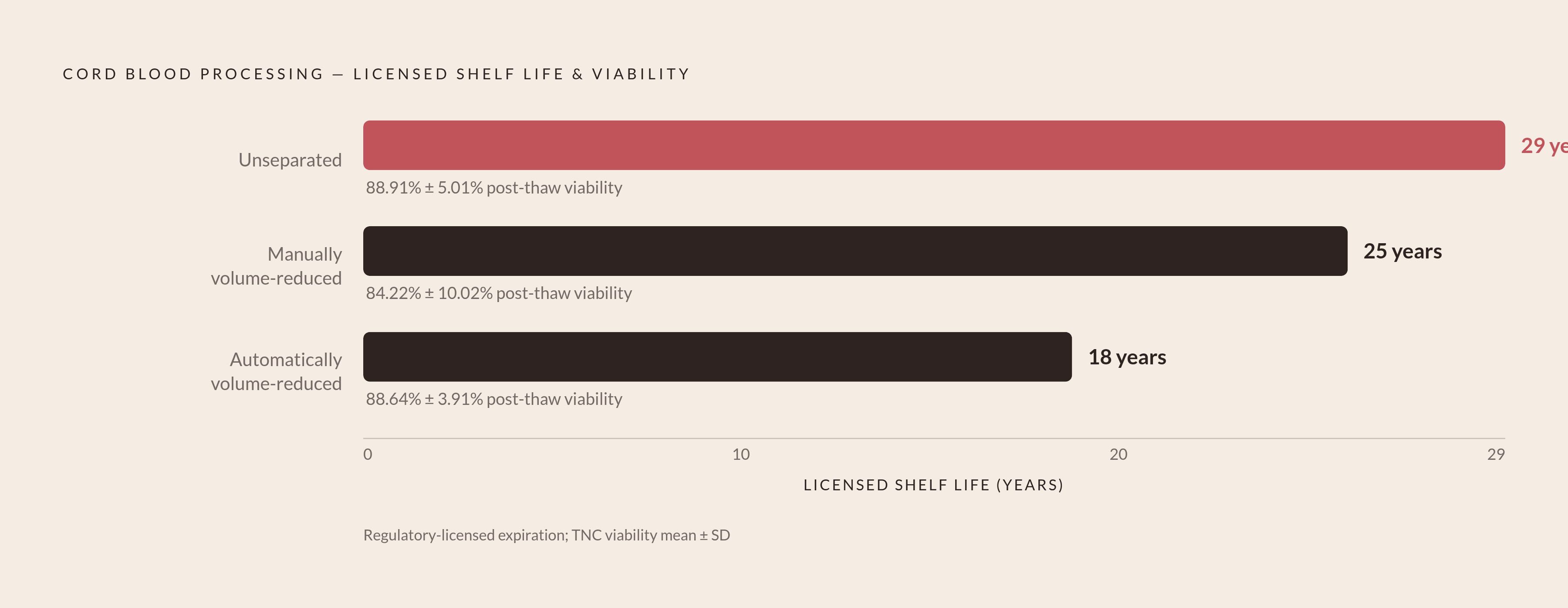
The José Carreras Cord Blood Bank in Düsseldorf currently holds the longest regulatory-licensed expiration dates on record for cord blood units, and those dates are grounded in measured viability data, not extrapolation. Unseparated units carry a licensed shelf life of 29 years, supported by a mean total nucleated cell viability of 88.91% plus or minus 5.01% at that duration. Manually volume-reduced units are licensed to 25 years, with mean viability of 84.22% plus or minus 10.02%. Automatically volume-reduced units carry an 18-year licensed period, with mean viability of 88.64% plus or minus 3.91%. All three processing types remain well above the internationally recognized thresholds used to qualify units for transplantation, and the processing method is what determines how far the certification period extends. Unseparated units showed the longest certified stability, reflecting fewer procedural variables introduced during processing.
One caveat the Carreras data carries forward honestly: sample numbers at the longest storage durations were limited, which means engraftment outcome data for those cohorts aren't yet robust. The viability measurements are solid; clinical outcome confirmation at the outer edge of the certified range is still accumulating. That's an honest reflection of where the field stands chronologically, rather than a flaw in the data.
Work published by MEDIPOST in South Korea in 2021 examined units cryopreserved for 20 years and found stable recovery of viable total nucleated cells and CD34-positive cells, with the investigators concluding that storage duration alone didn't disqualify units from clinical use. The finding sits comfortably within the pattern established by earlier work.
The most nuanced contribution to this record comes from a study published in Vox Sanguinis examining units stored up to 16 years. Post-thaw viabilities exceeded international quality standards, consistent with prior work. But the study also identified a statistically significant negative correlation between cryopreservation period and CD34-positive cell viability, with a correlation coefficient of negative 0.306. Units stored between 1 and 8 years showed significantly higher CD34-positive viability than those stored between 9 and 16 years. That decline is real and shouldn't be minimized. It also falls short of pushing units below accepted clinical thresholds at the storage durations for which regulatory certification currently exists.
The study's practical implication is precise: an adequate starting CD34-positive dose at collection provides a buffer against viability loss over time. A higher initial count means more margin. The Vox Sanguinis data give that principle specific temporal grounding.
Near-flat total nucleated cell viability across decades and a gradual CD34-positive viability decline over the same period are not contradictory findings. They point toward the same conclusion. The variable that warrants closest attention in long-term storage is CD34-positive cell dose, and unit selection should be calibrated accordingly.
Why cell dose and HLA match drive engraftment outcomes while storage age does not
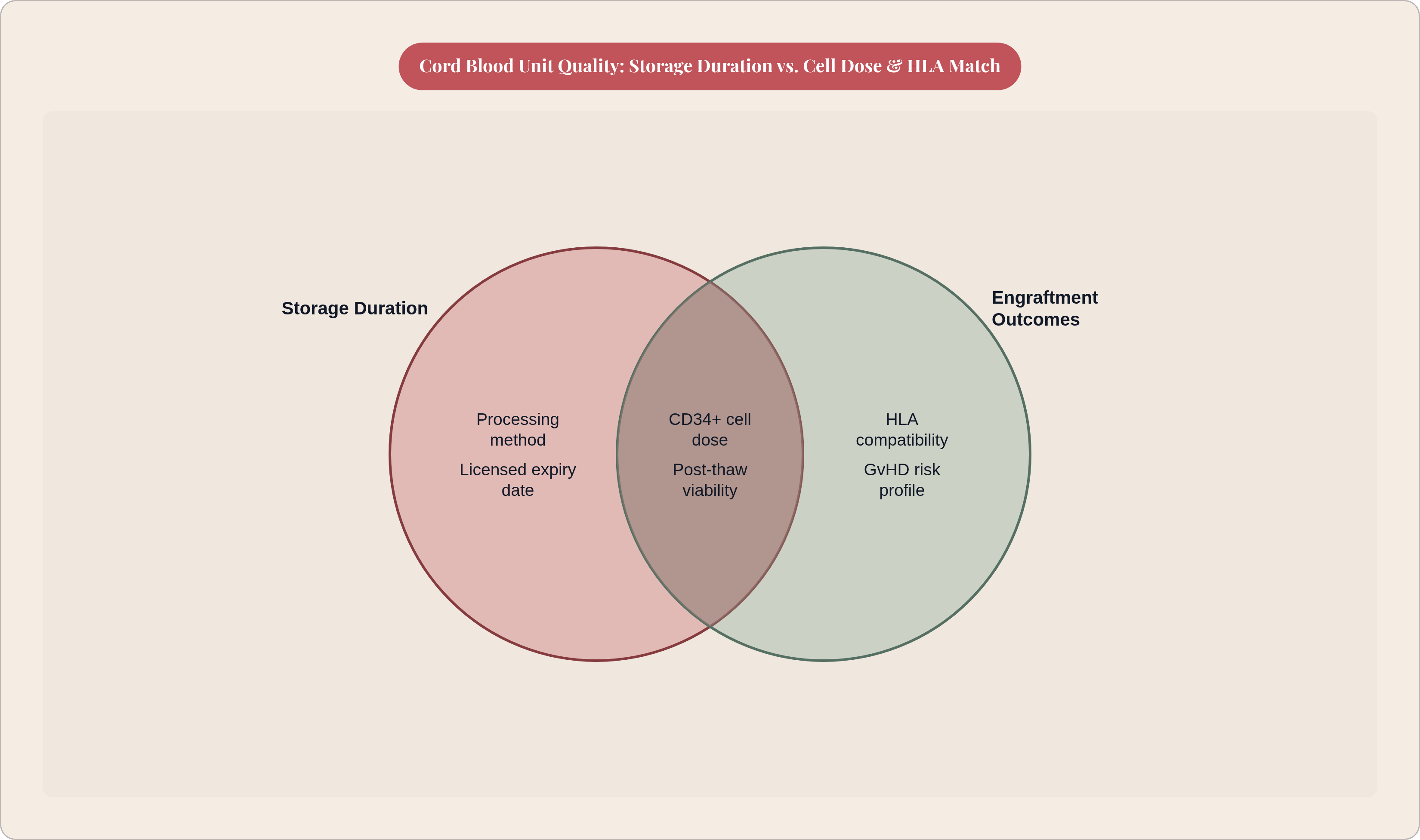
In double-unit cord blood transplantation, the CD34-positive cell dose of the dominant unit was the only characteristic independently associated with engraftment, with a hazard ratio of 1.43 (p = 0.002) for pre-thaw count and a hazard ratio of 1.95 with an even stronger p-value for post-thaw count. Those numbers represent a direct, quantified relationship between dose and outcome, with no mediation by storage duration.
The FDA currently designates pre-thaw total nucleated cell count as the defined measure of cord blood potency for unit selection. The research literature, however, indicates that CD34-positive cell count, both pre- and post-thaw, along with colony-forming unit counts at infusion, are more predictive of actual engraftment. Post-thaw CFU-GM, total nucleated cell count, and CD34-positive count all correlate with neutrophil engraftment speed. Cryopreserved CD34-positive dose has shown superiority to total nucleated cell dose and CFU-GM dose in predicting neutrophil, platelet, and red blood cell engraftment in single-unit adult cord blood transplantation. The regulatory standard and the clinical evidence are converging, but they're not fully aligned yet.
HLA compatibility remains the other primary selection criterion, determining the immunological basis for engraftment and shaping graft-versus-host disease risk. Neither cell dose nor HLA match is a function of how long a unit has been stored. The attributes that determine whether a unit works are fixed at collection and processing; storage duration introduces no independent variable into that outcome equation.
The practical implication for unit selection is direct. When a clinician evaluates an older unit, the productive question is whether it carries an adequate cell dose and an acceptable HLA match, not how many years it's spent in liquid nitrogen. Storage age becomes relevant only to the degree it affects the CD34-positive dose available post-thaw, and the data indicate that units with a strong initial dose retain clinical adequacy across the storage durations for which regulatory certification currently exists.
What cord blood banks and regulators now require to certify long-term unit quality
The regulatory infrastructure surrounding cord blood banking has moved from voluntary best practice toward enforceable standard. The FDA requires that licensed cord blood banks perform in vitro studies evaluating hematopoietic progenitor cell recovery and potency as a condition of licensure. Stability testing is mandatory. The Foundation for the Accreditation of Cellular Therapy and Germany's Paul-Ehrlich Institute impose parallel accreditation requirements; the José Carreras Bank's 29-year licensed expiration date exists within that multi-layered regulatory framework, not outside it.
A licensed expiration period is not a theoretical ceiling derived from physical principles. It's a period backed by measured viability data obtained from that bank's specific units, processed by that bank's specific method. The Carreras data show that unseparated units support the longest certified duration, while automatically volume-reduced units, which involve additional procedural steps with additional variables, carry a shorter certified period. That distinction matters when families or clinicians are evaluating a unit's documented stability against its actual storage time.
Banks also perform routine post-thaw quality checks on sample segments drawn from stored units, providing ongoing real-world verification alongside the initial stability studies that underpin licensure. The research literature and the regulatory system don't operate in parallel. They are describing the same underlying reality through different instruments.
The architecture of evidence supporting long-term cord blood storage spans more than three decades of in vitro work, multiple independent clinical outcome analyses, the longest regulatory-certified stability data ever recorded, and a quality oversight framework that treats storage duration as a measurable, verifiable characteristic. Properly cryopreserved cord blood units retain clinically meaningful engraftment capacity across the storage durations in current use. The clinical criteria that determine transplant success have never been about the calendar.